
Daylily
Hemerocallis
At a Glance
| Botanical name | Hemerocallis |
|---|---|
| Common name(s) | Daylily |
| Family | Asphodelaceae |
| Plant type | perennial (Most are deciduous, dying down in autumn and re-sprouting in spring; some types are evergreen.) |
| Height × Spread | 10–120 cm × 10–100 cm |
| Hardiness | — |
| Position | Full sun, Partial shade |
| Soil | well-drained, fertile soil; adaptable to poorer soils and heavy clay; dislikes waterlogged soil |
| Flowering | June–August |
| Toxicity | some species are extremely toxic; a select few have edible petals |
| Native range | Asia |
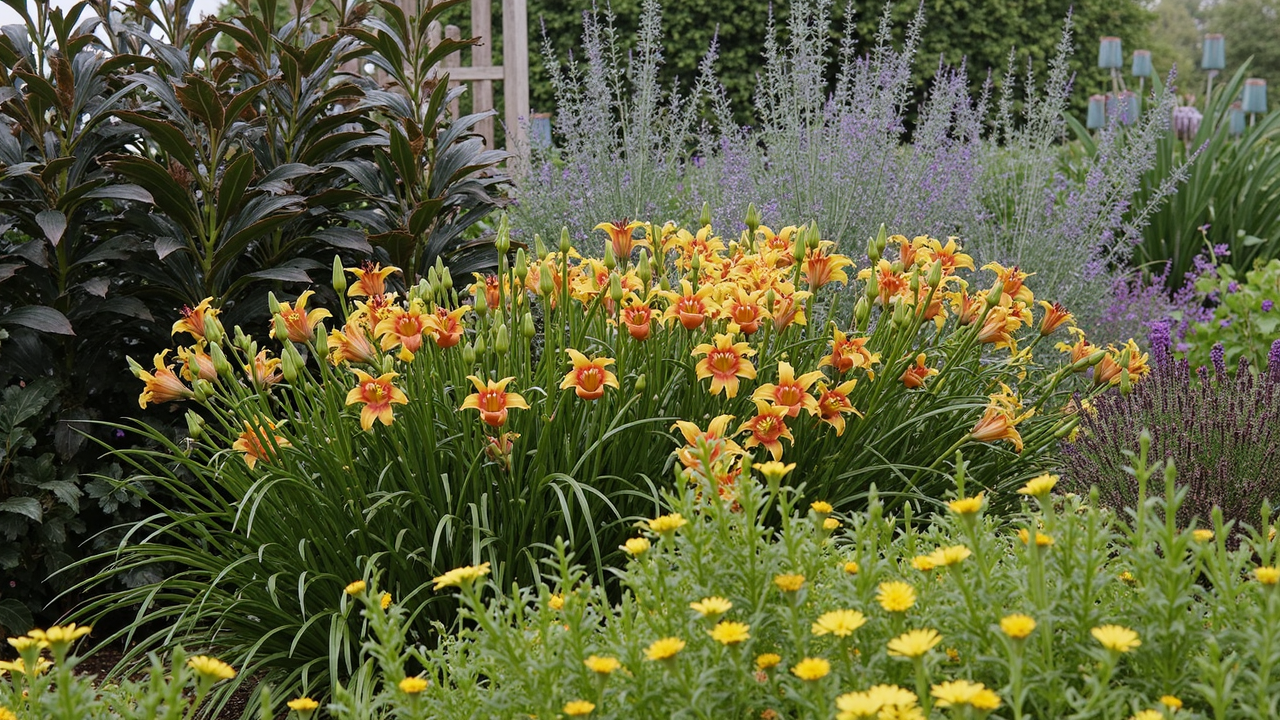
The daylily is a clump-forming herbaceous perennial grown for its showy, lily-like flowers, each of which lasts only a single day. Belonging to the family Asphodelaceae (formerly placed in Liliaceae and Hemerocallidaceae), the genus Hemerocallis contains roughly 15 to 20 species native to Asia, chiefly China, Korea, Japan and parts of the Russian Far East. From these wild ancestors, breeders — most prolifically in the United States from the late nineteenth century onwards — have produced tens of thousands of named cultivars, and the plant is now a mainstay of herbaceous borders worldwide. In the United Kingdom the daylily is a reliable, low-maintenance perennial suited to a wide range of gardens.
Overview
Daylilies are valued in British gardens for their hardiness, their tolerance of a broad range of soils, and their capacity to produce prolific displays of trumpet-shaped flowers over several weeks in summer. Each scape (leafless flowering stem) carries a succession of buds, with individual blooms opening for a single day before withering — hence the common name. Mature clumps are long-lived, often remaining vigorous for many years without division, although they flower more heavily when lifted and split every four to six years.
The genus is widely understood to be toxic to cats if any part of the plant is ingested, and cats should therefore be kept away from daylily foliage and flowers. Toxicity to dogs, humans and livestock is much less clearly established in published veterinary sources, and the edible use of daylily buds and flowers in some East Asian cuisines should not be taken as evidence of safety for pets. Gardeners with cats are generally advised to choose a different perennial.
In garden design, daylilies sit comfortably in the middle of a herbaceous border, where their arching foliage softens the front of a planting and the flower scapes rise to mingle with taller perennials. They are also effective as ground cover on banks or in groups of three to five of one cultivar for a strong block of colour. They combine well with late-summer perennials such as Echinacea, Rudbeckia, Crocosmia and ornamental grasses, and their tolerance of some morning shade makes them useful on the east-facing side of a border, beneath a wall, or in the dappled light cast by a light-canopied tree.
Appearance
Daylilies form dense clumps of arching, strap-shaped leaves that are bright to mid-green and roughly 2–3 cm wide. The foliage is deciduous in most cultivars, dying back to the crown in late autumn, though a small number of cultivars classed as "evergreen" or "semi-evergreen" retain some leaf in mild winters. New growth emerges in early spring from a thickened, fleshy root system with tuberous storage roots. The crown sits at or just below the soil surface and slowly increases in diameter as the plant matures, with offsets forming at the edges of the clump that can be detached and grown on.
The flower scapes rise above the foliage and bear anything from a handful to over thirty buds, depending on cultivar vigour. Each flower has six perianth segments (three petals and three sepals of similar appearance), giving a flat, open, lily-like face typically 7–15 cm across, depending on the cultivar. Colours range from pale lemon and apricot, through orange, pink and red, to deep mahogany and near-purple. Many modern cultivars display contrasting throats, midrib stripes, picotee edges, or ruffled and doubled forms. Stamens are prominent, with a single elongated pistil. Flowers typically open in the morning and fade by evening, though individual plant performance varies. Many cultivars are lightly fragrant, with scent strongest in the early morning and on warm, still days.
Growing Conditions
Daylilies perform best in full sun, where flowering is most prolific, but they tolerate light, dappled shade, particularly in the south of England. In heavily shaded positions the foliage remains healthy but flower production is reduced.
Soil requirements are modest. A moist but well-drained, reasonably fertile loam is ideal, but daylilies will grow in clay, sandy and chalky soils provided drainage is not waterlogged in winter. They prefer a pH close to neutral, somewhere in the 6.0 to 7.5 range, and tolerate mildly acidic or alkaline conditions outside this. Incorporating well-rotted garden compost or manure at planting improves both fertility and soil structure.
RHS hardiness ratings assigned to Hemerocallis cultivars vary. Most widely grown hybrids in UK trade are classed at H6 (hardy down to approximately -15 to -20 °C), making them reliable throughout the British Isles including upland and northern gardens. The RHS Award of Garden Merit (AGM) has been given to a small number of cultivars, including 'Stella de Oro', and these AGM plants are noted as reliable performers in UK conditions.
Planting and Care
Planting. Container-grown daylilies can be planted at any time the soil is workable, though spring (March to May) and early autumn (September to October) are the most favourable windows in the UK. Bare-root crowns, sold by mail order in late winter, should be soaked briefly before planting and set with the crown at or just below soil level. Space plants 45–60 cm apart, more for very vigorous cultivars.
Watering. During the first growing season, water regularly to keep the soil evenly moist and help the root system establish. Established daylilies are notably drought-tolerant, drawing on their tuberous roots, but flower production suffers in prolonged dry spells. Deep weekly soakings are preferable to frequent light watering.
Feeding. A balanced general-purpose fertiliser applied in spring as new growth emerges is usually sufficient. A second, lower-nitrogen feed after flowering can support continued bud development in remontant cultivars. Mulching with compost in spring helps conserve moisture and feeds the soil gradually.
Pruning and tidying. Cut away spent flower scapes once flowering on a particular stem has finished, to keep the clump tidy and, in remontant varieties, to encourage further scapes. In late autumn, once the foliage has died back naturally, cut the old leaves down to within a few centimetres of the ground to reduce overwintering slugs and disease.
Propagation. Division is the standard method. Lift mature clumps in spring or early autumn, split them into fans of three to five shoots each with attached roots, and replant immediately. Daylilies can also be raised from seed, though seedlings will not come true to the parent in the case of hybrids, and named cultivars must be propagated vegetatively to preserve their characteristics.
Seasonal care. In a typical UK year, expect fresh foliage from March, first flowers from late June or early July, a main flush through July and into August, and a tail of bloom into September on remontant cultivars. In mild regions of the south and west, some cultivars will continue producing occasional flowers until the first hard frost. Container-grown daylilies should be moved to a sheltered spot in winter in colder inland or northern areas, as the roots are more exposed to freezing than in the open ground. In very exposed gardens, an autumn mulch of compost or leaf mould over the crown of newly planted daylilies offers a little extra protection in the first winter while the root system establishes.
Common Problems
Daylilies are generally trouble-free, but a few issues recur in British gardens.
Daylily rust (Puccinia hemerocallidis) is the most conspicuous foliar disease, producing orange-yellow pustules on the leaves. It first reached the UK in the early 2000s. Infected foliage should be removed and disposed of (not composted) at the end of the season, and resistant cultivars chosen where the disease is known to be problematic.
Aphids colonise new spring growth and flower buds. They are usually controlled naturally by predators but can be washed off with a strong jet of water or treated with insecticidal soap if heavy.
Slugs and snails attack young spring foliage and the flower buds of some cultivars, particularly in damp conditions. Standard controls (night-time hand-picking, beer traps, biological nematodes, or ferrous-phosphate slug pellets) are effective.
Thrips can cause scarring and distortion of petals in hot, dry summers. Keeping plants well watered helps reduce damage.
Crown rot can occur in waterlogged soils, particularly over winter. Improving drainage before planting is the best preventive measure.
Bud drop, in which unopened buds yellow and fall, is occasionally reported and is usually linked to a combination of drought stress at bud development and sudden temperature swings, both of which are uncommon in the British climate but can occur in hot, dry southern summers.
Deer and rabbit damage is occasionally reported on daylily foliage, though daylilies are not a preferred food of either. In areas with high deer populations, protective netting or repellents may be needed.
Popular Varieties
The following cultivars are widely available from UK nurseries and have a reliable record in British conditions. Availability varies year to year, and gardeners are encouraged to check current catalogues.
- 'Stella de Oro' — A compact, remontant cultivar reaching around 30–40 cm in height, with golden-yellow flowers produced freely from early summer well into autumn. Holds the RHS Award of Garden Merit and is one of the most widely sold daylilies in the UK.
- 'Pardon Me' — A small to medium cultivar, around 45–60 cm tall, with deep red flowers and a green throat, flowering in midsummer and again later in the season.
- 'Catherine Woodbery' — A classic cultivar at roughly 75 cm, with pale, lavender-pink blooms and a green throat, noted for its fragrance and elegant form.
- 'Burning Daylight' — A vigorous older cultivar of about 75–90 cm, bearing large, fragrant, clear orange flowers in midsummer.
- 'Gentle Shepherd' — Among the nearest to white of any daylily, with creamy near-white petals and a green throat, on stems of roughly 70 cm.
Pests and Diseases
| Problem | Symptoms | Management |
|---|---|---|
| Hemerocallis gall midge | Flower buds become abnormally swollen, shorter, and fatter than usual, then fail to open. | Remove and burn affected flower scapes as soon as symptoms appear to prevent larvae from maturing. |
| Lily beetle | Bright red-orange beetles and black slugs of larvae skeletonise leaves, leaving them ragged. | Hand-pick adults and larvae regularly or use a biological control agent like nematodes. |
| Powdery mildew | A white, dusty fungal growth appears on leaves, often in humid conditions with poor air circulation. | Improve airflow by thinning clumps and apply a fungicide if infection is severe. |
| Slugs and snails | Irregular holes chewed into young leaves and flower buds, often accompanied by slimy trails. | Use physical barriers like copper tape or apply slug pellets sparingly around new growth. |
| Root rot | Foliage turns yellow and wilts despite adequate moisture due to waterlogged soil conditions. | Ensure well-drained soil and avoid overwatering; lift and divide congested clumps in spring. |
Quick Care Summary
| Sunlight | Full sun, Partial shade |
|---|---|
| Soil | well-drained, fertile soil; adaptable to poorer soils and heavy clay; dislikes waterlogged soil |
| Hardiness | — |
| Sow | — |
| Plant | March, April, May, September, October, November |
| Prune | — |

As an Amazon Associate, GardenWizz earns from qualifying purchases made through the links above. This does not affect the price you pay. See our disclaimer for details.