Bearded Iris
Iris germanica
At a Glance
| Botanical name | Iris germanica |
|---|---|
| Common name(s) | Bearded Iris |
| Family | Iridaceae |
| Plant type | perennial (It is of hybrid origin. It is a rhizomatous perennial that blooms mid to late spring. Some cultivars are known to re-bloom in the autumn (fall).) |
| Height × Spread | 120 cm × 30 cm |
| Hardiness | H6 (to -20.0 °C) |
| Position | Full sun |
| Soil | well-drained or sharply drained neutral or slightly alkaline soil |
| Flowering | May–June |
| Toxicity | Potentially harmful. Harmful if eaten. Wear gloves and other protective equipment when handling. |
| Native range | Mediterranean region |
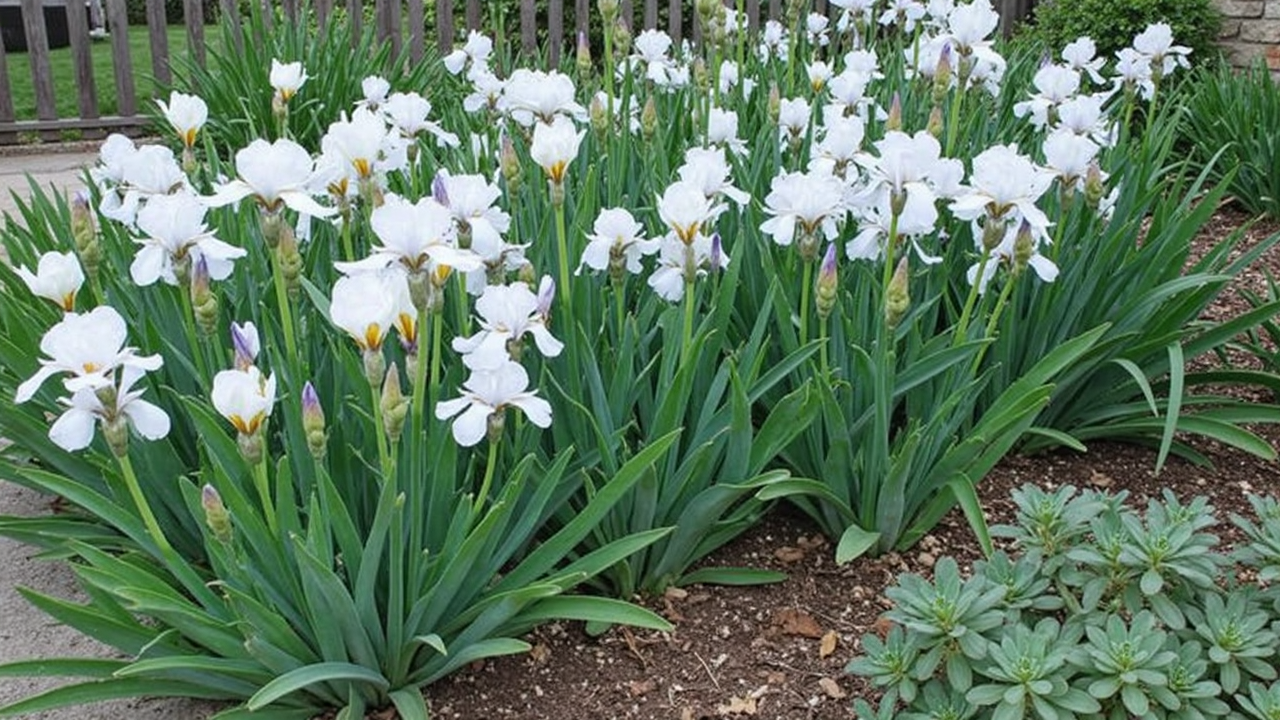
The bearded iris is a rhizomatous, herbaceous perennial grown for its spring and early-summer flowers and its tolerance of dry, sunny borders. Native to a wide area of southern and central Europe, it has been cultivated in British gardens for centuries and remains one of the most widely planted irises in the UK. Its common name refers to the line of soft hairs running down the centre of each fall (the lower petals of the flower).
Overview
Iris germanica is the principal species behind the tall bearded iris group, a category that also includes many hybrids of complex parentage. Bearded irises grow from thick, fleshy rhizomes that sit at or just below the soil surface. The foliage is grey-green, sword-shaped, and usually evergreen or semi-evergreen in mild British winters. The flowers appear on sturdy stems that branch just above the leaves, with each stem carrying several buds that open in succession over a few weeks.
The plant is well suited to most of the UK, thriving in regions with warm, dry summers and cold winters. It performs best where summers are reliably sunny, but it is also grown successfully in cooler, wetter parts of northern England and Scotland, provided the rhizomes are kept free of winter wet. Bearded irises are long-lived, undemanding once established, and useful for adding structure, height, and a broad colour range to herbaceous borders in late spring.
Appearance
Bearded irises form clumps of upright, strap-like leaves typically 30–70 cm tall, with the leaves often flushed a slightly glaucous blue-green. The flower stems rise above the foliage and can reach 70–120 cm in tall cultivars, with smaller intermediate and dwarf forms topping out well below this.
Each flower is composed of three upright "standards" and three drooping "falls". The falls carry the "beard" — a line of coloured hairs that runs from the throat of the flower outwards along the centre of the fall. Standards, falls, and beard may all be the same colour, or contrast in two or three tones. Colour range is wide: white, cream, yellow, orange, pink, red, purple, blue, near-black, and various bicolours and plicatas (flowers with stitched or stippled margins) are all available in UK nursery lists.
Flowers are usually 10–15 cm across and may be ruffled, laced, or relatively smooth-edged depending on cultivar. The blooming period in most of the UK is May to June, with reblooming cultivars (often sold as "remontant") producing a second, lighter flush in late summer or autumn in favourable years.
Growing Conditions
Bearded irises prefer a sunny, open position and a neutral to slightly alkaline, free-draining soil. The rhizomes rot in cold, heavy, waterlogged ground, so improving drainage is more important than enriching the soil. On clay, planting on a gentle slope or in a raised bed, and working in coarse grit or sharp sand, is usually more effective than adding compost alone.
The Royal Horticultural Society lists Iris germanica in hardiness category H7 in some cultivar assessments, indicating tolerance of temperatures below −20 °C, though ratings vary by cultivar and have not been formally published for every named variety. In practical terms, established plants tolerate UK winters without protection; the more usual cause of losses is winter and spring wet around the rhizomes rather than cold itself.
Light requirements are high: at least six hours of direct sun in summer is ideal, and flowering is noticeably reduced in shade. Soil pH between about 6.5 and 7.5 is generally suitable. Bearded irises tolerate poor, stony soils well and do not need rich feeding, which can in fact encourage soft growth and rhizome rot.
Planting and Care
Planting is best done between July and September, when the rhizomes are dormant and have time to establish before winter. The rhizome should be set shallowly, with the top sitting at or just above the soil surface, and the roots spread out beneath. Spacing depends on cultivar vigour, but 25–40 cm between rhizomes is typical for tall bearded irises. Newly planted rhizomes benefit from a thorough watering, but once rooted they prefer the soil to dry out between waterings.
Watering is most important in the first growing season and during prolonged summer drought. Established plants in the open ground usually need no supplementary watering in the UK, and overwatering is a more common cause of failure than underwatering.
Feeding should be modest. A low-nitrogen fertiliser, or a top-dressing of bone meal and superphosphate in early spring and again after flowering, supports strong growth and bud formation. High-nitrogen feeds produce lush leaves at the expense of flowers and can encourage soft, rot-prone tissue.
Pruning is limited to removing spent flower stems down to the rhizome once the last bloom has faded, tidying away any leaves that become badly damaged, and cutting back foliage to about 15 cm in late summer if it is looking tired. The leaves should otherwise be left intact, as they feed the rhizome for the following year's display.
Propagation is straightforward by division. Every three to five years — or whenever flowering begins to decline — clumps should be lifted, the old central rhizome discarded, and the healthy outer sections replanted. The best time to divide is shortly after flowering, in July or August, when new root growth is starting. Divisions with at least one fan of leaves and a healthy set of roots will normally flower the following year.
Seasonal care in the UK centres on the late-summer and autumn period: keeping the area around the rhizomes free of fallen leaves, mulching very lightly only with materials that will not hold moisture against the rhizome, and removing any weeds that might shade the rhizome. In wetter regions, raising the soil level slightly at planting time is often worthwhile.
Common Problems
The most frequent problem is rhizome rot, caused by wet conditions, deep planting, or heavy soil. Symptoms include softening, discolouration, and a sour smell at the base of the leaves. Affected tissue should be cut back to firm, healthy rhizome, and growing conditions improved.
Leaf spot (various fungal pathogens) produces brown lesions on the foliage. Removing and destroying affected leaves, improving air movement, and avoiding overhead watering keep it in check. In severe cases, fungicides labelled for ornamental use may be considered, though cultural measures are usually sufficient in the UK.
Iris sawfly larvae can strip the foliage in late spring, leaving translucent papery patches. They are best controlled by hand-picking on small plantings, or by checking the undersides of leaves regularly from May onwards.
Failure to flower is usually caused by one of: too much shade, rhizomes planted too deep, overcrowded clumps that need dividing, over-rich feeding (especially with nitrogen), or winter wet rotting the rhizomes.
Bearded irises are generally considered to be of low toxicity to humans. There is some popular concern about their effect on pets, but reliable veterinary sources note that bearded irises can cause mild gastrointestinal upset if eaten in quantity; growers who keep dogs or cats that chew garden plants may wish to position clumps away from paths used by animals. Specific toxicity for particular cultivars has not, to the writer's knowledge, been formally characterised.
Popular Varieties
The following cultivars are widely offered by UK nurseries and represent a useful cross-section of the available colour range. The RHS Award of Garden Merit (AGM) is noted where it applies, as the AGM is the most consistent current indicator of garden performance in British conditions.
- 'Immortality' — a tall bearded iris with pure white, lightly ruffled flowers and a soft yellow beard. It is a reliable rebloomer in many parts of the UK, producing a useful second flush in late summer. AGM.
- 'Jane Phillips' — a classic mid-blue tall bearded, long-established in British gardens and valued for its strong, clear colour and sturdy stems. AGM.
- 'Ola Kala' — a tall bearded with deep golden-yellow flowers, widely grown in UK trials and a useful contrast to the purples and blues that dominate many iris plantings. AGM.
- 'Raspberry Blush' — a tall bearded with pink standards and falls flushed a deeper raspberry tone, popular in UK cottage-style plantings.
- 'Mer du Sud' — a vigorous tall bearded in a saturated mid-blue, frequently listed by British specialist iris nurseries.
Other names frequently encountered in UK catalogues include the historic plicata 'Stepping Out' and the deep-purple 'Dusky Challenger', though availability varies year to year. Gardeners seeking the widest selection are generally best served by specialist iris nurseries, several of which exhibit at the RHS shows and list new introductions alongside long-established varieties.
Pests and Diseases
| Problem | Symptoms | Management |
|---|---|---|
| Iris leaf spot | Small purple or brown spots appear on the leaves, often causing them to yellow and die back from the tips. | Remove and dispose of all leaf debris at the end of the year and pick off lightly infected leaves during the season. |
| Bacterial soft rot | The base of the plant and rhizome become soft, mushy, and may collapse with a foul smell. | Ensure well-drained soil and partially exposed rhizomes; cut away affected tissue with a disinfected knife and allow to dry before replanting. |
| Slugs and snails | Irregular holes are eaten in the leaves and flower buds, often accompanied by slimy trails. | Use physical barriers like copper tape or eggshells, and hand-pick pests at night; avoid chemical slug pellets where possible. |
| Iris rust | Orange or yellow pustules form on the leaves, leading to yellowing and premature leaf death. | Improve air circulation around plants and remove infected foliage to slow the spread of spores. |
| Aphids | Small green or black insects cluster on new growth and flower buds, secreting sticky honeydew. | Encourage natural predators like ladybirds and lacewings, or blast off infestations with a strong jet of water. |
Quick Care Summary
| Sunlight | Full sun |
|---|---|
| Soil | well-drained or sharply drained neutral or slightly alkaline soil |
| Hardiness | H6 (-20.0 °C) |
| Sow | — |
| Plant | March, April, May, July, August, September, October, November |
| Prune | June–August |


As an Amazon Associate, GardenWizz earns from qualifying purchases made through the links above. This does not affect the price you pay. See our disclaimer for details.