
Catmint
Nepeta
At a Glance
| Botanical name | Nepeta |
|---|---|
| Common name(s) | Catmint |
| Family | Lamiaceae |
| Plant type | perennial (Most species are herbaceous perennials, but some are annuals.) |
| Height × Spread | — × — |
| Hardiness | — |
| Position | Full sun, Partial shade |
| Soil | Free-draining soil; most thrive in dry soil, though some species prefer moister soil. Avoid heavy clay or permanently wet soils. |
| Flowering | May–September |
| Toxicity | — |
| Native range | Europe, Asia, and Africa |
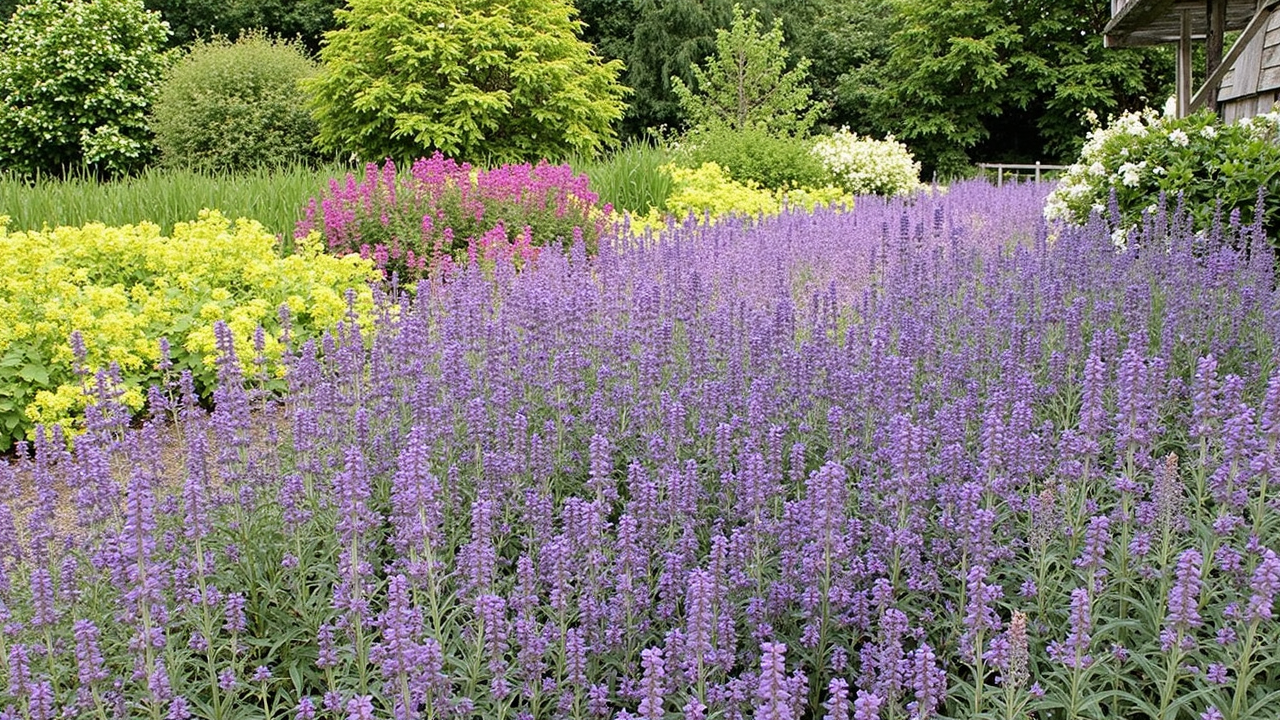
Catmint (Nepeta) is a genus of hardy perennial herbs in the mint family (Lamiaceae), widely grown in British gardens for their long-lasting blue to violet flower spikes, aromatic grey-green foliage and exceptional value to pollinating insects. Several species are cultivated as ornamental plants, edging for paths and ground cover on sunny borders, with Nepeta x faassenii and its cultivars being the most frequently planted in the UK.
Overview
Catmint is a reliable, low-maintenance perennial suited to a wide range of UK gardens, from cottage borders to gravel gardens and wildlife plantings. The most widely grown forms are sterile hybrids that flower prolifically from late spring through summer and are highly attractive to bees, hoverflies and other pollinators. Foliage is aromatic when brushed or crushed, releasing a mild, mint-like scent. The plant is closely related to catnip (Nepeta cataria), but ornamental catmints are generally selected for garden display rather than feline appeal, and many cultivars are noticeably less stimulating to cats. Catmint is drought-tolerant once established, deer- and rabbit-resistant, and grows well in coastal and exposed sites.
Appearance
Catmint forms rounded, slightly sprawling mounds of softly hairy, opposite leaves. Foliage is typically grey-green to sage-green, with a heart-shaped to lanceolate outline and a serrated or crenate margin. Leaves are held on square stems characteristic of the mint family, and the entire plant is softly downy, giving it a slightly silvery appearance in strong sun.
Flowers are borne in whorled spikes (verticillasters) at the stem tips from late spring onwards. The tubular, two-lipped blooms are most commonly a soft lavender-blue, though white- and pink-flowered forms exist. Individual flowers are small, around 1-1.5 cm long, but they are produced in dense, elongated clusters that create a hazy, cloud-like effect when several plants are grouped together. After the main flush, plants can be cut back hard to encourage a second, smaller flush in late summer.
Mature size varies by species. Nepeta racemosa ('Little Titch', 'Walker's Low') typically reaches 30-45 cm in height with a spread of 45-60 cm. Nepeta x faassenii selections such as 'Six Hills Giant' are taller, often 60-90 cm tall and 60-90 cm wide. Nepeta nervosa is more upright, with flower spikes held clear of the foliage.
Growing Conditions
Catmint performs best in full sun, where it produces the strongest flowering display and the most compact growth. It will tolerate light or partial shade, particularly in warmer southern and eastern counties, but flowering tends to be reduced and the mounds become looser.
Soil should be free-draining. Catmint tolerates poor, chalky, gravelly and stony soils well, and is a common sight in UK gravel gardens. Heavy, waterlogged ground is unsuitable and leads to root rot, especially over winter. Soil pH is not critical; the plant grows in mildly acid, neutral and alkaline conditions.
RHS hardiness ratings vary by species. Many commonly grown Nepeta x faassenii cultivars are listed as RHS H7, hardy throughout the UK even in severe winters. Some species, including certain forms of Nepeta grandiflora and Nepeta sibirica, are rated H6 and may suffer in the coldest inland or northerly gardens. In practice, established plants in well-drained soil are robust across most of England, Wales and lowland Scotland.
UK seasonal guidance: new growth emerges from April, with the main flowering flush from late May or early June through July. A hard cut-back after the first flush typically produces a second, lighter display in August and September. Foliage dies back in late autumn, and the dormant crown is best left undisturbed over winter.
Planting and Care
Planting is best done in spring or early autumn, allowing roots to establish before summer drought or winter wet. Space plants 30-60 cm apart, depending on the mature spread of the chosen cultivar, to allow good air circulation. Container-grown plants can be planted out at any time the soil is workable, provided they are kept watered in dry spells during the first growing season.
Watering: catmint is drought-tolerant once established and rarely requires supplementary watering in UK conditions. Newly planted specimens should be kept moist through their first summer. Avoid overwatering established plants, particularly on heavier soils.
Feeding: most catmints perform well in unfertilised garden soil. On very poor sandy or gravelly soils, a light mulch of well-rotted compost in spring is sufficient. Avoid high-nitrogen feeds, which encourage soft, leafy growth that flops and reduces flowering.
Pruning: the principal pruning task is the mid-summer cut-back. After the first main flush of flowers has finished, typically in late July, cut the entire plant back to within 10-15 cm of the ground. New foliage and a second flush of flowers will follow within a few weeks. In late winter (February to early March), cut back any remaining dead stems to make way for new growth. Do not cut back in autumn, as the old stems help protect the crown over winter.
Propagation: ornamental catmints are usually propagated by division or by softwood cuttings, as many of the best garden forms are sterile hybrids that do not come true from seed. Softwood cuttings taken in late spring or early summer root readily in a free-draining compost under cover. Established clumps can be lifted and divided in autumn or early spring. Seed-raised species such as Nepeta cataria and Nepeta mussinii can be sown in spring, though named cultivars will not reproduce reliably.
Seasonal care: in spring, tidy away winter-damaged growth and apply a light mulch if desired. In summer, deadhead or cut back after the first flush. In autumn, leave the fading stems in place for winter structure and insect habitat. In cold inland gardens, an open cloche over the crown in the worst of winter can help protect borderline-hardy species.
Common Problems
Catmint is generally pest- and disease-free in UK gardens. The most common problem is collapse of the mound in mid- to late summer on fertile or shaded sites, where lush growth flops outwards. This is a cultural rather than pathological issue and is best addressed by the mid-summer cut-back and by growing in full sun on lean soil.
On poorly drained or heavy soils, plants may suffer from crown and root rot during wet winters, particularly in the west and north of the UK. Improving drainage before planting, or relocating affected plants to a raised bed or gravel garden, usually resolves this.
Cats are sometimes considered a problem in the sense that Nepeta cataria (catnip) attracts them, who may crush or roll in the foliage. The ornamental hybrids (Nepeta x faassenii, Nepeta racemosa) are generally far less attractive to cats. No serious toxicity to humans, dogs, cats or livestock is recorded for the commonly grown ornamental species, though, as with all garden plants, ingestion of large quantities of foliage may cause mild stomach upset in pets.
Powdery mildew can occasionally affect plants in dry summers with poor air movement, but is rarely severe enough to require treatment. Slug and snail damage is uncommon, as the aromatic foliage is unpalatable to most molluscs.
Popular Varieties
'Nepeta x faassenii' itself is a hybrid of uncertain parentage, but several named cultivars of it and related species are widely available from UK nurseries.
- 'Six Hills Giant': a vigorous, tall selection typically reaching 60-90 cm, with large lavender-blue flower spikes. Awarded the RHS Award of Garden Merit (AGM). Reliable in most UK gardens.
- 'Walker's Low': despite its name, a medium-sized plant around 45-60 cm tall, with an exceptionally long flowering season. Holds an RHS AGM and is one of the most popular varieties for UK borders.
- 'Six Hills Gold': a variegated form with yellow-margined leaves and lavender-blue flowers. Less vigorous than 'Six Hills Giant' and best in light shade to prevent leaf scorch.
- 'Little Titch': a compact form of Nepeta racemosa, around 20-30 cm tall, useful for the front of borders, path edging and containers.
- 'Junior Walker': a more compact sport of 'Walker's Low', typically 30-40 cm tall, with a tidier, less sprawling habit.
- Nepeta racemosa 'Superba': a dense, lower-growing form with rich violet-blue flowers, often sold as a reliable edging plant.
Availability of named cultivars varies year to year; the AGM-holding varieties ('Six Hills Giant', 'Walker's Low') are the most consistently stocked across UK garden centres and online specialist nurseries.
Pests and Diseases
| Problem | Symptoms | Management |
|---|---|---|
| Powdery mildew | A white, dusty fungal growth appears on leaves and stems, particularly during dry summers. | Ensure good air circulation by thinning crowded plants and avoid overhead watering. |
| Slugs and snails | Irregular holes are chewed in young leaves and shoots, often accompanied by slimy trails. | Use physical barriers like copper tape or apply organic slug pellets around the base. |
| Root rot | Plants wilt and collapse rapidly, with stems turning soft and brown near the soil line. | Plant in well-drained soil and avoid waterlogging to prevent root suffocation. |
| Leggy growth | Stems become long, weak, and floppy with sparse foliage after the first flush of flowers. | Cut back stems by half immediately after the main flowering period to encourage compact regrowth. |
| Vine weevil | Notches appear on leaf margins and plants show sudden wilting due to root damage. | Inspect pots regularly for adult beetles at dusk and use biological nematodes in soil. |
Quick Care Summary
| Sunlight | Full sun, Partial shade |
|---|---|
| Soil | Free-draining soil; most thrive in dry soil, though some species prefer moister soil. Avoid heavy clay or permanently wet soils. |
| Hardiness | — |
| Sow | — |
| Plant | March–November |
| Prune | January, February, March, June, July, August, September, October, November, December |

As an Amazon Associate, GardenWizz earns from qualifying purchases made through the links above. This does not affect the price you pay. See our disclaimer for details.