
Red Bartsia
Odontites vernus
The Gardening Year
Best months in UK gardens · full planting calendar →
🖨 Printable care card (PDF)At a Glance
| Botanical name | Odontites vernus |
|---|---|
| Common name(s) | Red Bartsia |
| Family | Orobanchaceae |
| Plant type | perennial (lives partially as a parasite on the roots of grasses; deciduous foliage) |
| Height × Spread | — × 10–50 cm |
| Position | Full sun |
| Soil | well-drained soils with low fertility; Chalk Loam Sand; pH Acid, Alkaline, Neutral |
| Flowering | June–September |
| Toxicity | — |
| Native range | Europe and Asia |
Red Bartsia is a slender annual wildflower of unimproved grassland, roadside verges and traditional hay meadows across Britain and Ireland. Although easily overlooked, it is one of the more ecologically interesting native plants: it is a hemiparasite, drawing part of its water and nutrients from the roots of neighbouring grasses while still photosynthesising in the ordinary way. For UK gardeners restoring a meadow or stewarding a wild patch, Red Bartsia is a useful indicator species and a late-summer nectar source for long-tongued bumblebees.
Overview
Odontites vernus belongs to the broomrape family, Orobanchaceae, a group best known for its parasitic members such as yellow rattle and common broomrape. Red Bartsia sits at the less extreme end of that spectrum. It has green leaves of its own and can complete its life cycle on poor soil without a host, but it performs much better when its roots can tap into those of nearby grasses through small specialised structures called haustoria. This dual strategy makes it a common coloniser of disturbed, low-fertility ground where the sward is thin enough for light to reach the soil.
In Britain and Ireland the species is native, common and widespread, particularly on chalk and limestone grassland, in old hay meadows, on roadside verges that are cut late, and along hedge bottoms. It remains a characteristic component of unimproved meadows, valued for ecological rather than decorative reasons, and is not sold as a garden cultivar. The Royal Horticultural Society does not list Odontites vernus among its Award of Garden Merit plants, which is unsurprising for a wild meadow species.
Appearance
Red Bartsia is an erect, branched annual that usually grows between 15 and 60 cm tall, occasionally reaching 70 cm in lush meadow conditions. The main stem is solid, slightly four-angled, and covered in short, stiff hairs that give it a rough, downy texture. Side branches arise from the leaf axils and angle outwards, giving a loose, bushy outline rather than a single dominant spike.
Leaves are opposite, narrowly lance-shaped and tapered at both ends, typically 1–3 cm long and 3–8 mm wide, with shallowly toothed margins and the same rough-hairy surface as the stem. They are sessile or very nearly so, clasping the stem slightly at the base. The leaves are a dull, slightly greyish green, and unlike many meadow wildflowers they have no rosette stage: the seedling produces opposite leaves almost immediately.
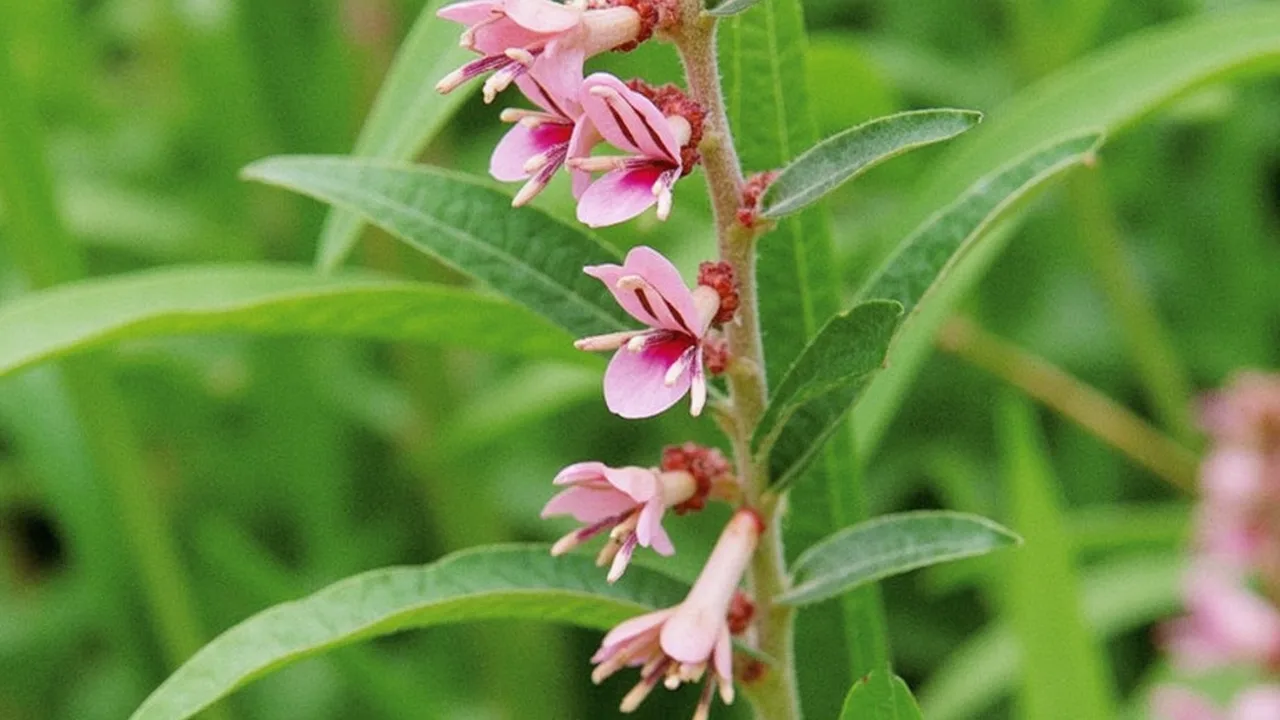
Flowers are carried in one-sided racemes at the upper leaf axils and at the tip of each branch, so the inflorescence has a loose, leafy appearance. Individual flowers are tubular and two-lipped, 8–12 mm long, with a hooded upper lip and a three-lobed lower lip, in shades of dull reddish-purple to pinkish-mauve. The calyx is bell-shaped, hairy and roughly half the length of the corolla, which is a useful identification feature against similar small pink-flowered plants such as lousewort. The flowers are self-fertile and are pollinated chiefly by long-tongued bumblebees, especially Bombus hortorum, which can reach the nectar at the base of the tube.
The fruit is a small, flattened, oval capsule containing numerous tiny pale brown seeds, each weighing only a fraction of a milligram. Seeds ripen from late August into October and are shed close to the parent plant, with most falling within a few tens of centimetres. There is no obvious dispersal mechanism; long-distance movement relies on seed carried in mud, hay or animal fur.
Growing Conditions
In the wild, Red Bartsia is a plant of low-fertility, free-draining ground. It occurs most freely on:
- Unimproved chalk and limestone grassland, particularly old hay meadows cut after midsummer.
- Roadside verges and hedge banks managed on a late-cut rotation.
- Heathland edges and the transition zones between heath and acid grassland.
- Disturbed ground such as quarries, railway embankments, rabbit scrapes and forest rides, where grass cover is naturally thin.
Soil requirements are modest but specific. Red Bartsia prefers neutral to mildly acidic substrates — roughly pH 5.0 to 7.5 — and tolerates sandy, loamy or chalky textures as long as drainage is good and fertility is genuinely low. Soils that have been heavily improved with manure, compost or fertiliser will support vigorous grasses that shade out the seedlings and out-compete them at the root level; on rich ground the plant tends to be spindly and short-lived. It will not grow in waterlogged conditions or in deep shade.
Light is important. Open, sunny sites produce the strongest flowering displays, but light dappled shade at the edge of a hedge or beneath a light canopy of hawthorn or birch is perfectly acceptable. The plant is fully hardy across the UK and Ireland, including upland areas of northern England and upland Scotland, and tolerates exposure on coastal cliffs and hilltops.
Planting and Care
Red Bartsia is not raised as a border or container plant and is not available as nursery-grown stock. It is normally introduced as seed into a prepared wildflower area, or it arrives of its own accord once conditions are right.
Sowing. The most reliable approach in a UK setting is to broadcast seed in autumn, between late September and early November, onto bare, weed-free, low-nutrient soil. A sowing rate of around 0.5 g per square metre is adequate when mixed with carrier such as sand or fine compost. Seed can also be sown in early spring, but autumn sowings tend to give larger plants because the seedlings establish roots before winter. Press the seed into the soil surface with a board or roller; do not bury it, as it needs light to germinate.
Watering. Once established from an autumn sowing, Red Bartsia needs no supplemental watering. In a dry spring, a light watering during germination can help, but adult plants are drought-tolerant and adapted to the typical moisture cycle of a British meadow.
Feeding. Do not fertilise. Any addition of nitrogen, phosphorus or potassium will simply encourage competing grasses to the detriment of the Bartsia. The plant's preference for poor soils is genuine, not a quirk of cultivation.
Pruning and cutting. There is no pruning requirement. In a meadow context the whole sward is cut once a year, ideally in late August or September after the Red Bartsia has set seed. Cuttings should be removed and ideally composted elsewhere so that nutrients are not recycled back into the soil. Cutting too early in the season, before seed has ripened, will prevent the population from maintaining itself.
Propagation. Red Bartsia is propagated exclusively by seed. It does not transplant well because the seedling's early attachment to grass roots is easily disrupted, so do not attempt to lift mature plants. Saved seed remains viable for several years if kept cool and dry, and home-collected seed can be used in the same way as commercial meadow mixes.
Seasonal care. Allow seed heads to stand through autumn so that capsules split naturally and shed seed in situ. Avoid mulching, raking or scarifying the area heavily in winter, as this can bury seed too deeply. A light late-winter rake to scatter fallen grass thatch is the most that is needed.
Common Problems
Red Bartsia is, in practical terms, a trouble-free plant. There are no significant pests or diseases specific to it in UK conditions, and the rough hairy surface of the leaves seems to deter most grazing invertebrates. The plant is generally ignored by deer and rabbits.
The main "problem" a gardener is likely to encounter is the opposite of trouble: the plant failing to establish. This is usually because the soil is too rich, the grass sward too dense, or the site too shaded. The remedy is to reduce fertility over several seasons by removing hay cuttings, by occasional heavy raking in autumn, and by introducing Yellow Rattle (Rhinanthus minor), which is itself a hemiparasite of grasses and suppresses their vigour, opening space for Red Bartsia and other wildflowers.
In agricultural settings, Red Bartsia can be a minor component of permanent pasture and is sometimes noted in agricultural weed lists, but it does not damage the sward and is not controlled for in routine farm practice. There is no record of toxicity to livestock, horses, dogs or humans under normal exposure, and the plant is not considered a hazard in gardens with children or pets.
Popular Varieties
Red Bartsia is a wild species and is not bred, selected or sold as a garden cultivar. There are no named varieties, no horticultural cultivars, and no seed strains developed for ornamental use. Stocks offered for meadow restoration or ecological sowing are simply wild-collected or wild-provenance seed of Odontites vernus, sometimes supplied as a generic component of a mixed wildflower packet rather than as a stand-alone item.
For gardeners who want to distinguish the plant in the field, the closely related Odontites vulgaris (now often treated as O. vernus subsp. serotinus or as a separate species depending on the flora consulted) flowers slightly later, from July onwards, and tends to be a little taller and more strictly branched; the two are often treated together for practical purposes, and seed sourced in Britain is generally not separated below species level.
Because there are no cultivars to recommend, growers seeking variety in a meadow planting are better advised to combine Red Bartsia with complementary wildflowers such as Yellow Rattle, Birdsfoot Trefoil, Common Knapweed, Oxeye Daisy and Meadow Cranesbill, all of which are widely available as UK-native seed and bring their own structure and colour to a sown sward.
Pests and Diseases
| Problem | Symptoms | Management |
|---|---|---|
| Slugs and snails | Irregular holes chewed in young leaves and stems, often accompanied by silky trails. | Use physical barriers like copper tape or beer traps, and hand-pick at night. |
| Vine weevil | Notched leaf margins on seedlings and root damage leading to wilting plants. | Check roots when planting and apply biological nematodes in warm, moist soil. |
| Powdery mildew | White, dusty fungal growth on leaves and stems, potentially causing distortion. | Ensure good air circulation and avoid overhead watering to keep foliage dry. |
| Root rot | Yellowing, wilting foliage despite moist soil due to waterlogged conditions. | Plant in well-drained soil and avoid overwatering, especially in heavy clay. |
For step-by-step help, read Dealing with Slugs and Snails and Treating Powdery Mildew. Or browse the full plant problem solver to diagnose an issue by symptom.
As an Amazon Associate, GardenWizz earns from qualifying purchases made through links on this page (including links within the article). This does not affect the price you pay. See our disclaimer for details.