
Broadleaf Dock
Rumex obtusifolius
The Gardening Year
Best months in UK gardens · full planting calendar →
🖨 Printable care card (PDF)At a Glance
| Botanical name | Rumex obtusifolius |
|---|---|
| Common name(s) | Broadleaf Dock |
| Family | Polygonaceae |
| Plant type | perennial |
| Height × Spread | 40–150 cm × — |
| Position | Full sun, Partial shade |
| Soil | Poorly–drained, Well–drained; pH Acid, Alkaline, Neutral |
| Flowering | June–September |
| Toxicity | Harmful if eaten in large amounts. Wear gloves and other protective equipment when handling |
| Native range | Europe |
Broadleaf dock is one of the most familiar perennial weeds of British gardens, allotments, pastures and waste ground. Robust, deep-rooted and prolifically seeding, it colonises disturbed soil with ease and outcompetes slower-growing neighbours. It is also a native plant of considerable ecological value, supporting insects and birds across the UK.
Overview
Broadleaf dock belongs to the Polygonaceae (dock and knotweed family) and is native to the UK and temperate Europe. It is a coarse, upright perennial that establishes readily wherever soil is disturbed or nitrogen-rich, from vegetable beds and lawns to field margins, road verges and hedgerows. Its success as a coloniser comes from a deep taproot that draws on subsoil moisture, dense seed production, and seeds that can persist in the soil for decades.
Although usually regarded as a weed, broadleaf dock has long-standing herbal and culinary uses. Young leaves can be cooked as a leafy green, fresh leaves have been applied as a folk remedy for nettle stings and minor burns, and the plant supports a range of UK wildlife, including the caterpillars of several native moth species.
Appearance
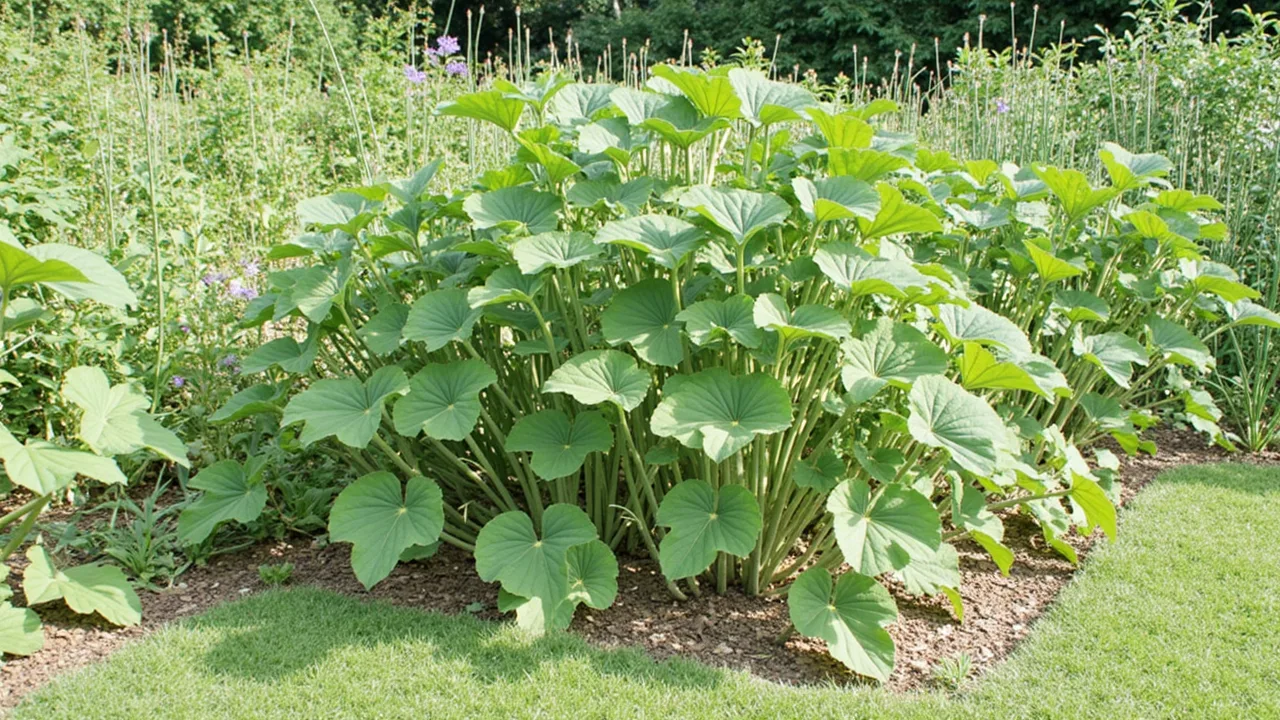
A mature broadleaf dock forms a bold, clump-forming rosette with a tall flowering stem. Plants reach 60–150 cm in height when in bloom. The most distinctive feature is the basal leaf: large, broadly oval to broadly lance-shaped, with a rounded or blunt tip — hence the name obtusifolius, meaning "blunt-leaved". Leaves grow up to about 30 cm long and 12–15 cm wide, with smooth (entire) margins and a slightly leathery, mid-green surface. The leaves have long stalks and a noticeably flattened petiole base where it meets the stem.
The upright flowering stems are stout, slightly ridged and branched only near the top. They carry much smaller, narrower stem leaves. From June through to October the plant produces tall, dense spikes of tiny greenish-white flowers that turn reddish-brown as seeds ripen. Individually the flowers are inconspicuous, but a stand of docks in seed is conspicuous from a distance. The fruiting spikes cling readily to clothing, animal fur and machinery, which is one of the main dispersal mechanisms.
Below ground, the plant produces a thick, fleshy taproot that can extend 60 cm or more into the soil, often forking as it descends. The root is yellowish inside and is the plant's main survival organ.
Growing Conditions
Broadleaf dock tolerates an exceptionally wide range of UK soils and situations. It grows readily on heavy clay, loam, sandy soils and improved garden ground, and it is often an indicator of nutrient-rich, slightly compacted or disturbed land. Soil pH is not a limiting factor in practice.
Moisture is more important than soil texture. The plant favours moist but well-drained sites and is common in damp meadows, riverbanks, ditch sides and the lower parts of gardens. It copes well with short periods of drought by drawing on its deep taproot, which is why established plants survive dry summers better than many shallow-rooted weeds.
In terms of light, broadleaf dock grows in full sun, partial shade and fairly heavy shade, though flowering is most prolific in open conditions. Its shade tolerance is one reason it persists in orchard swards, hedge bottoms and shrub borders where many other weeds struggle.
The species is fully hardy throughout the UK and is rarely damaged by winter cold. It is one of the first plants to come back into growth in early spring, often producing fresh basal leaves from March.
Planting and Care
Broadleaf dock is not normally planted deliberately. Management is therefore focused on control and prevention rather than cultivation.
Preventing establishment is the most effective approach. Mulching bare soil in spring, keeping beds densely planted with ground-cover or vigorous ornamentals, and avoiding leaving disturbed ground fallow all reduce dock colonisation. Maintaining healthy lawn swards through regular mowing and autumn scarification also limits dock ingress.
Hand weeding and hoeing work well on young plants. The aim is to remove the entire root before the plant flowers. Pulling is best done when the soil is moist, sliding a fork or daisy-grubber down the full length of the taproot to lift it intact. Any fragments of root left in the soil — even short pieces — can resprout, so care should be taken to extract the whole structure.
Established plants require more effort. A long-handled fork or a purpose-made dock weeder is the most reliable tool for levering out the full taproot. Repeated removal over several seasons progressively exhausts the root reserves, particularly if carried out before flowering.
Timing matters. Hoeing and hand-pulling are most effective from spring through early summer, when plants are growing actively and have not yet set seed. Once seed has been produced, removing the plant becomes a question of limiting future weed burden rather than eradicating the current individual.
Chemical control may be considered in severe infestations of paddocks, gravel areas or rough ground. Selective broadleaf herbicides are available for use in established grassland, and glyphosate-based products can be used on non-crop areas. In all cases, current Health and Safety Executive and DEFRA-approved product labels must be followed, and grazing intervals and water-course buffers observed.
Common Problems
The main problems with broadleaf dock are all consequences of its biology rather than attacks by pests or pathogens.
- Regrowth from root fragments. Even small pieces of taproot left in the soil can produce new shoots. This makes digging out mature plants a job that needs patience and complete root removal.
- Long-lived seed bank. Broadleaf dock seeds remain viable in soil for many years — figures of 50 years or more are reported in the agricultural literature — so even a single season's seed set creates a long-term weed burden.
- Animal dispersal. The seeds cling readily to the coats of livestock, dogs, deer and foxes, and pass through the digestive system of cattle and horses intact, meaning docks spread quickly through grazed and manured ground.
- Competition with cultivated plants. In vegetable beds, allotments, flower borders and newly sown lawns, dock competes strongly for moisture and nutrients, and its tall leaves smother smaller neighbours.
- Coarseness in flower arrangements. A minor point, but cut dock stems bleed sap readily and wilt quickly; they are not useful as cut flowers.
On the positive side, broadleaf dock is largely free of significant pest and disease pressure in the UK. Rust (Puccinia species) occasionally colonises the leaves but rarely causes serious damage, and slugs and snails only browse seedlings.
Popular Varieties
Broadleaf dock has not been bred into ornamental cultivars in the way that many Polygonaceae relatives have. It is essentially treated as a single species across the UK. Where named variants appear in the horticultural literature, they are usually botanical subspecies or historical folk types rather than garden selections, and they have no formal Award of Garden Merit or named cultivar status to confirm. As a result, anyone encountering a "named" broadleaf dock variety for sale should treat the name with caution.
In practical terms, the only groupings that have any currency are:
- Rumex obtusifolius subsp. obtusifolius — the common broadleaf dock of lowland Britain, with broad oval basal leaves and tall flowering stems.
- Rumex obtusifolius subsp. sylvestris — sometimes listed in older floras, generally with narrower basal leaves and a more upright habit; the distinction between subspecies is not consistently drawn in modern field guides.
- Folk variant "butter dock" — a traditional country name applied to plants from dairy pasture, with no botanical standing.
For gardeners, the practical message is that broadleaf dock is one species with a fairly uniform appearance, and the focus should be on managing it rather than selecting it.
Pests and Diseases
| Problem | Symptoms | Management |
|---|---|---|
| Slugs and snails | Irregular holes chewed in young leaves and seedlings, often accompanied by silky trails. | Use beer traps, copper tape barriers, or iron phosphate-based pellets to reduce populations. |
| Aphids | Clusters of small soft-bodied insects on stems and leaf undersides, causing distorted growth. | Spray off with a strong jet of water or apply insecticidal soap; encourage ladybirds for natural control. |
| Root regeneration | New shoots emerging from soil where dock roots were previously dug out or chopped. | Remove the top 12-15cm of root system completely; hoe seedlings on dry days to desiccate roots. |
| Self-seeding spread | Numerous small dock seedlings appearing in lawns and borders after flowering. | Deadhead flower spikes before seeds ripen or cut back plants prior to seed setting. |
For step-by-step help, read Controlling Aphids Naturally and Dealing with Slugs and Snails. Or browse the full plant problem solver to diagnose an issue by symptom.
As an Amazon Associate, GardenWizz earns from qualifying purchases made through links on this page (including links within the article). This does not affect the price you pay. See our disclaimer for details.