
Plantain
Plantago major
At a Glance
| Botanical name | Plantago major |
|---|---|
| Common name(s) | Plantain |
| Family | Plantaginaceae |
| Plant type | perennial |
| Height × Spread | 13–70 cm × 15–70 cm |
| Position | Full sun, Partial shade |
| Soil | Moist but well–drained; tolerates heavy and compacted soils; pH Acid, Alkaline, Neutral; types Chalk, Clay, Loam, Sand |
| Flowering | — |
| Toxicity | No specific toxicity is listed by the RHS. This is not a guarantee of safety — check with a vet or the ASPCA before pets or children eat any plant. |
| Native range | Eurasia (most of Europe and northern and central Asia) |
A common sight in British lawns, paths and field margins, greater plantain is one of the most recognisable wild plants in the UK. Often dismissed as a weed, Plantago major is a hardy native perennial with a long history of culinary, medicinal and ecological use. Understanding its biology is the first step to managing it in cultivated ground, or welcoming it where space allows.
Overview
Greater plantain belongs to the family Plantaginaceae and is native to Europe, including the whole of the UK and Ireland. It is a low-growing, rosette-forming perennial that thrives in disturbed ground and is now naturalised across much of the temperate world. The species has accompanied human activity for millennia, with archaeobotanical records showing its seeds in European settlements dating back to the Neolithic, and is often described as a "camp follower" of cultivation, turning up wherever soil is bared or trodden. The generic name Plantago derives from the Latin planta, meaning "sole of the foot", a reference to the flat rosette pressed against the ground.
In garden contexts, P. major is usually regarded as a lawn and border weed, particularly in closely mown turf where its flat rosettes sit below the level of the mower deck. Outside the cultivated garden, however, it is a valuable component of wildflower meadows, road verges, and rewilding schemes, providing nectar, pollen and larval food for a wide range of invertebrates and birds. Its tolerance of trampling and compaction also makes it useful for stabilising bare patches on paths, banks and the edges of driveways, where its fibrous roots bind the surface soil and slow erosion. The plant is also a useful bioindicator: where it thrives in quantity, the soil is almost always compacted, low in organic matter, or regularly disturbed.
Appearance
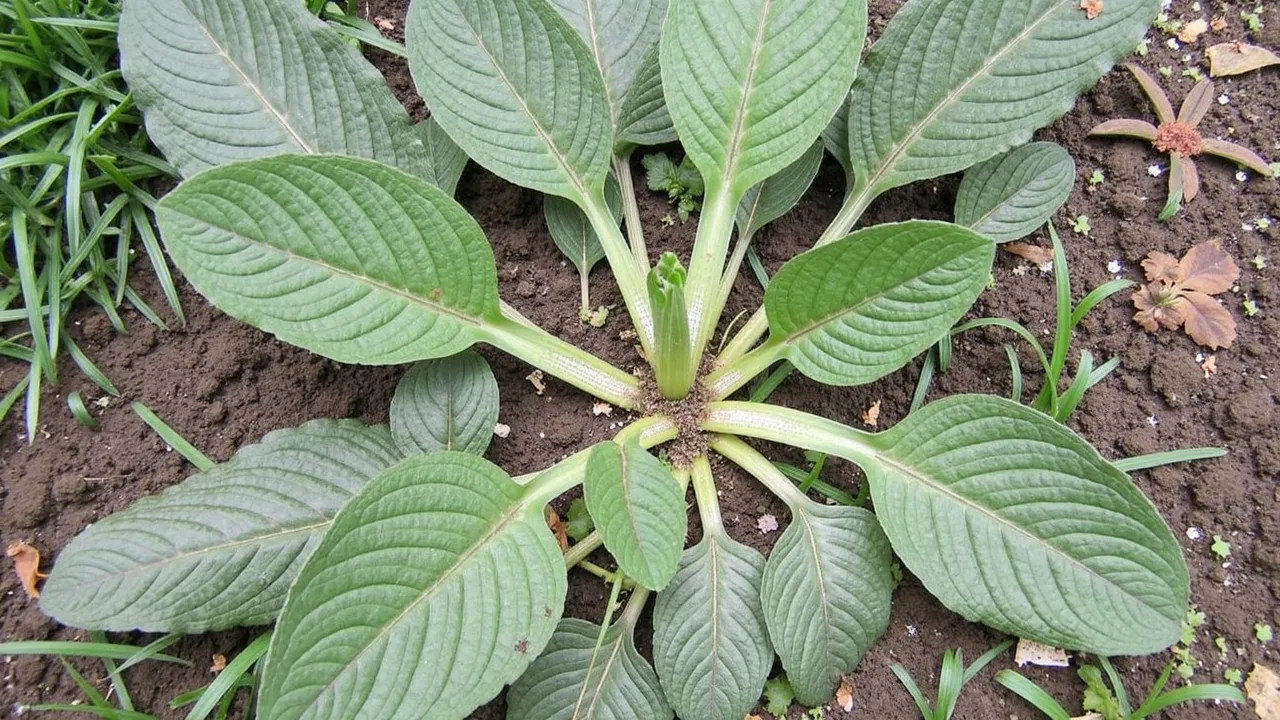
Plantago major produces a flat basal rosette of broad, ovate to elliptical leaves that lie close to the ground. Each leaf typically measures 5–20 cm long and 4–9 cm wide, with a smooth or slightly wavy margin, a long petiole, and a characteristically ribbed surface showing five to seven prominent parallel veins running from base to tip. These veins are unusually strong for a non-grass plant and give the foliage its corrugated, almost celery-like appearance; they also keep the leaf largely intact underfoot, which is why the plant survives trampling where softer-leaved species are crushed. The leaves are usually a fresh mid-green, though plants in dry or sunny conditions can take on a tougher, more leathery texture, and a degree of bronze or purple flush on the petioles is common in autumn.
From the centre of the rosette, slender, leafless flower spikes (called scapes) rise between 5 cm and 60 cm tall, depending on growing conditions, soil fertility and competition. The spikes are furrowed, slightly hairy at the base, and carry small, inconspicuous greenish-brown flowers tightly packed into a cylindrical inflorescence that elongates as the season progresses. Each flower has four tepals and protruding stamens tipped with pale, cream-coloured anthers, and the inflorescence is often described as resembling a small, tapered rat's tail — hence the older common name "rat's tail plantain". The flowers are primarily wind pollinated, though they are also visited by pollen-collecting hoverflies and bees, and a single plant is largely self-fertile.
A single plant can produce several thousand seeds in a season. The seed capsules are small, ovoid pyxidia (lidded capsules) roughly 3–4 mm long, each releasing between 4 and 16 tiny, brown, mucilaginous seeds. These seeds stick readily to footwear, animal fur and mower blades, which explains the plant's extraordinarily efficient spread along paths and field edges. Beneath the soil, the plant develops a short, stout taproot supported by a shallow, fibrous root system that exploits the upper layers of the soil profile. Established plants are tenacious: the crown will regrow from fragments left after weeding, which is why complete removal usually requires lifting the whole root.
Growing Conditions
Greater plantain is exceptionally adaptable. It grows happily on loam, clay, sand, and chalk, and tolerates a wide pH range from roughly 5.0 to 8.0. It has a particular affinity for compacted, disturbed and nutrient-poor soils, which is why it is so often seen on paths, gateways, road verges and the edges of car parks. It will, however, also colonise richer garden soils, especially where turf is thin, mossy, or otherwise stressed, and it is a common colonist of new-build gardens in their first two or three seasons before the lawn knits together.
Light is rarely a problem: the plant tolerates full sun, partial shade, and reasonably deep shade beneath hedges and trees. It is fully hardy across the UK (hardiness ratings of H6 to H7 are commonly given, corresponding to minimum temperatures of roughly −20 °C to −15 °C), and survives prolonged frost, snow and winter wet with no protection. Once established it is also notably drought tolerant, drawing on its taproot and benefiting from the run-off and warm microclimate of hard surfaces — which is why it often outlasts lawn grasses in midsummer.
The species' tolerance of mowing, trampling and grazing is one of the keys to its success. In lawns cut at a moderate height, the flat rosettes are often missed by the mower and continue to grow; in shorter ornamental turf they are more conspicuous and spoil the uniformity of the sward. Tolerant though it is, it is outcompeted by vigorous, well-fed, dense swards of ryegrass and fescue, which is one reason a neglected, underfed lawn tends to become plantain-dominant within a few seasons. Longer growing seasons and drier summers have, on balance, suited the species, particularly on light, free-draining soils in the south and east of England.
Planting and Care
Greater plantain is not normally planted deliberately as an ornamental. In most UK gardens the question is how to control it, or in wildlife-focused plots how to encourage it in the right places.
In lawn management, the most effective approach is cultural: maintain a dense, healthy sward by feeding the turf in spring and early autumn, scarifying to remove thatch, and aerating compacted areas in autumn with a hollow-tine or solid-tine aerator to relieve the conditions plantain favours. Raising the cutting height to around 4–5 cm during dry spells also helps the desired grasses shade out the rosettes, and removing clippings for the first cut after seed-set reduces the number of new plants establishing from seeds carried on the mower. Hand-weeding is straightforward for individual plants, ideally after rain when the soil is soft, and the short taproot comes away cleanly if loosened with a hand fork. A narrow daisy grubber or old kitchen knife is a useful tool for prising out rosettes from established turf without disturbing the surrounding grass.
In flower borders and cultivated beds, regular hoeing in spring and summer removes seedlings before they establish, and a 5–7 cm mulch of composted bark or well-rotted leaf mould, refreshed annually in late winter, suppresses germination by blocking light. In larger infestations, particularly on allotments or in rough grass, selective broadleaf herbicides are an option, though many UK gardeners prefer cultural methods, and care is needed where pollinators may be exposed to spray.
Where plantain is wanted — in a wildflower lawn, a rewilding area or a forage patch — it requires no real care. Sow ripe seed in autumn or spring onto raked, weed-free ground at a rate of around 1 g per square metre, or allow established plants to self-seed into a thin, species-poor sward. For leaf harvest, cut young, tender leaves in spring and early summer before the plant flowers; they can be used raw in salads or cooked as a spinach-like potherb, with a mildly bitter, mushroomy flavour. Older leaves become stringy and are best left for wildlife. Flower spikes can be cut just as the first flowers open and dried for use in infused syrups and tinctures; harvesting at this stage also prevents unwanted self-seeding.
Propagation is almost always by seed. The species does not produce useful divisions, and the long-lived seed bank (seeds can remain viable in soil for several decades — figures of 60 years or more are commonly cited in the ecological literature) is one reason it is so persistent once introduced. Cutting back flower spikes before they set seed is the single most effective cultural control in any setting where reduction rather than encouragement is the goal.
Common Problems
The principal "problem" posed by Plantago major in cultivation is competition with desired plants. In lawns it mars the uniformity of the sward; in beds and borders it takes water and nutrients from ornamentals and vegetables; in newly sown leys and wildflower meadows its vigorous seedlings can outcompete slower-establishing species in the first year.
The plant is, however, remarkably free of serious pests and diseases. Occasional aphid infestations may appear on flower spikes in late summer and are usually kept in check by hoverflies, lacewings and other aphid predators. The leaves are a host for the larvae of various tortrix moths and for the caterpillars of several common British butterflies, including the Gatekeeper (Pyronia tithonus) and Meadow Brown (Maniola jurtina). None of these cause significant damage in most years and, in a wildlife context, are an asset rather than a problem. The most commonly reported fungal issues are leaf spot caused by Ramularia plantaginis and powdery mildew (Erysiphe species) in prolonged humid weather. Both are usually minor, largely cosmetic, and rarely justify treatment in a non-crop setting; affected leaves can simply be removed and disposed of (not composted) if appearance is a concern.
In wildlife and rewilding contexts, none of these are problems at all — they are evidence of a functioning ecosystem supporting invertebrates at the base of the food chain.
Popular Varieties
Named cultivars of greater plantain are relatively few; it is grown mostly as the true wild species, with the ornamental and herbal forms noted below.
The species Plantago major itself is the form most often encountered in the UK. A number of variants and related taxa are grown, mostly in herbal, ornamental or ecological contexts, rather than as mainstream garden plants.
Plantago major 'Rubrifolia' is a form with noticeably purple-tinged leaves, sometimes raised as an ornamental foliage plant and occasionally included in herb gardens for its visual contrast. Plantago major 'Rosularis' (also sold as the "rose" or "flowering" plantain) produces a tightly packed, rosette-like cluster of bracts in place of a normal flower spike, and is grown as a curiosity rather than for ornament. Variegated leaf forms have been offered by specialist nurseries in the past, though they are rarely listed by mainstream UK growers and availability is inconsistent.
Outside P. major itself, the closely related Plantago lanceolata (ribwort plantain) and Plantago media (hoary plantain) are common UK natives with similar growth habits and a comparable, if milder, suite of traditional uses. Ribwort plantain in particular is frequent in lawns and meadows throughout the British Isles, has narrower lance-shaped leaves, and is the more common parent of the herbal remedy known as "plantain syrup". Hoary plantain favours calcareous grassland and has silvery-hairy leaves with shorter, more conical flower spikes. Plantago coronopus (buck's-horn plantain) is another native, with deeply lobed leaves, often found in coastal lawns.
Note that cultivar names and availability vary between nurseries, and not all of the forms listed above are stocked by mainstream UK growers; specialist herb and wildflower nurseries are the most reliable source. The Royal Horticultural Society does not currently assign an Award of Garden Merit (AGM) to P. major or its common cultivars, as the species is treated as a wild plant rather than a cultivated ornamental.
🌿 Wild species. Grown as the true native plant, not as named garden cultivars — so there is no cultivar list here by design, not for want of data.
Pests and Diseases
| Problem | Symptoms | Management |
|---|---|---|
| Aphids | Clusters of small green or black insects on stems and leaves causing sticky residue. | Squash by hand or spray with a strong jet of water; use insecticidal soap if severe. |
| Red spider mites | Fine webbing on foliage and stippled, yellowing leaves during hot, dry weather. | Increase humidity by watering regularly and spray with horticultural oil or water jet. |
| Powdery mildew | White, powdery fungal growth on the surface of leaves and stems. | Improve air circulation and apply a fungicide labelled for use on ornamentals if necessary. |
| Downy mildew | Yellowing patches on upper leaf surfaces with fuzzy grey growth underneath. | Remove affected leaves and avoid overhead watering to keep foliage dry. |
| Slugs and snails | Irregular holes chewed in young leaves and silvery slime trails on the ground. | Use beer traps, copper tape barriers, or iron phosphate-based pellets to control populations. |
For step-by-step help, read Controlling Aphids Naturally, Dealing with Slugs and Snails and Treating Powdery Mildew. Or browse the full plant problem solver to diagnose an issue by symptom.
As an Amazon Associate, GardenWizz earns from qualifying purchases made through links on this page (including links within the article). This does not affect the price you pay. See our disclaimer for details.