Foxglove
Digitalis purpurea · common foxglove
The Gardening Year
Best months in UK gardens · full planting calendar →
🖨 Printable care card (PDF)At a Glance
| Botanical name | Digitalis purpurea |
|---|---|
| Common name(s) | foxglove, common foxglove |
| Family | Plantaginaceae |
| Plant type | biennial (monocarpic) |
| Height × Spread | 1–2.4 m × 10–50 cm |
| Position | Full sun, Partial shade, Full shade |
| Soil | moist but free-draining; prefers lighter soils but grows well on heavy clay with added organic matter |
| Flowering | June–September |
| Toxicity | poisonous to humans and some animals |
| Native range | Western Europe and North Africa |
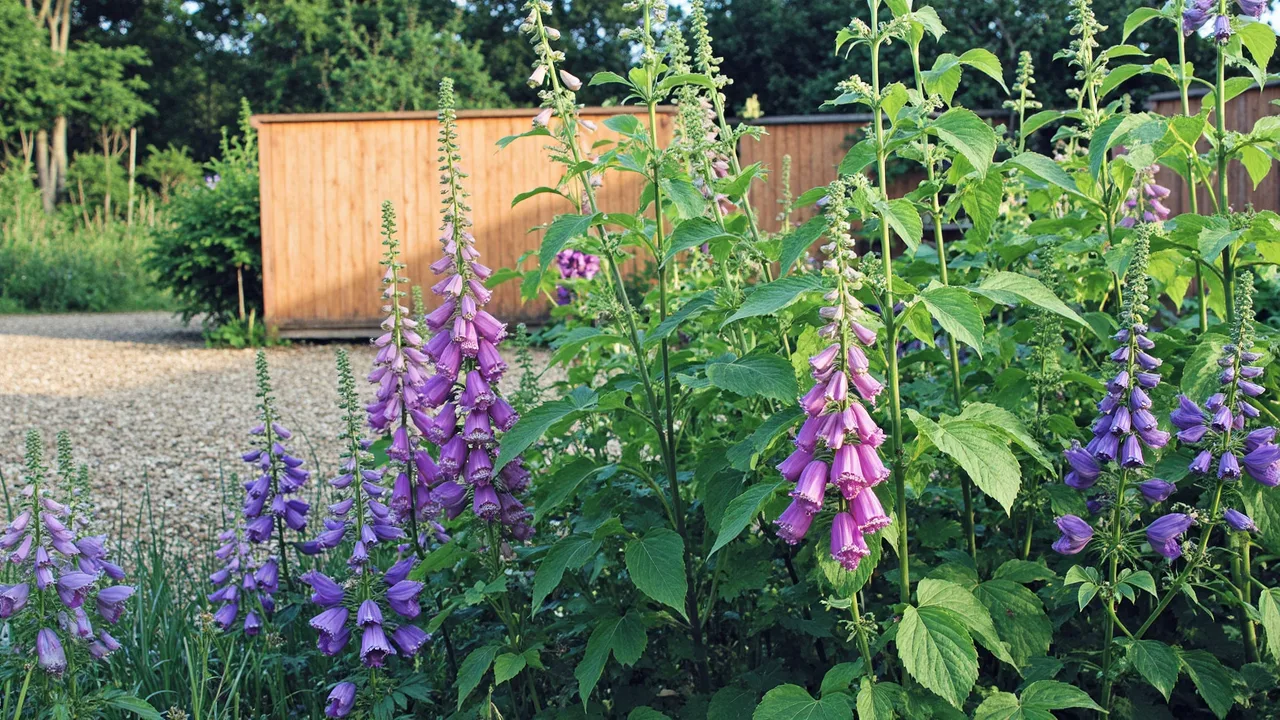
Foxglove (Digitalis purpurea) is a short-lived herbaceous perennial or biennial, widely naturalised across the British Isles and a familiar sight on woodland edges, in cottage gardens and along roadside banks. Native to western and southwestern Europe, it has become thoroughly established in the UK and is one of the most recognisable flowering plants of the British summer. Its tall flower spikes, clothed in tubular, often purple blooms, support substantial pollinator communities, particularly bumblebees. All parts of the plant are highly toxic if ingested, and handling is best done with gloves.
Overview
Digitalis purpurea is a member of the Plantaginaceae (the plantain family), having been reclassified from the Scrophulariaceae following modern molecular work. The species is a rosette-forming biennial: in its first year it produces a low clump of soft, downy leaves, and in its second year it sends up the flowering spike, sets seed and usually dies. Under favourable conditions, however, individual plants may persist for a further year or two and behave as short-lived perennials. The plant is widely naturalised in the UK and is the source of cardiac glycosides, including digitoxin and digoxin, which have been used in medicine since the eighteenth century and remain important in the controlled treatment of certain heart conditions.
Foxgloves are valuable in a garden setting for their vertical structure, tolerance of partial shade, and ability to self-seed freely without becoming weedy. They are a mainstay of the traditional English cottage garden, alongside roses, delphiniums and hardy geraniums, and they perform reliably in informal plantings under deciduous trees and along the shaded side of hedges.
Appearance
The first-year rosette consists of broadly lance-shaped to ovate leaves, 15–30 cm long, with a softly wrinkled surface and a covering of fine grey hairs. The leaf margin is gently toothed. In the second year, an upright stem rises from the centre of the rosette, carrying alternate, smaller leaves that grade into the flower spike.
The inflorescence is a terminal raceme, typically 30–60 cm long, bearing pendant tubular flowers. Each flower is roughly 4–5 cm long, with the corolla divided into short upper lobes and a longer, paler, spotted lower lip that serves as a landing platform for pollinators. The classic flower colour is a deep purple-pink on the outside, paler and heavily marked with dark crimson and white spots within. White- and pale-pink-flowered forms occur naturally and have been selected into named cultivars.
The fruit is a dry, ovoid capsule containing numerous small brown seeds. As the capsules ripen and split, seed is released close to the parent plant, and established colonies tend to maintain themselves through self-sowing rather than vegetative spread.
Growing Conditions
Foxgloves are hardy throughout the UK. RHS hardiness ratings for the genus are commonly reported in the H6 to H7 range, indicating tolerance of low temperatures across most British and Irish gardens, although individual cultivars vary and it is prudent to check the rating for the specific plant at the point of purchase, particularly for less widely tested selections.
The plant prefers a position in full sun or partial shade. In the hotter, drier south and east of England, light dappled shade tends to produce the best results, while further north and in Scotland, open sun suits the plant well. Deep shade reduces flowering and leads to leggy growth. Soil should be moist but well-drained, with reasonable organic content; sandy soils benefit from the addition of well-rotted leafmould or garden compost before planting, and heavy clay is improved by the same material worked into the top spit. A slightly acidic to neutral pH is ideal, though foxgloves tolerate mildly alkaline conditions.
Good siting reduces the need for supplementary watering once the plants are established. Avoid spots where water sits in winter, as crown rot can be a problem in cold, saturated ground.
Planting and Care
Autumn or early spring planting is preferable. Pot-grown plants from garden centres can be set out at any time the soil is workable, but autumn planting allows the rosettes to establish before winter and typically produces stronger flowering spikes the following year. Space plants 40–60 cm apart, taking into account their final height and the need for air movement around the base of the stems.
Watering. Water newly planted foxgloves regularly during their first growing season to keep the soil evenly moist. Established plants are reasonably drought-tolerant in shade but will benefit from watering during prolonged dry spells, particularly in late spring as the flower spikes are developing. Water at the base of the plant rather than over the foliage to reduce the risk of fungal leaf spot.
Feeding. A single application of a balanced general-purpose fertiliser in early spring is usually sufficient. On very poor soils, a second, lighter application as the flower spikes begin to elongate will support strong bloom. Avoid high-nitrogen feeds, which encourage leafy growth at the expense of flowers and can make the tall stems top-heavy.
Pruning. Cut back the spent flowering stem to the basal rosette once flowering has finished if seed is not required. This tidies the plant and, in cultivars that occasionally behave as short-lived perennials, can encourage a second, smaller flush. If seed is wanted for naturalising, leave one or two stems in place until the capsules have ripened and shed, then cut and compost them.
Propagation. Foxgloves are easily raised from seed, which is the standard method for the species. Sow in late spring or early summer in trays of seed compost, barely cover the fine seed, and keep moist. Prick out seedlings once they have developed two true leaves and grow on until large enough to handle. Transplant to flowering positions in early autumn for bloom the following year. Selected cultivars do not come true from seed and must be increased by division of larger clumps in spring or autumn, although division is not always reliable in foxgloves and named forms are often best replaced by new stock.
Seasonal care. In winter, the basal rosettes remain visible and benefit from a light mulch of leafmould in colder districts. Staking is advisable for taller cultivars in exposed gardens, as the flowering stems can snap in summer storms. Deadheading the lower flowers as they fade can extend the display slightly, as the upper buds continue to open.
Common Problems
Foxgloves are generally robust but are affected by a small number of recurring issues.
Powdery mildew is the most frequent complaint, producing a white fungal coating on the leaves in dry, crowded conditions toward the end of summer. Improving air circulation by thinning self-sown seedlings is the most effective preventive measure. Affected foliage can be removed and disposed of; fungicides are rarely necessary.
Leaf spot fungi cause brown or black markings on the foliage, particularly in damp seasons. Removing affected leaves, avoiding overhead watering, and clearing spent material in autumn reduces carry-over of the infection.
Crown rot occurs in waterlogged soils, especially over winter, and is best prevented by siting plants on well-drained ground and avoiding heavy mulches that sit wet against the rosette.
Aphids occasionally colonise the flower spikes, and slugs and snails can damage young rosettes in spring, particularly in damp, shaded positions.
Note on safety: all parts of the plant contain cardiac glycosides and are toxic if eaten. Skin contact is unlikely to cause harm, but gloves are recommended when handling large quantities of cut foliage or seed. Gardeners with small children or pets should consider siting foxgloves away from play areas and washing hands after handling.
Popular Varieties
A wide range of cultivars is available in the UK trade. The following are well-established, widely grown and reliably obtainable from mainstream British nurseries.
'Excelsior Group' is a tall strain reaching around 1.5 m, with flowers held more horizontally than in the species, allowing the spotted throat to be seen from the front. Colours range across white, pink and purple. It is a popular choice for the back of a mixed border.
'Pam's Choice' is a large-flowered selection with creamy white blooms heavily marked with deep burgundy spotting in the throat. It reaches roughly 1.2 m and is one of the most widely planted white-flowered foxgloves.
'Camelot Series' is a true first-year-flowering strain, blooming from a spring sowing in the same season. Plants reach about 1 m and come in a range of colours including rose, cream, lavender and white. It is particularly useful where a quick display is required.
'Dalmatian Series' is another first-year-flowering strain, similar in height to 'Camelot' and selected for uniform, compact growth and a broad colour range. It is commonly offered as mixed-colour plugs in spring.
'Foxy' is a shorter cultivar at around 80 cm, suitable for smaller gardens and containers. It flowers from an early sowing in the same year and is reliably perennial in mild districts, although usually grown as a biennial.
Availability of specific cultivars varies year to year. Where a particular variety is important to a planting scheme, it is worth ordering from a specialist nursery in good time, as the most popular strains sell out quickly in late summer and autumn.
Cultivars and Varieties
| Cultivar | Height | Flower | Notes | AGM |
|---|---|---|---|---|
| 'Camelot Cream' | — | — | RHS AGM (H5) | ✓ |
| 'Camelot Lavender' | — | — | RHS AGM (H5) | ✓ |
| 'Camelot Rose' | — | — | RHS AGM (H5) | ✓ |
| 'Camelot White' | — | — | RHS AGM (H5) | ✓ |
| 'Dalmatian Crème' | — | — | RHS AGM (H7) | ✓ |
| 'Dalmatian Peach' | — | — | RHS AGM (H5) | ✓ |
| 'Dalmatian Purple' | — | — | RHS AGM (H7) | ✓ |
| 'Dalmatian Rose' | — | — | RHS AGM (H5) | ✓ |
| 'Dalmatian White' | — | — | RHS AGM (H5) | ✓ |
| 'Excelsior hybrids' | — | white, pink and purple | — | |
| 'Pam' | — | — | RHS AGM (H7) | ✓ |
| 'The Shirley' | — | — | RHS AGM (H7) | ✓ |
Pests and Diseases
| Problem | Symptoms | Management |
|---|---|---|
| Digitoxin toxicity | low pulse rate, nausea, vomiting, uncoordinated contractions of different parts of the heart, leading to cardiac arrest and death | — |
Or browse the full plant problem solver to diagnose an issue by symptom.
Foxglove in our guides
- Gardening for Pollinators
- How to Divide Perennials for More Free Plants
- Designing a Cottage Garden
- The Rise of Wildlife Gardening
Recommended Products
GardenWizz earns a commission from qualifying purchases made through affiliate links on this page (including links within the article) — as an Amazon Associate, and from Thompson & Morgan via the Awin network. This does not affect the price you pay. See our disclaimer for details.