
Primrose
Primula vulgaris
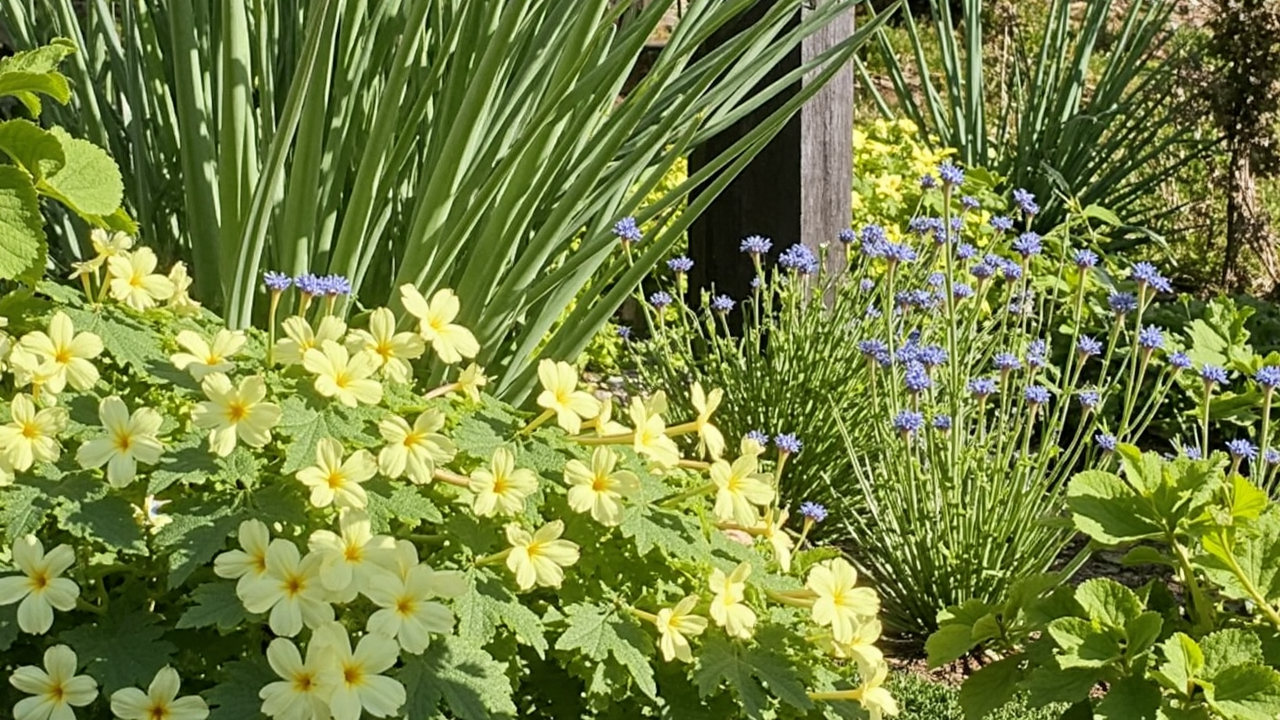
At a Glance
| Botanical name | Primula vulgaris |
|---|---|
| Common name(s) | Primrose |
| Family | Primulaceae |
| Plant type | perennial (Semi evergreen; basal rosette of leaves. Can be grown as biennials for bedding or in containers.) |
| Height × Spread | 10–30 cm × — |
| Hardiness | H7 (to -20.0 °C) |
| Position | Full sun, Partial shade |
| Soil | Moist but well-drained; nutrient-rich, lime-poor, humus-rich, loose and often stony loam. Does not do well on very limey (alkaline) soil or soil prone to drying out. |
| Flowering | February–April |
| Toxicity | — |
| Native range | Eurasia; western and southern Europe, extending from central Norway to Algeria in the south, and through southern European peninsulas to Crimea, Balkans, Syria, Turkey, and Armenia. |
A low-growing native perennial of British hedgerows, banks and woodland edges, the common primrose is one of the earliest flowering plants in the UK garden. Its pale yellow blooms appear from late winter into spring, often before the last frost, and provide a vital early nectar source for bees and other pollinators emerging from hibernation. Reliable, undemanding and suited to a wide range of garden situations, Primula vulgaris has been grown in British gardens for centuries and remains a staple of the cottage garden, the wildflower lawn and the shaded border.
Overview
Primula vulgaris belongs to the family Primulaceae and is native to much of western and southern Europe, including the British Isles. In the UK it is found wild across England, Wales and parts of Scotland and Ireland, typically in deciduous woodland, on banks, in hedgerows and on damp grassy slopes. It was first formally described by Linnaeus in 1753 and has since been hybridised extensively to produce the wide range of garden colours now available.
The wild plant is a rosette-forming perennial with a short rhizome and a clump of wrinkled, tongue-shaped leaves that lie close to the ground. From the centre of each rosette a succession of short flower stems emerges, each carrying a single, five-petalled, pale yellow flower with a deeper yellow centre. The flowers are faintly scented and are among the first to be visited by bumblebee queens in early spring.
Primroses are fully hardy throughout the UK and tolerate temperatures well below freezing. They are unfussy about soil pH provided the ground does not dry out, and they self-seed readily in the right conditions, forming natural drifts in damp, partly shaded settings. They are listed by the Royal Horticultural Society as suitable for pollinators and hold a place in many RHS-partner garden plantings.
Appearance
The primrose forms a flat, evergreen rosette of leaves. Individual leaves are oblong to obovate, 5–15 cm long, tapering towards the base and broadest near the tip. The leaf surface is strongly wrinkled or rugose, with a network of sunken veins, and is softly hairy when young, becoming smoother with age. Colour is a mid- to dark green on the upper surface, paler beneath.
Flower stems are 10–20 cm tall, slender, hairy and leafless. Each stem carries a single flower 2–3 cm across, with five flat, notched petals fused at the base into a narrow tube. In the wild form the petals are a soft, sulphurous yellow, often paler on the outer half, with a deeper yellow throat. The calyx is tubular and ribbed, and the whole flower has a delicate, slightly musky scent that strengthens in warm weather.
The fruit is a small, oval capsule containing numerous tiny seeds, which are shed close to the parent plant in early summer. Mature clumps reach 15–20 cm in height and spread slowly outwards via a short rhizome, often forming colonies where conditions suit.
Garden forms, grouped broadly as Polyanthus primroses, carry their flowers in clusters on taller, sturdier stems and are available in a wide colour range including white, pink, red, blue, purple, orange and bicolours. These have a more upright, showy habit than the wild species.
Growing Conditions
Primroses thrive in conditions that mimic their native woodland-edge habitat. The two non-negotiable requirements are moisture and protection from the strongest sun. Soil should be moisture-retentive but not waterlogged; a loam or sandy loam improved with well-rotted leaf mould or garden compost is ideal. Soil pH is not critical, but slightly acid to neutral ground (pH 6.0–7.0) suits them best.
Light levels should be partial shade for most of the day. A position under deciduous trees, on the north or east side of a building, or in a border shaded for the afternoon is ideal. In damp ground in the north and west of the UK, primroses tolerate full sun, but in drier eastern and southern gardens they scorch and go dormant early if exposed.
Primroses are hardy throughout the UK. The RHS lists Primula vulgaris as hardy in most regions, with the species typically rated H6 (hardy to between -15 °C and -20 °C). Garden cultivars may be slightly less tolerant, particularly those with double flowers or fancy Polyanthus types, and can suffer in prolonged severe frost if grown in containers.
In the UK, the main flowering season runs from late February in mild southern counties to May in colder northern and upland areas, with the peak display in March and April. The foliage remains evergreen through winter, making primroses useful for adding structure to shaded borders in the off-season.
Planting and Care
Watering. Primroses need consistently moist soil, particularly during the spring growth and flowering period and again in autumn when new roots are made. Watering is rarely needed in a normal UK spring, but container-grown plants and those in sandy or free-draining soil benefit from supplementary watering during dry spells. Avoid allowing the crown to sit in waterlogged soil, which can cause rot.
Feeding. A single light application of a general-purpose fertiliser in early spring, as new growth emerges, is usually sufficient for established clumps in the ground. Container-grown plants benefit from a dilute liquid feed every two weeks during the flowering period. Mulching annually with leaf mould or well-rotted compost provides slow-release nutrients and helps conserve soil moisture.
Pruning. Primroses need little pruning. Removing spent flower stems encourages further blooms and prevents the plant expending energy on seed production where this is not wanted. Tidy away old, damaged or diseased leaves in late winter before new growth emerges. Do not cut back healthy green foliage in autumn, as it carries the plant through winter.
Propagation. Primroses are easily raised from seed, which is best sown fresh in late summer or autumn in trays of moist seed compost and left outdoors through winter for natural stratification. Seedlings flower in their second year. Mature clumps can also be divided in early autumn or immediately after flowering: lift the plant, tease the rosettes apart, and replant the strongest pieces at the same depth, watering in well. Division every three to four years keeps clumps vigorous.
Seasonal care. In spring, top-dress clumps with compost and remove winter-damaged leaves. During summer, water during dry spells and watch for signs of stress in hot weather. In autumn, divide congested clumps and sow fresh seed. In winter, container-grown plants benefit from being moved to a sheltered spot to prevent the compost from freezing solid; plants in the ground generally need no protection. After flowering, plants may go semi-dormant in dry summers; this is normal and growth resumes in autumn.
Common Problems
Primroses are generally trouble-free, but a few issues are worth watching for.
Aphids. Greenfly and other aphids sometimes colonise the new growth and flower buds in spring. They rarely cause serious damage but can distort flowers and spread virus. Encourage natural predators such as ladybirds and hoverflies, or spray with a soap-based insecticide if colonies are heavy.
Vine weevil. Adult vine weevils chew notches in the leaf margins, and the more damaging grubs feed on roots, particularly in containers. Pots can be treated with a biological control based on Steinernema kraussei nematodes applied in late summer.
Primula leaf spot. A fungal disease causing brown spots with yellow haloes on the foliage, more common in damp, poorly ventilated conditions. Remove and destroy affected leaves, improve air circulation, and avoid overhead watering.
Botrytis (grey mould). Grey, fuzzy mould on flowers and leaves, particularly in wet springs. Remove affected material and improve airflow around the plants.
Root rot. Caused by waterlogged soil, especially in heavy clay that has not been improved with organic matter. Prevention through site selection and drainage is the most effective remedy.
Slugs and snails. Young foliage and flower buds can be damaged by slugs and snails in damp conditions, particularly in spring. Standard controls (barriers, biological controls, or pet-safe pellets) are effective.
Toxicity: Primula vulgaris is generally considered non-toxic to humans, though some people experience contact dermatitis from handling the hairy leaves and stems. The plant is sometimes listed as mildly toxic to pets, but cases of serious poisoning are rare; if concerned, consult a veterinarian.
Popular Varieties
The following are well-established, widely available forms of the common primrose and its Polyanthus relatives in the UK.
'Wanda' — A compact, vigorous cultivar with deep mahogany-red flowers and dark green foliage. Bred for tolerance of sunnier positions and often listed as one of the most reliable garden primroses. Usually 10–15 cm tall.
Primula vulgaris subsp. sibthorpii — A wild subspecies with pink to lilac-pink flowers rather than the usual yellow. Native to parts of the Balkans and naturalised in some UK gardens; seed is occasionally offered by specialist British growers.
'Belarina' series — A range of fully double-flowered primroses in colours including cream, deep yellow, pink, lilac, blue and red. Bred for garden performance and widely sold in UK garden centres in spring. Hardiness ratings vary by cultivar; treat as H5–H6 in most of the UK.
Polyanthus 'Pacific Giants' — A traditional Polyanthus mix with large flower heads in a wide colour range, carried on stout stems 20–25 cm tall. Long-standing favourite for spring bedding and container displays.
'Hose-in-Hose' primroses — An old-fashioned group in which the calyx is coloured to resemble a second corolla, giving the appearance of one flower nested inside another. Available in yellow, pink and red forms from specialist primula nurseries.
'Guinevere' — A distinctive variety with bronze-tinged foliage and soft pink flowers, popular for shaded borders and woodland plantings.
Pests and Diseases
| Problem | Symptoms | Management |
|---|---|---|
| Primula rust | Clusters of tiny, cup-like orange or brown spore structures appear on the undersides of leaves. | Remove and destroy infected leaves immediately to prevent spread; avoid using fungicides to protect biodiversity. |
| Slugs and snails | Irregular holes chewed in leaves and flowers, often accompanied by silky trails and slimy residue. | Use physical barriers like copper tape or crushed eggshells, and hand-pick pests at night. |
| Vine weevil | Notched edges on leaves above ground and wilting plants due to larvae feeding on roots underground. | Apply biological nematodes (Steinernema carpocapsae) to the soil in late summer or autumn. |
| Aphids | Clusters of small green or black insects on new growth and flower stems, often leaving sticky honeydew. | Encourage natural predators like ladybirds or blast off with a strong jet of water. |
| Powdery mildew | A white, dusty fungal growth covering the surface of leaves and stems. | Improve air circulation around plants and avoid overhead watering to keep foliage dry. |
Quick Care Summary
| Sunlight | Full sun, Partial shade |
|---|---|
| Soil | Moist but well-drained; nutrient-rich, lime-poor, humus-rich, loose and often stony loam. Does not do well on very limey (alkaline) soil or soil prone to drying out. |
| Hardiness | H7 (-20.0 °C) |
| Sow | — |
| Plant | — |
| Prune | — |



As an Amazon Associate, GardenWizz earns from qualifying purchases made through the links above. This does not affect the price you pay. See our disclaimer for details.