Bracken
Pteridium aquilinum
At a Glance
| Botanical name | Pteridium aquilinum |
|---|---|
| Common name(s) | Bracken |
| Family | Dennstaedtiaceae |
| Plant type | fern (Herbaceous perennial, deciduous in winter. Regrows from underground rhizome.) |
| Height × Spread | 30–250 cm × — |
| Hardiness | H5 (to -15.0 °C) |
| Position | Full sun, Partial shade |
| Soil | Moist but well-drained, acidic to neutral (Clay, Loam, Sand) |
| Flowering | — |
| Toxicity | Contains carcinogenic compound ptaquiloside; poisonous to livestock and humans. |
| Native range | Eurasia and North America |
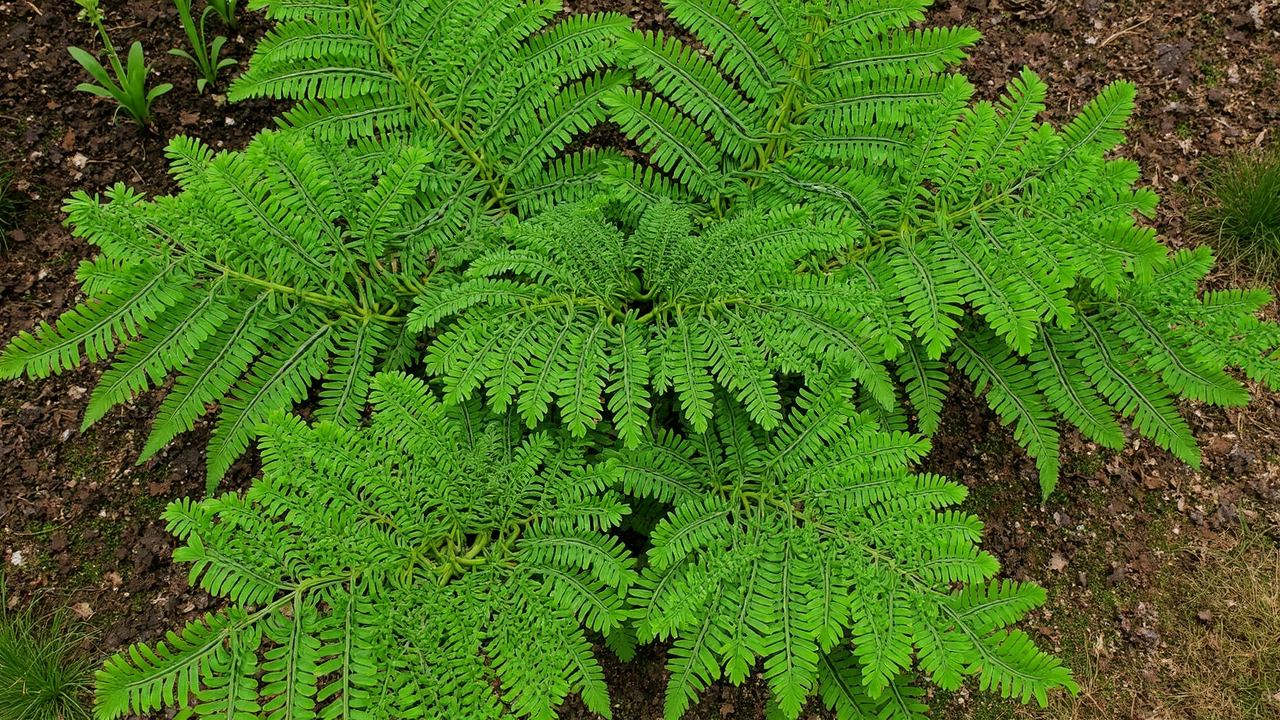
Bracken is the common name for Pteridium aquilinum, a large, deciduous fern native to the UK and one of the most widespread vascular plants in the northern hemisphere. It forms extensive colonies on heathland, moorland, open woodland and rough grassland, and is generally regarded in the UK as an invasive weed rather than a garden plant. The species belongs to the family Dennstaedtiaceae and, unlike flowering plants, reproduces both by spores and by an aggressive network of underground rhizomes. Its scientific name aquilinum refers to a fancied resemblance of the frond's vascular pattern to an eagle's wings.
Overview
Bracken is a vigorous, rhizomatous fern that typically grows 0.5–2 m tall, with mature fronds reaching well over head height on fertile sites. In the UK it is ubiquitous on acidic soils, particularly in upland and western districts, and is one of the most recognisable features of the British countryside in late summer. Because it spreads quickly, casts dense shade, and produces allelopathic chemicals that suppress other plants, bracken is a significant management issue on protected sites, common land and grazing pasture.
Although it is rarely — if ever — planted deliberately, bracken is a useful species to be able to identify. It is poisonous to livestock, can be a serious fire hazard in dry summers, and its encroachment onto SSSIs and other wildlife sites is a recognised conservation concern in the UK. For gardeners, the principal relevance of bracken is recognising it and knowing that, once established, it is exceptionally difficult to remove.
Appearance
Bracken produces some of the tallest fronds of any native British fern. The young fronds emerge in spring as tightly coiled, reddish-brown croziers, often called "fiddleheads". As they unfurl, they expand into broadly triangular or oval blades, divided three times (tripinnate), giving a finely cut, lacy outline. The individual leaflets (pinnae) have rounded, almost blunt bases and are arranged in opposite pairs along a robust, grooved central stem (rachis).
Mature fronds are typically 0.5–2 m tall, exceptionally to 3 m or more on the most fertile, sheltered sites. The underside of fertile fronds carries a continuous row of spore-bearing structures (sori) along the leaflet margins, protected by a whitish, inrolled membrane. Spores ripen from late summer into autumn.
Unlike many native ferns, bracken is fully deciduous. By late autumn the green fronds have usually turned bronze and then brown, and the dead, withered fronds persist through winter, rattling in the wind. Growth begins again from the rhizomes the following spring. Below ground, the rhizome system is extensive and long-lived, running horizontally just beneath the soil surface for several metres and branching freely, which is what makes established colonies so difficult to eradicate.
Growing Conditions
In the wild, bracken thrives on acidic, infertile soils with a pH of roughly 3.5–5.5. It is most abundant on well-drained but moisture-retentive loams and sandy loams over acidic bedrock, and is uncommon on chalk or limestone. Typical UK habitats include:
- Lowland and upland heathland
- Moorland and rough hill pasture
- Open, acidic woodland and woodland edges
- Bracken-covered hillsides and old railway embankments
- Disturbed ground, especially after fire or tree clearance
Bracken tolerates a wide range of light conditions, from open, full-sun slopes to light dappled shade beneath birch, oak and pine. It is hardy across the UK and is unaffected by all but the most severe winters. Although it prefers moist soils, established colonies are remarkably drought-tolerant, because the deep rhizome system draws on water well below the surface. Bracken is also tolerant of exposure, and is a characteristic sight on windswept upland sites in the north and west of Britain.
Soils that are waterlogged, calcareous, or heavily fertilised tend to suppress bracken, which is one of the reasons regular liming and improvement of pasture can reduce its spread.
Planting and Care
Bracken is not normally planted in gardens. Its rhizomatous, colonial habit makes it one of the most difficult of all UK plants to confine, and it is listed under Schedule 9 of the Wildlife and Countryside Act 1981 in the sense that its spread from gardens onto neighbouring land can attract enforcement action. Where bracken is found in a garden it is almost always an uninvited arrival — typically as airborne spores from nearby colonies — and most advice treats it as a weed to be removed rather than cultivated.
Watering. Newly exposed or disturbed soil can be colonised by bracken spores within a season. Watering is not used to encourage bracken; instead, the goal is usually to keep desirable plants vigorous so they can compete with it.
Feeding and soil management. Bracken is suppressed by fertile, less-acidic soils. On acidic garden soils, light liming to raise pH towards neutral, combined with mulching and feeding of surrounding plants, will gradually reduce its vigour.
Pruning and cutting. The standard non-chemical control is repeated cutting or bruising of the fronds over several growing seasons, timed to exhaust the rhizome's carbohydrate reserves. Cutting alone is rarely enough: a programme of two or three cuts per year, repeated for at least three to four years, is needed. Cutting is most effective in mid- to late summer, after the fronds have fully expanded.
Propagation. Bracken spreads naturally by wind-borne spores and vegetatively by rhizome extension. Gardeners should not deliberately propagate it. Spore propagation is feasible under controlled conditions, but is rarely attempted and is not recommended.
Removal of established colonies. On a small garden scale, persistent digging-out of rhizomes is the most reliable method, but it must reach every fragment of rhizome, and follow-up treatment is usually needed for several years. Heavy mulching with opaque, light-excluding material can weaken colonies over two to three seasons. On larger sites, professional control usually combines cutting, herbicide treatment of the cut stumps, and where appropriate rotational burning under a Heather Moorland burning licence. Any chemical treatment should be carried out by a qualified contractor following current UK regulations.
Seasonal care. The fronds die back naturally in autumn; dead material can be cut and composted, but the rhizomes remain active year-round. Active growth runs from late April through to the first hard frosts.
Common Problems
Bracken is itself the most common problem: its allelopathy and dense shade make it one of the most aggressive native plants in the UK. Specific issues include:
- Encroachment on moorland and heathland. Bracken is classed as a problem plant on many SSSIs and Natura 2000 sites because it displaces heather, bilberry, and the specialist plants and invertebrates associated with open heath.
- Toxicity to livestock. Bracken contains ptaquiloside, a carcinogen, and is poisonous to cattle, horses, sheep and pigs when eaten in quantity. Chronic ingestion damages bone marrow and can cause haemorrhagic disease and bladder tumours. Hay containing dried bracken remains toxic. Pastures with significant bracken should be managed to keep livestock off, particularly when other forage is short.
- Fire risk. Mature bracken dies back to highly flammable tinder by midwinter, and large stands are a recognised fire hazard in dry summers. Controlled rotational burning is used in some upland management plans, but escapes can cause serious wildfires on moorland and adjacent woodland.
- Allelopathy. The litter and living tissues release chemicals, including ptaquiloside, that suppress the germination and growth of other plants. This is one reason why bracken stands are often near-monocultures.
- Pests and diseases of bracken itself. Bracken is generally robust and is not subject to serious pest or disease outbreaks in the UK. Minor issues include occasional rust fungi and insect damage, but these do not weaken established colonies significantly.
- Human health. Ptaquiloside is a recognised carcinogen, and prolonged exposure to bracken litter or dust has been associated with increased risk of certain cancers. People cutting or strimming large areas of bracken should wear a dust mask and wash exposed skin afterwards.
Popular Varieties
There are no widely grown ornamental cultivars of Pteridium aquilinum, and bracken is not a plant on which the RHS confers an Award of Garden Merit. The species is treated as an invasive weed in UK gardening literature, and no named garden varieties are offered by mainstream UK nurseries.
The plant does, however, have a small number of recognised botanical varieties and subspecies worldwide. The two most frequently cited are:
- Pteridium aquilinum subsp. aquilinum — the typical subspecies, widespread in Europe including the UK, with fronds usually 0.5–2 m tall.
- Pteridium aquilinum subsp. latiusculum — the North American bracken, sometimes treated as a distinct species (Pteridium latiusculum), with somewhat larger, more leathery fronds. It is not native to the UK and is of interest here mainly as a comparison.
- Pteridium aquilinum subsp. pinetorum — another northern European taxon reported from parts of Scotland, associated with pine woods.
- Pteridium aquilinum var. pseudocaudatum — a tail-pointed form sometimes mentioned in older British flora references.
In addition, occasional atypical forms appear in the wild, such as crested or forked-tip fronds, but these have no established names and are collector's curiosities rather than cultivated plants.
For UK gardeners the practical message is clear: there is no ornamental bracken variety to seek out, and any bracken appearing in a garden border is best treated as an unwelcome colonist rather than a feature plant. Where a large, architectural fern is wanted in a similar setting, non-invasive alternatives such as dryopteris, polystichum or matteuccia offer comparable form without the invasive root system.
Pests and Diseases
| Problem | Symptoms | Management |
|---|---|---|
| Rhizome spread | Dense thickets form as underground rhizomes extend up to a metre deep, smothering surrounding vegetation. | Install deep root barriers and consistently cut back fronds before spores are released to weaken the plant. |
| Spore dispersal | Brown sporangia appear on the undersides of mature fronds in late summer, releasing wind-blown spores. | Remove and burn or bag fronds before they turn brown to prevent new colonies from establishing nearby. |
| Soil acidification | Thrives in acidic soils (pH below 7), often indicating poor soil health for other garden plants. | Raise soil pH with lime if cultivating other species, as bracken prefers and indicates acidic conditions. |
| Nutrient depletion | Surrounding plants show stunted growth or yellowing due to competition for nitrogen and phosphorus. | Clear established patches thoroughly and mulch well to restore soil fertility for desired plants. |
Quick Care Summary
| Sunlight | Full sun, Partial shade |
|---|---|
| Soil | Moist but well-drained, acidic to neutral (Clay, Loam, Sand) |
| Hardiness | H5 (-15.0 °C) |
| Sow | July–September |
| Plant | — |
| Prune | September–November |


As an Amazon Associate, GardenWizz earns from qualifying purchases made through the links above. This does not affect the price you pay. See our disclaimer for details.