Wild Garlic
Allium ursinum
At a Glance
| Botanical name | Allium ursinum |
|---|---|
| Common name(s) | Wild Garlic |
| Family | Amaryllidaceae |
| Plant type | bulb (Bulbous perennial herbaceous monocot; leaves die back after flowering and regrow the following spring.) |
| Height × Spread | 50 cm × 10 cm |
| Hardiness | — |
| Position | Full shade, Partial shade |
| Soil | Moist, well-drained, moderately fertile, humus-rich; tolerates acidic conditions and heavier soils. |
| Flowering | April–June |
| Toxicity | — |
| Native range | Eurasia (Europe and Asia) |
Wild garlic (Allium ursinum) is a spring-flowering bulbous perennial native to damp broadleaf woodland across the British Isles and much of temperate Europe. Also called ramsons, cowleekes, buckrams or wood garlic, it carpets ancient woodland floors in April and May with broad, shiny green leaves and clusters of white, star-shaped flowers, releasing a strong garlic scent when bruised. It is one of the most useful wild edibles in the UK and an increasingly popular choice for shaded, damp gardens where little else thrives.
Overview
Wild garlic is a member of the Amaryllidaceae (formerly Alliaceae), the onion family, and shares the sulphur-based chemistry that gives garlic, chives and ramsons their characteristic aroma. In the wild it forms extensive colonies in ancient woodland, along damp hedgerow banks, by stream sides and on riverside meadows, generally on soils that stay moist through the summer. The plant is a spring ephemeral: it grows, flowers and sets seed in a six-to-eight-week window before the tree canopy closes in fully above it, and then the foliage dies back by late June. The bulbs remain dormant through summer and autumn, sending up fresh leaves the following February or March.
In UK gardens it serves three useful purposes. It provides early-season ground cover in shade where grass is thin, supplies a genuinely ornamental flush of white flowers at a quiet time of year, and offers a free, reliable crop of mild garlic-flavoured leaves for the kitchen. It is fully hardy, largely unbothered by slugs and rabbits, and is visited by bees, hoverflies and early butterflies when in flower. The main challenge is containment: in the right conditions a single bulb becomes a colony within five years, and birds, ants and water can carry seed well beyond the original planting.
Caution is needed when foraging. The leaves resemble those of lily of the valley (Convallaria majalis) and autumn crocus (Colchicum autumnale), both of which are toxic and grow in similar habitats. The garlic smell on crushing a leaf is the simplest field test; if the leaf has no scent, do not eat it. The plant should also not be confused with the unrelated but superficially similar three-cornered leek (Allium triquetrum), an invasive non-native that hybridises with wild garlic in some southern English sites.
Appearance
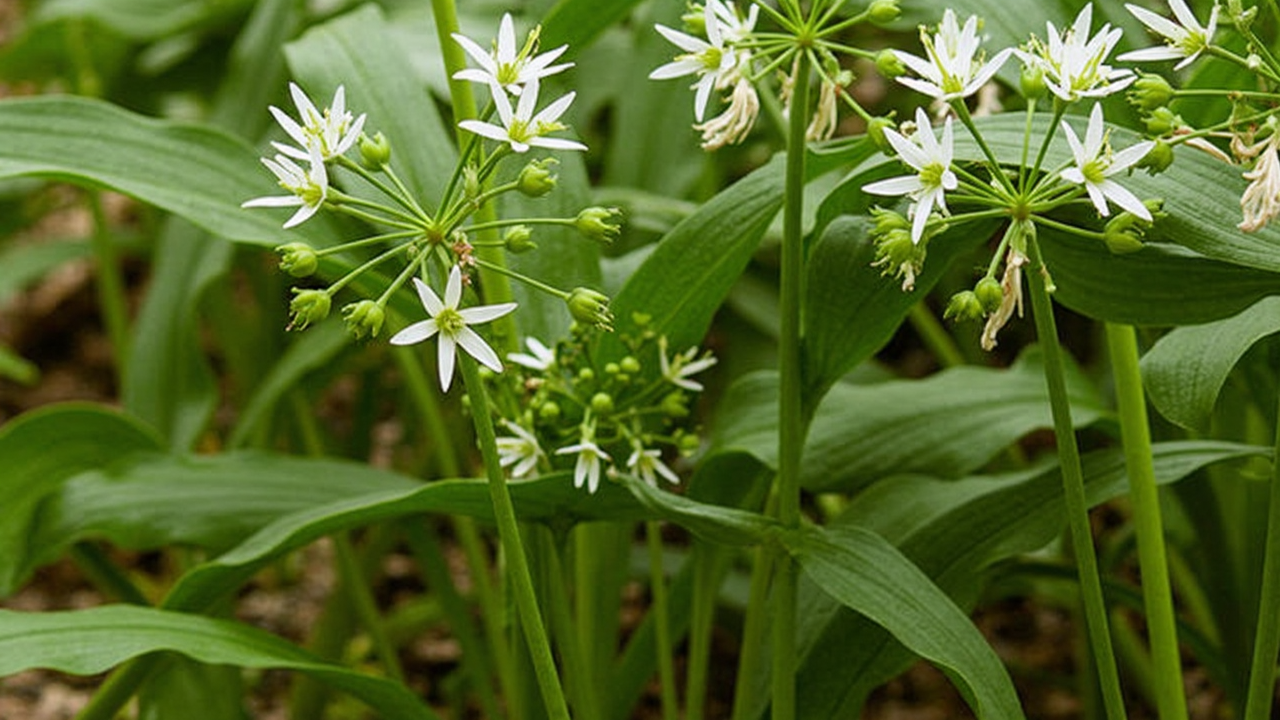
Wild garlic grows from a slender, elongated white bulb, around 1–2 cm across, that sits 5–15 cm below the soil surface and produces contractile roots. From each bulb rise two (occasionally three) upright leaves on a triangular, often slightly winged petiole. The leaves are the most recognisable feature: bright, slightly yellowish green, smooth and glossy on the upper surface, lance-shaped to elliptical, and typically 15–25 cm long and 3–6 cm wide with a pointed tip. They are soft and slightly floppy, often bending under their own weight, and are released from a papery sheath at the base as they emerge in early spring.
The flowering stem (scape) appears from April onwards, generally after the leaves have fully expanded. It is a solid, triangular-in-cross-section stalk, 20–45 cm tall, bearing a flat-topped umbel of 6 to 20 (sometimes more) individual flowers, each enclosed before opening in a papery spathe that splits and falls away. The flowers are pure white, six-tepalled, star-shaped and around 1.5–2 cm across, with a faint green stripe on the reverse of each tepal. They open in succession over two to three weeks. After pollination — chiefly by bees and other long-tongued insects — each flower develops into a small three-valved seed capsule containing round, black seeds roughly 2 mm across. As the seed ripens in June, the entire above-ground plant yellows and collapses; only the dormant bulb remains.
A distinctive in-between feature, useful for identification, is the way crushed foliage, scape or bulb releases a strong, unmistakable garlic smell within seconds. No toxic lookalike in UK woodland shares this chemistry.
Growing Conditions
Wild garlic is a plant of damp, deciduous woodland on mildly acidic to neutral soils. In cultivation it does best where these conditions can be reproduced. The single most important factor is summer moisture: bulbs that dry out completely in July and August will survive but will not bulk up or flower well the following spring. Soils that are deep, humus-rich and cool — a typical loam enriched with leaf mould or well-rotted garden compost — are ideal. Sandy or stony soils are workable provided they are mulched heavily in late spring, after the foliage has died back, to lock in moisture.
Light requirements are modest. Full shade under deciduous trees (oak, beech, ash, hazel, sycamore) is the textbook situation and the one in which the plant will gradually form a carpet. Light, dappled shade — for example on the north or east side of a building, or beneath a silver birch — is also acceptable. Very deep, dry shade under evergreens tends to be too dark and dry; the bulbs will sulk and eventually rot.
Hardiness is not an issue in any part of the UK. Wild garlic tolerates winter lows of at least -20 °C and emerges through frost. It is untroubled by late snow. Wind exposure is rarely a problem in cultivation because the foliage is short and the woodland understorey environment is, by definition, sheltered.
The plant is broadly unfussy about pH, doing well from roughly pH 5.0 to 7.5, with a slight preference for the slightly acidic end of the range. It will not thrive in chalky or lime-rich soils unless these are heavily improved with organic matter, and the leaves tend to yellow prematurely on thin, hungry ground.
Planting and Care
Planting. The most reliable way to establish wild garlic is to plant bulbs in late summer or early autumn, ideally from August to October while the bulbs are dormant. Set them 8–10 cm deep, point upwards, and 10–15 cm apart in well-prepared ground that has been forked over and enriched with leaf mould or compost. In heavier clay, add a layer of grit at the base of the planting hole to improve drainage around the bulb. Water in well and mulch thinly with leaf mould. Bulbs can also be planted in spring, but they tend to sulk in their first year and may not flower until the second season. Wild-collected bulbs should be avoided; the plant is protected in some areas and is slow to recover from disturbance. Use only nursery-propagated stock.
Watering. From late winter until the foliage dies back, the soil should be kept reliably moist. In a normal British spring this is automatic; in a dry spring, water once a week with a good soak. Once the leaves have yellowed in June, watering can be reduced and the plant can be allowed to dry out, matching its wild summer dormancy.
Feeding. Wild garlic is a light feeder. An annual top-dressing of leaf mould or well-rotted garden compost in autumn, applied as a 2–3 cm mulch, is usually enough. Bonemeal can be forked in at planting time to support bulb establishment. Avoid high-nitrogen fertilisers, which produce lush leaves at the expense of flowers and can lead to rot in damp conditions.
Pruning. No real pruning is needed. The simplest management is to leave the foliage to die back naturally, which feeds the bulb for the following year. If the appearance of yellowing leaves is unwelcome, the area can be strimmed or sheared once the foliage has fully collapsed in late June.
Propagation. Two methods work well. The first is division of established clumps: lift dormant bulbs in late summer, separate the small offset bulbs that have formed around the parent, and replant immediately. A single mature bulb typically produces three to six offsets each year, so a colony expands quickly. The second is seed: collect ripe seed capsules in June as they turn from green to tan, sow immediately in trays of seed compost kept shaded and moist, and expect germination the following spring. Seed-raised plants reach flowering size in three to four years. Note that seed-grown plants hybridise readily with the invasive three-cornered leek where both are present; in southern England it is worth removing Allium triquetrum nearby to keep stock pure.
Seasonal care. From February to May the plant is in active growth and benefits from any available moisture. In June the foliage yellows and is best left in place. Through summer and early autumn the bed can be mulched and used as normal; the dormant bulbs will not be damaged by light foot traffic or by overplanting with summer-interest perennials. Mark the position of the colony in autumn before the leaves disappear, to avoid accidentally digging into dormant bulbs.
Common Problems
Wild garlic is notably trouble-free, but a few issues are worth knowing.
Yellowing leaves in spring. Usually a sign of dry soil rather than disease. Water deeply and mulch. On thin, sandy soils a thick annual mulch of leaf mould is the long-term fix.
Leaves fail to appear. In newly planted stock this is normal; bulbs often take a full year to settle. In established colonies, suspect waterlogging in heavy clay (bulbs will rot), or damage from voles, mice or squirrels digging for the bulbs. Deer and rabbits generally leave wild garlic alone.
White rot and downy mildew. Wild garlic is in the same family as onions and can be affected by the same soil-borne fungi, though it is significantly more resistant than cultivated alliums. White rot shows as fluffy white mould at the bulb base and yellow, wilting foliage. Downy mildew produces pale, distorted leaves with a greyish down underneath in damp weather. Affected plants should be lifted and destroyed (not composted), and the bed rested from other alliums for at least five years.
Confusion with toxic lookalikes. The main practical risk is misidentification at the table rather than in the garden. Lily of the valley and autumn crocus both grow in similar conditions and have similar strap-shaped leaves, and both are seriously toxic. The rule is simple: never eat any wild leaf in this habitat without first crushing it and confirming the garlic smell. The plant should also be kept away from grazing pets for the same reason.
Invasiveness. In a suitably damp, shaded garden, wild garlic can spread faster than expected, both vegetatively and by seed. In a small garden it may be wise to plant it in a contained bed or to remove flowering scapes before seed sets, while still enjoying the leaves. In larger gardens and on heavier soils this is rarely a problem.
Popular Varieties
Genuine cultivar selection in wild garlic is limited; most stock sold in the UK is the straight species. Where named forms exist, they tend to be foliage or flower variants selected from wild populations. The following are the most widely available, although nursery availability varies year to year.
- 'Hans Lohaus' — a vigorous German selection with broader, more robust leaves and a strong garlic flavour. Often listed as improved for culinary use.
- 'Pink' — a form with palest pink rather than white flowers, otherwise typical. Slower to bulk up than the species.
- 'Brian' — a UK selection noted for particularly large flower umbels and tidy, upright foliage.
- 'Trefoil' — occasionally offered, distinguished by a tendency to produce three leaves per bulb rather than the usual two, giving denser ground cover.
If a source of cultivated bulbs or seed cannot be found locally, planting the straight species is perfectly satisfactory; wild garlic is naturally uniform across its range and a colony of the species is just as attractive and useful as any named form. Buyers should be wary of any cultivar name that cannot be cross-checked against a reputable nursery list, as several internet listings recycle invented names.
Pests and Diseases
| Problem | Symptoms | Management |
|---|---|---|
| Onion white rot | Leaves turn yellow and wilt while bulbs become soft and covered in white fungal growth. | Remove affected plants immediately and avoid replanting alliums in that soil for many years. |
| Downy mildew | Yellowish patches appear on leaves with a fuzzy grey-green mould developing underneath. | Improve air circulation and remove infected foliage to reduce humidity around the plants. |
| Slugs and snails | Irregular holes are eaten in young emerging leaves, often accompanied by slimy trails. | Use beer traps or iron phosphate pellets to protect tender new growth in spring. |
| Vine weevil | Notched edges on leaves above ground and wilting plants due to root damage below. | Check roots for grubs when planting and apply biological nematodes if infestation is found. |
| Excessive spreading | Dense carpets of foliage form, crowding out other plants and becoming difficult to control. | Install root barriers or regularly dig up new bulbils to restrict expansion into unwanted areas. |
Quick Care Summary
| Sunlight | Full shade, Partial shade |
|---|---|
| Soil | Moist, well-drained, moderately fertile, humus-rich; tolerates acidic conditions and heavier soils. |
| Hardiness | — |
| Sow | — |
| Plant | — |
| Prune | — |


As an Amazon Associate, GardenWizz earns from qualifying purchases made through the links above. This does not affect the price you pay. See our disclaimer for details.