
Stonecrop
Sedum · Sedum
At a Glance
| Botanical name | Sedum |
|---|---|
| Common name(s) | Stonecrop, Sedum |
| Family | Crassulaceae |
| Plant type | succulent (Includes annual, biennial, and perennial herbs; varies from annual and creeping herbs to shrubs.) |
| Height × Spread | 60 cm × 100 cm |
| Hardiness | — |
| Position | Full sun |
| Soil | well drained soil |
| Flowering | August–November |
| Toxicity | — |
| Native range | Northern Hemisphere, extending into the southern hemisphere in Africa and South America |
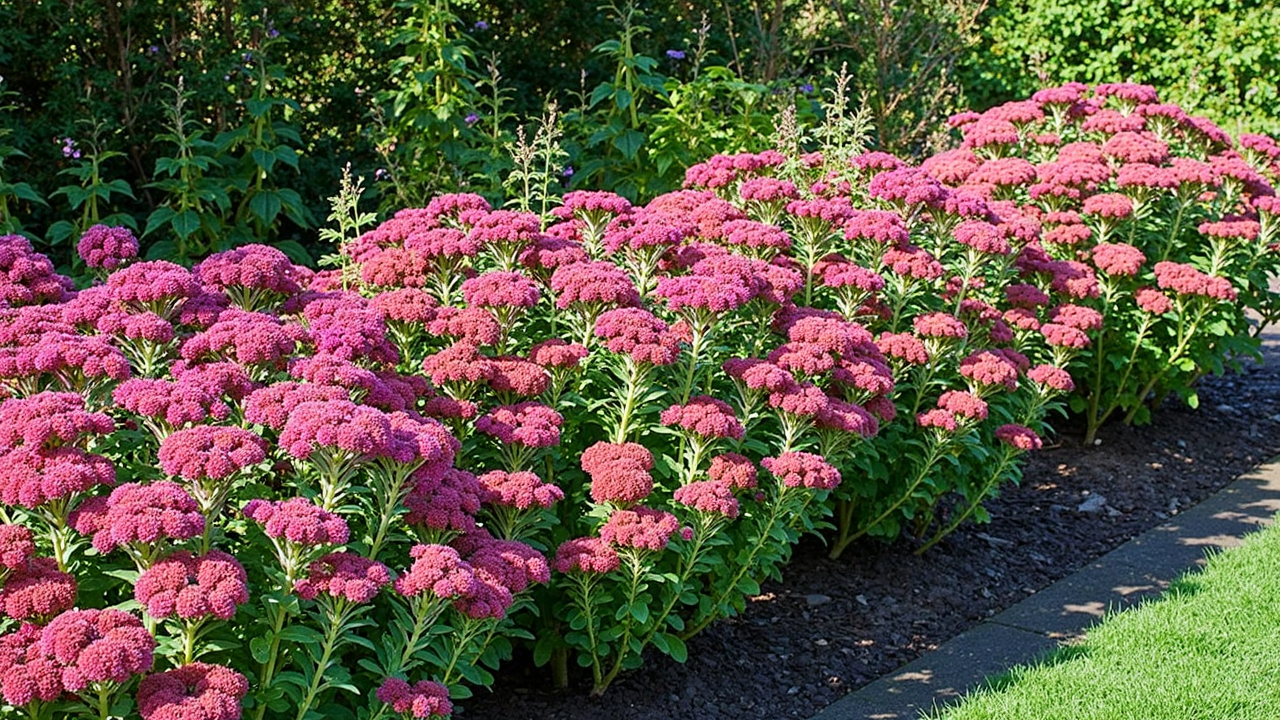
Stonecrop is the common name applied to a large group of succulent perennials in the genus Sedum (family Crassulaceae), many of which are well suited to UK gardens. The genus contains several hundred species distributed across the Northern Hemisphere, with a strong representation in temperate regions of Europe, Asia and North America. A number of species and hybrids have become reliable garden plants in Britain, valued for their drought tolerance, late-season flowers and attractiveness to pollinators. The taller border sedums, formerly grouped under Hylotelephium (or Sedum spectabile/telephium types) by some authorities, are also covered here under the broad common name stonecrop, as this remains the name most UK gardeners recognise.
Overview
Stonecrops are succulent-leaved perennials grown for their fleshy foliage, often in glaucous blue-green or burgundy tones, and for their flat or star-shaped flower heads that open in late summer. The flowers are rich in nectar and attract bees, hoverflies, butterflies and other insects at a time of year when little else is in bloom, giving the plants significant value for pollinator-friendly gardens. Many sedums also overwinter with structural seed heads that hold their shape into autumn and early winter.
In UK horticulture, the name stonecrop covers a wide habit range. Mat-forming alpine sedums such as Sedum acre and S. rupestre are used for green roofs, wall crevices, gravel gardens and the front of borders, typically staying under 10 cm tall. Taller border sedums — including the Hylotelephium (formerly Sedum) 'Herbstfreude' group — form upright clumps 45–60 cm tall and are used in herbaceous borders, cottage gardens and prairie-style plantings. All share a preference for sun, sharp drainage and lean soil, and most are reliably hardy across the UK, including in colder inland and northern districts.
Appearance
Stonecrops are recognisable by their thick, fleshy leaves arranged in opposite, alternate or whorled patterns along the stems, depending on species. Leaf colour ranges from bright green in Sedum acre to glaucous blue-grey in S. spectabile and S. rupestre, with bronze and purple tints appearing in cultivars such as Hylotelephium 'Purple Emperor' and 'Karfunkelstein'. The leaves store water, allowing the plants to withstand dry conditions.
The taller border sedums carry their flowers in broad, flattened corymbs (sometimes called "ice plate" heads) typically 7–15 cm across. Individual flowers are small, star-shaped, with five petals, and appear in shades of pink, rose, brick-red, white and pale yellow. Mat-forming species produce looser clusters of smaller yellow, white or pink flowers, usually in early to mid-summer. Seed heads turn from green to buff and persist on the plant well into winter.
Growing Conditions
Stonecrop performs best in full sun, where the foliage stays compact and the flowers colour well. In shade, the plants become leggy, flower poorly, and the fleshy stems may collapse. The single most important soil requirement is sharp drainage; sedums will tolerate nutritionally poor, stony, sandy or gravelly ground, but they will not tolerate winter waterlogging, which rots the crown and roots. Heavy clay soils should be improved with grit and organic matter before planting, or sedums should be grown in raised beds, containers or on slopes.
Most commonly grown species are fully hardy in UK conditions, generally to around RHS H5–H7 (roughly −15 °C to −20 °C, depending on species and cultivar). Sedum acre and the Hylotelephium border types are typically H7. Some compact alpine forms, particularly those from Mediterranean climates, may sit at H5 and benefit from a gritty top-dressing in wetter regions. UK gardeners in the colder upland areas of northern England, Scotland and parts of Northern Ireland should still expect most species to overwinter successfully in well-drained soil.
Seasonally, growth begins in mid-spring, flowering follows in summer for alpines and late summer for border types, and top growth dies back in late autumn. Border sedums in particular are best left standing over winter for structure, then cut back in early spring.
Planting and Care
Watering. Once established, stonecrop is highly drought tolerant and needs little supplementary watering. New plantings should be kept moist through their first growing season; after that, rainfall in most of the UK is sufficient. Container-grown plants need more careful watering, as compost dries out fast in summer, but the compost should be allowed to dry between waterings.
Feeding. Stonecrop thrives in lean soil and does not require routine feeding. Over-rich soil encourages soft, floppy growth, particularly in border sedums, which then collapse in summer rain. A light top-dressing of well-rotted garden compost in spring is plenty.
Pruning. Border sedums are traditionally cut back to ground level in early spring once the worst winter weather has passed, leaving the previous year's stems in place over winter for structure and to support early pollinators. The Chelsea chop (cutting stems back by a third in late May) can be used to keep taller cultivars compact and to delay flowering by a couple of weeks. Mat-forming alpines need only the removal of any damaged or congested growth in spring.
Propagation. Sedums are among the easiest perennials to propagate. Border types can be increased by division in spring or by stem cuttings taken in early summer and rooted in gritty compost; individual leaves laid on the surface of moist compost will also root and form plantlets. Mat-forming alpines root readily from small pieces of stem pressed into gritty compost, and many self-layer where stems touch bare soil.
Seasonal care. In wetter regions, an annual gravel mulch around the crown of border sedums helps to keep the base of the stem dry through winter. In containers, raise pots on feet over winter so they do not sit in saturated compost, and consider moving alpine types to a sheltered spot during prolonged wet weather.
Common Problems
The most common problem in UK gardens is crown and root rot caused by waterlogged soil, particularly on heavy clay. This presents as blackened, mushy stems at the base, collapse of the plant in midsummer, and a general failure to establish. Prevention — through improved drainage and avoiding overwatering — is far more effective than any treatment once rot has taken hold.
Powdery mildew can affect the foliage of border sedums in late summer, particularly on Hylotelephium 'Herbstfreude' and similar cultivars, where a white fungal bloom coats the leaves. It is usually cosmetic rather than fatal and can be reduced by avoiding overhead watering, improving airflow around clumps, and dividing congested plants every three to four years.
Aphids occasionally colonise the new spring growth and flower buds, but populations are usually kept in check by predators. Blackbirds and other birds sometimes flatten border sedums while foraging for invertebrates, and weak-stemmed cultivars can collapse under their own weight in wet weather — the Chelsea chop is the standard remedy.
Slugs and snails generally ignore the succulent foliage. Rabbits and deer rarely browse stonecrops. Note that Sedum is generally regarded as non-toxic to humans and pets, but specific cultivars and related Crassulaceae have not all been individually assessed; if toxicity is critical to a planting decision, confirm with the supplier or a current toxic-plant reference.
Popular Varieties
Several well-established cultivars are widely available in UK garden centres and from specialist nurseries. The following are real, long-standing names and should be straightforward to source.
- Hylotelephium 'Herbstfreude' (syn. Sedum 'Autumn Joy') — the classic border stonecrop, with grey-green leaves and large salmon-pink flower heads that age to copper. Typically 50–60 cm tall. RHS Award of Garden Merit holder.
- Hylotelephium 'Matrona' — an upright cultivar to around 60–75 cm with bronze-tinted, blue-green foliage and soft pink flower heads. A reliable performer in mixed herbaceous borders.
- Sedum 'Purple Emperor' — dark purple-bronze foliage with dusty pink flower heads in late summer, around 40–50 cm tall. Holds its colour well in sun and is widely used in contemporary planting schemes.
- Sedum spurium 'Schorbuser Blut' (Dragon's Blood) — a low, mat-forming evergreen, with red-tinted green leaves and deep pink flowers, useful for ground cover, green roofs and wall plantings.
- Sedum acre — a native British stonecrop forming low mats of bright green leaves and yellow star-shaped flowers in early summer, often seen on walls, rocky ground and old roofs.
Where specific hardiness ratings or growth dimensions are not given here, the figures given in the quick-care table apply; cultivar performance does vary, and where a property is uncertain, this is stated rather than invented.
Pests and Diseases
| Problem | Symptoms | Management |
|---|---|---|
| Slugs and snails | Irregular holes chewed into soft new growth and fleshy leaves. | Use physical barriers like copper tape or apply iron phosphate pellets around the base. |
| Vine weevil larvae | Plant wilts and collapses due to roots being eaten away, especially in containers. | Apply nematodes to moist soil in late summer or use systemic insecticides preventatively. |
| Root rot | Stems become soft, mushy and discoloured due to waterlogged soil conditions. | Ensure excellent drainage with gritty compost and avoid overwatering during winter. |
| Powdery mildew | White powdery fungal growth appears on leaves, often in humid or crowded conditions. | Improve air circulation and spray with a sulphur-based fungicide if severe. |
Quick Care Summary
| Sunlight | Full sun |
|---|---|
| Soil | well drained soil |
| Hardiness | — |
| Sow | — |
| Plant | March–August |
| Prune | February, March, May |


As an Amazon Associate, GardenWizz earns from qualifying purchases made through the links above. This does not affect the price you pay. See our disclaimer for details.