Wild Service Tree
Sorbus torminalis
At a Glance
| Botanical name | Sorbus torminalis |
|---|---|
| Common name(s) | Wild Service Tree |
| Family | Rosaceae |
| Plant type | tree (Deciduous) |
| Height × Spread | 3000 cm × — |
| Hardiness | H6 (to -20.0 °C) |
| Position | Full sun, Partial shade |
| Soil | moderately fertile, humus-rich soil; moist but well-drained; deep, fertile soil |
| Flowering | May–June |
| Toxicity | Fruit are ornamental, not to be eaten. Wear gloves and other protective equipment when handling. |
| Native range | Europe, parts of northern Africa and western Asia |
The Wild Service Tree is one of Britain's least-known native trees, a medium-sized deciduous species of the rose family that has grown in English and Welsh woodlands since the last ice age. It is prized by dendrologists for its distinctive lobed foliage, its clusters of creamy-white spring flowers, and its richly coloured autumn display, yet it remains genuinely rare in cultivation and is rarely offered by mainstream nurseries. For gardeners with patience and a suitable soil, it is one of the most rewarding specimen trees available, and a worthwhile choice for anyone interested in native species, ancient woodland restoration, or simply growing something a little out of the ordinary.
Overview
Sorbus torminalis is a long-lived deciduous tree native to the UK, much of mainland Europe, parts of western Asia and North Africa. In Britain it is classed as a Priority Species under the UK Biodiversity Action Plan and is one of the rarest of our native broadleaves, surviving chiefly in ancient woodland on chalk and limestone in southern and central England, with stronger populations in Wales and parts of western Europe. Mature specimens can live for three centuries or more, and although the tree grows slowly, its combination of ornamental foliage, spring blossom, autumn colour and historical interest has long appealed to those planting larger gardens, parklands and native-species schemes. It is not a tree for a small suburban plot, but in the right place it needs almost no maintenance once established and rewards the gardener for many decades.
Appearance
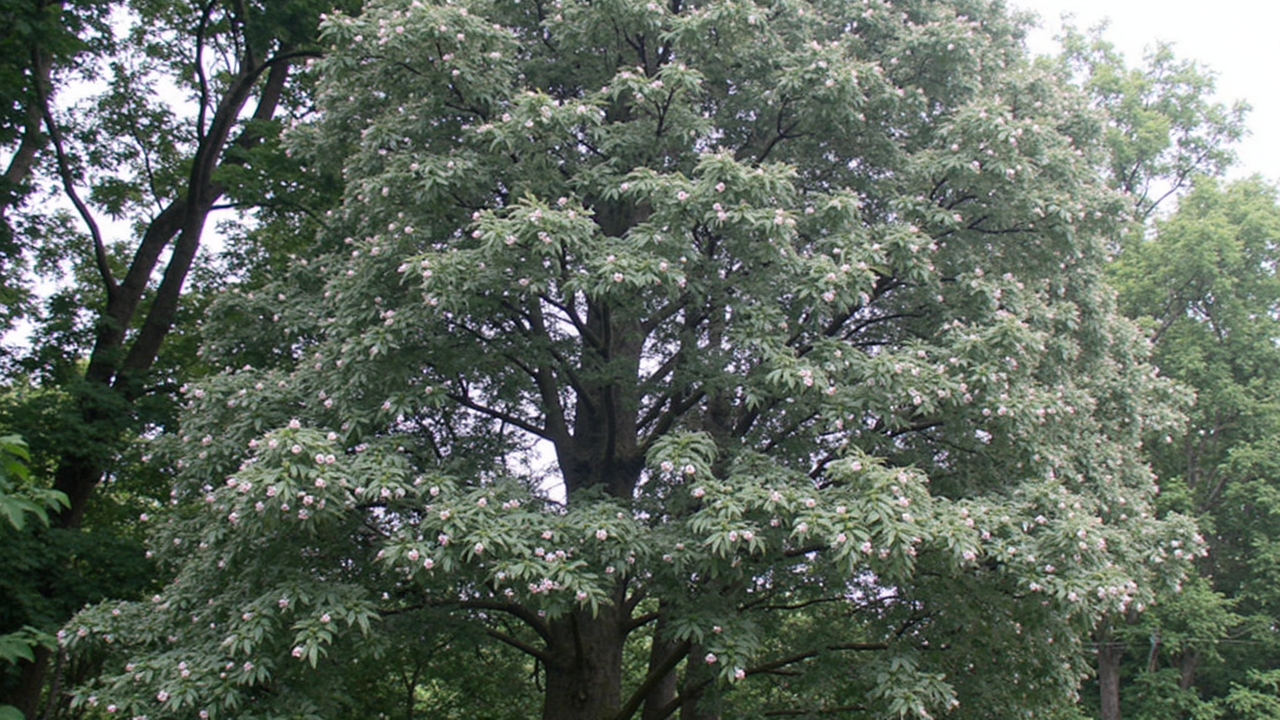
In growth habit the Wild Service Tree forms a broad, rounded and rather domed crown that becomes wider than tall with age. In the open it develops a sturdy, low-branched silhouette; in woodland competition it draws up to a cleaner, taller trunk. Mature height is typically 15–25 m, with exceptional individuals reaching close to 30 m on deep, moisture-retentive but free-draining soil. The bark is smooth and pale grey in youth, gradually breaking into small, shallow rectangular fissures as the tree matures.
The leaves are the species' most recognisable feature and are quite unlike those of any other common British Sorbus. Each blade is 5–11 cm long, broadly ovate, and cut into three to five sharply pointed lobes on each side, giving a distinctly maple-like outline. Upper surfaces are a clean dark green and largely hairless; the underside is paler and softly downy when young, becoming smoother with age. In autumn the foliage turns a brilliant mix of yellow, orange, flame and deep red, often on the same tree and sometimes on the same leaf, putting the species in the front rank of British trees for autumn colour.
Flowers appear in late May and into June, in broad, loose clusters 5–12 cm across, each individual bloom about 1 cm across with five creamy-white petals. The flowers carry a faint, slightly musky scent and are well-visited by bees, hoverflies and other pollinating insects. The fruit that follows is a small, oval pome, 10–15 mm long, ripening from greenish to a mottled, tawny reddish-brown in October. Each fruit carries a small pale dot at its base, the "checker" marking that gives the tree one of its old common names.
Growing Conditions
The Wild Service Tree is, in cultivation as in the wild, a tree of well-drained, base-rich ground. In Britain it is found most often on chalk and limestone, in ancient woodland, on woodland edges and in chalk scrub, and it grows most happily in a soil that is alkaline to neutral, deep, and reliably free-draining. It will tolerate clay only where drainage is good; it resents sitting wet at the root, and on strongly acid soils it grows poorly, shows chlorosis and is best avoided.
Sunlight requirements are flexible. The tree performs best in full sun, where it makes the most compact shape and the best autumn colour, but it is perfectly at home in light dappled shade, and in the wild it often establishes at the woodland edge. It is fully hardy across the UK and Ireland, tolerating winter temperatures well below freezing and performing reliably through cool, damp northern summers. Shelter from cold spring winds helps protect the early leaf burst, and shelter from strong westerlies is helpful in exposed western gardens for the first few years. Once established the tree is notably wind-firm.
A practical note on siting: because the species can reach a substantial size with a broad crown, it needs space. Allow at least 8–10 m from a building, a fence line or a competing tree, and more if you are aiming for a fully developed specimen shape. The tree is moderately tolerant of atmospheric pollution, which makes it a candidate for larger urban sites where the soil is right.
Planting and Care
Planting is best done in autumn or early spring, when the soil is workable, moist and not frozen. Container-grown stock can be planted at any time the ground is suitable, but autumn planting generally gives the strongest first-year growth because roots can establish before the following summer's drought stress. Bare-root or root-balled whips and standards are sometimes offered by specialist nurseries and should be planted promptly on arrival.
Prepare a planting hole at least twice the width of the root ball and no deeper, loosening the base and sides with a fork. Backfill with the original garden soil improved with a generous forkful of well-rotted organic matter such as garden compost or leaf mould; avoid burying the root flare. Water in thoroughly, apply a 5–8 cm organic mulch over the rooting area (kept clear of the trunk itself), and stake low and loose for the first growing season in exposed sites, removing the stake after twelve to eighteen months.
Watering is the main job for the first two to three years. Water deeply during dry spells in spring and summer, particularly on free-draining chalk soils, reducing as the tree establishes. After that the Wild Service Tree is largely self-sufficient on all but the very driest sites. Feeding is generally unnecessary; on reasonable garden soil an annual spring mulch of compost is enough. Avoid high-nitrogen lawn or rose feeds, which can encourage soft, late growth that is more vulnerable to canker and to windthrow.
Pruning is minimal. The species develops a pleasing shape unaided, and routine cutting is limited to the removal of dead, damaged, diseased or crossing branches, carried out in late autumn or winter when the tree is fully dormant. Avoid heavy summer pruning, which can attract infection. If a young tree produces a competing leader, reduce to a single strong central shoot in winter to encourage a clean trunk.
Propagation is normally by seed. The pomes are collected in October when fully ripe, the seed extracted, stratified through a cold winter (either outdoors or in a refrigerator at around 4 °C for sixteen to twenty weeks) and sown in spring. Germination is often slow and erratic, and a proportion of seed will wait until the second spring. Vegetative propagation by grafting onto Sorbus aucuparia or hawthorn rootstocks is used commercially for selected forms but is not generally a home-garden project.
Common Problems
The Wild Service Tree is generally healthy once it has settled in, but as a member of the rose family it shares the susceptibility of apples, pears, whitebeams and rowans to a small group of familiar problems.
Fireblight (Erwinia amylovora) is the most serious. It causes blossom blight, leaf scorch that looks as though the foliage has been held over a flame, and progressive dieback of shoots and branches, often with a characteristic "shepherd's crook" bend at the shoot tip. Infected material should be cut back at least 30 cm into clean wood and destroyed (burned or removed from the site; do not compost), and in the UK fireblight is notifiable, so suspected cases on commercial holdings should be reported to the relevant authority. The Wild Service Tree is less frequently affected than hawthorn or pyracantha, but in gardens near susceptible neighbours it is worth keeping an eye on spring blossom after warm, wet weather.
Canker, caused by various Nectria species and related fungi, can produce sunken, discoloured lesions on stems and branches, often associated with wounds or stress. Cut out affected tissue cleanly back to healthy wood and dispose of it. Improving the tree's general vigour — by mulching, watering in drought and avoiding unnecessary nitrogen — is the best prevention.
Sawfly larvae (slugs of the genus Caliroa) may skeletonise leaves in late spring, leaving the upper surface intact in papery patches. On a mature tree the damage is cosmetic; on a young specimen a forceful hose, a sheet and a hand-pick is usually enough. Aphids occasionally cluster on soft young shoot tips in spring but rarely justify treatment on an established tree. Powdery mildew can mark the leaves in warm, dry late summers, and is best managed by improving air circulation rather than spraying. Grey squirrels may strip bark from young stems, particularly in winter, and a plastic tree guard for the first few years is a sensible precaution where squirrels are active.
Popular Varieties
The Wild Service Tree is unusual among garden ornamentals in that the species itself is so rarely planted that very few selected forms have ever been named and propagated in any quantity. The brief that accompanies this article does not document established cultivar names, and accordingly no cultivars are named here; the species, raised from British or continental European seed, is the form normally offered.
A small number of selections are recorded in continental European literature, including variants with particularly good autumn colour or a more compact growth habit, but these are largely restricted to specialist collections and arboreta rather than to general nursery trade. Gardeners wanting a guaranteed autumn display are best advised to buy a plant of known wild provenance from a specialist native-plant nursery, plant it with space, and let it grow into character. The plain species of Sorbus torminalis is, in any case, one of the finest autumn-colour trees hardy in the UK, and the rarity of selected forms is no real loss.
---
Pests and Diseases
| Problem | Symptoms | Management |
|---|---|---|
| Fireblight | Shoots and branches suddenly wilt, turn black, and curl into a shepherd's crook shape. | Prune out infected wood well below the visible symptoms during dry weather, disinfecting tools between cuts. |
| Apple canker | Sunken, discoloured lesions appear on branches and trunk, often oozing sap or causing bark to crack. | Cut out cankers with a sharp knife down to healthy wood and apply wound paint to prevent reinfection. |
| Honey fungus | General decline in vigour, dieback of branches, and white fungal growth under the bark at the base. | Improve drainage and avoid soil compaction; severe cases may require removal of the tree to prevent spread. |
| Silver leaf | Leaves develop a distinctive silvery sheen on their undersides due to fungal infection. | Prune out infected branches and avoid wounding the bark, as the fungus enters through injuries. |
| Aphids | Clusters of small soft-bodied insects on new growth causing leaf curling and sticky honeydew. | Encourage natural predators like ladybirds or use a strong jet of water to dislodge them. |
| Pear blister mite | Leaves become puckered, thickened, and may turn reddish or brown as the season progresses. | Apply horticultural oil in late winter before bud burst to suppress overwintering eggs. |
Quick Care Summary
| Sunlight | Full sun, Partial shade |
|---|---|
| Soil | moderately fertile, humus-rich soil; moist but well-drained; deep, fertile soil |
| Hardiness | H6 (-20.0 °C) |
| Sow | — |
| Plant | — |
| Prune | — |



As an Amazon Associate, GardenWizz earns from qualifying purchases made through the links above. This does not affect the price you pay. See our disclaimer for details.