
Stinging Nettle
Urtica dioica
The Gardening Year
Best months in UK gardens · full planting calendar →
🖨 Printable care card (PDF)At a Glance
| Botanical name | Urtica dioica |
|---|---|
| Common name(s) | Stinging Nettle |
| Family | Urticaceae |
| Plant type | perennial (Dioecious, herbaceous perennial. Dies down to ground level in winter; creeping horizontal stems and spreading roots survive through winter and produce new growth each spring.) |
| Height × Spread | 0.9–2 m × — |
| Position | Full sun, Partial shade, Full shade |
| Soil | moist soil |
| Flowering | May–September |
| Toxicity | Skin irritant. Harmful if eaten by pets (dogs) and via skin contact. |
| Native range | Europe, much of temperate Asia and western North Africa |
Stinging nettle is one of the most familiar native wild plants in the British Isles. A robust herbaceous perennial of the Urticaceae family, it colonises field margins, hedgerows, woodland edges, waste ground and allotments with equal enthusiasm, and is recognised instantly by the raised welts produced when bare skin brushes against its leaves. Despite its stinging reputation, it has a long history in the UK as a culinary, medicinal and fibre plant, and remains ecologically invaluable: more than thirty species of insect depend on it, including the larvae of several common garden butterflies.
Overview
Urtica dioica is native to the UK and widespread throughout lowland Britain and Ireland, from the Channel Islands to northern Scotland, becoming scarcer only on the most exposed upland and maritime ground. It is dioecious, meaning male and female flowers are borne on separate plants, and the species shows considerable variation in stature and leaf size according to soil fertility and moisture. Above-ground growth dies back in winter, with new shoots emerging from an extensive creeping rhizome each spring. Although most gardeners regard it as a persistent weed, nettles are deliberately cultivated in some wildlife gardens, on organic smallholdings, and by foragers who value the young spring tops as a free, vitamin-rich green.
Appearance
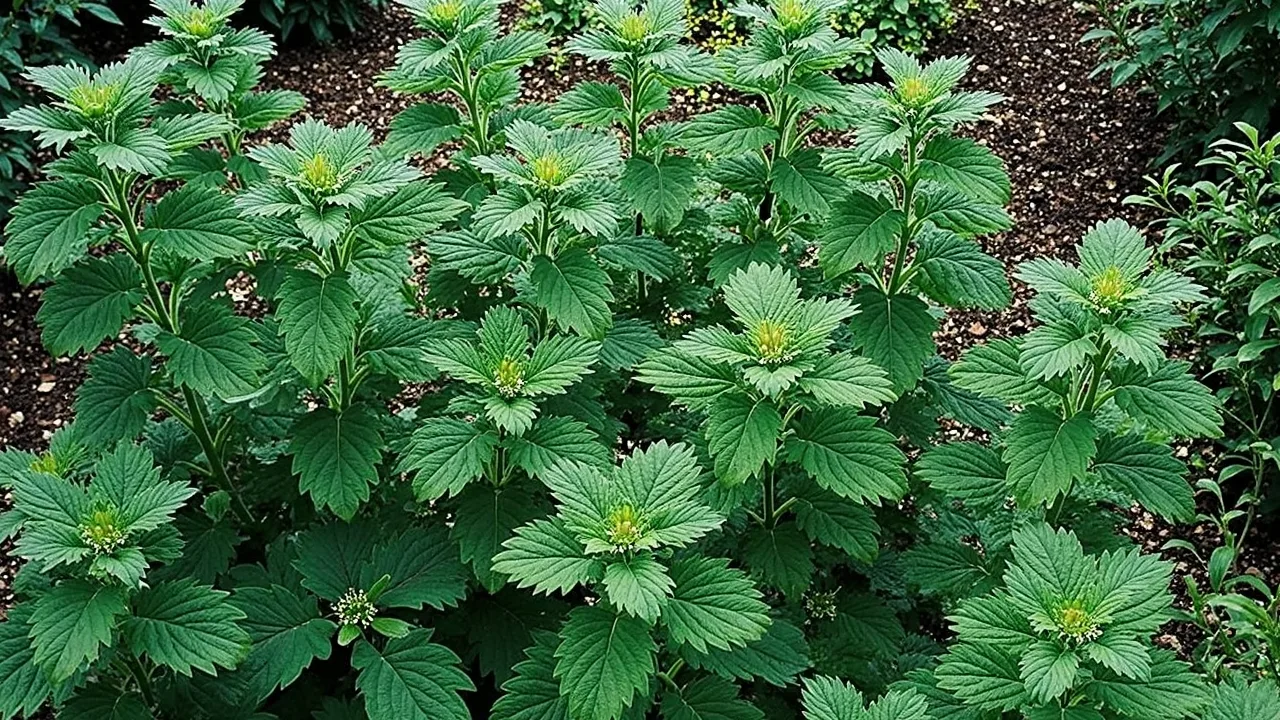
A mature nettle in fertile soil typically reaches 50–150 cm in height, with exceptional specimens exceeding 2 m where conditions are unusually rich. The stems are characteristically square in cross-section and bear stiff downward-pointing hairs, while the leaves are arranged in opposite pairs, each leaf 3–15 cm long, broadly heart-shaped, pointed at the tip, and edged with coarse, forward-pointing teeth. Both surfaces of the leaf are cloaked in the fine, brittle trichomes that give the plant its common name; these hollow silica-tipped hairs inject a cocktail of formic acid, histamine, serotonin and acetylcholine on contact, producing the familiar instant burning sensation.
Flowering begins in June and continues through August. The small greenish flowers are inconspicuous, carried in slender drooping clusters (male) or compact axillary spikes (female) at the upper leaf joints. Pollination is entirely by wind, and a single large plant can produce tens of thousands of seeds in a good year. The root system is yellow, branching and rhizomatous, and is the principal reason the plant is so difficult to clear once it has become established.
Growing Conditions
Nettles are not fussy. They grow on a very wide range of soils, from sandy loam to heavy clay, and tolerate pH values from around 4.5 to 8.5. Their strong preference is for nitrogen-rich, moist but not waterlogged ground, which is why they congregate near compost heaps, livestock pens, rabbit warrens, old nettle beds and the broken edges of cultivated land. Established plants are fully hardy across the whole of the UK and are rated H6 by the Royal Horticultural Society, meaning they tolerate winter lows of around −20 °C without damage.
Light requirements are flexible. Nettles grow most vigorously in full sun or dappled shade, but they persist in quite deep shade beneath hedgerows, where flowering is reduced and the plants take on a leggier habit. The combination of moist soil, ambient warmth and an open canopy produces the densest, tallest stands.
Planting and Care
No gardener deliberately plants stinging nettle in an ornamental border, but where the plant is wanted for wildlife value, for a nettle patch used as a butterfly nursery, or for cut-and-come-again harvesting for the kitchen, it can be introduced without difficulty. The simplest method is to lift and replant a small section of rhizome in early spring, setting it 5–8 cm deep in prepared ground and watering in well. Seed can be sown in autumn or spring but is slower to establish and less reliable than divisions.
Care of a nettle bed is minimal. In dry summers the foliage will scorch, so an occasional deep watering is worthwhile on light soils. There is no need to feed an established patch; on the contrary, over-rich ground only encourages more vigorous spread. For culinary use, cut the young tops when the plants are around 15–20 cm tall, ideally before the lower leaves have toughened, and always wear thick gloves. Cooking, drying or finely blending destroys the sting.
Seasonal care follows the calendar in a straightforward way. In March and April the new shoots push through; this is the moment to lift and divide established clumps if more plants are wanted, or to begin cutting back where control is the aim. May and June bring the first flush of usable tops for the kitchen, along with the first aphid colonies on the shoot tips. By July the plants are in full flower, and from late August through October the females set and shed seed in prodigious quantities. Cutting back hard in early September deprives the bed of both its seed and its late-season re-growth, and noticeably weakens the rhizomes the following spring. There is no need for staking, tying, dead-heading or winter protection in any part of the UK.
Where control is the aim, regular cutting is the most reliable organic method: cut the foliage to ground level three or four times between April and September, and the rhizomes will eventually weaken, though full clearance of an old bed usually takes two full growing seasons. Mulching with thick black plastic or several layers of cardboard for at least a full year achieves similar results. Forking out rhizomes is effective on light soils but laborious; a single missed fragment will regenerate. There is no routine need to stake, prune for shape, or protect from cold.
Propagation, where desired, is straightforward: lift and divide established clumps in autumn or early spring, replanting immediately into prepared ground, or allow cut stems to dry in place and collect the seed in late summer. Self-seeding is prolific in the right conditions, and an isolated female plant will seed freely if a male plant is within wind-pollinating distance.
Common Problems
The chief problem associated with stinging nettle in cultivation is its own vigour. The rhizomes spread laterally at a rate of up to a metre a season in fertile soil, and the plant will quickly colonise any cultivated ground it is allowed into. On allotments and in vegetable beds it is considered one of the most tenacious perennial weeds.
Among pests, the nettle aphid (Microlophium carnosum) is the most visible, forming dense colonies on the shoot tips in mid- to late summer. It is generally tolerated because it supports large numbers of ladybirds, hoverflies and lacewings, which in turn help control aphids on neighbouring crops. The rust fungus Puccinia urticata produces small orange-brown pustules on the leaves during damp weather and is cosmetic rather than damaging. No serious viral or bacterial diseases are recorded on the species in the UK.
The sting itself is the only hazard to humans. Reactions vary: most people experience a transient burning itch that subsides within an hour, but sensitive individuals can develop large raised welts (urticaria) lasting a day or more. Wearing gloves, long sleeves and sturdy trousers when working among nettles is the standard precaution. Nettle stings are not known to be toxic, and fatalities from contact with the plant are not recorded in modern UK medical literature.
Popular Varieties
Genuine cultivar selection in Urtica dioica is limited; most named forms in cultivation are subspecies or naturally occurring variants rather than formally bred plants.
- Urtica dioica subsp. dioica — the common stinging nettle of lowland Britain, with the largest leaves and the most vigorous growth.
- Urtica dioica subsp. galeopsifolia — the fen nettle, distinguished by its narrower, less deeply toothed leaves and a much weaker sting; found in damp fens and ditches in eastern England.
- Urtica dioica subsp. gracilis — a more slender North American form occasionally grown for comparison in botanical collections.
- Urtica dioica 'Stingless' — a little-documented selection marketed by some European herb nurseries as a culinary nettle without the sting; seed set and vigour are notably lower than in the wild type, and stock should be regarded as potentially unstable.
The related annual small nettle (Urtica urens) is sometimes confused with the common species but is smaller, more branched, and is only occasionally grown as a curiosity. The tree nettle of New Zealand (Urtica ferox), though not hardy in the UK, is sometimes mentioned in passing literature and should not be confused with British material.
For most UK gardeners, the sensible choice is the wild type. It is locally adapted, supports the largest range of native invertebrates, and is the form documented in every standard British flora from the Flora of the British Isles onwards.
🌿 Wild species. Grown as the true native plant, not as named garden cultivars — so there is no cultivar list here by design, not for want of data.
Pests and Diseases
| Problem | Symptoms | Management |
|---|---|---|
| Slugs and snails | Irregular holes chewed into young leaves and seedlings, often accompanied by silky trails. | Use beer traps, copper tape barriers, or hand-pick at night to protect tender new growth. |
| Aphids | Clusters of small green or black insects on stems and leaf undersides, causing curling and sticky residue. | Spray with a strong jet of water or apply insecticidal soap; encourage natural predators like ladybirds. |
| Powdery mildew | White, powdery fungal growth on leaves and stems, particularly in humid conditions. | Improve air circulation and avoid overhead watering; remove severely affected foliage. |
| Root rot | Yellowing, wilting leaves and stunted growth despite adequate moisture, indicating waterlogged soil. | Ensure well-drained soil conditions and avoid overwatering to prevent fungal attack on roots. |
| Nutrient deficiency | Pale green or yellowing leaves and reduced vigor in plants growing in poor soil. | Apply a balanced organic fertilizer or compost to improve soil fertility and plant health. |
For step-by-step help, read Controlling Aphids Naturally, Dealing with Slugs and Snails and Treating Powdery Mildew. Or browse the full plant problem solver to diagnose an issue by symptom.
As an Amazon Associate, GardenWizz earns from qualifying purchases made through links on this page (including links within the article). This does not affect the price you pay. See our disclaimer for details.