
Strawberry 'Cambridge Favourite'
Fragaria ananassa 'Cambridge Favourite'
The Gardening Year
Best months in UK gardens · full planting calendar →
🖨 Printable care card (PDF)At a Glance
| Botanical name | Fragaria ananassa 'Cambridge Favourite' |
|---|---|
| Common name(s) | Strawberry 'Cambridge Favourite' |
| Family | Rosaceae |
| Plant type | perennial (Semi evergreen, stoloniferous perennial with leaves composed of three leaflets, and rounded white or pink flowers followed by edible red fruits.) |
| Height × Spread | 10–50 cm × 10–50 cm |
| Position | Full sun |
| Soil | fertile, moist but well-drained soil |
| Flowering | April–July |
| Toxicity | No specific toxicity is listed by the RHS. This is not a guarantee of safety — check with a vet or the ASPCA before pets or children eat any plant. |
| Native range | — |
Overview
Strawberry 'Cambridge Favourite' (Fragaria ananassa 'Cambridge Favourite') is a widely grown June-bearing strawberry cultivar raised in the mid-twentieth century and long valued in UK gardens and pick-your-own plots for its reliable mid-season crops. It is grown primarily for its dessert fruit — medium-sized, conical berries with a recognisable flavour that balances sweetness and acidity. The variety has remained a staple in British fruit cultivation because it crops dependably across most of the UK and tolerates a range of soils.
Distinctive Features
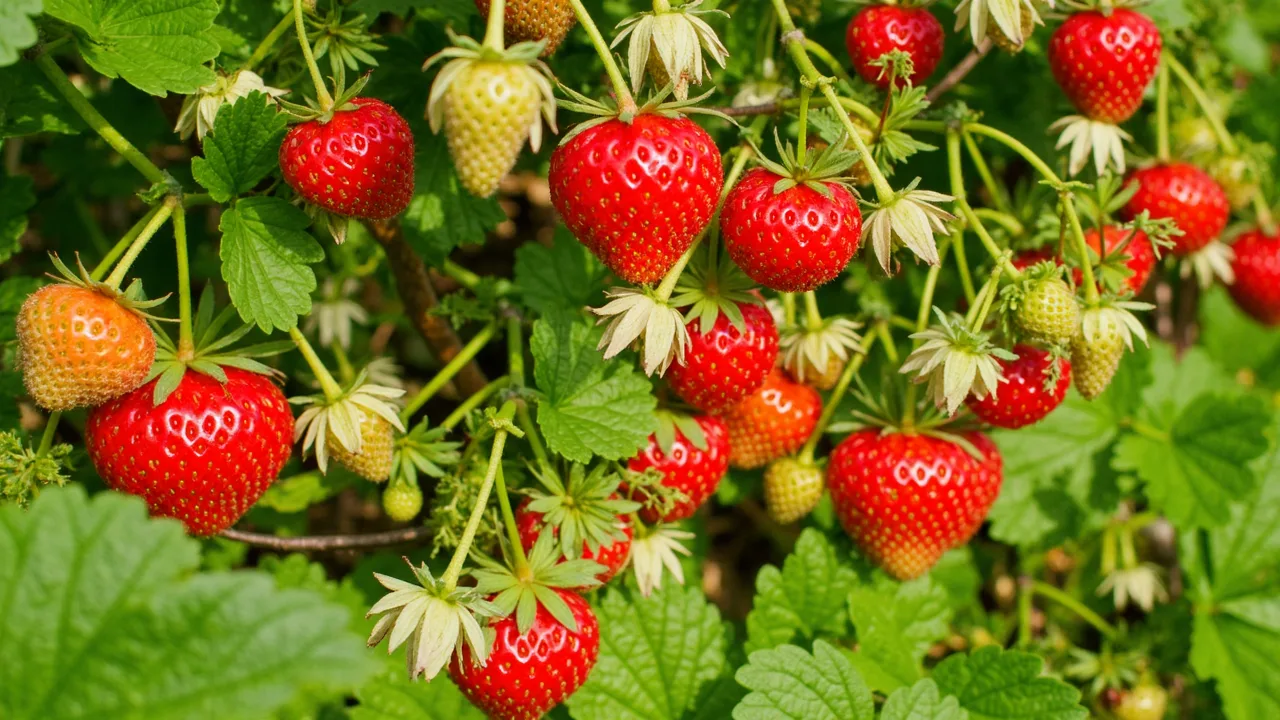
Compared with the species-type strawberry, 'Cambridge Favourite' produces a more uniform, conical fruit and tends to crop over a slightly more concentrated mid-season window rather than spread thinly across many weeks. The berries are typically a bright, even red with a glossy skin and a paler, firm flesh. Plants are moderately vigorous, forming a tidy crown with leaves held above the mulch line, and they produce runners freely, which makes propagation straightforward for the home gardener.
It should not be confused with the later 'Cambridge Late Pine' or with modern F1 hybrids sometimes sold under similar names; the genuine 'Cambridge Favourite' has been propagated for decades and is usually supplied as cold-stored runners or potted plants. The cultivar holds an RHS Award of Garden Merit (AGM), reflecting its long-standing performance in UK trials for cropping, flavour and garden usefulness. Flowers are the usual white, five-petalled strawberry type, and there is no ornamental flower colour or variegation to set it apart — its distinction lies in reliable fruiting rather than looks.
Growing Notes
'Cambridge Favourite' is hardy across most of the UK and is generally treated as hardy to around -15°C once established, though container-grown plants are more vulnerable to root-zone cold and benefit from fleece or moving to a sheltered spot in harsh winters. Like most June-bearers, it should have flowers removed in the first summer after planting to let the crown establish, with the main crop taken the following year; in established beds the entire crop is then sacrificed if renewed every two to three years by replacing mother plants with rooted runners.
Site it in full sun in moisture-retentive but free-draining soil with a pH near neutral; on very acid ground a light liming the winter before planting is helpful. Plant with the crown at, not below, soil level to avoid rot. Water well during fruit swelling and mulch with straw or matting to keep the berries clean. The cultivar shows moderate tolerance of the common strawberry diseases but, as with all strawberries, rotation of beds and replacement of plants every few years is advised; virus-free stock should be sourced if previous strawberry plantings have declined. Runners are best restricted on cropping plants to keep fruiting strong.
Best Used For
'Cambridge Favourite' suits a traditional kitchen garden or allotment row, a small fruit bed in a cottage-style border, and large containers or grow-bags on a sunny patio. It is a sound choice where a single, dependable mid-season dessert strawberry is wanted rather than a long drawn-out harvest, and the fruit freezes well for later jam-making. Pollinators are attracted to the spring flowers, though the chief value here is eating rather than wildlife value.
Pests and Diseases
| Problem | Symptoms | Management |
|---|---|---|
| aphids | — | — |
| slugs | — | — |
| glasshouse red spider mite | — | — |
| vine weevil | — | — |
| strawberry viruses | — | — |
| root rot | — | — |
| grey moulds | Fruit may be susceptible | — |
For step-by-step help, read Controlling Aphids Naturally and Dealing with Slugs and Snails. Or browse the full plant problem solver to diagnose an issue by symptom.
As an Amazon Associate, GardenWizz earns from qualifying purchases made through links on this page (including links within the article). This does not affect the price you pay. See our disclaimer for details.