
White Bryony
Bryonia dioica
The Gardening Year
Best months in UK gardens · full planting calendar →
🖨 Printable care card (PDF)At a Glance
| Botanical name | Bryonia dioica |
|---|---|
| Common name(s) | White Bryony |
| Family | Cucurbitaceae |
| Plant type | climber (perennial climbing vine) |
| Height × Spread | 10 m × 10 m |
| Position | Full sun, Partial shade |
| Soil | well-drained, rich soils; Moist but well–drained, Well–drained pH Alkaline, Neutral |
| Flowering | June–August |
| Toxicity | All parts are poisonous/harmful if eaten. White bryony may cause skin irritation (inflammation, rash, ulcers). Consumption causes gastrointestinal irritation, nausea, vomiting; larger amounts cause anxiety, paralysis, or death. |
| Native range | Central and Southern Europe; Europe, N Africa, SW Asia |
White Bryony is the only British native climbing member of the gourd family, a vigorous herbaceous perennial that scrambles through hedgerows and woodland edges across much of southern and central England. Closely related to the cucumber and the marrow, it produces small, greenish-white flowers in early summer followed by glossy red berries in autumn. The plant is decorative in a wild setting but emphatically not an ornamental garden subject: every part, and especially the root and the ripe berries, is poisonous to mammals, and its fleshy taproot makes it difficult to remove once established. This entry summarises the species as it occurs in the United Kingdom, with practical notes for naturalists, foragers and gardeners who may encounter it.
Overview
White Bryony (Bryonia dioica) is a dioecious climbing perennial in the family Cucurbitaceae. It is native to the United Kingdom and widespread across much of lowland England and Wales, particularly on chalk and limestone substrates; populations thin out markedly in northern England and are largely absent from Scotland and most of Ireland. The species climbs by means of unbranched, coiling tendrils borne singly opposite each leaf, hauling itself through hawthorn, blackthorn and field maple to a height of 2–4 m in a single season before dying back to a large underground tuber in autumn.
In gardens, White Bryony has very limited use: the foliage is attractive in a wild setting, the flowers are useful to early-season pollinators, and the red autumn berries are striking against the yellowing leaves of the host shrub. Against that, the entire plant is toxic, the berries are dangerously attractive to children, and the taproot can be substantial. Gardeners wanting a less hazardous native climber usually look to honeysuckle, ivy or Traveller's Joy.
Appearance
The stems are annual, slender, somewhat angular and roughened with minute bristles. They scramble rather than twine, anchoring themselves with a simple, undivided tendril at every node. The leaves are alternate, palmate and typically five-lobed in the manner of a small maple leaf, 5–10 cm across, mid-green and roughly hairy on both surfaces; the margins are irregularly toothed.
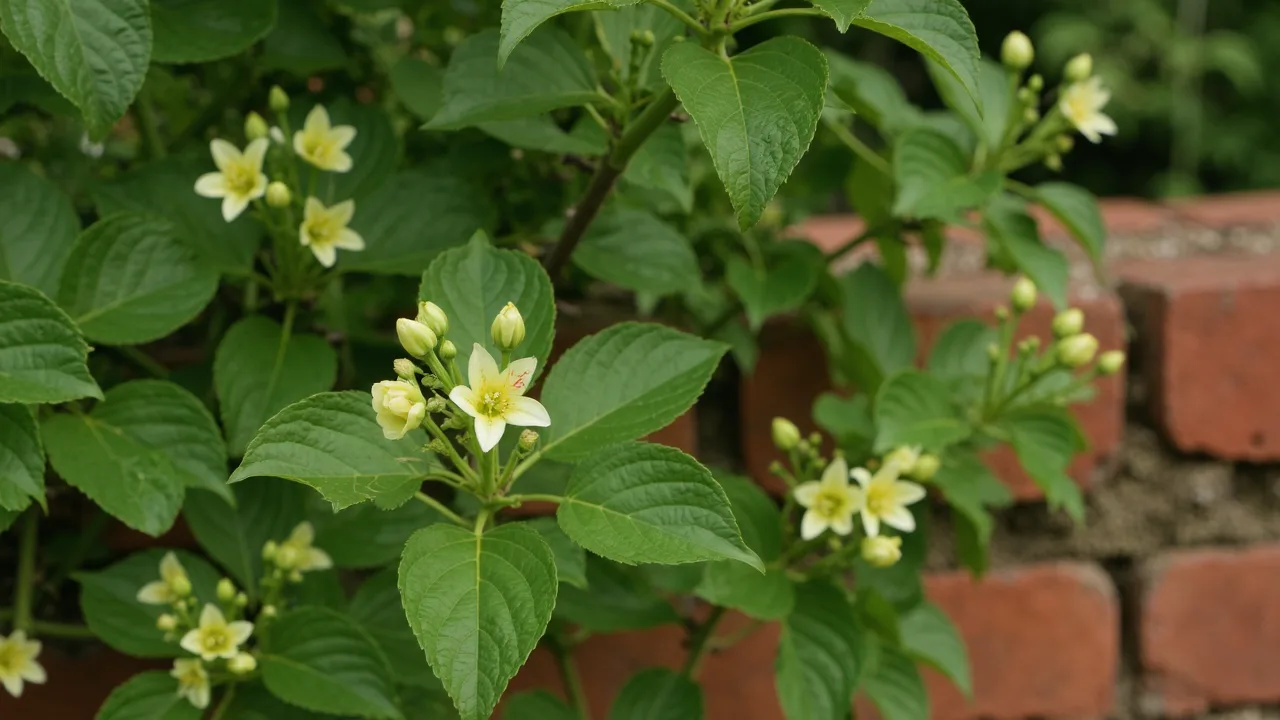
The flowers appear from late May into July. They are small (about 1–1.5 cm across), star-shaped, with five petals, and greenish-white with conspicuous green veins. Because the species is dioecious, individual plants are either male or female; the male flowers are carried in long-stalked clusters that rise clear of the foliage, while the female flowers sit in shorter, fewer-flowered clusters close to the leaf axils. Only pollinated female plants go on to fruit.
The fruit is a small, smooth, globular berry, 6–8 mm across, green at first and ripening through orange to a bright, glossy red in September and October. Clusters typically carry a dozen or so berries and remain on the dead stems well into winter. Beneath the soil, the plant produces a thick, white, fleshy taproot that can reach several kilograms in weight on mature specimens, occasionally forking in a way that has given rise to the folk name "English Mandrake".
Growing Conditions
White Bryony is fully hardy throughout the United Kingdom and tolerates a wide range of conditions provided the soil is not waterlogged. In the wild it is most abundant on calcareous soils — chalk downland edge, limestone scrub, and the older hedgerows of southern England — but it also grows on mildly acidic loams over clay, particularly where the underlying geology has some base-rich influence.
The plant prefers partial shade and a sheltered position, which is consistent with its natural niche along woodland margins, in hedgerows and at the edges of scrub. It tolerates full sun provided the soil does not dry out in summer, and it tolerates deeper shade, though flowering and fruiting are reduced where light is poor. Soil texture should be well-drained loam; permanently wet ground causes the tuber to rot. A pH in the range of roughly 6.5–8.0 suits it best.
Within the UK climate the season runs from late March, when new shoots emerge from the tuber, through to the first hard frosts, after which the aerial growth dies back completely. The tuber overwinters below ground and produces fresh stems the following spring.
Planting and Care
White Bryony is not normally stocked by general garden centres, and there is little reason to plant it in a domestic garden given its toxicity and vigorous habit. Where it is wanted — typically in a wildlife hedge, a native plant scheme or a naturalistic woodland-edge planting — seed is the most reliable starting material. Sow ripe berries in autumn either directly outdoors in a prepared seed bed or in deep pots of loam-based compost; the seed requires a period of cold and damp to break dormancy and will germinate the following spring. Spring sowing is possible only after eight to twelve weeks of cold stratification in a domestic refrigerator.
Choose a permanent site before planting. The tuber dislikes disturbance, and established plants are difficult to transplant because the deep taproot resents damage. Site the young plant at the base of a sturdy shrub, a post-and-wire fence or a dead hedge, and water it through its first summer while the root system establishes. After that, supplementary watering is unnecessary.
Pruning consists of a single annual cut back to the base in late autumn once the stems have died down; remove the cut material rather than composting it, as the berries can retain traces of toxicity. Feeding is rarely needed: in fertile garden soil an excess of nitrogen encourages leafy growth at the expense of flower and fruit. Propagation beyond seed is possible from semi-ripe cuttings in midsummer, but seed is simpler and avoids disturbing mature tubers.
Take care when handling the plant. Wear gloves if cutting back mature growth, and wash hands afterwards; the sap and crushed berry juice can irritate the skin of sensitive individuals. Do not plant White Bryony where young children or domestic pets can reach the berries.
Common Problems
The principal hazard associated with White Bryony is its toxicity. All parts of the plant contain cucurbitacin glycosides, principally bryonin, concentrated most heavily in the root and in the ripe berries. Ingestion of even a relatively small number of ripe berries has been reported to cause severe vomiting, bloody diarrhoea and abdominal pain in adults; smaller quantities can be dangerous to children. The plant should not be handled near the mouth and is not a species to be encouraged in school gardens, nursery settings or any garden to which unsupervised toddlers or pets have access.
Beyond toxicity, the plant's chief horticultural problem is its own vigour. In a garden setting a White Bryony can swamp a neighbouring shrub in a single season, and the twining tendrils can distort the stems of young trees. It is also difficult to eradicate once established: any fragment of tuber left in the soil will resprout, and chemical controls are largely ineffective on the deep taproot.
White Bryony is not a host to many persistent insect pests in the UK. The leaves are occasionally mined by the larvae of small flies and may show some powdery mildew late in the season, but neither is usually severe enough to require treatment. Slugs and snails may graze the emerging shoots in spring, which can check growth on isolated plants.
Popular Varieties
White Bryony is, in practical terms, a single wild species with no widely-grown ornamental cultivars in the UK trade. Garden centres that stock it at all tend to offer the species itself, raised from native British or north-western European seed. Where finer distinctions are needed, the following botanical variants and close relatives are the most likely candidates to appear under the Bryonia name, and they are useful to recognise correctly in the field.
- Bryonia dioica (the species): the dioecious, red-berried native of England and Wales described in this article.
- Bryonia cretica subsp. dioica: a taxonomic treatment that some European authorities use to place the British plant within Bryonia cretica as a subspecies; the plant in cultivation is unaffected.
- Bryonia alba: the White-berried Bryony of continental Europe; very rare as a casual in the UK and easily distinguished by its black and white berries rather than red.
- Tamus communis (Black Bryony): unrelated to Bryonia (it belongs to the yam family, Dioscoreaceae) but frequently confused with it. Black Bryony is also a British native twining climber with red berries and shares the same hedgerow habitat, so any positive identification of White Bryony should rule it out first.
Pests and Diseases
| Problem | Symptoms | Management |
|---|---|---|
| Vigorous smothering of other plants | The plant climbs rapidly using tendrils, shading out and physically suppressing neighbouring vegetation. | Control by manually pulling up young shoots or cutting stems to prevent re-establishment from the tuberous root. |
| Toxicity hazard | Ingestion of any part of the plant, particularly the red berries, causes severe gastrointestinal distress. | Wear protective gloves when handling and ensure children and pets do not consume the berries or foliage. |
| Powdery mildew | A white, dusty fungal growth appears on leaves and stems, particularly in humid conditions. | Improve air circulation around the plant and apply a suitable fungicide if infection becomes severe. |
| Slugs and snails | Irregular holes are eaten into young leaves and shoots, often accompanied by slimy trails. | Use physical barriers like copper tape or apply organic slug pellets around the base of the plant. |
| Root rot | Foliage turns yellow and wilts despite adequate moisture, indicating waterlogged soil conditions. | Ensure the planting site has well-drained soil to prevent water accumulation around the tuberous roots. |
For step-by-step help, read Dealing with Slugs and Snails and Treating Powdery Mildew. Or browse the full plant problem solver to diagnose an issue by symptom.
As an Amazon Associate, GardenWizz earns from qualifying purchases made through links on this page (including links within the article). This does not affect the price you pay. See our disclaimer for details.