Woodrush
Luzula sylvatica
The Gardening Year
Best months in UK gardens · full planting calendar →
🖨 Printable care card (PDF)At a Glance
| Botanical name | Luzula sylvatica |
|---|---|
| Common name(s) | Woodrush |
| Family | Juncaceae |
| Plant type | perennial |
| Height × Spread | 30–80 cm × 100–150 cm |
| Position | Full sun, Partial shade, Full shade |
| Soil | Moist but well-drained, poorly-drained; Acid, Neutral |
| Flowering | May–June |
| Toxicity | Not known to be toxic to humans, dogs, cats or livestock. |
| Native range | Europe and southwest Asia |
Woodrush (Luzula sylvatica) is a tough, evergreen, grass-like perennial native to the woodlands of the UK and much of temperate Europe. Despite its common name it is not a true grass but a rush, belonging to the family Juncaceae, and it is prized in British gardens for its ability to thrive in difficult shaded spots where many ornamental grasses fail. Its broad, glossy, deep green leaves form dense tussocks that suppress weeds, while airy sprays of brown flowers rise above the foliage in late spring and early summer. For gardeners seeking low-maintenance ground cover beneath trees or on the shaded side of a border, woodrush is one of the most dependable choices.
Overview
Luzula sylvatica is a rhizomatous evergreen perennial that occurs naturally in deciduous and mixed woodland across the UK, particularly on acidic, humus-rich soils. It is widely planted in cultivation as a shade-tolerant ground-cover plant and as a structural element in naturalistic and woodland-style gardens. In the UK it is fully hardy and behaves as a long-lived clump-former rather than a spreading weed, expanding slowly over many years from a tight crown into a broad, leafy tussock.
Unlike many true grasses (Poaceae), the leaves of woodrush are flat, relatively broad (often 8–12 mm wide), and fringed with conspicuous white hairs along the margins — a feature that distinguishes it from similar-looking sedges and grasses and gives the foliage a slightly soft, almost frosted appearance when backlit. The plant is well adapted to dry shade once established, making it especially valuable beneath mature trees where turf and many ornamentals struggle.
Appearance
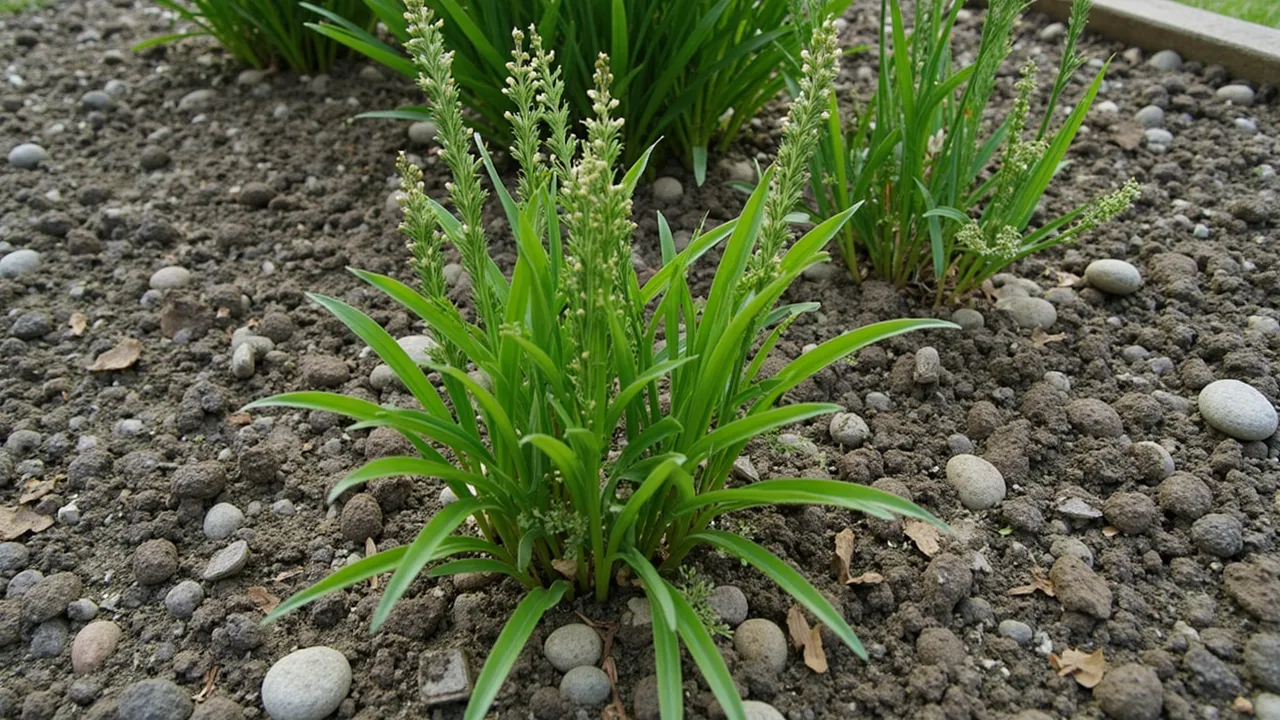
Woodrush forms dense, compact clumps of strap-shaped leaves that are mid to dark green, glossy on the upper surface, and slightly paler beneath. The leaves arch gracefully outwards from the crown and typically reach 20–40 cm in length, giving each tussock a fountain-like outline. The characteristic marginal hairs are most easily seen by running a finger along the leaf edge or by holding a leaf up to the light.
In late spring and early summer (typically May to July), mature plants send up loose, branched panicles of small, chaffy flowers on slender, wiry stems that can reach 30–80 cm tall. Individual flowers are reddish-brown to pale chestnut and, while individually insignificant, are carried in airy, arching sprays that contrast well with the solid green of the foliage below. As the season progresses the spent inflorescences turn a soft straw colour and may be left in place for winter interest or removed for tidiness.
The plant is technically evergreen, but in exposed sites or after a hard winter some of the older leaves may die back. New growth emerges from the base in spring, quickly replacing damaged foliage.
Growing Conditions
Aspect: Woodrush grows best in partial to full shade. It is a woodland understorey plant by nature and will tolerate north-facing aspects and the dry shade cast by mature trees, including beech, oak and sycamore. In deep, year-round shade flowering is reduced but the foliage effect is at its best. It will tolerate some morning sun but suffers in hot, exposed sites, where leaves may scorch.
Soil: It performs well on a wide range of soils, from sandy loams to heavier clays, provided drainage is reasonable. It prefers a humus-rich, moisture-retentive soil and shows a slight preference for acidic or neutral conditions, but tolerates mildly alkaline (chalky) soils as well. Established plants cope well with dry shade, although they grow more slowly and flower less freely than those in moister soils.
Hardiness: Rated RHS H7, indicating tolerance of temperatures below −20 °C. It is native to the British Isles and is fully suited to UK conditions when planted in appropriate soil.
Growth rate: Slow to moderate. Clumps expand gradually via short rhizomes and typically reach their full size — around 30–60 cm tall and 30–45 cm across — after three to five years. It is not invasive and rarely self-seeds aggressively in gardens.
Planting and Care
Planting time: Plant container-grown stock in spring (March–May) or early autumn (September–October), when the soil is moist and warm enough to encourage rapid root establishment. Avoid planting into frozen or waterlogged ground.
Spacing: For effective ground cover, space plants 30–40 cm apart; they will close gaps within two to three growing seasons. As a single specimen in a border, allow at least 45 cm of clear space around the crown.
Watering: Water thoroughly at planting and keep the soil moist for the first growing season. Once established, Luzula sylvatica is moderately drought-tolerant and needs little supplementary watering except in prolonged dry spells under dense tree canopies.
Feeding: Generally unnecessary. Woodrush thrives on poor to average soils and excessive fertility tends to produce lush, floppy growth. An annual light mulch of leaf mould or well-rotted garden compost in autumn is beneficial and mimics the natural woodland litter the plant evolved with.
Pruning: In early spring (February–March), cut back any winter-tattered or discoloured foliage to ground level before new growth emerges. Alternatively, comb through the tussock with gloved fingers to pull out dead leaves. Avoid cutting into the crown.
Propagation: The easiest method is division of established clumps in spring or autumn. Lift the entire plant, tease the rootball apart into smaller sections with several growing points each, and replant immediately. Seed can be sown in autumn or spring in a cold frame; germination is usually reliable but seedlings are slow to reach flowering size.
Seasonal care: Little routine work is needed. Watch for slug damage on emerging spring growth and check for rust later in the season (see below). Mulch annually in autumn and refresh the planting only when clumps show a bare, tired centre — typically every 5–8 years, when division is also a useful opportunity.
Common Problems
Slugs and snails: Young spring foliage can attract grazing by slugs and snails, particularly in damp, shaded sites. Damage is usually cosmetic and rarely affects established plants. Hand-picking, beer traps or iron-phosphate slug pellets are effective controls; avoid over-mulching with materials that provide slug shelter.
Rust fungi: Luzula sylvatica is moderately susceptible to rust (Puccinia luzulae), which appears as orange-brown pustules on the leaves in mid to late summer. Remove and destroy affected foliage, improve air circulation by thinning surrounding plants, and avoid overhead watering in the evening. Rust is rarely serious enough to kill a plant but can disfigure foliage late in the season.
Crown and root rot: In persistently waterlogged soils, particularly on heavy clay, the crown and roots may rot. Improve drainage by incorporating grit and organic matter before planting, and avoid siting woodrush in low spots that collect winter wet.
Wind and frost damage: Older leaves can be torn or scorched by cold winter winds and late frosts. This is purely cosmetic and the plant recovers quickly as new foliage emerges in spring.
Toxicity: Luzula sylvatica is not considered toxic to humans, dogs, cats or livestock, and is generally unpalatable to deer and rabbits, although very hungry rabbits may take an occasional nibble in winter.
Popular Varieties
Several named forms of Luzula sylvatica are offered by UK nurseries, mostly selected for variegated or unusually coloured foliage. The most widely available include:
- Luzula sylvatica 'Marginata' — a robust, cold-hardy selection with leaves edged in a narrow cream-white margin. It is one of the most reliable variegated forms and brightens shaded corners well.
- Luzula sylvatica 'Aurea' — a golden-foliaged form whose young leaves emerge bright yellow in spring, maturing to a softer yellow-green in summer. Best in light shade, as the foliage can scorch in strong sun.
- Luzula sylvatica 'Taggart's Cream' — a slower-growing, more compact selection with broad cream-white leaf margins. Useful where a tidier, more contained clump is wanted.
- Luzula sylvatica 'Bromeliad' — a distinctive form with stiff, more upright leaves arranged in a tighter rosette, named for its resemblance to a bromeliad. Forms a neat clump and is particularly striking in container plantings.
Availability of named cultivars varies year to year, and several specialist variegated selections are offered only by a small number of UK nurseries. Where cultivar names are not specified, plain Luzula sylvatica is an excellent, vigorous choice and the form most commonly sold in garden centres.
Cultivars and Varieties
| Cultivar | Height | Flower | Notes | AGM |
|---|---|---|---|---|
| 'Hohe Tatra' | — | — | RHS AGM (H7) | ✓ |
| 'Marginata' | — | — | RHS AGM (H7) | ✓ |
Pests and Diseases
| Problem | Symptoms | Management |
|---|---|---|
| Slugs and snails | Irregular holes in leaves or young shoots eaten, often accompanied by slimy trails. | Use beer traps, copper tape barriers, or hand-pick at night to reduce populations. |
| Vine weevil | Notched leaf margins and wilting plants caused by larvae feeding on roots underground. | Apply nematodes in autumn or use biological controls like Steinernema carpocapsae. |
| Root rot | Foliage turns yellow and collapses due to waterlogged, poorly drained soil conditions. | Improve drainage by amending soil with grit or planting in raised beds if necessary. |
| Powdery mildew | White powdery fungal growth appears on leaves during humid, still weather periods. | Ensure good air circulation and spray with a fungicide or milk solution if severe. |
For step-by-step help, read Dealing with Slugs and Snails and Treating Powdery Mildew. Or browse the full plant problem solver to diagnose an issue by symptom.
Recommended Products
GardenWizz earns a commission from qualifying purchases made through affiliate links on this page (including links within the article) — as an Amazon Associate, and from Thompson & Morgan via the Awin network. This does not affect the price you pay. See our disclaimer for details.