Coneflower
Echinacea purpurea · Purple Coneflower
At a Glance
| Botanical name | Echinacea purpurea |
|---|---|
| Common name(s) | Coneflower, Purple Coneflower |
| Family | Asteraceae |
| Plant type | perennial |
| Height × Spread | 50–120 cm × 10–50 cm |
| Hardiness | H5 (to -15.0 °C) |
| Position | Full sun, Partial shade |
| Soil | deep, well-drained, humus-rich soil; tolerating dry soil; Chalk, Loam, Sand; Acid, Alkaline, Neutral pH |
| Flowering | July–November |
| Toxicity | — |
| Native range | North America |
Coneflower (Echinacea purpurea) is a clump-forming herbaceous perennial native to the prairies and open woodlands of central and eastern North America. Widely naturalised in cultivation, it has become a mainstay of UK perennial borders since the late twentieth century, valued for its long flowering period, its attractiveness to pollinators and its tolerance of warm, dry summers. It is also one of the most commonly grown ornamental members of the daisy family (Asteraceae) in British gardens, alongside rudbeckia, helenium and aster.
Overview
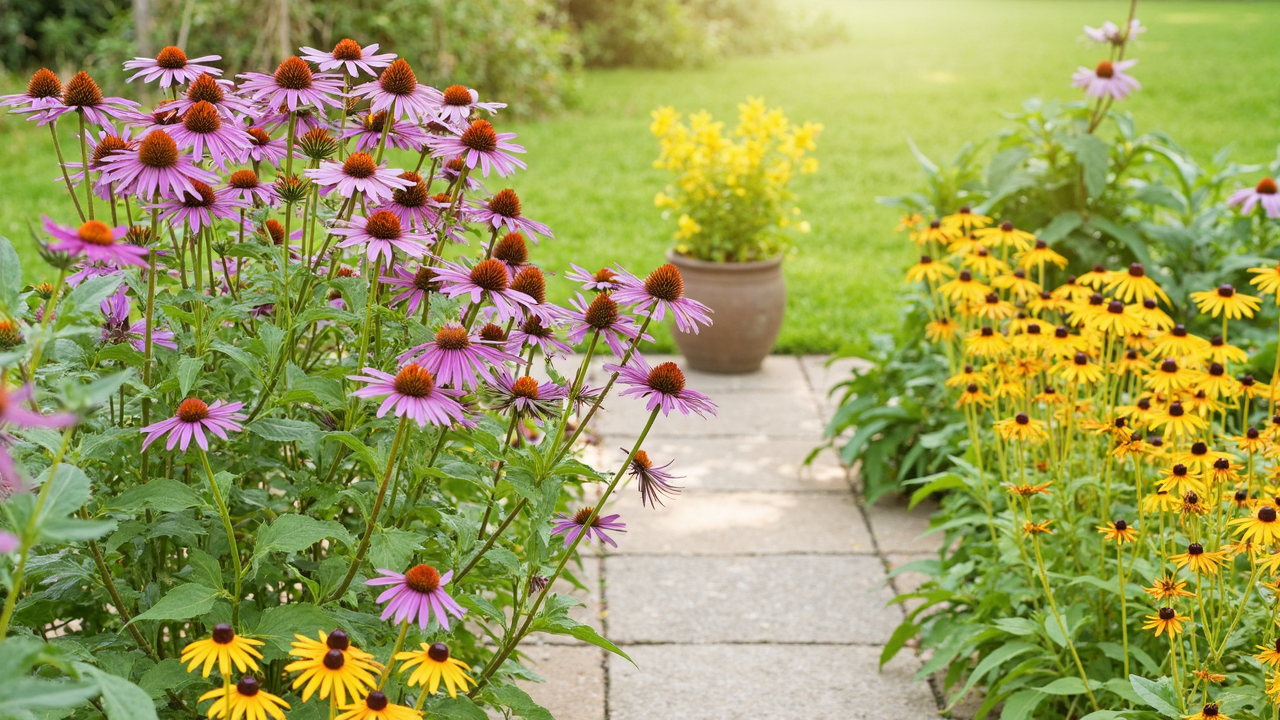
Echinacea purpurea is a robust, long-lived perennial suited to a wide range of UK garden conditions. It forms an upright clump of lance-shaped leaves from which stiff, branching stems rise in summer, each topped with a single, daisy-like flower head. The flowers are characterised by a prominent central cone — typically orange-brown to rust — surrounded by ray florets that range from the original rose-purple through to white, in modern cultivars.
The species is fully hardy across most of the British Isles and is generally straightforward to grow, provided it is given a sunny position and reasonable drainage. It is an excellent choice for prairie-style plantings, mixed herbaceous borders, gravel gardens and pollinator-friendly schemes, and the dried seed heads persist well into winter, providing structure as well as food for goldfinches and other seed-eating birds.
Appearance
Echinacea purpurea grows from a fibrous, occasionally woody rootstock that develops into a slowly expanding clump. The basal leaves are oval to lance-shaped, coarsely toothed, dark green and rough to the touch, with prominent veins. They are held on long stalks and can reach 15–20 cm in length. Smaller, narrower stem leaves alternate up the flowering stalks.
Flower stems typically reach 60–120 cm in height, though stature varies with cultivar and growing conditions. Each stem branches near the top and carries a solitary flower head 7–12 cm across, comprising a domed, spiny disc of tiny tubular florets ringed by slender, slightly drooping ray florets. In the species these rays are a distinctive rose-purple, but cultivars extend the palette to white, pink, coral, orange, red and yellow, with some double and anemone-centred forms.
The central cone is technically a collection of sharp-pointed bracts subtending the disc florets, and gives the plant its common name. As flowers age, the cone darkens and the rays reflex further, producing the characteristic shuttlecock shape.
Growing Conditions
Coneflowers perform best in full sun, where they produce the strongest stems and the most abundant flowering. They tolerate very light, dappled shade, particularly in the hotter south and east of England, but flowering is reduced in deeper shade and stems may become leggy.
Soil should be well-drained. Echinacea purpurea is notably tolerant of poor, stony and free-draining soils, including those over chalk, and is well suited to gravel gardens. It grows less happily in heavy, slow-draining ground, particularly in the wetter west and north of the UK, where winter wet can cause crown rot. In heavy clay, it is worth working in coarse grit and well-rotted organic matter before planting, or growing on a raised bed.
RHS hardiness ratings for Echinacea purpurea are generally given as H5 (hardy across most of the UK in a typical winter) to H6 in milder regions. The plant tolerates temperatures down to roughly −15 °C once established, though young plants benefit from a dry winter mulch in their first season. It is worth noting that hardiness ratings differ between the species and some modern cultivars, and growers in colder inland or northern gardens may prefer to source plants raised in the UK rather than imported stock.
In the UK, the active growing season runs from April through October, with the main flush of flowers from July into September, sometimes continuing into October in a mild autumn.
Planting and Care
Watering. Newly planted coneflowers should be watered regularly through their first growing season to help them establish a deep root system. Once established, Echinacea purpurea is notably drought-tolerant and rarely needs supplementary watering except in prolonged dry spells on very free-draining soil.
Feeding. A single application of a balanced, slow-release fertiliser in spring, or a top-dressing of well-rotted garden compost, is generally sufficient. Over-rich soils tend to produce lush foliage at the expense of flowers and can lead to weak, floppy growth, particularly in taller cultivars.
Pruning. Deadheading spent flowers regularly through summer will extend the flowering season by encouraging the production of secondary blooms. In autumn, many gardeners leave the seed heads in place for winter interest and as a food source for birds, then cut the dead stems back to the base in late winter (February or early March) before new growth emerges. Dividing congested clumps every three to four years in spring helps maintain vigour.
Propagation. Echinacea purpurea can be raised from seed, though seed-raised plants are variable and named cultivars will not come true. Species seed can be sown in autumn or spring under cold conditions. Cultivars are best propagated by division in spring, or by basal cuttings taken in late spring. Root cuttings taken in late autumn or winter are another reliable method for the species and some cultivars.
Seasonal care. In spring, top-dress established clumps and divide if necessary. During summer, deadhead and water young plants in dry weather. In autumn, leave seed heads for winter interest unless tidy appearance is preferred. In late winter, cut back old stems and apply a light mulch of compost around, but not over, the crown.
Common Problems
Coneflowers are generally trouble-free in the UK, but a few issues are worth noting.
Crown rot. The most serious problem, particularly on heavy or wet soils, is rotting at the crown over winter. Improving drainage and avoiding mulching directly over the crown are the main preventative measures.
Powdery mildew. A fungal disease that can affect the leaves in dry summers, particularly in crowded plantings with poor air circulation. It is usually cosmetic rather than fatal and can be managed by spacing plants adequately and removing affected foliage.
Aphids and leafhoppers. Sap-sucking insects occasionally colonise the new growth, particularly in late spring. They rarely cause lasting damage and are usually controlled by natural predators.
Aster yellows phytoplasma. A less common issue in the UK, causing distorted flowers and yellowed foliage. There is no cure, and affected plants should be removed and destroyed to prevent spread.
Vine weevil. Container-grown plants in particular can be attacked by vine weevil grubs, which feed on the roots. Biological control with nematodes is effective.
There are no significant toxicity concerns associated with Echinacea purpurea for humans or pets under normal garden handling, though it should not be confused with medicinal preparations of the root, which are a separate matter.
Popular Varieties
A number of well-established cultivars of Echinacea purpurea are widely available from UK nurseries, including the following.
- 'Magnus' — a strong, upright selection with horizontal, deep pink ray florets and a contrasting orange-brown cone. A recipient of the RHS Award of Garden Merit, it typically reaches around 90 cm.
- 'White Swan' — a popular white-flowered form with a prominent yellow-green cone, growing to about 60–70 cm. Suited to the front of a border or to lighter colour schemes.
- 'Ruby Star' ('Rubinstern') — an intense, non-fading carmine-pink cultivar with horizontal rays, often cited as an improvement on 'Magnus' for colour retention.
- 'Fatal Attraction' — a compact form, roughly 60–65 cm, with vivid purple-pink flowers held on notably dark stems.
- 'Kim's Knee High' — a dwarf cultivar reaching around 45–55 cm, useful at the front of a border or in smaller gardens.
- 'Virgin' — a tall, white-flowered cultivar with a green cone and reliably upright stems, often reaching 80–90 cm.
The plant is also the parent of many interspecific hybrids in the Big Sky, Sombrero and Color Coded series, which offer colours outside the original purple-pink range, including orange, yellow and red. These hybrids are not strictly Echinacea purpurea and may differ in hardiness, longevity and soil tolerance, so it is worth checking their requirements individually before planting. Cultivar availability in the UK changes year to year, and a current RHS Plant Finder or specialist perennial nursery is the best source for up-to-date stockists.
Pests and Diseases
| Problem | Symptoms | Management |
|---|---|---|
| Root rot | Plants collapse and die back, particularly in winter on wet or heavy soils. | Ensure well-drained soil and avoid autumn planting to prevent waterlogging. |
| Powdery mildew | White powdery fungal growth appears on leaves and stems, often in humid conditions. | Improve air circulation and avoid overhead watering; remove affected foliage. |
| Slugs and snails | Irregular holes chewed into young leaves and seedlings, often with slime trails. | Use physical barriers like copper tape or organic slug pellets around new plants. |
| Stem weakness | Tall stems bend or break under the weight of flowers, especially in shade. | Plant in full sun and stake tall varieties if necessary to support blooms. |
Quick Care Summary
| Sunlight | Full sun, Partial shade |
|---|---|
| Soil | deep, well-drained, humus-rich soil; tolerating dry soil; Chalk, Loam, Sand; Acid, Alkaline, Neutral pH |
| Hardiness | H5 (-15.0 °C) |
| Sow | — |
| Plant | March–August |
| Prune | — |
As an Amazon Associate, GardenWizz earns from qualifying purchases made through the links above. This does not affect the price you pay. See our disclaimer for details.