
Fuchsia
Fuchsia
At a Glance
| Botanical name | Fuchsia |
|---|---|
| Common name(s) | Fuchsia |
| Family | — |
| Plant type | shrub (Most are shrubs or small trees; one species is a tree. Leaves can be deciduous or evergreen depending on the species.) |
| Height × Spread | 20–1500 cm × — |
| Hardiness | — (to -5.0 °C) |
| Position | Full sun, Partial shade |
| Soil | moist-but-well-drained soil |
| Flowering | June–November |
| Toxicity | — |
| Native range | South America, Central America, Mexico, New Zealand, Tahiti |
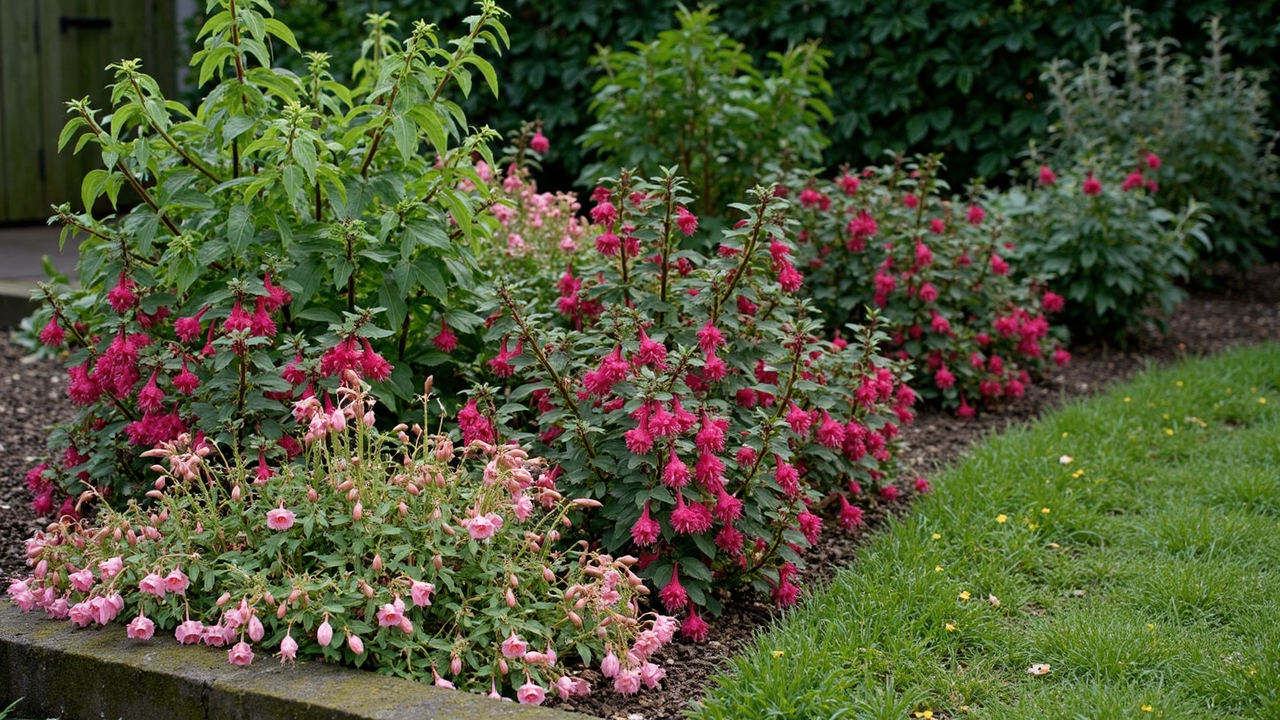
Fuchsia is a large genus of flowering plants in the family Onagraceae, comprising well over 100 species of shrubs, small trees and trailing plants. The genus is native primarily to Central and South America, with a smaller number of species occurring in New Zealand. Fuchsias are widely grown across the United Kingdom as ornamental plants for their distinctive pendulous flowers, which combine elongated tubular sepals with contrasting petals in a wide range of colour combinations. They are grown in gardens, on patios, in hanging baskets, and as standards, and are a mainstay of the British summer display.
Overview
Fuchsias are grown in the UK principally for their long flowering season and their tolerance of partially shaded sites where many summer-flowering shrubs struggle. The genus includes hardy border types that can be planted permanently in the ground, and half-hardy types that are most often grown in containers and brought into a frost-free place for the winter. The flower structure is unmistakable: a flared or reflexed calyx of four sepals surrounds a corolla of four (occasionally five) petals, with conspicuous stamens and a long style extending beyond the petals. Colours range from white through pink, red, purple, magenta, and near-blue, and bicolour combinations are common.
In British gardens fuchsias are particularly valued for late summer colour, flowering from June well into October, and they are popular with pollinators, especially bumblebees. The RHS recognises fuchsias through its Award of Garden Merit (AGM) for cultivars of outstanding garden performance in UK conditions.
Appearance
Fuchsia growth habit divides broadly into two groups relevant to UK gardeners: upright or bushy forms, used in borders or as standards, and trailing or prostrate forms, used in hanging baskets, wall baskets, and as ground cover. Leaves are generally opposite or whorled, ovate to lanceolate, with serrated margins, and mid- to dark green. Some cultivars have golden or variegated foliage.
Flowers are produced singly or in clusters from leaf axils along the current season's growth. Each flower hangs from a slender pedicel and consists of a tube (formed by the fused bases of the sepals), four sepal lobes, and a corolla of four petals that may be tightly furled, flared, or almost flat. The colour contrast between sepals and petals is a key feature: classic combinations include red sepals with purple petals, white sepals with violet petals, and pink sepals with magenta petals. Double-flowered cultivars, in which extra petals obscure the stamens, are also widely grown.
The fruit is a small, oblong, often dark purple to black berry, edible in some species (notably Fuchsia magellanica, whose fruit is used in some regions) but generally not considered a feature in UK cultivation.
Growing Conditions
Fuchsias prefer a site with morning sun and afternoon shade, or dappled shade through the day. In cooler northern parts of the UK they tolerate more sun provided the roots remain moist; in southern and eastern England they benefit from shelter from the hottest midday sun, particularly in dry summers. A position sheltered from cold, desiccating winds reduces the risk of die-back in winter.
Soil should be moist but well-drained, ideally a fertile loam enriched with organic matter. Heavy clay can be improved with well-rotted compost and grit; very sandy soils benefit from organic matter to retain moisture. A near-neutral pH is fine, and fuchsias are not strongly lime-sensitive. Container-grown plants do well in a peat-free multipurpose compost with added slow-release fertiliser.
RHS hardiness ratings for the genus vary considerably. Tender fuchsia cultivars, including most of the Fuchsia × hybrida types grown for hanging baskets, are typically rated H1c (half-hardy, tolerating 1 °C to 5 °C) and must be overwintered indoors. Hardy border fuchsias, principally forms of Fuchsia magellanica and related hybrids, are generally H4 to H5, with H4 indicating hardiness to about −10 °C to −5 °C across most of the UK, though prolonged severe frost in cold inland or northern gardens can still kill top growth. Where uncertainty exists about a particular cultivar's rating, this should be confirmed against the current RHS database or the original plant description.
Planting and Care
Watering. Fuchsias in active growth are thirsty. Border plants benefit from mulching in late spring to conserve moisture; container plants may need watering daily in warm weather and may require watering twice daily in hanging baskets during July and August. Avoid waterlogging, particularly in winter, when waterlogged cold compost is a common cause of loss.
Feeding. From late spring until early autumn, a high-potash liquid feed (such as one formulated for tomatoes or flowering plants) applied weekly supports continuous flowering. A single application of controlled-release fertiliser at potting time is a useful complement for container plants. Stop feeding in late September to allow growth to harden before winter.
Pruning. Hardy border fuchsias are cut back to near ground level, or to a low woody framework, in mid to late spring once the risk of hard frost has passed. The old top growth is best left in place over winter as it offers some protection to the crown. Half-hardy standards and pot plants are pruned in early spring as new growth begins, removing weak or crossing shoots and shortening the previous season's growth to a bud or pair of buds.
Propagation. Softwood cuttings of 5–10 cm taken in late spring or early summer root readily in a free-draining cutting compost under cover. Semi-ripe cuttings can also be taken in late summer. Seed propagation is possible but seedlings will not come true to the parent on hybrid cultivars.
Seasonal care. In the UK, the main seasonal tasks are: potting on or planting out in late May after the last frost; pinching out shoot tips through late spring to encourage bushy growth; deadheading or picking over to keep plants tidy and flowering; reducing watering and feeding in autumn; lifting tender pot plants to a frost-free greenhouse, conservatory, or windowsill before the first hard frost; and pruning in spring as growth resumes. Hardy types planted in the ground usually need no winter protection beyond leaving the old stems in place.
Common Problems
Fuchsia rust (Pucciniastrum epilobii) is a fungal disease that produces yellow patches on the upper leaf surface and orange pustules beneath, leading to premature leaf drop in wet summers. Improving air circulation, avoiding overhead watering, and removing affected leaves help, and resistant cultivars should be selected where the disease has been a problem previously.
Botrytis (grey mould) affects soft growth and flowers in damp, still conditions, particularly in greenhouses and among crowded basket plants. Prompt removal of affected material and improved ventilation are the main controls.
Aphids, especially the fuchsia aphid and common greenfly, colonise soft shoot tips in spring and early summer, distorting growth and transmitting viruses. They are usually managed by squashing, by encouraging natural predators, or with insecticidal soap.
Vine weevil grubs feed on fuchsia roots in containers and can quickly kill mature plants. Biological control with Steinernema kraussei nematodes applied in late summer or autumn is effective in pots, and adults can be picked from plants at night.
Capsid bug damage shows as distorted new growth and small holes in leaves. Damage is usually minor and is tolerated by established plants.
Fuchsias are generally not classified as toxic to humans or pets in mainstream UK horticultural references, and the berries of some species are technically edible, but plants and berries are not normally considered for consumption. Gardeners handling fuchsias need take no special precautions.
Popular Varieties
The following are real, widely available cultivars and species in UK nurseries, and have been recognised by the RHS with the Award of Garden Merit unless otherwise noted.
- Fuchsia magellanica — the hardiest species commonly grown in UK gardens, forming a graceful arching shrub to about 1.2–1.5 m, with small red and purple flowers from summer into autumn. Tolerates more sun and drier soil than most.
- 'Mrs Popple' — a vigorous hardy cultivar, an F. magellanica type, with bright scarlet sepals and violet-purple petals; a long-flowering, reliable garden shrub.
- 'Tom Thumb' — a compact, hardy fuchsia, usually under 30 cm tall, with red and purple flowers; useful for the front of a border or a small container.
- 'Genii' — a hardy F. magellanica cultivar noted for its golden-yellow foliage and small red and purple flowers; the bright foliage extends the season of interest.
- 'Voodoo' — a tender, large-flowered trailing cultivar widely sold for hanging baskets, with very double, deep red and dark purple flowers; needs frost-free overwintering.
- 'Hawkshead' — a hardy, single-flowered cultivar with slender white sepals and white petals faintly flushed with pink, a quieter alternative to the classic red-and-purple forms.
Other widely grown AGM cultivars include 'Alice Hoffman', 'Dollar Princess', 'Lady Thumb', and 'Snowcap'. Cultivars without AGM status may be perfectly good garden plants but have not been formally assessed, and a lack of recorded hardiness rating in some cases means the gardener should treat them as half-hardy unless the supplier specifies otherwise.
Pests and Diseases
| Problem | Symptoms | Management |
|---|---|---|
| Fuchsia gall mite | Shoot tips become distorted with masses of yellowish-green or reddish-pink tissue instead of normal leaves or flowers. | Prune out affected growth immediately and dispose of it in general waste, not compost. |
| Fuchsia rust | Orange pustules appear on the undersides of leaves, causing them to shrivel and fall prematurely. | Remove infected leaves promptly and avoid wetting foliage when watering to reduce spread. |
| Slugs and snails | Irregular holes are eaten in soft new leaves and flower buds, often accompanied by slimy trails. | Use physical barriers like copper tape or beer traps, and hand-pick pests at night. |
| Vine weevil | Notches appear on leaf margins while roots are eaten away underground, causing plants to wilt. | Apply biological controls containing nematodes to the soil in autumn and spring. |
| Powdery mildew | A white, dusty fungal growth covers leaves and stems, potentially stunting new growth. | Ensure good air circulation around plants and water at the base to keep foliage dry. |
Quick Care Summary
| Sunlight | Full sun, Partial shade |
|---|---|
| Soil | moist-but-well-drained soil |
| Hardiness | — (-5.0 °C) |
| Sow | — |
| Plant | June |
| Prune | March–May |

As an Amazon Associate, GardenWizz earns from qualifying purchases made through the links above. This does not affect the price you pay. See our disclaimer for details.