Hardy Geranium
Geranium · Cranesbill
At a Glance
| Botanical name | Geranium |
|---|---|
| Common name(s) | Hardy Geranium, Cranesbill |
| Family | Geraniaceae |
| Plant type | perennial (Annual, biennial, and perennial plants; hardy geraniums die back in autumn and regrow in spring.) |
| Height × Spread | 30–50 cm × — |
| Hardiness | — |
| Position | Full sun, Partial shade |
| Soil | Moist but well-drained soil; any soil type as long as it is not waterlogged; rich in humus. |
| Flowering | May–August |
| Toxicity | — |
| Native range | Temperate regions of the world and the mountains of the tropics, with the greatest diversity in the eastern part of the Mediterranean region. |
Overview
Hardy geraniums, commonly known as cranesbills, are a large genus of herbaceous perennials in the family Geraniaceae. The genus Geranium contains several hundred species distributed across temperate regions of the world, with many species and cultivars well suited to gardens throughout the United Kingdom. Hardy geraniums should not be confused with the brightly coloured "geraniums" sold as summer bedding, which are in fact Pelargonium species. True Geranium species are fully hardy in UK conditions and return year after year, providing reliable ground cover, long flowering periods, and a tolerance of a wide range of garden conditions.
The genus is valued in British gardens for its dependability, its long season of bloom, and its usefulness at the front of borders, in wildflower-style plantings, and as underplanting for shrubs and roses. Many cultivars have received the Royal Horticultural Society's Award of Garden Merit (AGM), indicating they have performed consistently well in UK growing conditions. The genus name Geranium derives from the Greek geranos, meaning crane, referring to the long, pointed fruit that develops after flowering and resembles a crane's bill.
Appearance
Hardy geraniums are highly variable in habit, leaf form, and flower colour, reflecting the breadth of the genus. Foliage is typically palmately lobed or deeply divided, often soft and slightly hairy, and ranges from bright fresh green to grey-green. In several species the leaves take on attractive autumn tints, and in some cultivars the foliage is scented when crushed. Stems are generally sprawling or mounding, and the overall effect is loose and natural rather than stiffly upright.
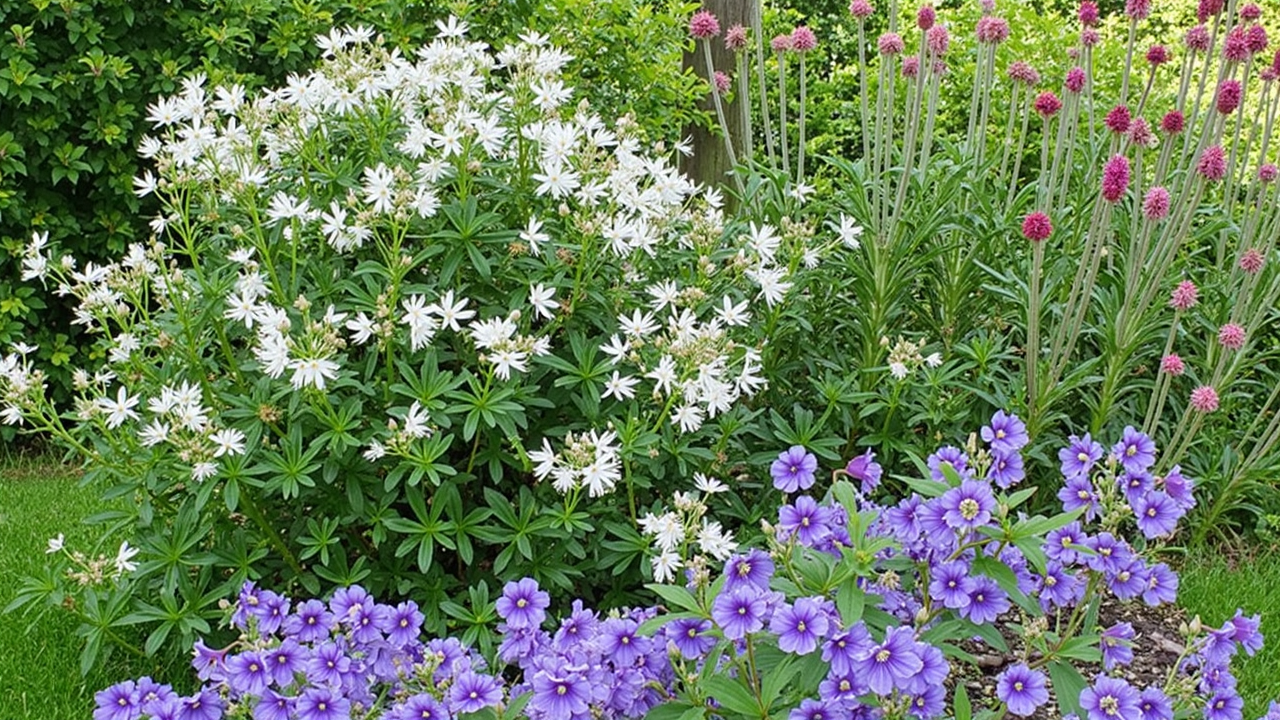
Flowers are borne singly or in loose clusters on slender stems held above the foliage. Each flower has five petals arranged symmetrically around a central cluster of stamens. Colour range is broad: white, pink, lilac, mauve, violet, magenta, and blue are all represented across the genus, with veining and contrasting centres common. Flowers of most species are 2 to 4 cm across, though some woodland species are smaller and a few have flowers 5 cm or more wide. The characteristic beak-shaped fruit that follows the flowers gives the plant its common name of cranesbill.
The size of mature plants depends on the species. Low-growing mat-formers such as Geranium × cantabrigiense may spread to around 60 cm but stay close to the ground, while robust border types such as Geranium 'Johnson's Blue' and Geranium × oxonianum forms can reach 60 to 90 cm tall with a similar spread.
Growing Conditions
Hardy geraniums are among the most adaptable perennials in UK cultivation. They succeed in full sun and in partial shade, making them suitable for open borders, the dappled shade beneath deciduous trees, and the cooler north- or east-facing aspects where many flowering plants struggle. Most species prefer a well-drained soil that retains some moisture through the summer, but tolerance varies: woodland species such as Geranium maculatum and Geranium sylvaticum tolerate heavier, moisture-retentive soils, while species such as Geranium cinereum and Geranium sanguineum cope well with drier, grittier conditions.
Soil pH is not critical; the genus tolerates a range from slightly acidic to slightly alkaline, which covers the majority of British garden soils. Mulching in early spring with garden compost or well-rotted manure helps to retain moisture and feeds the plant slowly through the season. The RHS hardiness rating for most hardy geraniums is H7, the highest category, indicating the plants withstand severe UK winters down to below -20 °C, and they are reliable in every region of the British Isles from southern coastal gardens to colder inland and northern sites.
Planting and Care
Planting can be carried out in autumn or spring, when soil is workable and not waterlogged. Container-grown plants from nurseries and garden centres establish readily; set them at the same depth as the pot and water in well. Space according to the expected spread of the species or cultivar, typically 30 to 60 cm apart for the most common border types.
Watering. Newly planted geraniums need regular watering during their first growing season to establish a strong root system. Once established, most species are reasonably drought-tolerant, although flowering is more prolonged where soil does not dry out completely during prolonged dry spells. A soak rather than a daily sprinkle encourages deeper roots.
Feeding. Hardy geraniums are not heavy feeders. An annual application of general-purpose fertiliser in spring, or a mulch of well-rotted organic matter, is generally sufficient. Over-rich soils can lead to lush foliage at the expense of flowers, particularly in mat-forming species.
Pruning and tidying. After the first flush of flowers, many geraniums benefit from a "Chelsea chop"-style cut-back: shear the whole plant to within a few centimetres of the ground, water well, and apply a light feed. This encourages fresh foliage and a strong second flush of flowers in late summer. Removing faded flowers and seed heads also extends the display. Cut back old growth in autumn once the plant has died back, or leave it in place over winter for shelter to invertebrates and tidy in early spring.
Propagation. Hardy geraniums are easily propagated by division in autumn or early spring. Lift established clumps, split them with a spade or hand fork, and replant the vigorous outer portions. Basal cuttings of new growth in spring also root readily in a gritty compost. Seed-raised species will come true; named cultivars will not and must be propagated by division or cuttings.
Seasonal care. In UK conditions the routine is light: mulch and cut back in spring, water during prolonged drought, deadhead through summer, and tidy in autumn. Container-grown specimens need more frequent watering and benefit from a top-dress of fresh compost each spring.
Common Problems
Hardy geraniums are generally trouble-free, particularly when grown in conditions that suit them. A few issues can occur, however.
Powdery mildew can affect some cultivars, especially in dry, crowded conditions or at the end of the season. Improving air circulation, avoiding overhead watering, and cutting back affected growth all help. Some cultivars, notably older forms of Geranium × oxonianum, are more susceptible than others, and choosing resistant cultivars reduces the risk.
Vine weevil grubs can attack the roots of container-grown plants, particularly in loam-based composts. Biological control with nematodes (Steinernema species) is effective in pots.
Downy mildew has been observed on some geraniums in recent years, producing yellowing and discoloured foliage. Removing affected leaves and improving airflow is the main course of action; fungicides are not generally needed in garden settings.
Virus diseases are occasionally seen, causing mottling, distortion, or stunted growth. There is no cure, and affected plants should be removed and disposed of rather than composted.
Slugs and snails can damage new spring growth on softer-leaved species, though established clumps usually outgrow the damage. Rabbits and deer generally leave hardy geraniums alone, which is one of the reasons they are useful in rural and edge-of-garden plantings.
Toxicity: Geranium species are not generally listed as toxic to humans, cats, or dogs by the ASPCA or the RHS, although ingestion may cause mild gastrointestinal upset in pets. Gardeners handling plants are not at risk.
Popular Varieties
Many excellent hardy geraniums are widely available in UK nurseries and garden centres. The following are established, real cultivars and species, and most hold the Royal Horticultural Society's Award of Garden Merit.
Geranium 'Johnson's Blue' is a sterile hybrid of G. himalayense and G. pratense, prized for its large, lavender-blue flowers from early to mid summer over a low mound of deeply divided leaves. It is a classic border geranium, typically reaching around 50 cm tall, and performs reliably in full sun or partial shade.
Geranium × oxonianum 'Wargrave Pink' is a vigorous clump-former with salmon-pink flowers from late spring through summer. It is one of the most widely grown hardy geraniums in the UK and tolerates a range of conditions, including dry shade once established. Height is generally 50 to 60 cm.
Geranium 'Rozanne' ('Gerwat') is a long-flowering sterile cultivar with large, violet-blue, white-centred flowers produced continuously from early summer well into autumn. It received the RHS Chelsea Plant of the Year award on introduction and has since been given the AGM. 'Rozanne' sprawls gently and is excellent at the front of a border or spilling over a path edge, reaching around 50 cm tall with a wider spread.
Geranium macrorrhizum 'Ingwersen's Variety' is a vigorous, semi-evergreen cranesbill with pale pink flowers in late spring and aromatic, slightly sticky foliage that turns red and gold in autumn. It is widely used as ground cover in shade, where its dense rhizomatous roots suppress weeds. Height is around 40 cm.
Geranium sanguineum is a native European species often grown in its white form, G. sanguineum 'Album', which bears clear white flowers over a low mound of finely divided leaves from late spring into summer. It tolerates drier, sunnier conditions than most geraniums and is useful for chalky soils and the front of sunny borders, reaching 20 to 30 cm tall.
Geranium × cantabrigiense 'Biokovo' is a mat-forming cranesbill with white flowers flushed pale pink, and aromatic evergreen foliage. It is well suited to edging paths and tolerates light foot traffic, growing to around 20 cm tall. AGM.
These are widely stocked in British nurseries and online plant retailers, and most are sold in 9 cm or 2-litre pots. Availability of named cultivars varies year to year, and where a specific cultivar cannot be sourced, the species form is usually a reliable substitute.
Pests and Diseases
| Problem | Symptoms | Management |
|---|---|---|
| Geranium sawfly | Greyish-green larvae chew irregular holes in leaves during spring and summer. | Hand-pick larvae or use biological controls; damage is often cosmetic. |
| Slugs and snails | Irregular holes in young foliage and silky trails on leaves and stems. | Use beer traps, copper tape, or iron phosphate-based pellets to reduce populations. |
| Powdery mildew | White, dusty fungal growth appears on leaves and stems in humid conditions. | Improve air circulation and apply a sulphur-based fungicide if severe. |
| Root rot | Yellowing lower leaves and wilting despite moist soil, often with browning roots. | Ensure well-draining compost and avoid overwatering to prevent waterlogging. |
| Vine weevil | Notched leaf margins during the day and root damage causing plant decline at night. | Apply nematode treatments in autumn or use biological controls on potted plants. |
Quick Care Summary
| Sunlight | Full sun, Partial shade |
|---|---|
| Soil | Moist but well-drained soil; any soil type as long as it is not waterlogged; rich in humus. |
| Hardiness | — |
| Sow | — |
| Plant | March–May |
| Prune | May–August |


As an Amazon Associate, GardenWizz earns from qualifying purchases made through the links above. This does not affect the price you pay. See our disclaimer for details.