
Hellebore
Helleborus · Christmas Rose · Lenten Rose
At a Glance
| Botanical name | Helleborus |
|---|---|
| Common name(s) | Hellebore, Christmas Rose, Lenten Rose |
| Family | Ranunculaceae |
| Plant type | perennial (They tend to be short lived, but removing the flowering stems once the blooms fade in spring will encourage new growth.) |
| Height × Spread | — × 35–120 cm |
| Hardiness | — |
| Position | Full sun, Partial shade, Full shade |
| Soil | fertile, well-drained soil; rich, moisture-retentive soil but not boggy or waterlogged |
| Flowering | January, February, March, December |
| Toxicity | Many hellebore species are poisonous. |
| Native range | Eurasian |
Hellebores are evergreen, herbaceous perennials in the buttercup family (Ranunculaceae), widely grown in British gardens for their late-winter and early-spring flowers. The genus contains roughly twenty species, most native to southern and central Europe and parts of Asia, with hybrids dominating modern UK garden centres. Their quiet reliability in shade, combined with flowers that open when little else is in bloom, has made them a staple of the British winter garden for over a century.
Overview
Hellebores are low-maintenance, long-lived clump-formers suited to the temperate UK climate. The two groups most commonly encountered in British gardens are the Helleborus orientalis hybrids (often sold as H. × hybridus or Lenten rose), which flower from February into April, and Helleborus niger (the Christmas rose), which can flower from December onwards in mild winters. Both are hardy across most of the UK, including northern and exposed gardens, and cope well with the damp, mild winters and cool summers typical of the British Isles.
The plants are toxic if ingested and can cause skin irritation in sensitive individuals. Gardeners should wear gloves when handling mature clumps for division and keep them away from grazing pets and livestock. The foliage of most species is leathery and persists through winter, though older leaves can become tatty by late winter and are often removed before the new flowering stems emerge.
Hellebores are listed by the Royal Horticultural Society among the most reliable winter-flowering perennials for UK gardens and have received multiple Award of Garden Merit (AGM) ratings at cultivar level.
Appearance
Hellebores form clumps of palmate, divided leaves held on sturdy stalks. Foliage colour ranges from deep green to grey-green, with H. argutifolius (the Corsican hellebore) having the most pronounced blue-grey tint and spiny-edged leaflets. Mature clumps typically reach 30–60 cm in height with a similar spread, though H. foetidus can push taller in flower.
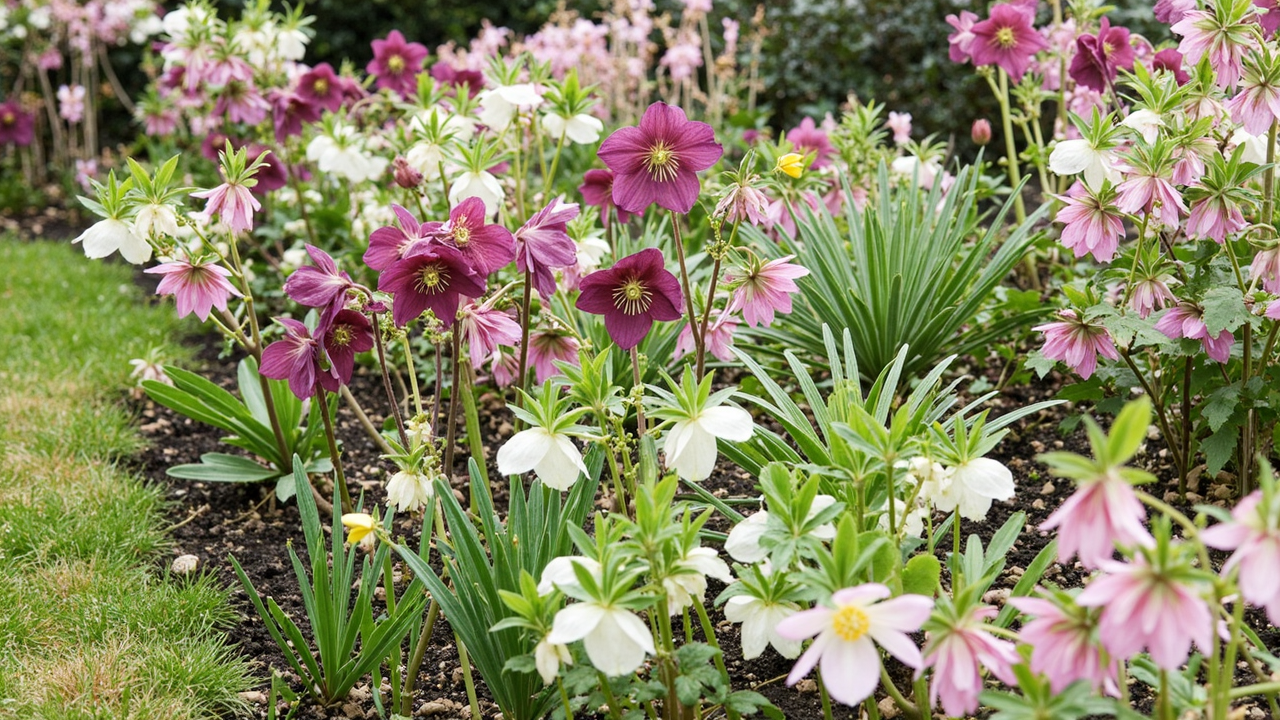
The true flowers are small and cup-shaped, but what most gardeners recognise as the "flower" is in fact a set of five showy sepals, since the petals have been modified into small nectaries. Colour range in orientalis hybrids now spans white, cream, green, pink, plum, purple, slate, near-black, and yellow, often with spotted, picotee, or veined centres. Double-flowered forms are also widely available. H. niger tends to hold pure white sepals that may flush pink with age; modern cultivars extend this into cream and pink shades.
Flowers are carried singly or in loose clusters on stems that usually rise above the foliage. Seed pods develop through late spring and split to scatter seed, and many orientalis hybrids will self-sow freely in undisturbed borders, producing variable offspring that can differ markedly from the parent.
Growing Conditions
Hellebores grow best in the conditions found in much of the UK: partial to deep shade, in moisture-retentive but well-drained soil that is rich in organic matter. They tolerate neutral to slightly alkaline soils, which suits many British garden situations, particularly those over chalk or limestone. Heavy clay is tolerated once established, provided it does not waterlog in winter.
The RHS has assigned Helleborus orientalis subsp. abchasicus and H. foetidus the hardiness rating H7, the highest in the RHS scale, indicating they tolerate lows below −20 °C. H. niger is generally rated H6 (−15 to −20 °C). Cultivars vary; AGM listings on the RHS website give the most up-to-date cultivar ratings, as some named forms are notably less vigorous than others.
The plants dislike being moved once established and can take two to three years to settle into a new site and flower well. They are notably resistant to damage by rabbits and deer, a useful trait in rural British gardens where grazing pressure is high.
Planting and Care
Watering. Hellebores are reasonably drought-tolerant once their root systems have developed, but they perform best with consistent moisture during the growing season. Water new plantings during their first summer if conditions are dry. Established clumps in shade rarely need supplementary watering except in extended dry spells on light soils.
Feeding. An annual mulch of well-rotted garden compost or leaf mould in autumn or early spring supplies most of the nutrients required. For plants in lean soils, a slow-release fertiliser in spring supports strong flowering the following winter. Avoid heavy nitrogen feeds, which encourage foliage at the expense of flowers.
Pruning. The most important pruning task is the removal of old, damaged, or diseased leaves in late winter, just as the new flower stems begin to emerge. This improves the display and reduces the carry-over of fungal leaf spot, which is the most common foliar problem. Cut each leaf at the base, taking care not to damage emerging flower stalks. Spent flower stems can be removed once seed has set, unless self-sowing is desired.
Propagation. Mature clumps can be lifted and divided in early autumn, though hellebores resent disturbance and may sulk for a season afterwards. The simplest approach is to dig the clump, split it into fist-sized pieces with roots and growth buds attached, and replant immediately at the original depth. Seed propagation is straightforward: fresh seed sown in late summer germinates the following spring, though offspring of hybrid cultivars will be variable. Specialist hellebore nurseries in the UK sell seed-raised plants in addition to selected forms.
Seasonal care. Little routine care is needed beyond the annual tidy of old leaves. Container-grown hellebores need repotting every two to three years into a loam-based compost with added grit for drainage, and watering should be monitored more closely than for plants in the ground. In cold regions, applying a loose mulch of bracken or bark over the crown in late autumn can protect flower buds from the worst of the weather, though this is rarely necessary in most of lowland Britain.
Common Problems
Hellebore leaf spot (caused by Coniothyrium hellebori) is the most widespread disease, producing brown or black blotches on foliage. Removing affected leaves promptly and clearing debris around the base of the plant reduces carry-over. Improving air circulation by avoiding overcrowding also helps.
Aphids can colonise flower stems and new growth in spring. They rarely kill established plants but disfigure flowers and can transmit viruses. A strong spray of water or a soft soap solution controls small infestations; severe cases may require treatment.
Downy mildew has become more frequently reported on hellebores in the UK in recent years, causing yellowing and distortion of new growth. Removing affected plants and avoiding overhead watering are the main cultural controls. The RHS provides updated guidance as the situation evolves.
Vine weevil grubs can attack the roots of container-grown plants, particularly in peat-based composts. Biological control with nematodes (Steinernema kraussei) is effective where the pest is suspected.
All hellebores are toxic, containing saponins and other compounds in the foliage, stems, and roots. Ingestion causes nausea and more serious gastric symptoms; skin contact can trigger dermatitis in sensitive individuals. Gloves are recommended for division and for the removal of old foliage.
Popular Varieties
'Harvington Shades of the Night' is part of the Harvington series developed in the UK, with dusky purple to near-black single flowers over dark green foliage. It is widely available from British hellebore specialists and has an AGM from the RHS.
'Anna's Red' is a well-established cultivar with deep pink, outward-facing single flowers and silver-veined young foliage. It is part of the Rodney Davey Marbled Group and reliably clump-forming in UK gardens.
'Penny's Pink' is another Rodney Davey introduction, with clear pink single flowers and marbled foliage. It performs well in typical British garden soil and is widely sold in garden centres from late winter onwards.
Helleborus niger 'Christmas Carol' is a Christmas rose selection with pure white sepals and a relatively compact habit, often grown in containers for winter display near doorways.
Helleborus × ericoides, a hybrid between H. argutifolius and H. lividus, is occasionally offered by specialist nurseries; its exact cultivar names vary and buyers should check current stock from reputable UK growers, as naming in this group has historically been inconsistent.
Helleborus foetidus 'Wester Flisk' has finely divided, dark green foliage with reddish stems and pale green flowers, and holds an AGM from the RHS. It is one of the most reliable seed-raised forms in British gardens.
Pests and Diseases
| Problem | Symptoms | Management |
|---|---|---|
| Hellebore leaf spot | Roundish, dead brown spots appear on leaves and stems, often carried over from old foliage. | Remove affected leaves promptly and cut back old foliage in autumn to reduce infection sources. |
| Hellebore black death | Plants become stunted and deformed with distinctive black streaks and netting patterns on leaves. | Dig up and destroy infected plants immediately as there is no cure for this viral disease. |
| Hellebore aphid | Whitish-green insects form colonies on leaves and flowers, excreting sticky honeydew that leads to sooty mould. | Encourage natural predators like ladybirds; tolerate light infestations or use targeted controls if severe. |
| Hellebore leaf miner | Larvae tunnel within the foliage, creating visible mines primarily on stinking hellebore (H. foetidus). | Remove and dispose of heavily mined leaves to reduce larval populations for the following season. |
| Slugs and snails | Irregular holes chewed in young shoots, flowers, and emerging foliage, often accompanied by slime trails. | Use physical barriers like copper tape or organic pellets, and hand-pick pests at night. |
Quick Care Summary
| Sunlight | Full sun, Partial shade, Full shade |
|---|---|
| Soil | fertile, well-drained soil; rich, moisture-retentive soil but not boggy or waterlogged |
| Hardiness | — |
| Sow | — |
| Plant | January–December |
| Prune | March–May |


As an Amazon Associate, GardenWizz earns from qualifying purchases made through the links above. This does not affect the price you pay. See our disclaimer for details.