
Hosta
Hosta · Plantain Lily
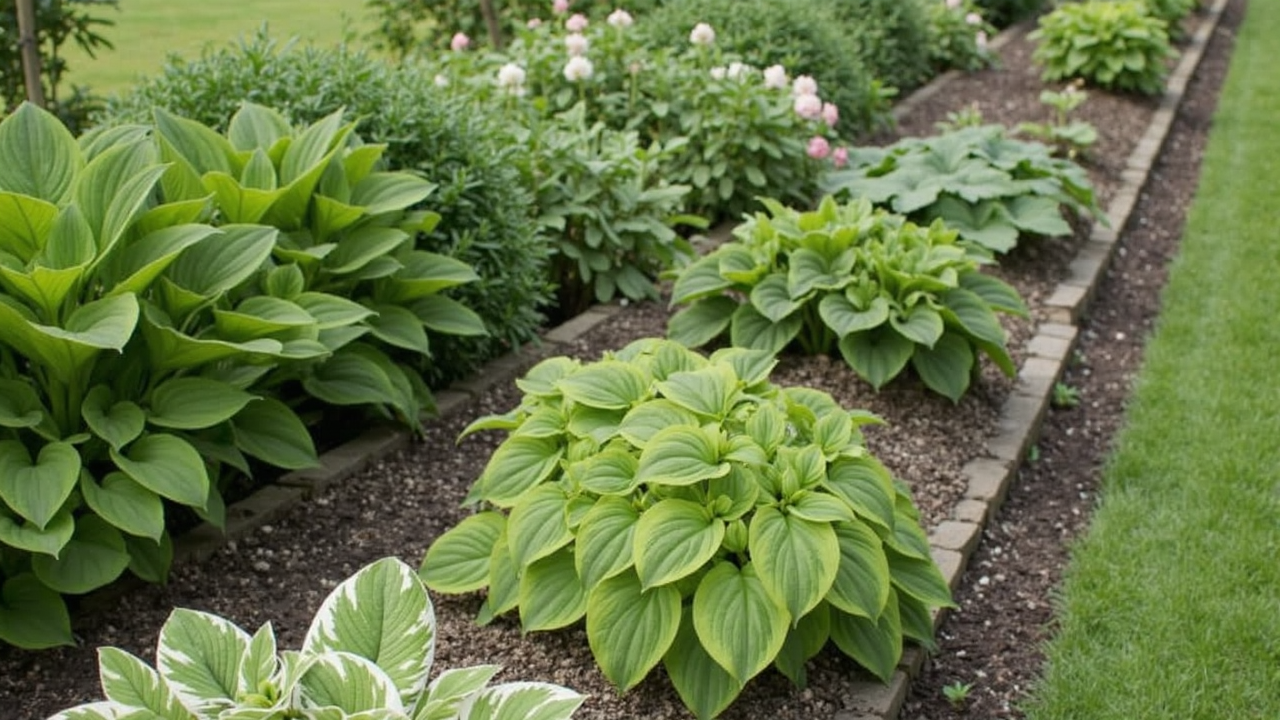
At a Glance
| Botanical name | Hosta |
|---|---|
| Common name(s) | Hosta, Plantain Lily |
| Family | Asparagaceae |
| Plant type | perennial (Herbaceous perennial plants, growing from rhizomes which are sometimes stoloniferous.) |
| Height × Spread | 7–120 cm × 10–180 cm |
| Hardiness | — |
| Position | Partial shade |
| Soil | Moist, fertile soil; heavy clay improved with garden compost or well-rotted manure; water-retentive. |
| Flowering | June–August |
| Toxicity | — |
| Native range | Northeast Asia (China, Japan, Korea, and the Russian Far East) |
Overview
Hosta is a genus of clump-forming, herbaceous perennials in the family Asparagaceae (formerly placed in Liliaceae or Hostaceae), grown chiefly for their ornamental foliage. Native to woodland edges, stream banks and shaded slopes in eastern Asia — Japan, China, Korea and the Russian Far East — hostas have been cultivated in British gardens since the nineteenth century and remain among the most widely planted shade-tolerant perennials in the United Kingdom. The genus contains roughly 40 accepted species and several thousand named cultivars, ranging from diminutive rockery plants under 15 cm to substantial specimens exceeding 1 m across. The following quick-care table summarises the essentials for UK growers; the full article below covers each in detail.
Hosta foliage emerges in spring from dormant rhizomes and dies back to the ground after the first hard frosts of autumn. The leaves are the principal ornamental feature: ovate to lance-shaped, often with a glossy, matt or seersucker surface, and ranging in colour from deep blue-green to chartreuse, gold, near-white and variegated combinations. Flowers are produced in summer on scapes (leafless stems) held above the foliage; they are funnel- or bell-shaped, usually lavender, violet or white, and are attractive to bees. In the UK, hostas perform reliably in the cooler, damper conditions that suit woodland-style planting, but they are vulnerable to slug and snail damage, which is the single most important practical consideration for British gardeners.
Appearance
Hosta leaves are the focal point of the plant. They arise in basal clumps from a short rhizome, with each leaf carried on a long, channelled petiole. The leaf blade is typically ovate to broadly lance-shaped, with a pointed tip and a tapering base, and ranges in size from a few centimetres in miniature forms to 45 cm or more in large specimens. Surface texture varies considerably: some cultivars have smooth, glossy leaves, others a matt finish, and many — particularly those derived from Hosta sieboldiana — carry pronounced puckering or seersucker corrugation between the veins. Leaf colour spans deep blue-green, mid-green, lime-green, chartreuse, gold and near-cream, with countless combinations of marginal variegation, central variegation, streaking and sectoral changes. Variegation may be white, cream, yellow or pale green, and is generally more vivid early in the season, fading or greening as the summer progresses.
The flowers appear in mid to late summer, typically from July into September, on scapes 30 cm to over 1 m tall depending on the cultivar. Each scape carries several funnel-shaped flowers arranged along the upper portion; the flowers open in succession from the base upwards and are usually a soft lavender or violet, although white-flowered cultivars exist. Some hosta flowers are fragrant, a feature most strongly associated with cultivars such as Hosta plantaginea and Hosta 'Royal Standard'; others are scentless. The flowering scapes can be removed at the base once the blooms fade if a tidier appearance is preferred, but leaving them in place provides late-season interest and feeds pollinating insects.
The overall habit of a mature hosta is a low, broad mound of overlapping leaves, with the flowering scapes rising vertically above. Established clumps expand slowly outward each year, forming dense colonies where conditions suit them. The dormant winter form is simply a bare patch of soil — the rhizome sits at or just below the surface and produces fresh growth from buds at the crown each spring.
Growing Conditions
Hostas prefer a position in partial to full shade, sheltered from cold drying winds and from the strongest midday sun, which can scorch paler and variegated foliage. A site with dappled shade through the day, or morning sun followed by afternoon shade, is generally ideal. Deep, full shade is well tolerated, though flowering may be reduced; full sun is tolerated only where the soil remains reliably moist and the cultivar has appropriate parentage, and it usually causes leaf scorch and faded colour in blue- and variegated-leaved forms.
Soil should be moist but free-draining, rich in organic matter, and slightly acidic to near-neutral. Incorporating well-rotted garden compost, leaf mould or manure before planting produces the loose, humus-rich conditions in which hostas thrive. They do not perform well in thin, gravelly soils that dry out in summer, nor in heavy, waterlogged ground where the rhizome is liable to rot. Mulching in spring with a 5 to 7 cm layer of organic matter helps to conserve moisture and keep the soil cool around the crown. The RHS rates many commonly grown hostas as hardy across the UK; specific RHS hardiness ratings vary by cultivar and should be checked for borderline or newly introduced forms, since hardiness can differ between blue-leaved, gold-leaved and variegated selections.
In the UK, hostas are suitable for woodland gardens, shaded borders, courtyard gardens and large containers kept out of the strongest sun. They combine well with ferns, brunneras, heucheras, epimediums, hardy geraniums and other shade-tolerant perennials. In wetter western and northern regions, the higher humidity is generally beneficial to foliage quality provided drainage is adequate; in drier eastern areas, supplementary watering in prolonged dry spells keeps the leaves in good condition.
Planting and Care
Plant container-grown hostas at any time from spring to early autumn, avoiding the heat of midsummer, with spring and early autumn generally the most reliable windows in the UK. Set the crown at the same depth as in the pot, firm the soil, and water thoroughly. Space smaller cultivars 30 to 45 cm apart and larger ones 60 to 90 cm apart, allowing room for the clump to develop over several years.
Watering is the most important summer task. Hostas dislike drying out at the roots, particularly during the main leaf-expansion period in late spring and early summer; a thorough soaking once or twice a week in dry weather is far more effective than frequent light sprinklings. A damp-but-not-waterlogged regime suits them best.
Feeding is light but beneficial. A top-dressing of well-rotted compost in spring, followed by a slow-release general fertiliser or a liquid feed high in nitrogen during the leaf-expansion period, produces stronger, more colourful foliage. Excessive feeding of weak, soft growth that is then vulnerable to slug damage should be avoided.
Pruning is minimal. The principal task is the autumn tidy: once the foliage yellows and collapses after the first hard frosts, cut all leaves back to ground level and clear them away. This reduces overwintering sites for slug eggs and removes any diseased material. During the growing season, individual damaged or heavily slug-eaten leaves can be removed at the base to improve appearance.
Propagation is straightforward by division, ideally in early spring as the new shoots emerge, or in early autumn. Lift the clump, split it with a sharp spade or knife into sections each with at least two or three growing points and a share of the root system, and replant immediately at the same depth, watering well. Division every four to six years keeps vigorous cultivars within bounds and renews older, tired clumps. Seed propagation is possible for the species but produces variable offspring; named cultivars must be propagated vegetatively to come true.
Seasonal care in the UK follows a clear rhythm: divide or plant in March and April as growth begins; mulch in April or May; water consistently through June, July and August; deadhead faded flowers in August or September; cut back dying foliage in October or November; and apply a fresh mulch after the autumn tidy to protect the crown over winter.
Common Problems
Slug and snail damage is the most widespread and frustrating problem for hosta growers in the UK, particularly in damp seasons and in gardens with heavy populations. The principal species responsible are the grey field slug (Deroceras reticulatum) and the garden snail (Cornu aspersum), both of which rasp irregular holes through the leaves and, in severe cases, strip plants back to the ribs. The most vulnerable cultivars are those with thin, pale or highly variegated foliage; thicker-leaved blue and gold forms are generally less badly affected, though none is immune. Control measures include night-time hand-picking, beer traps, copper rings around the crown, biological control with nematodes (Phasmarhabditis hermaphrodita) applied in warm, moist conditions, and the use of pelleted slug treatments according to the manufacturer's instructions, taking care to protect domestic animals and wildlife.
Vine weevil can also attack hostas, particularly those grown in containers. The adults notch the leaf margins, while the soil-dwelling grubs feed on roots and rhizomes and can kill small plants; biological control with parasitic nematodes is effective in pots.
Foliar fungal diseases are generally minor in the UK climate but can include anthracnose, which produces pale spots with dark borders, particularly in wet springs. Removing and destroying affected leaves and improving air circulation around the clump are usually sufficient.
Hostas are not considered toxic to humans or to cats and dogs in the standard horticultural references, although ingestion of large quantities of any non-food plant material may cause mild gastric upset; specific veterinary advice should be sought if a pet is suspected of eating a substantial amount of any ornamental plant.
Popular Varieties
Hosta sieboldiana is one of the most widely planted species in British gardens, forming large clumps of blue-green, heavily textured leaves roughly 60 to 75 cm tall and 1 m or more across, with pale lilac flowers in early summer. Hosta 'Royal Standard' is a vigorous, sun-tolerant cultivar with bright green, slightly glossy leaves and strongly fragrant white flowers in August, often considered the most reliable fragrant hosta for UK conditions. Hosta 'Francee' is a long-established cultivar with dark green leaves narrowly edged in white, holding its variegation well through the season and reaching about 50 cm in height. Hosta 'Sum and Substance' is a large, gold-leaved form noted for its slug resistance and tolerance of more sun than most, commonly exceeding 75 cm tall and 1.2 m wide when mature. Hosta 'Patriot' is a sport of 'Francee' with broader, brighter white margins on a dark green leaf, valued for its strong contrast. Hosta fortunei, in its various forms, is among the most frequently planted group in older UK gardens, with mid- to dark green leaves and pale lilac summer flowers, and includes named selections such as 'Hyacinthina' and 'Aureomarginata'.
Pests and Diseases
| Problem | Symptoms | Management |
|---|---|---|
| Slugs and snails | Irregular holes eaten through leaves, often with silvery slime trails visible on foliage. | Use physical barriers like copper tape or crushed eggshells, and apply iron phosphate pellets. |
| Vine weevil | Notched leaf margins above ground and white grubs feeding on roots in the soil. | Check new plants for grubs before planting and use nematodes or biological controls in spring. |
| Honey fungus | General decline, yellowing leaves, and white fungal growth under bark at the base. | Improve drainage and avoid replanting hostas in infected soil for several years. |
| Leaf scorch | Brown, crispy edges on leaves caused by exposure to strong sun or dry conditions. | Plant in partial shade and maintain consistent moisture with a thick layer of mulch. |
Quick Care Summary
| Sunlight | Partial shade |
|---|---|
| Soil | Moist, fertile soil; heavy clay improved with garden compost or well-rotted manure; water-retentive. |
| Hardiness | — |
| Sow | — |
| Plant | March, April, May, September, October, November |
| Prune | September–November |



As an Amazon Associate, GardenWizz earns from qualifying purchases made through the links above. This does not affect the price you pay. See our disclaimer for details.