
Peony
Paeonia lactiflora · Chinese peony · Chinese herbaceous peony · common garden peony
At a Glance
| Botanical name | Paeonia lactiflora |
|---|---|
| Common name(s) | Chinese peony, Chinese herbaceous peony, common garden peony |
| Family | Paeoniaceae |
| Plant type | perennial |
| Height × Spread | 50–100 cm × 50–100 cm |
| Hardiness | H6 (to -20.0 °C) |
| Position | Full sun, Partial shade |
| Soil | Fertile, humus-rich; clay, loam or sand — moist but well-drained |
| Flowering | May–June |
| Toxicity | — |
| Native range | central and eastern Asia from eastern Tibet across northern China to eastern Siberia |
Overview
Peony (Paeonia lactiflora) is one of the most widely grown herbaceous perennials in British gardens, valued for its late-spring and early-summer flowers, its tidy clump-forming habit and its longevity in the same position for decades. The quick-care table below summarises the essentials for UK growers; the rest of the article covers each point in detail.
Paeonia lactiflora is a clump-forming herbaceous perennial in the family Paeoniaceae, native to meadows, scrub and forest edges of eastern Asia, including northern China, Mongolia, Siberia and the Korean peninsula. It has been cultivated in China for well over a thousand years, reached Europe in the late eighteenth century, and has been grown in British gardens since the early nineteenth. The species is one of the parents of most modern garden peonies and is the source of the classic colours — white, blush, pink, crimson and deep red — together with several anemone-centred and fragrant forms. Mature plants form rounded clumps of dark green, deeply divided foliage roughly 60 to 90 cm tall, with sturdy stems that carry the blooms above the leaves in late spring and early summer. Several cultivars have been awarded the RHS Award of Garden Merit for reliable performance in typical British conditions. In the UK, peonies are widely planted in herbaceous and mixed borders, in cut-flower beds, and as specimen plants in cottage and formal gardens; they are also grown commercially in parts of Lincolnshire, the south-west and the Channel Islands.
Appearance
Paeonia lactiflora grows from a crown of thick, fleshy, tuberous roots that anchor the plant firmly in the soil and send up a cluster of annual stems each spring. The leaves are alternate, dark green, sometimes flushed bronze when young, and divided into broad, pointed leaflets; the foliage forms a dense, rounded mound that remains attractive well into autumn. New shoots emerge in early spring, often reddish at the base, and develop rapidly as the weather warms.
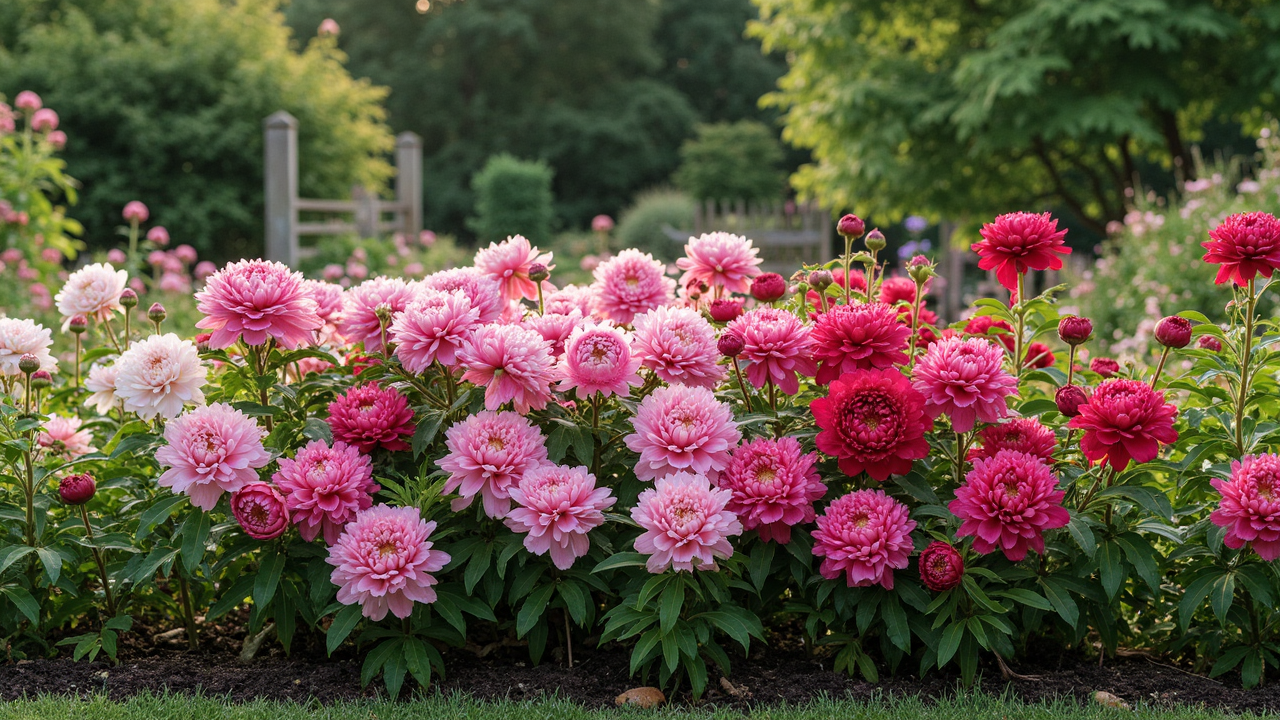
The flowers are borne singly or in small clusters at the tips of the stems. The basic species has five to eight broad, rounded outer petals around a central boss of golden-yellow stamens, but cultivated forms are predominantly double or semi-double, with many layered petals that hide the stamens, or anemone-centred, with a single outer ring of guard petals and a dense central tuft of narrow petaloids. Colour ranges from pure white through cream, blush, salmon and rose pink to crimson and deep wine red, and some cultivars carry a crimson or carmine mark at the centre of each petal. Many forms are strongly and sweetly scented, with a fragrance often described as rose-like or lemony, and the blooms are widely used in floristry because of their size, shape and keeping quality in water.
The seed pods that follow the flowers are large, leathery and grey-green, splitting in late summer to release glossy dark brown seeds; they are decorative in their own right and are often left on the plant well into autumn. Mature clumps broaden slowly and may remain productive in the same site for twenty years or more.
Growing Conditions
Peonies prefer a sunny, open position sheltered from strong winds, which can damage the heavy blooms in late spring. In the UK this usually means a south- or west-facing border; light, dappled shade during the hottest part of the day is tolerated, particularly in the warmer south and east. Soil should be deep, fertile, humus-rich and moisture-retentive yet free-draining, with a pH of about 6.5 to 7.5. Very light sands and shallow chalk are the most difficult substrates and need substantial improvement with garden compost or well-rotted manure before planting.
The RHS rates Paeonia lactiflora as H6, hardy in much of lowland and upland Britain down to about -15 to -20 °C, and the dormant crowns survive average UK winters without protection. The plant is, however, one of the first perennials to break into growth in spring, and the emerging shoots are vulnerable to late frosts, which can blacken the buds and reduce flowering in a cold year. Covering young growth with horticultural fleece on clear, still nights in April and May is often worthwhile in colder districts.
Peonies are deep-rooted and benefit from a site that is not regularly disturbed. They establish slowly, typically taking two to three years to flower well after planting, and dislike competition from greedy neighbours. They are also unsuited to containers for the long term, since the root system needs depth and a cool, even root run, although young plants can be kept in large pots for a year or two before being set out in their final position.
Planting and Care
Bare-root peonies are planted in autumn, usually October or November, with the crown of buds set no more than 2.5 to 5 cm below the soil surface; planting too deep is the most common cause of a peony that produces healthy foliage but few or no flowers. Container-grown plants can be set out at any time the ground is workable, although spring and autumn are preferable, and the same shallowness at planting should be observed. Prepare the site by digging in garden compost or well-rotted manure, water in well, and mulch lightly with compost in the first spring after planting.
Watering is most important in the first two growing seasons, while the root system establishes. Thereafter, established peonies cope with average rainfall and need supplemental irrigation only in prolonged drought, particularly in late spring as the buds form. Feeding should be modest but regular: a top-dressing of garden compost or well-rotted manure in early spring, followed by a balanced general-purpose fertiliser as the shoots come through, is sufficient for most soils. Avoid high-nitrogen feeds, which produce soft leafy growth at the expense of flowers and make the stems more likely to flop.
Pruning is limited. The flower stems can be cut for indoor use when the buds are still soft and showing colour; this does not weaken an established plant, provided some foliage is left on each stem. In autumn, after the first hard frosts have killed the foliage, cut the stems down to within a few centimetres of the ground and remove the cut material; this keeps the crown tidy and reduces the carry-over of fungal disease. Staking is usually only needed for the heaviest doubles: a simple ring of pea sticks or a herbaceous support placed over the clump in early spring is enough.
Propagation is by division of mature clumps in early autumn. Lift a well-established plant, wash the soil from the crown, and cut it into sections each carrying three to five healthy buds and a good fan of fleshy roots; replant at once, water in, and label. Seed can be sown fresh in autumn, but seedlings take several years to reach flowering size and do not come true to type, so this method is used only for the species or for raising new cultivars. Peonies are long-lived and generally need dividing only when flowering begins to decline, typically after fifteen to twenty years in one spot.
Seasonal care in the UK follows a simple rhythm. In late winter or early spring, clear away the old foliage and top-dress the crown. As the shoots emerge in April and May, watch for late frosts and, if necessary, protect the young growth. Water in dry spells as the buds develop. Cut flowers for the house or deadhead as they fade. In autumn, cut the foliage back once frost has killed it and mulch the crown with compost on poor soils.
Common Problems
The most common complaint is a peony that produces abundant foliage but few or no flowers, almost always because the crown has been planted too deeply, the plant has been moved too often, or it is being over-shaded by neighbouring plants. In such cases the remedy is to lift the clump in autumn and replant it at the correct depth in a more open position, accepting that flowering may be sparse for one or two seasons while the plant re-establishes.
Botrytis, or peony wilt, is the most significant fungal disease. It appears in cool, damp springs as shoots that blacken at the base and collapse, buds that turn brown and fail to open, and leaves with large brown blotches. The fungus overwinters on old stems and the crown, and the best defence is hygiene: cut the foliage back in autumn, remove and destroy affected material during the season, and improve air movement around the plant. A copper-based or other appropriate fungicide can be used in serious cases, applied at the first sign of infection and again two to three weeks later, but the emphasis should be on cultural control.
Other problems include powdery mildew in dry summers, particularly on crowded plants, and a virus-like condition that causes faint rings or mottling on the leaves and reduced vigour; affected plants should be lifted and destroyed rather than divided. Peonies in the UK are generally free of serious pest damage, although slugs and snails can graze the young shoots in spring.
Toxicity: most sources state that Paeonia lactiflora is mildly toxic if any part of it is eaten, with possible gastric effects in humans and domestic animals, but the threshold and severity are not well documented. As a precaution, gloves are advisable when cutting flowers and foliage, and the plant should be kept out of the reach of browsing pets and livestock. This article is concerned only with ornamental cultivation; medicinal or culinary use of peony material should be discussed with a qualified source.
Popular Varieties
'Sarah Bernhardt' is one of the oldest and most widely grown double pink peonies, with large, apple-blossom-pink, sweetly scented flowers in mid- to late season; it holds the RHS Award of Garden Merit and is the cultivar most often seen in British gardens and in the cut-flower trade. 'Duchesse de Nemours' is an early to mid-season double white cultivar, prized for its creamy-white, cupped blooms with a strong, lemony scent; it is reliable on heavier soils and is another AGM form. 'Karl Rosenfield' produces deep crimson, fully double flowers on stout stems in mid-season, with the dark colour showing up well against the green foliage; it is widely available from UK nurseries and is a popular counterpoint to the paler pinks and whites.
'Bowl of Beauty' is an anemone-centred cultivar with a single row of broad, deep rose-pink guard petals around a dense, pale yellow centre of narrow petaloids, giving a striking two-tone effect in early to mid-season. 'Festiva Maxima' is an old, vigorous double white, occasionally flecked with crimson at the centre of a few inner petals and strongly scented, flowering in mid-season. 'Shirley Temple' is a later, large-flowered double that opens blush-pink and fades to creamy white, useful for extending the season. Other dependable AGM forms available in the UK include the early white 'Krinkled White', the rich pink 'Pillow Talk', and the scarlet-red single 'Buckeye Belle'; a number of Itoh, or intersectional, hybrids derived in part from P. lactiflora are also offered by British nurseries and are worth considering where a longer flowering season and stronger stems are wanted.
Pests and Diseases
| Problem | Symptoms | Management |
|---|---|---|
| Peony wilt (Botrytis paeoniae) | Foliage collapses and turns brown, while flower buds hang down and fail to open, often showing grey mould in wet weather. | Remove and burn infected material promptly to reduce spores, and ensure good air circulation around plants. |
| Slugs and snails | Irregular holes chewed into emerging shoots and leaves, often accompanied by silky trails and slime. | Use physical barriers like copper tape or apply iron phosphate-based pellets around the base of plants. |
| Powdery mildew | A white, dusty fungal growth appears on leaves and stems, potentially causing distortion or yellowing. | Improve air circulation, avoid overhead watering, and apply a suitable fungicide if infection is severe. |
| Root rot | Plants appear stunted with yellowing foliage and general decline due to waterlogged soil conditions. | Ensure well-drained soil and avoid planting too deeply; lift and divide congested clumps in autumn. |
| Ants on buds | Ants are seen crawling over flower buds, often feeding on nectar secretions rather than damaging the plant. | Leave them alone as they are generally harmless and may help deter aphids; remove only if aesthetically undesirable. |
Quick Care Summary
| Sunlight | Full sun, Partial shade |
|---|---|
| Soil | Fertile, humus-rich; clay, loam or sand — moist but well-drained |
| Hardiness | H6 (-20.0 °C) |
| Sow | — |
| Plant | October–November |
| Prune | October–November |