Acanthocalycium spiniflorum
Acanthocalycium spiniflorum
The Gardening Year
Best months in UK gardens · full planting calendar →
🖨 Printable care card (PDF)At a Glance
| Botanical name | Acanthocalycium spiniflorum |
|---|---|
| Common name(s) | Acanthocalycium spiniflorum |
| Family | Cactaceae |
| Plant type | succulent |
| Height × Spread | 60 cm × 10–15 cm |
| Position | Full sun |
| Soil | Peat-free, loam-based potting compost with extra grit; keep it well drained |
| Flowering | June–August |
| Toxicity | — |
| Native range | Argentina |
Acanthocalycium spiniflorum is a small South American globular cactus prized by UK collectors for its compact, tidy form and its unusually vivid pink to purplish-pink funnel-shaped flowers. Native to the mountainous regions of western and central Argentina, it has been grown in British cactus collections for decades and remains one of the most reliable flowering species in its genus for windowsill and cold-greenhouse cultivation.
Overview
Acanthocalycium spiniflorum belongs to the family Cactaceae and was for many years treated as a small genus of perhaps half a dozen species from western Argentina. Recent molecular work has seen the genus subsumed into Echinopsis by some authorities, but the name Acanthocalycium remains in widespread UK horticultural use and is adopted here. Introduced to European cultivation in the nineteenth century, it has been a fixture of British collections ever since, valued for reliable flowering from a small, manageable body.
In the United Kingdom the plant is grown almost exclusively as a pot specimen — on a bright windowsill, in a cold greenhouse, or in a heated conservatory. It is not hardy enough to survive outdoors year-round anywhere in Britain, but its tolerance of cool, dry winter conditions makes it ideal for growers without a heated propagator. Plants can spend the warmer months on a sunny patio once frost risk has passed, returning indoors before the first autumn frosts.
Mature specimens flower freely once a proper winter rest has been observed, and a single plant in full bloom is striking enough to anchor any sunny sill. It is particularly suitable for beginners moving on from foliage houseplants to flowering cacti, and for collectors who appreciate the more compact Argentine species.
Appearance
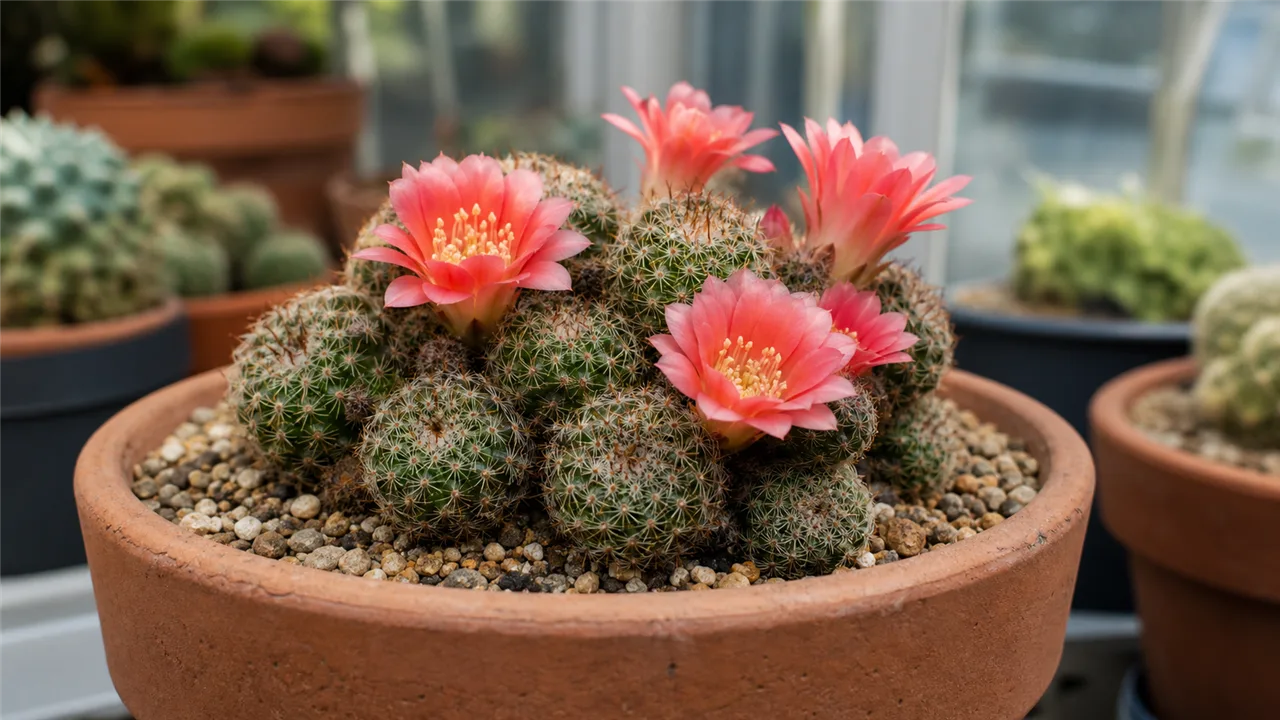
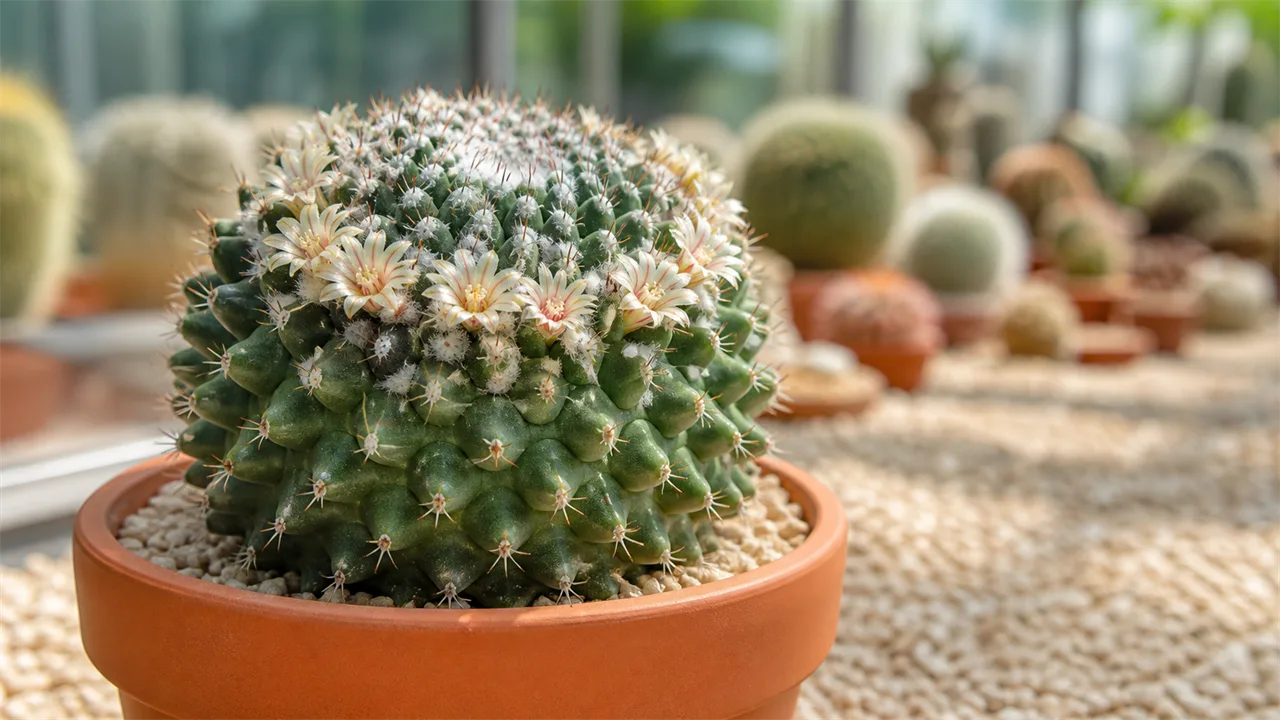
Acanthocalycium spiniflorum develops a simple, usually solitary body that is globular when young and becomes shortly cylindrical with age, ultimately reaching around 15 cm tall by 8–10 cm across in cultivation. The epidermis is a bright to slightly bluish green, smooth between the ribs and well camouflaged against stony ground in habitat. Old plants may offset from the base to form small clumps, but the species is not naturally clustering and a single-headed specimen is the norm.
The body is divided into 15 to 20 vertical ribs, fairly deep and well-defined, with the areoles spaced along them at regular intervals. From each areole arise a stout central spine and a ring of thinner radial spines. Central spines are typically a few centimetres long, stiff, and — on mature areoles — distinctly hooked at the tip, giving the plant its species name spiniflorum ("spine-flowered", a reference to the spiny flower tube). Radial spines are finer, paler, and more numerous, splaying outward and lying flatter against the body. Overall spine colour ranges from pale horn to grey-brown, darkening on older growth.
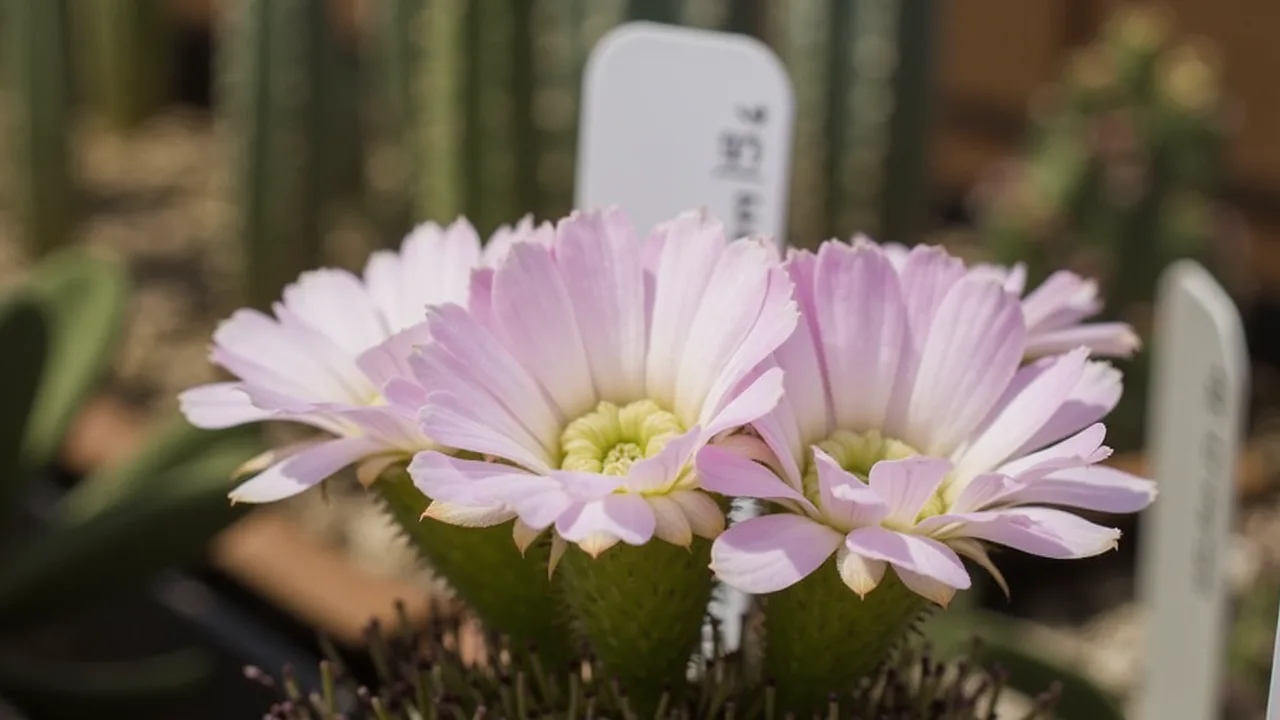
The flowers emerge in late spring and summer from areoles near the crown of the plant. Each bloom is funnel-shaped, opening to about 5 cm in diameter, with broad, slightly glossy petals in shades of pink, purplish-pink, or magenta and a paler throat. The flower tube is slender and densely covered in small scales and tufts of pale hair, from which the species takes both its common name "thistle cactus" and the meaning of the genus name (from the Greek akantho, thorn, and kalyx, bud). Flowers typically last several days in cool conditions out of direct midday sun.
After successful pollination the flowers are followed by small, rounded berries that ripen from green to a dull reddish tone. In UK cultivation hand pollination is rarely attempted by hobbyists; seed-raised plants are usually produced by specialist nurseries rather than home growers, who propagate vegetatively instead.
Growing Conditions
Acanthocalycium spiniflorum is rated H2 on the RHS hardiness scheme, meaning it is suitable for a heated glasshouse or indoor cultivation and will tolerate a minimum temperature in the range of 5 to 10 °C. It must be regarded as frost-tender in the UK and should never be left outside once night temperatures approach freezing.
Light is the single most important cultural factor for flowering. Plants need the brightest position available indoors — a south- or east-facing windowsill is ideal — or a position high in an unheated greenhouse during the growing season. Plants raised in lower light develop elongated, paler growth and flower poorly or not at all. After the lower-light winter months it is wise to acclimatise plants to stronger sun gradually over a couple of weeks to avoid scorch.
The compost must be sharply draining. A typical mix used by British cactus growers is three parts John Innes No. 2 or No. 3 combined with two parts horticultural grit or perlite and one part coarse sand. Purpose-made cactus composts sold in the UK are acceptable but are often improved by the addition of extra grit. The plant tolerates a wide pH range but performs best in a slightly acidic to neutral medium.
During the growing season (roughly April to September in the UK) Acanthocalycium spiniflorum prefers warm conditions, ideally 18 to 30 °C, with fresh air movement. A cool, dry winter rest at around 5 to 10 °C is essential to trigger flowering the following year. Without this cool, dry period plants tend to elongate, fail to flower, and become more susceptible to rot.
Planting and Care
Planting. Pot up in late spring to early summer (May or June) once temperatures are reliably warm. Use a terracotta pot one or two sizes larger than the current one, with adequate drainage holes. Place a small crock over the drainage hole, part-fill with the gritty mix described above, position the cactus at its previous depth, backfill, and tap to settle the compost. Water lightly after a few days rather than immediately, so any damaged roots can callous.
Watering. Use the soak-and-dry method during the growing season: water thoroughly until it runs from the drainage holes, then allow the compost to dry out completely before watering again. From late March through to early September this typically means watering once every one to two weeks depending on temperature and pot size. From late September reduce watering sharply, and from November to early March keep the plant almost dry, giving only a light sprinkle once a month or so to prevent excessive shrivelling. Never allow the pot to stand in water; an outer cache pot or saucer should be emptied within minutes of watering.
Feeding. Apply a low-nitrogen, potassium-rich cactus fertiliser at half the manufacturer's recommended strength once a month from April through August. Over-feeding, particularly with nitrogen, leads to soft, lanky growth that is prone to rot and flowers poorly.
Repotting. Repot every two to three years in spring, refreshing the compost and moving the plant up only one pot size if the roots have filled the container. Wear thick leather gloves or wrap the body in a folded newspaper when handling; the hooked central spines are sharp enough to penetrate ordinary gardening gloves. Disturb the root ball as little as possible; damaged roots should be allowed to dry and callous for a day before repotting.
Pruning. No routine pruning is required. Spent flower remains can be eased off once they dry, and any dead or damaged tissue should be removed cleanly with a sterilised blade.
Propagation. Vegetative propagation is by basal offsets where these occur — cut cleanly with a sharp knife, allow the cut surface to callous for several days in a warm, airy spot, then pot into dry gritty compost to root slowly. Seed propagation is straightforward with fresh seed: sow on the surface of a damp, gritty mix, cover lightly, and germinate at around 21 °C under bright light. Seedlings grow slowly and typically take four to five years to reach flowering size.
Seasonal care. In late May or early June, after the last expected frost, plants can move outdoors to a sheltered sunny patio for improved light and air. Bring back under cover in mid-September, before night temperatures fall below about 8 °C. Through winter, keep the plant in the brightest available position, withhold most water, and ventilate the greenhouse on mild days to discourage fungal disease.
Common Problems
Overwatering and basal rot. The single most frequent cause of loss. Symptoms include softening and browning at the base of the plant, a collapsed body, and compost that remains damp for more than a few days. Affected plants can sometimes be saved by cutting well above the rotted tissue, dusting the cut with sulphur powder, allowing it to callous for a week or more, and re-rooting the healthy top as a cutting in dry compost.
Mealybugs. White, waxy, cotton-like masses tucked into the areoles and in the crevices between ribs. Inspect plants regularly, particularly when bringing them indoors in autumn. Small infestations can be removed with a cotton bud dipped in 70 % isopropyl alcohol; larger outbreaks respond to a systemic insecticide approved for use on ornamental houseplants, or to applications of insecticidal soap or neem oil.
Scale insects. Small brown or greyish discs adhering to the body, often mistaken for part of the plant. Pick off manually with an alcohol-dipped bud, or treat as for mealybug.
Fungal rot. Soft brown or black patches appearing anywhere on the body, usually following overwatering, poor ventilation, or sustained cool damp conditions. Cut out affected tissue to clean healthy flesh, dust with sulphur, and repot into dry compost once the cut has calloused. Improve ventilation and reduce watering.
Sunburn. Bleached, papery, or yellow patches on the side of the plant most exposed to strong sun, typically after sudden relocation from shade to full sun. Acclimatise plants to brighter light gradually over a fortnight. Damaged tissue will not recover but the plant will grow out of it in time.
Red spider mite. Fine webbing between the ribs and a dull, dusty appearance to the epidermis, more common in dry warm conditions indoors. Increase humidity, wash the plant with a fine spray of tepid water, and treat with an appropriate acaricide if the infestation persists.
Popular Varieties
Named cultivar selection within Acanthocalycium spiniflorum is limited compared with the larger cactus genera, but a small number of recognised forms are widely circulated in UK collections. The following are representative of the kinds of variation available.
- Acanthocalycium spiniflorum (pink-flowered form). The typical wild-collected form with clear pink to purplish-pink flowers; the standard against which other selections are judged and the most commonly offered plant in UK garden centres and cactus nurseries.
- Acanthocalycium spiniflorum (white-flowered form). Less commonly seen, with petals in white or the palest pink. Less vigorous than the typical form in some grower's experience and somewhat slower to reach flowering size.
- Acanthocalycium spiniflorum 'Yellow' / yellow-flowered form. A relatively recent selection in cultivation, bearing flowers in pale to mid-yellow rather than the usual pink. Offered occasionally by specialist nurseries; growth habit and care requirements are as for the typical form.
In addition, hybrids between Acanthocalycium spiniflorum and other small South American cacti, particularly Echinopsis species, are produced by specialist growers and sold under a confusing array of names. Buyers should be aware that the genus boundaries in this group of cacti have been revised several times and that plants sold as Acanthocalycium, Echinopsis, or Lobivia may in some cases be closely related forms or hybrids rather than true species. For gardeners seeking a reliably named, well-understood plant the typical pink-flowered form remains the safest choice.
Pests and Diseases
| Problem | Symptoms | Management |
|---|---|---|
| Mealybugs | White, cottony wax patches appear in stem crevices and around the base. | Isolate the plant and dab infested areas with a cotton bud soaked in methylated spirits. |
| Root rot | The stem becomes soft, shrivelled, and discoloured brown or black at the base. | Ensure excellent drainage with gritty compost and withhold water during winter dormancy. |
| Vine weevil | Semi-circular notches on leaf margins (if present) or sudden collapse due to root damage. | Use nematode treatments in the soil or apply a systemic insecticide as a preventive measure. |
| Scale insects | Small, immobile brown or white bumps attached firmly to the stem surface. | Scrape off visible scales and treat with a horticultural oil spray during warmer months. |
| Sunburn | Pale, bleached, or scorched patches on the side of the cactus facing direct light. | Gradually acclimatise the plant to brighter conditions before moving it into full sun. |
Or browse the full plant problem solver to diagnose an issue by symptom.
Recommended Products
GardenWizz earns a commission from qualifying purchases made through affiliate links on this page (including links within the article) — as an Amazon Associate, and from Thompson & Morgan via the Awin network. This does not affect the price you pay. See our disclaimer for details.