Echeveria
Echeveria
The Gardening Year
Best months in UK gardens · full planting calendar →
🖨 Printable care card (PDF)At a Glance
| Botanical name | Echeveria |
|---|---|
| Common name(s) | Echeveria |
| Family | Crassulaceae |
| Plant type | succulent (evergreen, polycarpic perennial) |
| Height × Spread | 10–50 cm × 10–50 cm |
| Position | Full sun |
| Soil | well-drained, gritty, sharply draining, peat-free cactus compost or sandy slightly acidic soil |
| Flowering | June–August |
| Toxicity | Generally non-toxic to humans, cats and dogs; not for eating. |
| Native range | semi-desert areas of Central America, Mexico and northwestern South America |
Overview
Echeveria is a genus of evergreen rosette-forming succulents in the family Crassulaceae, native to semi-desert regions of Mexico and Central America, with a few species extending into northern South America. The genus was described by the Swiss botanist Augustin Pyramus de Candolle in 1828 and named in honour of the Mexican botanical illustrator Atanasio Echeverría y Godoy. There are around 150 accepted species and a very large number of named hybrids and cultivars, many of which have been raised in Korea, Japan, the United States and the Netherlands and are now widely sold as houseplants in the UK.
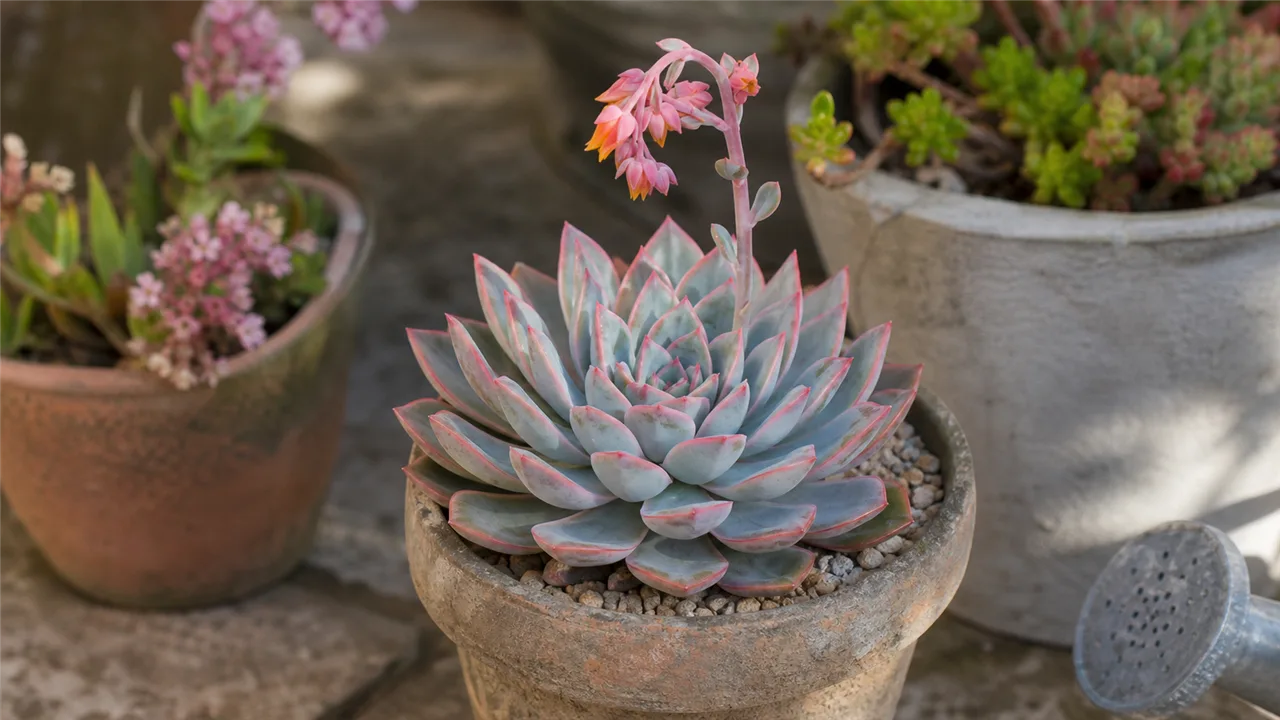
In British cultivation, Echeveria is treated as a tender indoor plant. The plants cannot survive freezing temperatures and are grown almost exclusively on windowsills, in conservatories and in summer patio displays that are brought under cover before the first frost. They are grown for the architectural beauty of their tightly packed leaf rosettes, which range from pale silvery blue through glaucous grey, fresh green, pink, plum and near-black, often with contrasting leaf margins or tips. Mature, well-grown specimens also flower freely, sending up arching stems of bell- or urn-shaped blossoms in shades of coral, orange, pink, red and yellow that are popular with late-season bumblebees and honeybees when plants are placed outdoors in summer.
Echeveria is closely related to Sedum, Graptopetalum, Pachyphytum and Crassula, and intergeneric hybrids such as Sedeveria, Graptoveria and Pachyveria are common in the trade. Echeveria itself crosses freely within the genus, and many of the most popular modern cultivars are complex hybrids rather than pure species. For the UK grower the practical distinction matters less than an understanding of the genus's basic cultural needs: bright light, free-draining gritty compost, restrained watering and protection from cold and wet.
Appearance
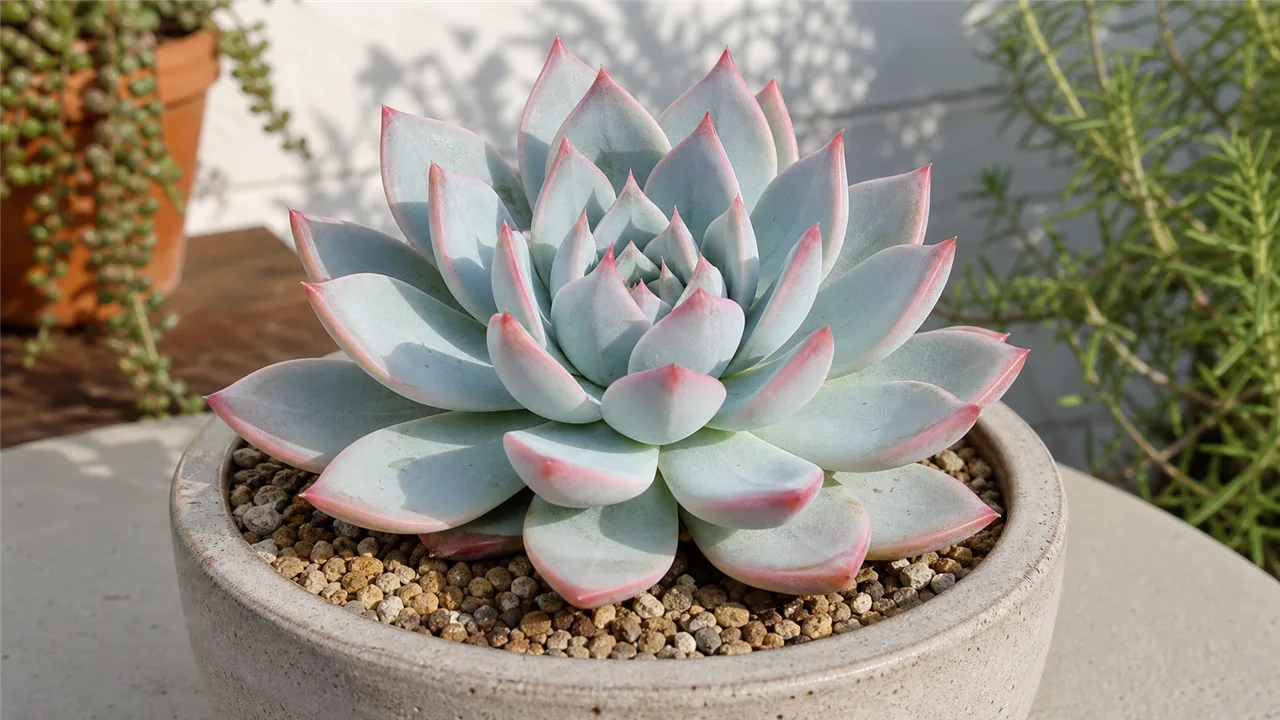
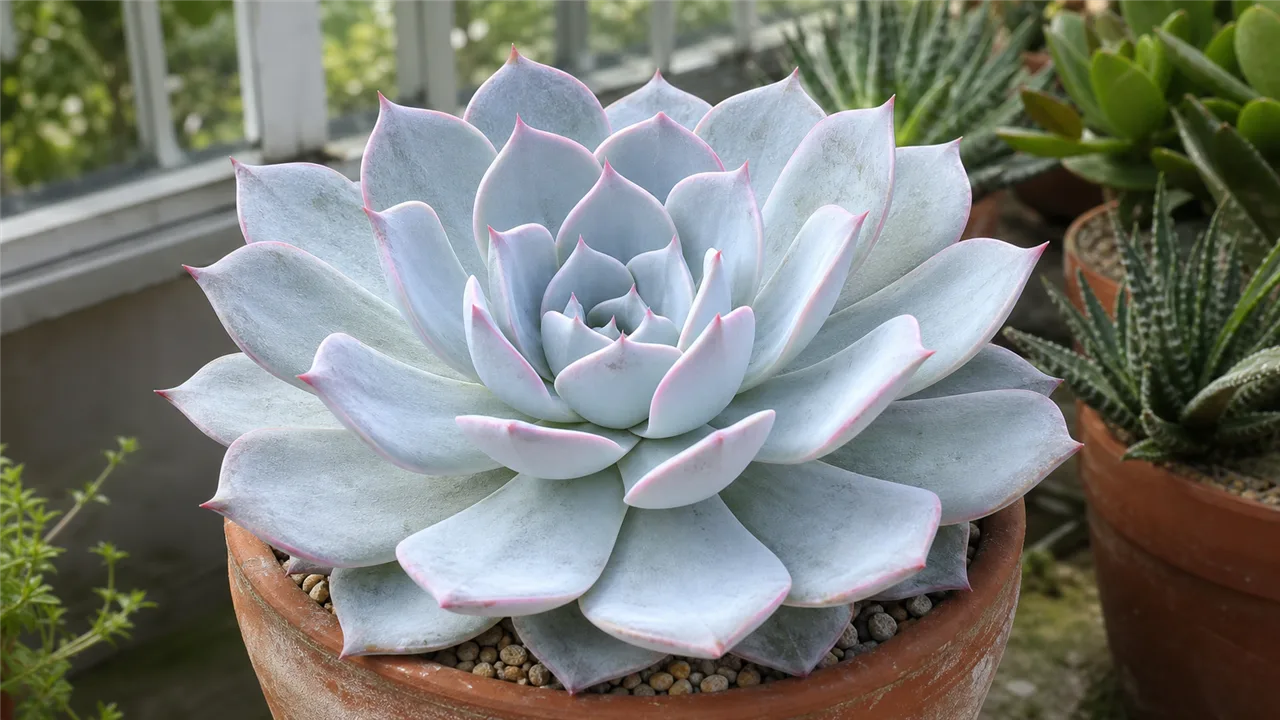
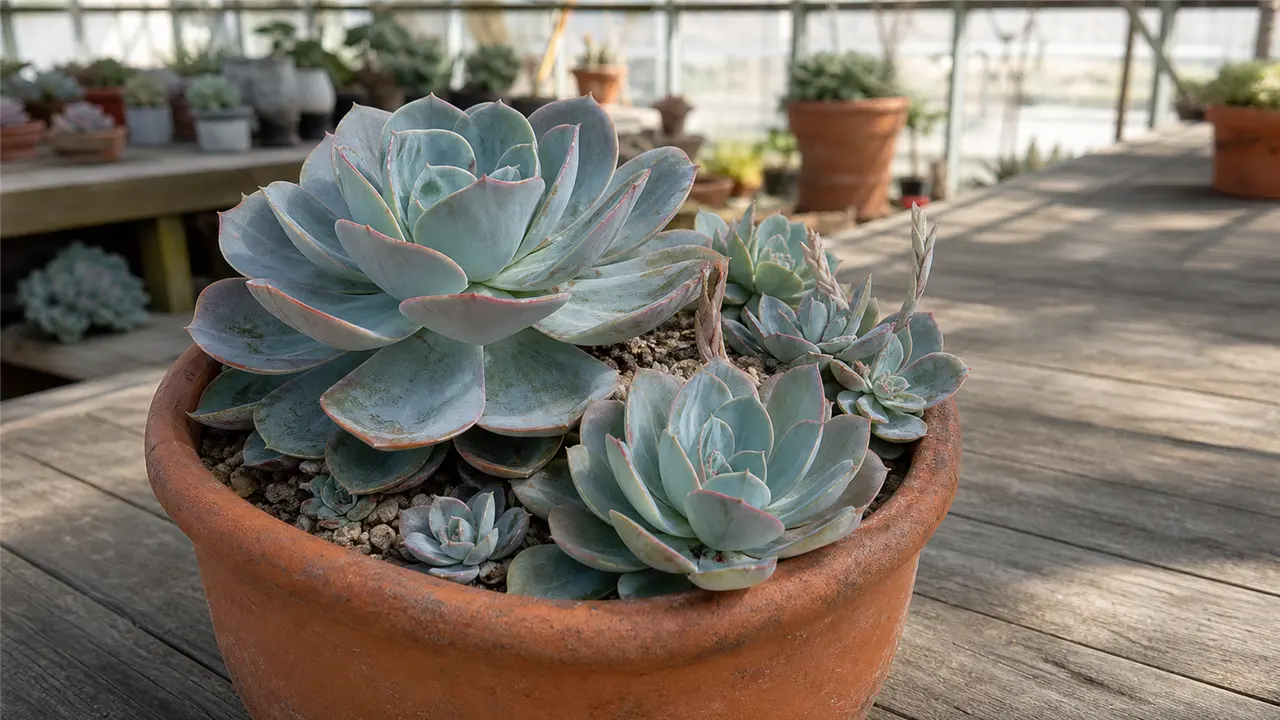
Echeveria species form symmetrical, spirally arranged leaf rosettes ranging from 5 cm to over 30 cm across depending on the species and cultivar. The rosettes are acaulescent (stemless) in most species, sitting flat at ground level in habitat, though older plants and certain species develop a short, stout stem that becomes visible as the lower leaves dry and are shed. Leaves are fleshy, obovate to lance-shaped, often pointed at the tip, and covered in varying degrees with a powdery farina (epicuticular wax) that gives many species their characteristic blue-white or silvery appearance. This farina is delicate and marks readily if handled, so plants are best moved and positioned by the pot rather than the leaves.
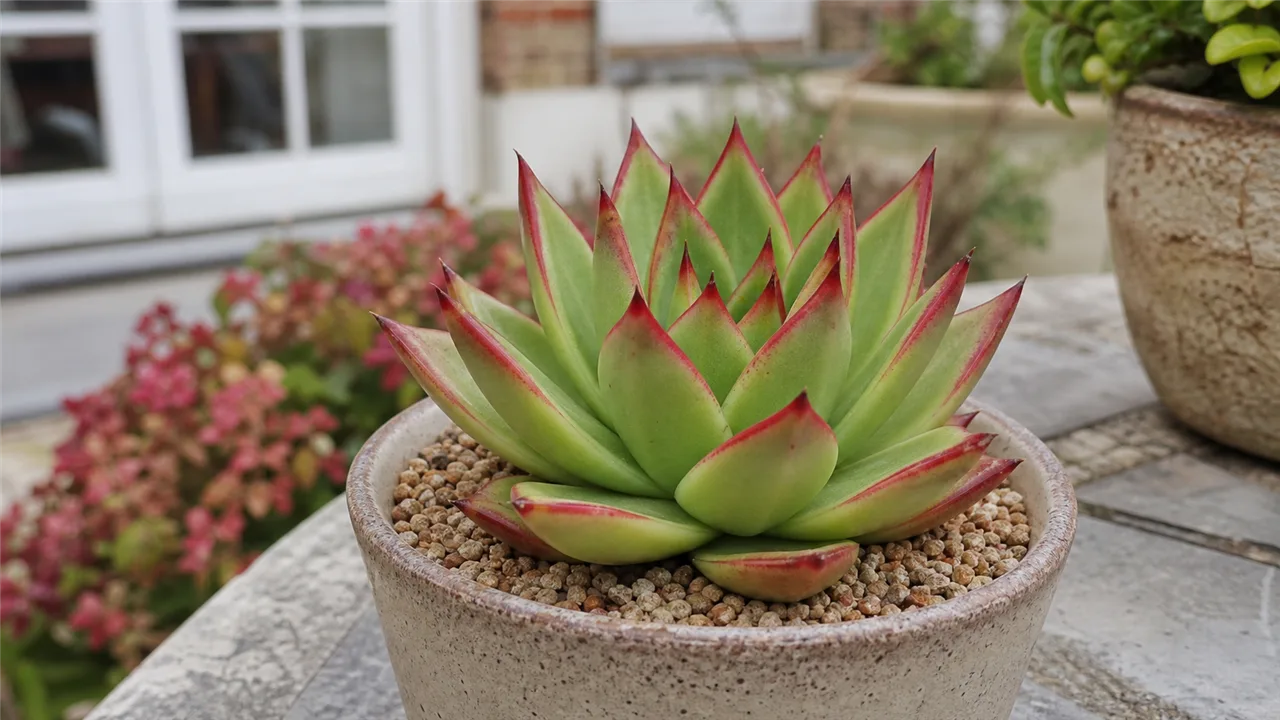
Leaf colour is highly variable. Echeveria elegans, sometimes called the Mexican snowball, has pale blue-white rosettes with a strong pink flush in winter. E. pulvinata and the related cultivar 'Ruby Blush' are softly hairy with green leaves edged in red. E. lilacina is a near-white, ghostly rosette that slowly develops into a tidy clump. E. 'Perle von Nürnberg' — a hybrid of E. gibbiflora and E. potosina — has opalescent lavender-pink rosettes and is among the most recognisable plants sold in UK garden centres. E. 'Black Prince' has deep mahogany-bronze rosettes that darken further in bright light.
Flowering in the UK typically occurs from late spring through to early autumn, with peak display in midsummer. Mature plants send up one or more slender, arching or pendent inflorescences (sometimes called "bloom stalks") from the leaf axils, 10–40 cm long, bearing a succession of small, spurred, bell-shaped flowers. Flowers are usually pink outside and yellow, orange or red within, and last for several weeks as new buds open along the stem. After flowering the inflorescence should be removed once dry; a spent rosette that has flowered does not usually die but will not reflower from the same growth point.
Growing Conditions
Light. Bright light is the single most important factor for Echeveria in the UK. A south- or west-facing windowsill that receives direct sun for at least four hours a day produces the best colour and the most compact rosette form. In insufficient light, plants become etiolated — the rosette opens out, the central stem stretches and the leaves turn a uniform pale green. In summer, plants can be moved outdoors to a sunny, sheltered patio once night temperatures are reliably above 10 °C, and the stronger light outdoors intensifies leaf colour noticeably. A gradual hardening-off period of one to two weeks is essential to avoid sunburn on leaves that were previously grown behind glass.
Temperature. Echeveria is frost-tender. The genus holds an RHS hardiness rating appropriate to a tender indoor plant; in practice most species tolerate cool, dry winter conditions down to single-figure Celsius and dislike any prolonged exposure to frost. The plants are killed outright by hard frost and suffer damage below freezing. Indoor winter temperatures of roughly 7–18 °C are ideal. Heated rooms above 22 °C in winter with low humidity cause leaf shrivel and stretching; cool, bright windowsills in an unheated room or a frost-free conservatory are best.
Compost and drainage. Echeveria requires very free-draining compost. Standard houseplant or peat-based multi-purpose is unsuitable on its own; a mix of roughly two parts loam-based John Innes No. 2 or No. 3 to one part sharp horticultural grit, pumice or perlite works well. Specialist cacti and succulent composts are acceptable but are often too peat-heavy and retain too much moisture for the wettest months of the UK year. The compost should dry out within a few days of watering. Always use a pot with drainage holes; decorative outer containers without drainage are acceptable as long as the plant is removed for watering and not left standing in water.
Watering. Treat Echeveria as a drought-adapted plant. Water thoroughly only when the compost has dried out at depth, then leave it to drain freely. In summer this typically means watering once every seven to fourteen days depending on pot size, sun exposure and ventilation. In winter, watering should be reduced to once a month or less, particularly for plants kept cool. Overwatering — particularly in winter and in poorly drained compost — is the single most common cause of failure, leading to basal rot, leaf drop and collapse.
Humidity and ventilation. Average UK household humidity is acceptable, but stagnant, humid air encourages grey mould (Botrytis) on damaged leaves and inflorescences. Good air movement, especially in winter, is important. A small oscillating fan in a crowded windowsill display or regular opening of the room helps considerably.
Planting and Care
Potting. Pot Echeveria in a terracotta or other porous container only slightly larger than the rosette. Over-potting into a large container leads to compost staying wet for too long and is a common cause of loss. A 9–11 cm pot is sufficient for most single rosettes up to 15 cm across; large specimen plants may need 15–20 cm pots. Top-dress the surface of the compost with a thin layer of grit or decorative gravel; this keeps the crown of the rosette dry, prevents the lowest leaves from sitting in damp compost, and deters fungus gnats.
Repotting. Repot every two to three years in spring, just as new growth begins. Knock the plant out, shake off the old compost, inspect the roots for signs of rot (blackened, soft or smelly roots — trim back to healthy white tissue) and replant into fresh dry mix. Do not water for at least a week after repotting to allow any damaged roots to callus and reduce the risk of rot. Leaves that have dropped during handling can be set aside on dry compost for propagation (see below).
Feeding. Echeveria is a modest feeder. Apply a half-strength balanced liquid fertiliser (such as a cactus and succulent feed or a general 1-1-1 tomato feed diluted by half) once a month during the active growing season from late March to early September. Avoid high-nitrogen feeds, which produce soft, leafy growth prone to rot. Do not feed at all between late autumn and early spring.
Propagation. Echeveria is one of the easiest succulents to propagate. Three methods are reliable:
- Offsets. Most Echeveria species produce small rosettes at the base of the parent or on short stolons. Detach offsets when they are at least 2–3 cm across and have formed their own roots. Pot into dry gritty compost and withhold water for a week before resuming normal watering.
- Leaf cuttings. Individual healthy leaves, removed cleanly from the parent by a gentle side-to-side twist, root readily when laid on the surface of dry compost in bright indirect light. A small rosette and roots form at the base of the leaf within four to eight weeks; the original leaf shrivels as the new plant establishes. This is the slowest method but produces the largest number of new plants.
- Stem cuttings. For leggy or rosette-headed specimens that have lost their lower leaves, cut the stem below the rosette with a clean knife, allow the cut surface to callus for two to three days in dry air, then pot the rosette in dry compost. The stump left in the original pot will usually reshoot from dormant buds lower down.
Seasonal care. From late May to early September, plants benefit from outdoor placement once night temperatures stay above 10 °C. A sunny, rain-sheltered patio or balcony is ideal. Bring plants back indoors before the first autumn frost, ideally in mid to late September for most of the UK. Reduce watering through October and November, keep plants cool and dry through the winter, and resume normal watering from late March as light levels rise and new growth appears. Dead-heading of spent flower stems is the only regular "pruning" needed; otherwise the rosette form is self-maintaining and no formative pruning is required.
Reconditioning etiolated plants. Plants that have stretched through the winter can be restored by beheading: cut the rosette off above the bare stem with a clean knife, callus for two or three days, and re-root as a cutting. The bare stump usually produces one or more offsets and can be kept as a stock plant.
Common Problems
Basal and root rot. Caused by overwatering, cold wet compost or poor drainage. The base of the rosette turns soft, brown or black and the plant collapses. Prevention through free-draining compost and careful watering is the only reliable cure; once rot is established the plant is usually lost. Affected specimens can sometimes be salvaged by beheading above the rot, callusing, and re-rooting the healthy top.
Etiolation. The rosette opens and the central stem stretches, with widely spaced pale leaves. Caused by insufficient light, particularly in winter. Move to a brighter position, gradually increasing exposure to direct sun to avoid scorch, or supplement with a grow lamp. Severely stretched plants can be beheaded and re-rooted as described above.
Sun scorch. White or brown papery patches on leaves after sudden exposure to strong sun. Common when plants moved outdoors in late spring have not been hardened off. Acclimatise gradually over one to two weeks and avoid moving plants straight from a north-facing windowsill into full midday sun.
Mealybug. The most persistent pest of Echeveria in the UK. White cottony tufts appear in the leaf axils and around the crown, and the plant becomes sticky with honeydew. Treat by dabbing individual insects with a cotton bud dipped in 70 % isopropyl alcohol, or spray the whole plant with a systemic insecticide containing acetamiprid, taking care to follow the manufacturer's instructions and avoid treatment in bright sun.
Vine weevil. Adult vine weevils notch the leaf margins but the more serious damage is done by the creamy-white grubs, which eat the roots of pot-grown Echeveria in autumn and winter. Symptoms include sudden wilting and collapse. Check the compost of suspect plants and treat with a biological control (Steinernema kraussei or Heterorhabditis bacteriophora) applied in late summer or autumn when the soil is warm and moist. Container-grown plants in regular use can also be drenched with a proprietary vine weevil treatment.
Aphids. Colonise flower stems in summer, particularly on plants placed outdoors. Spray off with water or treat with a fatty-acid or insecticidal soap if heavy.
Fungal leaf spots and grey mould. Small brown or black spots on leaves, or fuzzy grey growth on damaged tissue, indicate fungal infection in damp, poorly ventilated conditions. Remove affected leaves, improve air movement and avoid wetting the rosette when watering.
Toxicity. Echeveria is generally regarded as non-toxic to humans, cats and dogs, although it should not be eaten and individual sensitivities can occur, as with many houseplants.
Popular Varieties
The following species and cultivars are widely available in the UK trade and are reliable, recognisable choices for the indoor grower. Cultivar names are given in single quotes in line with horticultural convention; species names in italics.
- Echeveria elegans — the Mexican snowball. Pale blue-white, farinose rosettes to about 15 cm, flushed pink in winter, freely offsetting to form tidy clumps. One of the easiest species for beginners and a good indicator plant for correct watering.
- Echeveria lilacina — a slow-growing ghost-white rosette, sometimes called the ghost echeveria. Solitary or sparingly offsetting, with pale lilac-pink flowers in spring. Pairs well with darker-leaved cultivars in mixed displays.
- Echeveria pulvinata — a softly hairy species with green leaves edged red. The cultivar 'Ruby Blush' is particularly striking, with deep ruby leaf margins and orange-red flowers in late winter and spring. Best in slightly cooler conditions than farinose species.
- Echeveria 'Perle von Nürnberg' — a German hybrid of E. gibbiflora and E. potosina raised in the 1930s. Opalescent lavender-pink rosettes with a soft farina, the standard mid-range Echeveria in UK garden centres.
- Echeveria 'Black Prince' — a hybrid with very dark mahogany-bronze rosettes that deepen almost to black in strong light. Produces bright red-orange flowers in autumn, providing strong contrast against the dark leaves.
- Echeveria 'Lola' — a E. lilacina × E. derenbergii hybrid with pearlescent pinky-yellow rosettes and a slightly pointed leaf form. Awarded the Royal Horticultural Society's Award of Garden Merit and one of the most refined cultivars for indoor display.
- Echeveria 'Set-Oliver' — a larger hybrid with broad pale green leaves edged in pink. Particularly free-flowering, producing tall arching stems of coral flowers in summer.
- Echeveria agavoides — a Mexican species forming tight, pointed rosettes that do indeed resemble a small agave, with apple-green leaves tipped red. The cultivar 'Romeo' is widely sold and has densely packed, deeply coloured red-purple rosettes.
- Echeveria secunda — a vigorous clump-forming species with blue-green rosettes edged red and orange-red flowers in late spring. Hardy to short, light frosts in well-drained conditions and often used in UK summer bedding and container schemes.
For UK growers, E. elegans, E. agavoides, 'Perle von Nürnberg' and 'Black Prince' are the most readily available and the most forgiving of occasional watering mistakes. The Award of Garden Merit cultivars 'Lola' and E. elegans are good starting points where a defined standard of performance is desired.
Cultivars and Varieties
| Cultivar | Height | Flower | Notes | AGM |
|---|---|---|---|---|
| 'Perle von Nürnberg' | — | — | RHS AGM (H2) | ✓ |
| 'Phyllis Collis' | — | — | RHS AGM (H2) | ✓ |
Pests and Diseases
| Problem | Symptoms | Management |
|---|---|---|
| Root rot | Leaves become soft, mushy and translucent while the stem may blacken or collapse. | Ensure sharp drainage with gritty compost and water only when dry, keeping plants above 10°C in winter. |
| Mealybugs | White, cottony wax-like clusters appear in leaf axils and on stems. | Isolate the plant and dab infestations with a cotton bud dipped in methylated spirits or apply insecticidal soap. |
| Aphids | Small green or black insects cluster on new growth and flower stalks, causing distortion. | Wash off with a strong jet of water or treat with a systemic insecticide if infestations are severe. |
| Powdery mildew | A white, dusty fungal growth covers the leaves and stems, often in humid conditions. | Improve air circulation around plants and avoid wetting foliage when watering. |
| Leaf burn from fluoride | Brown tips or necrotic spots develop on leaf margins due to chemical sensitivity. | Water exclusively with rainwater or filtered water to avoid tap water containing fluoride. |
For step-by-step help, read Controlling Aphids Naturally and Treating Powdery Mildew. Or browse the full plant problem solver to diagnose an issue by symptom.
Recommended Products
GardenWizz earns a commission from qualifying purchases made through affiliate links on this page (including links within the article) — as an Amazon Associate, and from Thompson & Morgan via the Awin network. This does not affect the price you pay. See our disclaimer for details.