
Wayfaring Tree
Viburnum lantana
The Gardening Year
Best months in UK gardens · full planting calendar →
🖨 Printable care card (PDF)At a Glance
| Botanical name | Viburnum lantana |
|---|---|
| Common name(s) | Wayfaring Tree |
| Family | Viburnaceae |
| Plant type | shrub (deciduous) |
| Height × Spread | 4–5 m × — |
| Position | Full sun, Partial shade |
| Soil | moist but well-drained; tolerates acid, alkaline, and neutral pH; grows well in moderately fertile, humus-rich soils |
| Flowering | June–August |
| Toxicity | Fruit are ornamental - not to be eaten; may cause vomiting or diarrhea if consumed unripe or in large quantities; toxic when ingested causing stomach upsets |
| Native range | central, southern and western Europe (north to Yorkshire in England), northwest Africa, and southwestern Asia |
Overview
The Wayfaring Tree (Viburnum lantana) is a vigorous deciduous native shrub found across much of England and Wales, particularly on chalky soils and along woodland margins. The following quick-care table summarises the essentials for UK growers; the article below covers each in detail.
Viburnum lantana, commonly called the Wayfaring Tree or Twistwood, is a deciduous shrub in the family Adoxaceae (sometimes still placed in Caprifoliaceae), native across much of Europe and western Asia and fully naturalised in the British Isles. It is one of the most familiar native viburnums, found wild on calcareous downs, in hedgerows and along woodland edges, and is widely planted in gardens as a hardy, low-maintenance ornamental. The common name refers to its historical association with tracks and field boundaries: it was one of the shrubs most often planted along drove roads and waysides, where birds perch and disperse its seeds further along the route. In cultivation it forms a dense, upright, multi-stemmed shrub, typically 3 to 5 m tall, with dark green oval leaves, broad flat heads of creamy-white flowers in late spring, and clusters of bright red berries that ripen through red to black in autumn. It is valued by UK gardeners for its tolerance of chalk, clay and partial shade, its frothy spring display, and the long season of interest provided by its colour-changing fruit.
Appearance
Viburnum lantana is a vigorous, upright, multi-stemmed shrub with a broad, rounded crown. In the open ground it typically reaches 3 to 5 m in height with a similar spread; left unpruned on a good site it can make a small tree of around 6 m. The bark is grey-brown, smooth on young stems and becoming fissured with age, and the twigs are covered in a fine pale down when young that wears off through the season.
The leaves are opposite, simple and broadly ovate to elliptical, 6 to 13 cm long, with finely toothed margins. The upper surface is a dark, slightly wrinkled green and rather rough to the touch, while the underside is paler grey-green and densely covered in small stellate hairs, giving the foliage a softly felted look when the wind lifts the leaves. In autumn the foliage turns warm shades of amber, plum and dull red before falling.
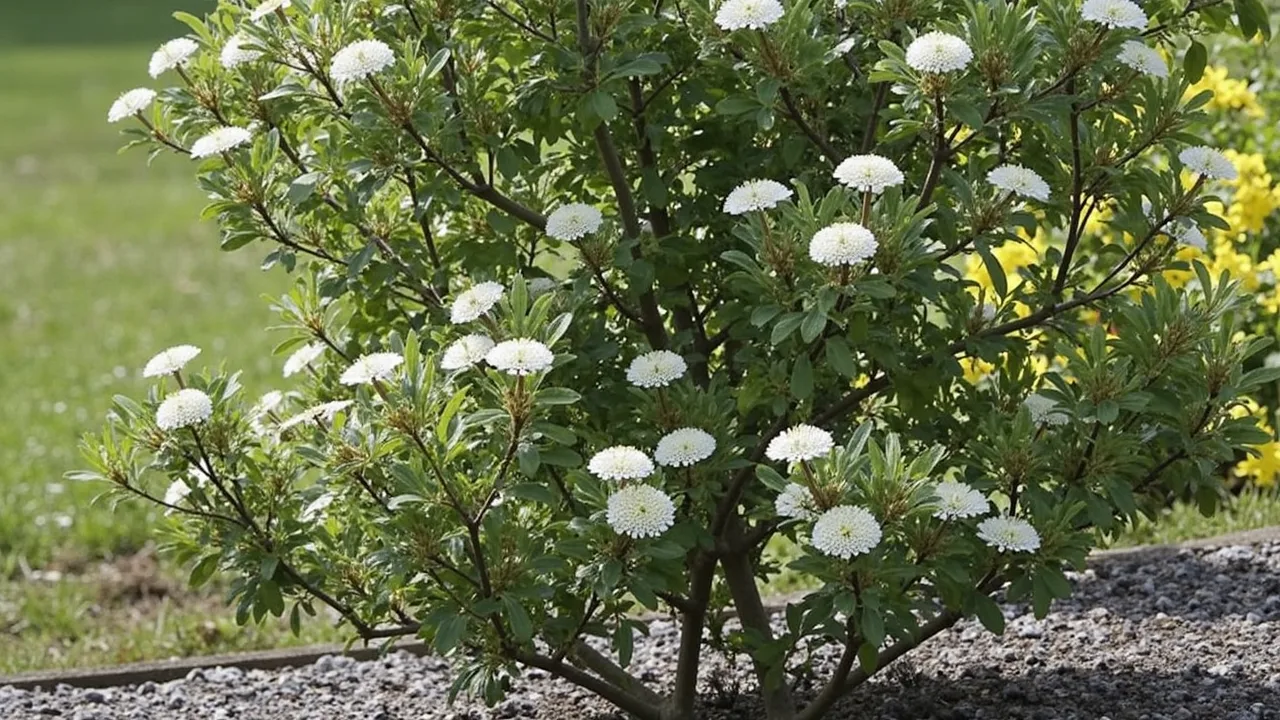
The flowers appear in late May and June in flat-topped terminal corymbs 5 to 10 cm across. Each individual flower is small, five-lobed, creamy-white and faintly fragrant; together they form the dense, slightly domed "lacecap" heads typical of the genus. Bees, hoverflies and other pollinating insects visit the flowers freely.
The fruit is a small oval drupe borne in heavy clusters that often weigh down the shoot tips. Berries ripen unevenly, so a single cluster commonly carries bright red, deep crimson and fully black fruit at the same time through July, August and into September. The black, ripe berries are a useful food source for thrushes, blackcaps and other garden birds, though they are not considered edible for humans and can cause mild gastric upset if eaten in quantity.
Growing Conditions
Viburnum lantana is among the most adaptable of the hardy viburnums and grows well across most of the UK. It thrives in full sun but tolerates light, dappled shade, making it useful at the back of a mixed border, on the edge of a woodland garden, or as part of a native mixed hedge. The species is particularly associated with calcareous soils and is one of the best viburnums for chalk ground; it also grows reliably on free-draining clay and on ordinary loam, only failing on ground that lies waterlogged through winter. A neutral to alkaline pH is ideal, but the shrub is generally tolerant of mildly acidic conditions provided the soil is not boggy.
The RHS rates Viburnum lantana as H5, meaning it is hardy across the whole of the UK including most lowland and upland Scotland, tolerating winter temperatures in the region of -10 to -15 °C without serious damage. It performs well in coastal and exposed sites, as the downy-backed leaves and dense habit help it shrug off wind, and it is notably drought-tolerant once its root system is established, coping well with the dry soil often found at the base of walls and fences. A shortcoming in very dry summers is that prolonged drought can lead to some leaf scorch and a reduced berry crop, so a deep soak in extended dry spells is worthwhile on lighter soils.
Planting and Care
Plant bare-root specimens between October and March, and container-grown plants at any time of year provided the ground is not frozen or waterlogged. For a standalone shrub, allow a spread of 2.5 to 4 m; for a hedge or screen, plant at 1.5 to 2 m intervals. Dig a hole twice the width of the rootball, set the plant at the same depth it sat in the nursery, backfill with the native soil improved with a forkful of well-rotted garden compost, and water in thoroughly. A spring mulch of compost or bark helps conserve moisture and keeps the root run cool through the first summers.
Once established, watering is rarely needed except in extended drought. Feeding should be modest: a single light application of a general-purpose fertiliser in early spring, or a top-dressing of garden compost, is sufficient on most garden soils, and over-rich ground tends to produce leafy growth at the expense of flowers and berries. Pruning is minimal. After flowering in late June or July, remove any dead, damaged or crossing stems and lightly shape the canopy if needed; the species does not respond well to hard cutting into old wood, so renovation pruning is best avoided. If size reduction is essential, spread the work over two or three seasons rather than cutting the whole plant back in one go.
Propagation is straightforward from seed (after a period of warm then cold stratification) or, more reliably for cultivars, from semi-ripe cuttings taken in mid- to late summer. Heel cuttings of 8 to 12 cm root readily in a gritty, free-draining compost under a cold frame or in a shaded corner of the garden. Established low branches can also be layered by pegging a flexible shoot into the soil and severing it once rooted. Seasonal care in the UK follows a simple rhythm: a light spring tidy and feed, deadheading not required, minimal summer watering, and a final check for crossing or damaged stems after flowering.
Common Problems
Viburnum lantana is generally a healthy, low-maintenance shrub, but a few issues are worth watching for. The viburnum beetle (Pyrrhalta viburni) is the most familiar pest across the genus: larvae and adults chew the foliage, producing the characteristic lacy, tattered look with small irregular holes, and a heavy attack can defoliate a plant by midsummer. On garden-sized plants, larvae can be picked off by hand in late spring, and affected shoots pruned out and destroyed. Aphids sometimes cluster on the soft young shoot tips in May, encouraging sooty mould; they are usually controlled by natural predators and only need treatment in severe cases.
Fungal leaf spot, caused by a range of pathogens, can produce brown or black blotches on the foliage in damp summers, but it is generally cosmetic and can be managed by improving air circulation and clearing up fallen leaves. Honey fungus (Armillaria spp.) is the most serious disease threat: it causes sudden wilting, die-back and white, fan-shaped mycelium beneath the bark at the collar, and affected plants should be dug up and burned along with as much of the root system as can be removed. Powdery mildew, appearing as a white coating on the leaves in dry, crowded conditions, is uncommon but can occur in still, shaded spots.
Poor flowering or sparse berry set is most often a sign of too much shade, hard pruning into old wood, or an over-rich, nitrogen-heavy feed regime. The berries should not be eaten; ingestion in quantity can cause mild stomach upset, although the fully ripe, black fruits are far less toxic than the unripe red ones and cases of serious poisoning are rare.
Popular Varieties
Viburnum lantana 'Aureum' is a slow-growing, golden-leaved form whose young foliage emerges a clear yellow before softening to yellow-green in summer; it is best in light shade, where the leaves are less likely to scorch, and reaches around 2.5 to 3 m. 'Rugosum' is a vigorous selection with noticeably larger, more heavily wrinkled and textured leaves than the type, giving the shrub a bolder appearance in the garden; it makes a fine specimen on its own and is sometimes offered simply as the large-leaved wayfaring tree. 'Variegatum' is an old garden form with cream-edged leaves, valued for its quieter, lighter colouring in mixed plantings. The straight species, sold simply as Viburnum lantana, is itself the most widely planted form and remains the best choice for a wildlife or naturalistic hedge, where its vigorous habit and heavy berry crops are the main attractions.
Pests and Diseases
| Problem | Symptoms | Management |
|---|---|---|
| Viburnum beetle | Leaves become skeletonised with only veins remaining, often causing significant defoliation. | Pick off adult beetles by hand or apply a systemic insecticide if infestations are severe. |
| Aphids | Clusters of small soft-bodied insects on new growth, often accompanied by sticky honeydew. | Squash colonies by hand or spray with a horticultural oil or insecticidal soap. |
| Phytophthora root rot | General decline, yellowing leaves, and wilting due to waterlogged soil conditions. | Ensure well-drained soil and avoid overwatering; remove severely affected plants. |
| Honey fungus | Slow decline with white fungal threads at the base and gumming on stems. | Improve drainage and air circulation; remove infected roots and soil if possible. |
| Grey mould (Botrytis) | Fuzzy grey growth on flowers, buds, or leaves, particularly in damp weather. | Remove affected material and improve air circulation around the plant. |
| Leaf spot | Distinct dark or brown spots appearing on the foliage, sometimes causing premature leaf drop. | Rake up fallen leaves to reduce spores and avoid wetting foliage when watering. |
For step-by-step help, read Controlling Aphids Naturally. Or browse the full plant problem solver to diagnose an issue by symptom.
As an Amazon Associate, GardenWizz earns from qualifying purchases made through links on this page (including links within the article). This does not affect the price you pay. See our disclaimer for details.