American Century Plant
Agave americana
The Gardening Year
Best months in UK gardens · full planting calendar →
🖨 Printable care card (PDF)At a Glance
| Botanical name | Agave americana |
|---|---|
| Common name(s) | American century plant |
| Family | Asparagaceae |
| Plant type | succulent (Monocarpic; flowers only once at the end of its life (typically 10-30 years) and then dies, producing adventitious shoots from the base.) |
| Height × Spread | 1–9 m × 0.5–3 m |
| Position | Full sun |
| Soil | Very free-draining, gritty soil; peat-free cactus compost or multi-purpose compost mixed with horticultural grit/perlite. |
| Flowering | June–August |
| Toxicity | Potentially harmful; skin irritant. Harmful if eaten by pets (dogs, cats). |
| Native range | Mexico and the United States (specifically Texas) |
Agave americana, the century plant or American agave, is a monumental evergreen succulent grown for its blue-grey rosette and strongly architectural form. In Britain it is most reliable in a large container that can spend summer outdoors and winter under bright, dry cover.
Overview
Native to Mexico, Agave americana belongs to the asparagus family, Asparagaceae, and is one of the best-known large agaves. Its common name, century plant, suggests an exact lifespan that the plant does not have. A rosette grows for many years, flowers once when mature and then dies. This life cycle is described as monocarpic. Basal offsets usually develop before or after flowering, so an established clump can continue even though the flowering rosette is lost.
In the UK, Agave americana is chiefly an ornamental plant for a sunny terrace, gravel garden, courtyard or conservatory. Its broad spread, formidable teeth and sharply pointed leaves rule out cramped positions. A movable container is the practical choice in most districts, combining an outdoor display in the warmer months with protection from winter cold and persistent rain. Permanent outdoor planting is a specialist option for exceptionally mild, dry, sheltered gardens, where excellent drainage is essential and winter losses remain possible.
This is a slow investment in structure rather than a plant grown for dependable bloom. Its foliage gives colour and presence throughout the year, while established plants cope well with dry conditions. The species is unsuitable beside narrow paths, doors, play areas or frequently used seating. Allow for its eventual width from the outset, and place the pot where it will not need to be manoeuvred often once heavy.
Appearance
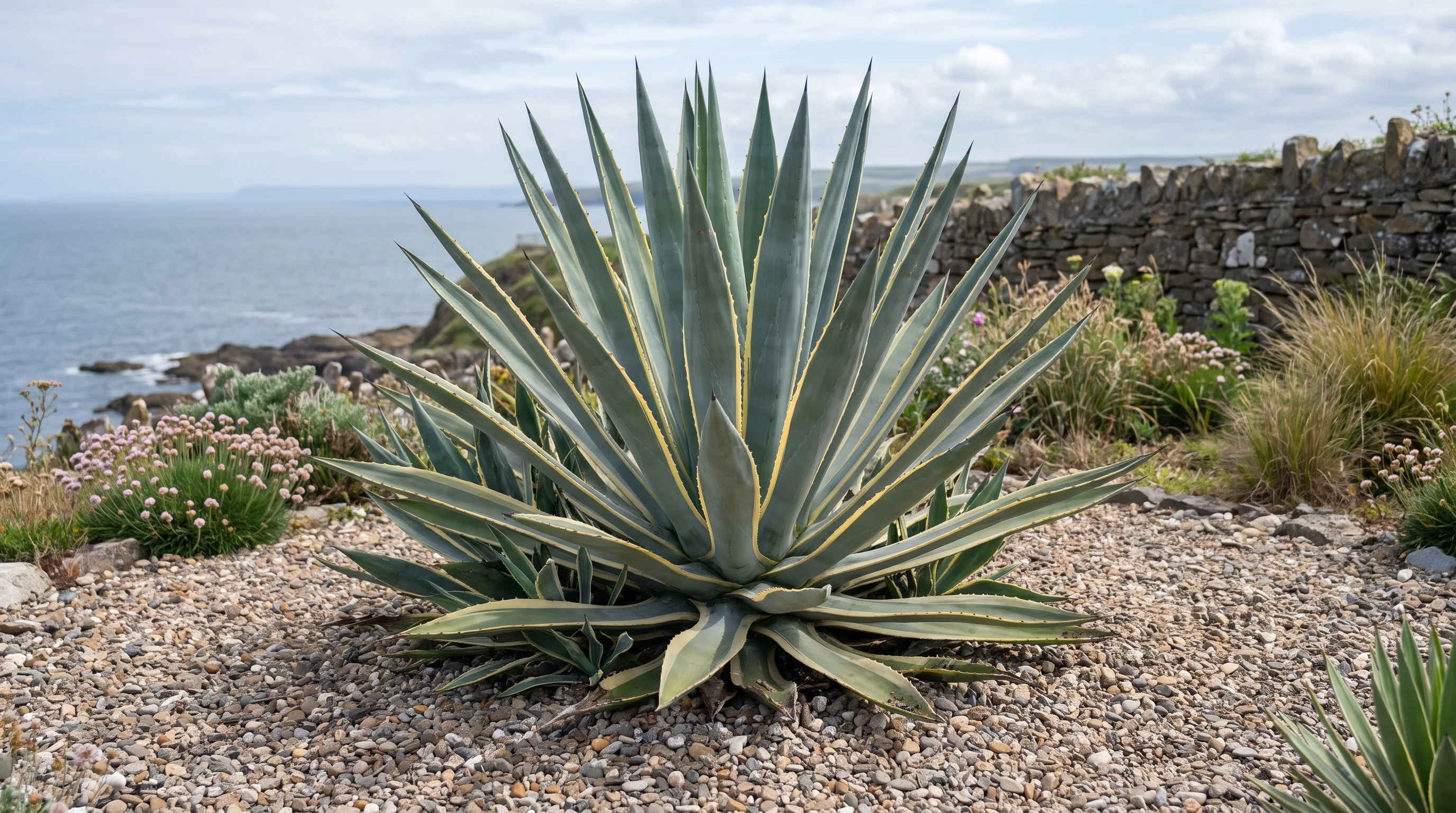
The plant forms a symmetrical basal rosette of thick, rigid, sword-shaped leaves. New foliage emerges tightly from the centre, then expands outwards and slightly upwards. The leaves are typically blue-green to grey-green, often with a powdery surface that softens their colour. Each one carries hooked teeth along its margins and ends in a hard terminal spine. Older lower leaves eventually angle downwards and may dry naturally as the rosette enlarges.
An unrestricted specimen can reach about 1.5–2 m in height and spread 2–3 m across, although size varies with clone, climate and growing conditions. Container restriction usually produces a smaller plant, but a mature rosette can still become exceptionally heavy and top-heavy. Offsets, sometimes called pups, arise around the base and gradually create a broader clump unless removed.
Flowering is a dramatic but uncommon event in Britain. A mature rosette sends up a stout, branched stem that may rise several metres above the foliage. Numerous yellow-green flowers are carried on the upper branches. The energy used in this single reproductive effort exhausts the main rosette, which declines afterwards. Any healthy offsets can then be retained as replacements. Plants grown in containers or under UK conditions may remain vegetative for decades, so flowers should be regarded as a rarity rather than an expected seasonal feature.
Growing Conditions
Full sun produces the strongest growth and best foliage colour. Choose a warm, bright site with shelter from excessive rain and cold winds. Plants moved outdoors for summer should be acclimatised gradually: several days in bright shade followed by increasing exposure reduces the risk of scorched leaves. Turn container specimens periodically only if it is safe to do so, as light from one direction can pull the rosette out of symmetry.
Drainage is the overriding requirement. In a pot, use a peat-free cactus and succulent compost or an open compost amended generously with coarse horticultural grit or other mineral drainage material. The container must have an unobstructed drainage hole. A wide, heavy terracotta pot helps counter the weight of the foliage, although it also makes moving the plant harder. Never allow the base to stand in a saucer of water.
For outdoor planting, a raised bed, gravel garden or pronounced slope is safer than level, moisture-retentive ground. Sandy or gritty loam is preferable; heavy clay is unsuitable unless drainage can be transformed over a broad area rather than merely within the planting hole. Soil need not be rich. Excess fertility and shade encourage softer, weaker growth that is less able to withstand poor winter conditions.
Under cover, provide maximum useful winter light and good air movement without cold draughts. A bright greenhouse, conservatory or similar dry, protected place is appropriate. The combination of low light, wet compost and cool conditions is much more damaging than dryness. Leaves should not press against cold glass, and the rosette needs enough room for air to circulate between its outer leaves and neighbouring plants.
Planting and Care
Plant or repot in spring, commonly during March or April, when increasing light allows roots to resume active growth. Select a container only modestly larger than the rootball; an oversized volume of damp compost dries too slowly. Set the crown at the same level as before, firm the gritty compost around the roots and leave space below the rim for watering. Thick gloves, eye protection and long sleeves are sensible whenever the plant is handled. Wrapping the rosette loosely in folded cardboard can make a smaller specimen safer to manage without crushing its leaves.
From spring through summer, water thoroughly and then wait until the compost has dried before watering again. The interval matters more than a fixed timetable: a small plant in warm sunshine dries faster than a large pot in dull weather. Recently planted specimens need monitoring while roots establish, whereas mature plants tolerate drought. Reduce water sharply as growth slows in autumn and keep the rootball almost dry during winter. Do not pour water into the crown, especially in cool conditions.
Feed sparingly. Container plants can receive a dilute cactus fertiliser a few times during active growth, but freshly repotted plants generally need no immediate feed. Avoid high-nitrogen or frequent general-purpose fertilisers, which promote lush, vulnerable tissue. Outdoor plants in lean ground rarely need supplementary feeding.
No routine pruning or shaping is required. Remove only completely dead or badly damaged lower leaves, using clean, sharp tools and cutting without injuring the living crown. Do not clip brown tips merely for symmetry, because each cut creates another conspicuous dry edge. The sap may irritate skin, while the teeth and terminal spines can injure; protect skin and eyes, keep tools clean and dispose of cut leaves where nobody will grasp them accidentally.
Propagation is most dependable from offsets. In spring or summer, select a well-developed pup, ideally with roots of its own, and separate it cleanly from the parent. Allow a damaged or freshly cut base to dry and callus before setting it into a small pot of gritty compost. Keep it bright and only lightly watered until new growth indicates rooting. Seed propagation is possible where viable seed is available, but flowering and seed production are too uncommon in UK-grown plants for this to be the usual method.
Move container plants outdoors only after the local risk of frost has passed, often in May, and acclimatise them to direct sun. During September or October, monitor forecasts and return them to dry cover before damaging weather arrives. Check the plant, pot and leaf bases for pests before bringing it among other protected plants. Large specimens demand advance planning: use a pot trolley, recruit suitable help and avoid lifting a heavy, spiny rosette by its leaves.
Common Problems
Root and crown rot are the most serious problems. Warning signs include a sour smell, blackened or translucent tissue, sudden collapse and leaves pulling loose from the base. Causes usually include blocked drainage, waterlogged compost, water trapped in the crown or the combination of cold and wet conditions. Stop watering, remove affected tissue where damage is limited and reassess the roots and compost. Advanced crown decay is often irreversible, but sound offsets may still be saved.
Mealybugs hide as white, waxy clusters deep between the leaves, while scale insects resemble small brown or pale shells attached to foliage. Both can weaken a plant and are harder to control once lodged inside a dense rosette. Inspect with a torch, isolate an affected specimen and use a treatment approved for the setting and pest, following its label exactly. Glasshouse red spider mite can cause fine pale mottling and webbing in hot, dry, enclosed conditions. Better ventilation and prompt isolation help limit its spread. Slugs and snails may rasp scars into young leaves, especially while pots stand outdoors.
Brown tips or patches are not automatically disease. Old wounds remain visible because an agave leaf does not repair damaged tissue. Abrasion, sudden exposure to strong sun, a cold surface or erratic watering can all leave marks. Soft, spreading discoloration is more concerning than a dry, stable scar. Yellowing combined with a soft base points towards excess moisture; stretched, weak or unusually green growth suggests insufficient light.
The plant's physical defences are also a practical hazard. Site it beyond normal reach, never at face level, and avoid positions where a visitor could back into it. Its sap can irritate the skin, and cut surfaces require careful handling. Children and pets should not have access to the plant or discarded leaves.
Popular Varieties
Several variegated selections offer the same sculptural habit with brighter foliage. Names in the nursery trade can be inconsistent, so buy labelled plants from a reputable supplier and judge the actual leaf pattern as well as the name.
- Agave americana 'Marginata' has blue-green leaves edged broadly in yellow, making the rosette appear brighter and emphasising each leaf outline.
- Agave americana 'Mediopicta Alba' carries a broad creamy-white central stripe bordered by grey-green leaf tissue. It is often more compact than the plain species.
- Agave americana 'Mediopicta Aurea' has a bold yellow stripe through the centre of each blue-green leaf and produces a strongly contrasting rosette.
- Agave americana 'Variegata' is another established variegated selection, generally grown for yellow-and-green foliage; the precise pattern offered under this name can vary between suppliers.
Variegated plants contain less green tissue and may grow more slowly than the species. They still need excellent drainage and strong light, but newly exposed foliage should be introduced to intense sun gradually. Their pale areas also make scorch and physical damage more noticeable. As with the plain form, container culture gives UK gardeners the greatest control over winter conditions, watering and eventual placement.
Pests and Diseases
| Problem | Symptoms | Management |
|---|---|---|
| Scale insects | Small, immobile, waxy bumps appear on stems and leaves. | Rub off with a cotton bud dipped in methylated spirit or use an insecticidal soap. |
| Root rot | Leaves become soft, mushy, and discoloured due to waterlogged soil. | Ensure sharp drainage with gritty compost and avoid watering during winter dormancy. |
| Vine weevil | Semi-circular notches on leaf margins and wilting caused by root damage. | Apply nematodes to the soil in autumn or use a systemic insecticide drench. |
| Mealybug | White, cottony fluff accumulates in leaf axils and on stems. | Isolate the plant and treat with a suitable horticultural oil or insecticide. |
| Winter wet damage | Leaves turn translucent, grey, or black and collapse from cold moisture. | Protect outdoor plants with a cloche or clear plastic sheeting in winter. |
Or browse the full plant problem solver to diagnose an issue by symptom.
Recommended Products
GardenWizz earns a commission from qualifying purchases made through affiliate links on this page (including links within the article) — as an Amazon Associate, and from Thompson & Morgan via the Awin network. This does not affect the price you pay. See our disclaimer for details.