Kalanchoe
Kalanchoe
The Gardening Year
Best months in UK gardens · full planting calendar →
🖨 Printable care card (PDF)At a Glance
| Botanical name | Kalanchoe |
|---|---|
| Common name(s) | Kalanchoe |
| Family | Crassulaceae |
| Plant type | succulent (Most are shrubs or perennial herbaceous plants, but a few are annual or biennial.) |
| Height × Spread | 6 m × — |
| Position | — |
| Soil | free-draining, cactus compost |
| Flowering | February–May |
| Toxicity | Contains bufadienolide compounds with sedative effects, positive inotropic effects associated with cardiac glycosides, and increasing effect on the central nervous system with greater doses. |
| Native range | Madagascar and tropical Africa; also found in south-eastern Asia and China. One species originates from the Americas. |
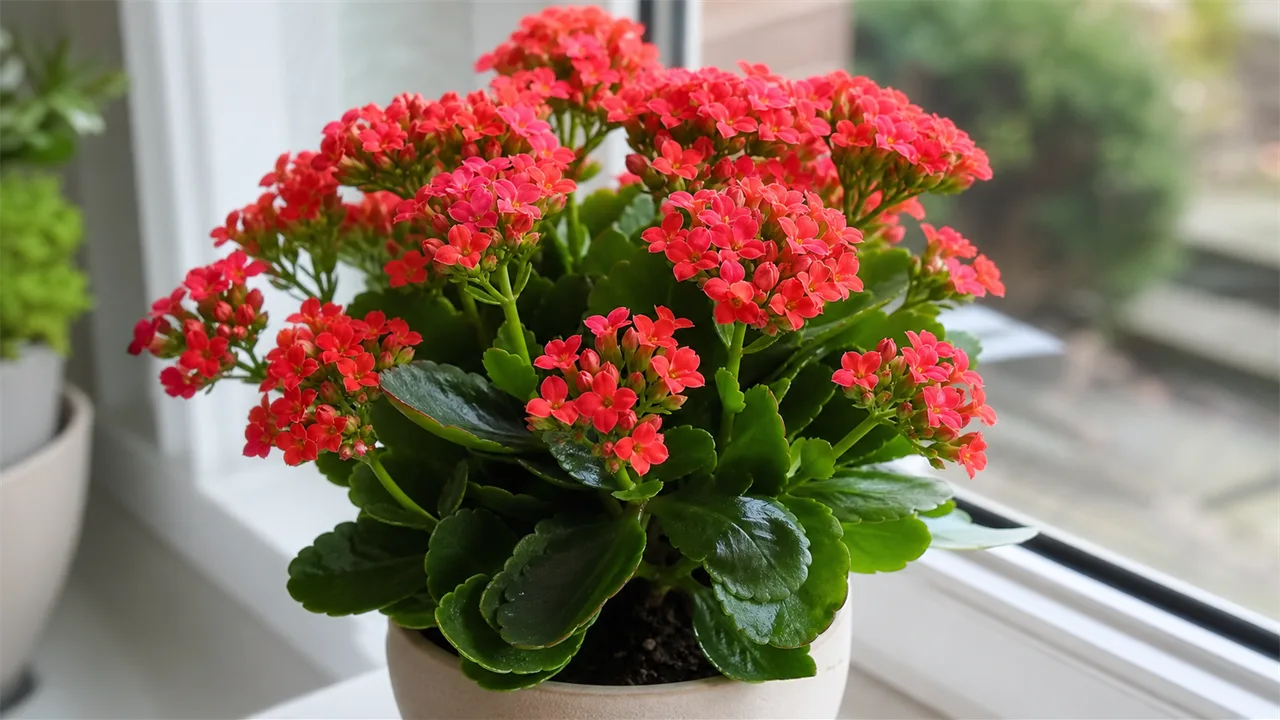
The bright little florist's kalanchoe on a supermarket shelf in February is one of the easiest ways to bring six weeks of colour into a cold British windowsill. Sold in clusters of red, pink, orange, yellow or white, Kalanchoe blossfeldiana — widely known as Flaming Katy — is the species most UK gardeners will recognise, but it sits inside a much larger genus of around 125 species of succulent, mostly native to Madagascar and tropical Africa. In UK conditions the genus is treated as a tender indoor or conservatory plant, and that single fact shapes everything else about how to grow it well.
| Kalanchoe Adans. | Kalanchoe (Flaming Katy for K. blossfeldiana) | Tender succulent perennial | Tender (RHS hardiness rating published; under glass all year, outside in summer) | Bright, filtered light | Peat-free, loam-based with added grit; free-draining | Late winter into spring (K. blossfeldiana indoors) | 20-60 cm tall in cultivation; some species reach 1 m+ |
Overview
Kalanchoe is a genus of succulent flowering plants in the family Crassulaceae. Most species form compact, upright bushes 20-60 cm tall in cultivation, with thick fleshy leaves arranged in opposite pairs. Flowers are small, four-petalled and carried in dense terminal clusters; in the popular K. blossfeldiana cultivars these clusters cover the plant for six to eight weeks in a cool room. All parts of the plant contain bufadienolide cardiac glycosides and are toxic to cats, dogs and other small animals if eaten, so positioning matters in pet households. The RHS holds an Award of Garden Merit for the genus, and K. blossfeldiana has a published RHS hardiness rating that places it firmly under glass — essentially "under glass all year, can be moved outside in summer" — which confirms what most UK growers discover for themselves: this is a houseplant, not a hardy border perennial.
Appearance
The "look" of a kalanchoe depends on the species, but a few traits carry across the genus. Leaves are thick, waxy and fleshy, usually glossy mid-green, and they hold water in the same way that a sedum or a Crassula does. In K. blossfeldiana the leaves are oval with scalloped edges, often 5-10 cm long. In K. tomentosa, the panda plant, they are lance-shaped and densely covered in silvery-white felt with small brown teeth along the margins. In K. beharensis, the felt bush, they are large, triangular and olive-bronze, dusted in coppery hairs. In K. luciae, the paddle plant or flapjacks, they are flat, round and stacked, flushing red on the edges in good sun.
Flowers are the headline feature. On K. blossfeldiana they are small, four-petalled and star-shaped, packed into tight domed cymes that can cover the top of the plant. The Calandiva series offers double, rose-bud-like blooms in the same colour range. Colours run from white through cream, yellow, orange, salmon, pink, magenta and red, and the natural flowering season is late winter into spring, which is exactly when UK gardeners buy them as indoor colour.
The compact size of the pot-grown K. blossfeldiana (20-50 cm tall) is the form most people picture, but in the wild several species become large shrubs. K. beharensis can exceed 1 m in ideal conditions, and K. arborescens grows into a small tree. Indoors in the UK, plants stay small and well-behaved, which is part of the appeal.
Growing Conditions
Kalanchoe is a sun-lover that resents wet feet. The RHS recommends bright, filtered light indoors: a south- or west-facing windowsill is ideal, and an east-facing window will also work. In summer UK plants can be stood outside once nights are reliably above 10 °C, but direct midday sun through glass can scorch the leaves, so a sheer curtain or a position one step back from the window is safer in June and July.
Temperature is the main constraint. Kalanchoe is not frost-tolerant, and most species suffer below 10 °C. The comfortable range is 15-25 °C, which matches the average UK living room. Conservatory growers need to watch ventilation in heatwaves — these plants like warmth but not the stagnant, humid air that encourages fungal disease.
Compost must be free-draining. The RHS recommends a peat-free, loam-based potting compost with added extra grit for sharp drainage, and a cactus and succulent mix is also suitable. Standard multi-purpose compost holds too much water for a kalanchoe and is the usual starting point for root rot.
Water sparingly. Allow the top 2-3 cm of compost to dry out between waterings in summer, and reduce further in winter when the plant is slower-growing. Humidity is rarely an issue — ordinary UK household humidity is fine — and no misting is required. Feeding is light: a half-strength balanced liquid feed once a month during spring and summer is plenty; do not feed in winter.
Planting and Care
Pot choice matters more than brand. Terracotta with a drainage hole is the conventional choice because it wicks moisture away from the rootball and lets air in through the sides. A 13 cm terracotta pot is a good starting size for a single mature K. blossfeldiana. Kalanchoe prefers to be slightly pot-bound, which both encourages flowering and reduces the risk of waterlogging. Repot every two to three years in spring, moving up only one pot size and refreshing the compost.
Deadheading is the single most useful job. Once the colour starts to fade on a flower cluster, cut the entire stem back to the base with clean secateurs — this tidies the plant and redirects energy back into the leaves. Pinching back leggy stems in spring keeps the plant compact and bushy.
Re-blooming a K. blossfeldiana indoors is a deliberate project. It is a short-day plant, which means it sets flower buds only when daylight drops below a certain length. To force a second flush, give the plant 14 hours of complete darkness for six weeks in autumn — a black bin liner draped over a cardboard box works, or a spare room with no artificial light after dusk. After six weeks, bring it back into normal light and resume monthly feeding. Many UK gardeners simply treat flowering kalanchoes as seasonal pot plants and replace them, which is also a perfectly reasonable approach.
Summer placement is straightforward once nights are above 10 °C: stand the pot outside in a sheltered, bright spot — a courtyard, a patio table, or against a south-facing wall. Bring it back indoors before the first frosts, which in most UK regions arrive in October.
Propagation is easy. Stem cuttings root readily in gritty compost kept just barely moist. Take a 5-8 cm cutting, allow the cut end to callus over for 24 hours, then insert it into a mix of cactus compost and perlite. Leaf cuttings also work for many species. In the "mother of thousands" group (K. daigremontiana, K. delagoensis), the plantlets that form along the leaf edges will root themselves if laid on the surface of compost.
Common Problems
Overwatering is the most common cause of failure. Yellowing, translucent leaves and a soft, mushy stem base are the usual signs. Prevention is far easier than cure: use a free-draining gritty mix, allow the compost to dry between waterings, and never let the pot sit in a saucer of water. A collapsed plant cannot usually be rescued.
Mealybugs are the most frequent indoor pest. White cottony tufts appear in leaf axils and on the underside of leaves, often with sticky honeydew. Treat early by dabbing the spots with a cotton bud dipped in 70 % alcohol, or use a soft soap spray. Heavy infestations warrant a systemic insecticide approved for houseplants.
Powdery mildew shows up as a white dusty coating on leaves and stems in stagnant, humid indoor air. Improve ventilation, reduce watering, and remove affected leaves. A sulphur-based or potassium bicarbonate fungicide is acceptable on indoor plants if the problem persists.
Aphids occasionally cluster on new spring growth, causing distorted leaves and sticky residue. A strong jet of water or a spray of insecticidal soap usually clears them.
Etiolation (legginess) is not a pest or disease but a symptom: stretched, pale growth means the plant needs more light. Move it to a brighter windowsill and new growth will be more compact.
Toxicity to pets and humans. All kalanchoes contain bufadienolides and are toxic to cats, dogs and other small animals if eaten, causing vomiting, diarrhoea and, in larger quantities, cardiac arrhythmias. The RHS marks K. blossfeldiana as "harmful if eaten". Keep plants out of reach of pets and small children.
Popular Varieties
Kalanchoe blossfeldiana (Flaming Katy) — the florist's kalanchoe, with dense heads of small four-petalled flowers in red, pink, yellow, orange or white; the form most UK gardeners will encounter.
Kalanchoe blossfeldiana Calandiva series — double-flowered sports of blossfeldiana with rose-bud-like blooms in the same colour range, longer-lasting in cooler rooms.
Kalanchoe tomentosa (Panda Plant) — silvery-grey, densely felted leaves with chocolate-brown toothed margins, grown for foliage rather than flowers.
Kalanchoe beharensis (Felt Bush) — large triangular felted olive-bronze leaves on a shrubby plant that can exceed 1 m in ideal conditions.
Kalanchoe luciae (Paddle Plant / Flapjacks) — large flat round leaves that flush red at the edges in good light, frequently sold alongside K. thyrsiflora which is often mislabelled in the trade.
Kalanchoe daigremontiana (Mother of Thousands) — tall stems with spotted spear-shaped leaves edged in plantlets, propagated by dropping the plantlets onto compost.
Kalanchoe 'Magic Bells' — a hybrid with long-lasting pendant tubular flowers, listed by the RHS as a distinct cultivar.
Kalanchoe tomentosa 'Nigra' — a select form of the panda plant with darker leaf markings.
Sources & Further Reading
- RHS — Kalanchoe blossfeldiana / Flaming Katy plant profile: rhs.org.uk/plants/78810/kalanchoe-blossfeldiana/details (accessed 2026-07-25)
- RHS — Kalanchoe 'Magic Bells' plant profile: rhs.org.uk/plants/217441/kalanchoe-magic-bell/details (accessed 2026-07-25)
- RHS — Powdery mildews advice: rhs.org.uk/disease/powdery-mildews (accessed 2026-07-25)
- BBC Gardeners' World — How to grow kalanchoe: gardenersworld.com/house-plants/how-to-grow-kalanchoe/ (accessed 2026-07-25)
- Wikipedia — Kalanchoe genus overview: en.wikipedia.org/wiki/Kalanchoe (accessed 2026-07-25)
- ASPCA — Toxic and Non-Toxic Plants: Kalanchoe: aspca.org/pet-care/animal-poison-control/cats-plant-list (accessed 2026-07-25)
- Missouri Botanical Garden — Kalanchoe blossfeldiana Plant Finder: missouribotanicalgarden.org/PlantFinder/PlantFinderDetails.aspx?kempercode=b561 (accessed 2026-07-25)
- Penn State Extension — Kalanchoe Diseases: extension.psu.edu/kalanchoe-diseases (accessed 2026-07-25)
Pests and Diseases
| Problem | Symptoms | Management |
|---|---|---|
| Root rot | Stems become soft, mushy and discoloured while leaves drop off easily. | Water only when the compost is completely dry and ensure pots have adequate drainage. |
| Mealybugs | White, cottony fluff appears in leaf axils and on stems, often accompanied by sticky honeydew. | Isolate the plant and treat with a systemic insecticide or dab spots with alcohol-soaked cotton. |
| Aphids | Small green or black insects cluster on new growth, causing distorted leaves and sticky residue. | Spray affected areas with a recommended insecticide or use a strong jet of water to dislodge them. |
| Powdery mildew | A white, dusty fungal growth covers the leaves and stems, often in humid conditions. | Improve air circulation around plants and apply a suitable fungicide if infection is severe. |
| Overwatering | Leaves turn yellow, become translucent and drop off while the stem base softens. | Allow the soil to dry out thoroughly between waterings and reduce frequency in winter. |
For step-by-step help, read Controlling Aphids Naturally and Treating Powdery Mildew. Or browse the full plant problem solver to diagnose an issue by symptom.
Recommended Products
GardenWizz earns a commission from qualifying purchases made through affiliate links on this page (including links within the article) — as an Amazon Associate, and from Thompson & Morgan via the Awin network. This does not affect the price you pay. See our disclaimer for details.