Bromfield's Living Stone
Lithops bromfieldii
The Gardening Year
Best months in UK gardens · full planting calendar →
🖨 Printable care card (PDF)At a Glance
| Botanical name | Lithops bromfieldii |
|---|---|
| Common name(s) | Bromfield's living stone |
| Family | Aizoaceae |
| Plant type | succulent |
| Height × Spread | 2–5 cm × — |
| Position | Full sun |
| Soil | well-draining soil |
| Flowering | September–November |
| Toxicity | — |
| Native range | Northern Cape Province of South Africa |
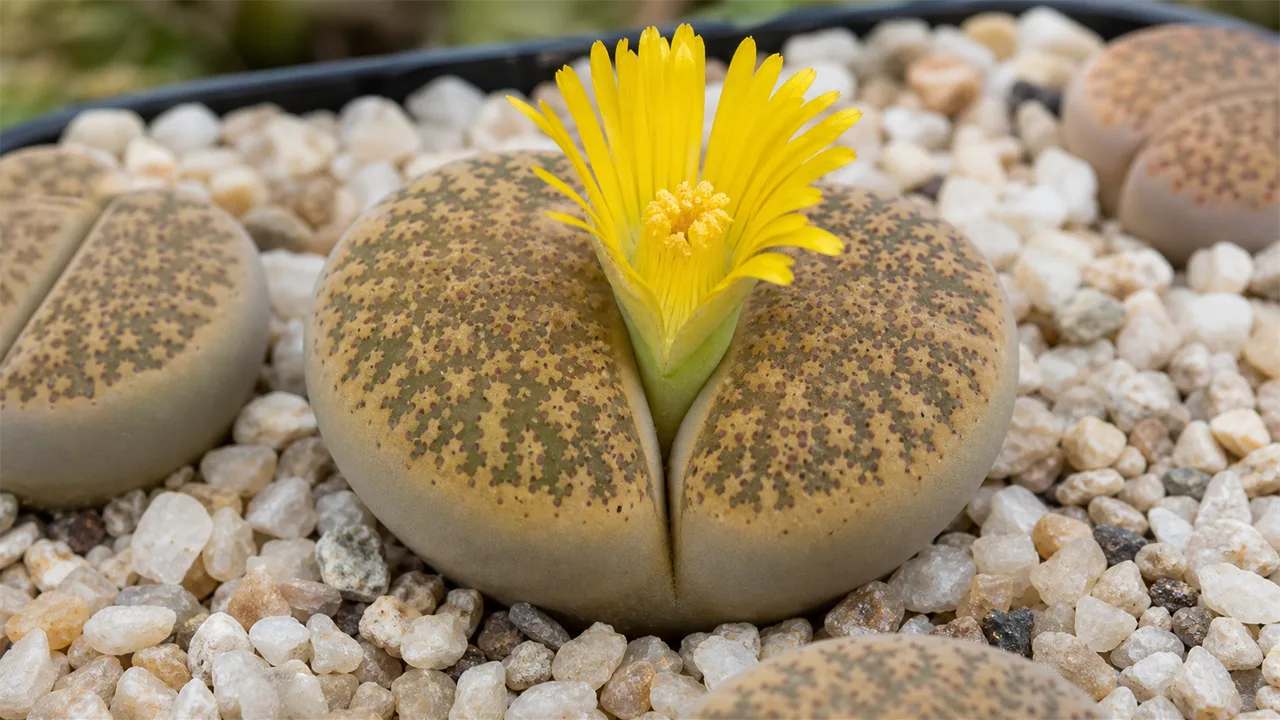
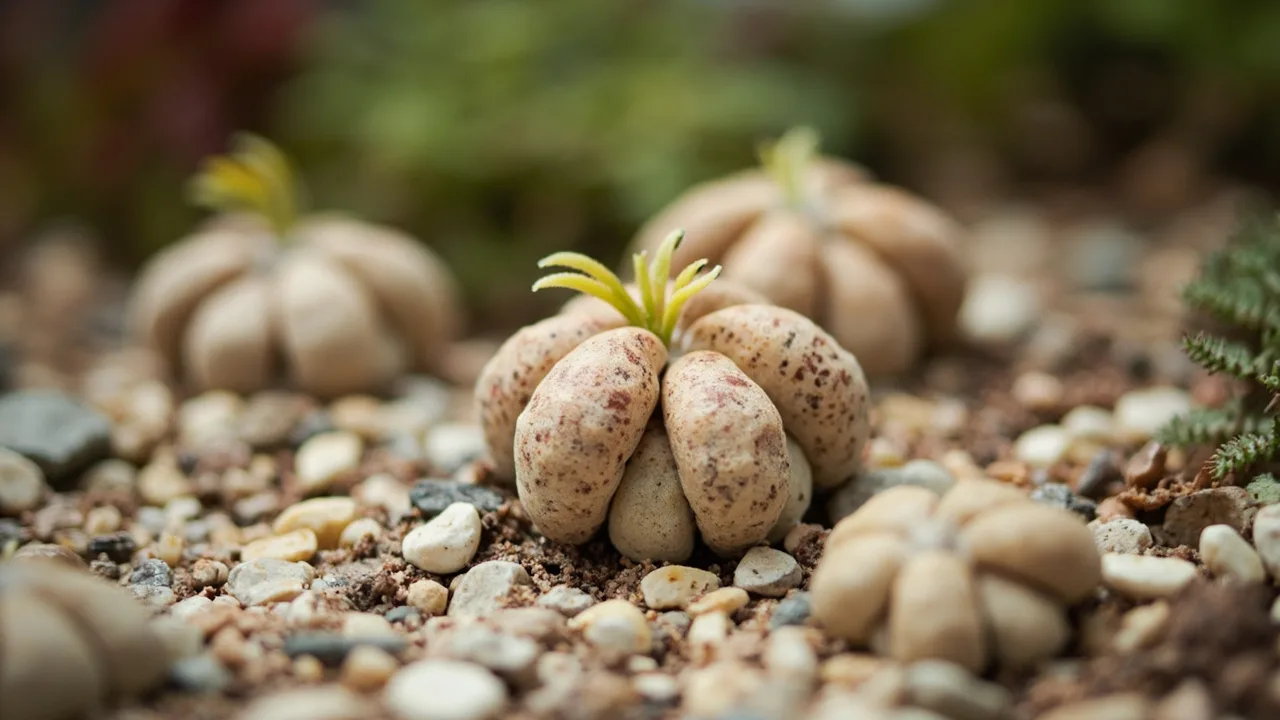
Lithops bromfieldii is a dwarf succulent whose two fleshy leaves sit so close to the soil that the plant often looks like a pebble with a slot cut across it. It is one of roughly 40 species in the genus Lithops, all of them mimicry plants from southern Africa, and among the most distinctive forms in cultivation, with bodies that range from grey-pink to deep plum and a single large yellow or white daisy-like flower that emerges from the fissure between the leaves in autumn.
Overview
Lithops bromfieldii is a member of the ice plant family, Aizoaceae, and is native to the winter-rainfall regions of South Africa, including Namaqualand, the Northern Cape and parts of the Western Cape. It was described by the South African botanist Louisa Bolus in the early twentieth century and takes its name from a 19th-century collector of South African flora. The species sits flush with the soil in habitat, growing among quartz chips and weathered rock on sandy or stony plains, where its mottled colours and reduced profile help it avoid being eaten by grazing animals.
In UK gardens Lithops bromfieldii is treated as a tender collector's plant rather than a border specimen. It is most often grown on a bright windowsill, in an alpine house, or in a heated greenhouse, where its winter-growing and summer-dormant cycle can be respected. It is widely sold by specialist succulent nurseries and is one of the easier lithops to bring into flower, thanks to its willingness to bloom from a relatively young age.
The species is closely related to Lithops aucampiae and Lithops karasmontana, and the genus as a whole shows considerable variation in body colour, fissure depth and window pattern. Lithops have no true stem; the visible "body" is in fact a pair of fused, highly succulent leaves, and almost all growth occurs through the annual leaf replacement that happens between late winter and early summer.
Appearance
The plant consists of one or more pairs of leaves, each pair forming a single unit called a body. A solitary body is roughly an inverted cone or top-shape, with a flattened upper surface 2–3 cm across and a tapering base that sits below the soil line. As the plant matures it produces offsets, slowly building clumps of two to ten bodies that share a common rootstock and form a tight, low colony.
The upper surface is the most diagnostic feature. It is divided into two lobes by a transverse fissure running across the top of the body, and may be almost flat, gently convex or slightly concave. Through this fissure the new leaf pair emerges each year, drawing moisture and reserves from the old pair, which dries away to a thin papery skin. The window tissue on the upper surface can be almost any shade of grey, brown, pink, rust, red or deep plum, and is usually marked with a network of paler channels and irregular islands that mimic the surrounding rock.
Flowering is the moment the plant stops being a stone. A single flower emerges from the fissure on a short tube, opening in late afternoon in the UK cultivation cycle. The blooms are daisy-like, 2–3 cm across, and are typically bright yellow in the type variety, though some forms have white petals. They are faintly scented and last about a week before closing for good. A healthy mature plant can flower every year from around its third year onward, and clumps often produce a flower from each body in the same season.
After pollination a small, woody seed capsule forms within the old leaf pair. The capsule is hydrochastic: it only opens when wetted, so in habitat the seeds are released by rain. In cultivation this feature is useful, as seed can be collected by watering a ripe capsule and catching the ejected seeds on a tray.
Growing Conditions
Lithops bromfieldii demands the conditions of its native habitat: strong light, very sharp drainage, low humidity in the dormant months, and a watering regime that follows the plant's natural rhythm. Getting these wrong is the cause of most failures with lithops in UK collections.
Light and aspect. The British Cactus and Succulent Society recommends at least five hours of direct sun per day, which in practice means a south- or east-facing windowsill or a high, unshaded bench in an alpine house. Insufficient light produces drawn, elongated bodies that lose their compact pebble shape and fail to flower. A plant that has been kept in poorer light should be acclimatised to stronger sun gradually over a couple of weeks to avoid scorching.
Temperature and air. As a South African winter-rainfall species, Lithops bromfieldii prefers cool, dry conditions through its winter rest. In the UK this means it is happy in an unheated room or greenhouse through the cooler months, well clear of any frost. The plant has an RHS hardiness rating that is rendered in the plant's badge; in practice, the more important figure is to keep it dry and frost-free in winter. High humidity combined with cold is the worst combination, as it encourages rot in the leaf bases. Air movement in a greenhouse is essential.
Soil and pot. The mix must be predominantly mineral. A typical UK recipe is two parts loam-based cactus compost to one part sharp grit (2–4 mm) and one part pumice or crushed LECA, with no peat. Terracotta pots are preferable to plastic, as they allow the sides of the root ball to dry out between waterings. Pots should be shallow — most lithops have a relatively short, carrot-like root — and only one size larger than the clump.
Planting and Care
In UK cultivation the year divides into a winter growing season and a summer rest, which is the opposite of a typical UK houseplant. New growers usually lose plants by watering them in summer, when the plant is actually dormant and cannot use the moisture.
Watering. From late August, when flower buds begin to show in the fissure, give a single thorough watering and then resume normal watering as the plant comes into growth. Through autumn and into early winter, water only when the top 1–2 cm of compost is bone dry, typically every two to three weeks. From late December, watering should be reduced further, and by late spring the plant should be kept almost dry. No water at all is needed during the leaf change in May and June; the old leaves supply everything the new pair needs. The first proper watering of the new season is usually given in late July or early August, once the old leaves have been fully absorbed.
Feeding. Lithops grow in very lean soils in habitat and need little fertiliser. A single half-strength feed with a low-nitrogen cactus fertiliser in early autumn, as flower buds are forming, is plenty. Too much nitrogen encourages soft, split bodies and a loss of the compact shape.
Re-potting. Most clumps are happy in the same pot for three to four years. Re-pot only at the start of the growing season, in late August or early September, using fresh dry mix. Damaged roots should be allowed to callus for a day or two before the plant is returned to its pot. Do not water for at least two weeks after re-potting.
Propagation. The simplest method is division of established clumps at re-potting time: gently separate the bodies and pot each clump into its own container, leaving the taproot intact. Seed is also a reliable route, though slower. Fresh seed germinates readily on a sterile, gritty mix kept just damp and covered with a clear lid until seedlings appear in two to three weeks. Seedlings should be kept growing without a true dormant period for their first two years, given light shaded water and protected from the strongest sun.
Seasonal care. In July and August the plant can stand outside in a sheltered, bright spot, but it must come back under cover before nights turn cold. Supplementary light in the darkest UK winter weeks helps prevent the elongation that leads to poor flowering the following autumn.
Common Problems
Lithops are tough plants once their dormancy is respected, but a few recurring issues catch out new growers.
Rotting bodies. The most common cause of death is watering during the summer rest. A body that turns soft, brown or mushy at the base is usually already lost; nearby bodies can sometimes be saved by removing the affected plant, stopping all watering and improving air movement. The fix is prevention: no water between leaf change and the first flowers.
Failure to flower. A plant that has reached a healthy size but refuses to flower is usually getting too much water, too much feed, or too little light. A true winter rest, with no water between December and late July, combined with at least five hours of direct sun, almost always restores flowering the following autumn.
Body splitting or doubling. New growers sometimes expect two pairs of leaves per body. In a healthy plant there is only one pair per body, and what looks like doubling is the natural growth of a new body from the old fissure. Persistent soft splitting and extra leaves point to over-feeding or over-watering, particularly in mid-summer.
Mealybug. The other common lithops pest is root or body mealybug, which appears as small white cottony tufts in the fissures or on the roots. A systemic insecticide labelled for succulents, or a few applications of 70 % isopropyl alcohol on a cotton bud for body infestations, will deal with light outbreaks. Heavy root infestations are best cleared by washing the roots, removing badly affected tissue and re-potting into fresh dry compost.
Sun scorch. Bodies moved from a shady position into full sun without acclimatisation can develop pale, papery patches on the upper surface. Move the plant into stronger light over two to three weeks, and the new growth will come through unmarked.
Popular Varieties
Three varieties of Lithops bromfieldii are well established in UK cultivation and are regularly offered by specialist nurseries.
Lithops bromfieldii var. menellii (often cited with field number C044) is the most commonly grown form. Its bodies are pale grey-pink to buff with a clear, opaque window rather than the more heavily patterned surface of the type, and the fissure is shallow. It is regarded as one of the easiest lithops for beginners and flowers reliably in UK collections.
Lithops bromfieldii var. insularis has more elongated, conical bodies with a network of deeper channels on the upper surface, giving a distinctly netted or "veined" appearance. It was originally described from a localised population around Keimoes in the Northern Cape and tends to be slower-growing than var. menellii, with bodies that sit closer to the soil.
Lithops bromfieldii var. glaudinae 'Embers' (field number C393A) is a selected cultivar with a markedly red to rust-coloured body and a distinctive dotted or stippled window. It is grown for its unusual colour rather than any growth difference, and commands a higher price in specialist lists. It needs the same cultivation as the species.
The plain type variety, also listed under field number C062, is the best choice for a first-time grower and is widely available from UK succulent nurseries.
Sources & Further Reading
- Royal Horticultural Society, Lithops cultivation advice and Aizoaceae plant records, source: rhs.org.uk, accessed 2026-07-23
- British Cactus and Succulent Society, Cultivation Notes on Lithops, source: bcss.org.uk/cultivation-notes-on-lithops/, accessed 2026-07-23
- BBC Gardeners' World, How to Grow Lithops, source: gardenersworld.com/house-plants/how-to-grow-lithops/, accessed 2026-07-23
- Horticulture.co.uk, Growing Lithops, source: horticulture.co.uk/blogs/growing/lithops, accessed 2026-07-23
- LLIFLE Encyclopedia of Succulents, Lithops bromfieldii var. menellii C044, source: llifle.com/Encyclopedia/SUCCULENTS/Family/Aizoaceae/13091/Lithops_bromfieldii_var._menellii_C044_TL:_25_km_SSW_of_Upington,_South_Africa, accessed 2026-07-23
- World of Succulents, Lithops bromfieldii (Living Stones), source: worldofsucculents.com/lithops-bromfieldii-living-stones/, accessed 2026-07-23
Pests and Diseases
| Problem | Symptoms | Management |
|---|---|---|
| Root rot | The plant becomes soft, mushy, and discoloured, often collapsing at the base. | Water sparingly, ensure excellent drainage with gritty compost, and allow soil to dry completely between waterings. |
| Mealybugs | White, cottony wax-like clusters appear in crevices and on the surface of the leaves. | Isolate the plant and treat with a systemic insecticide or dab spots with alcohol-soaked cotton. |
| Sunburn | Leaves develop bleached, white, or brown necrotic patches on exposed surfaces. | Acclimatise gradually to bright light and avoid placing in direct midday summer sun initially. |
| Overwatering | Leaves swell excessively, become translucent, or split prematurely before natural shedding. | Reduce watering frequency significantly, especially during winter dormancy and cloudy weather. |
Or browse the full plant problem solver to diagnose an issue by symptom.
Recommended Products
GardenWizz earns a commission from qualifying purchases made through affiliate links on this page (including links within the article) — as an Amazon Associate, and from Thompson & Morgan via the Awin network. This does not affect the price you pay. See our disclaimer for details.