Lithops dorotheae
Lithops dorotheae
The Gardening Year
Best months in UK gardens · full planting calendar →
🖨 Printable care card (PDF)At a Glance
| Botanical name | Lithops dorotheae |
|---|---|
| Common name(s) | Lithops dorotheae |
| Family | Aizoaceae |
| Plant type | succulent |
| Height × Spread | 2–3 cm × — |
| Position | Full sun |
| Soil | well-draining soil; coarse, well-drained substrate |
| Flowering | September–November |
| Toxicity | — |
| Native range | South Africa |
Lithops dorotheae crams an entire succulent into a pair of pebble-sized, fused leaves, then splits them open for a clean yellow daisy in early autumn. In Britain it sits happily on a sunny, frost-free windowsill, in a conservatory or under glass, where strict seasonal watering keeps it alive long enough to live up to its reputation as one of the most sought-after living stones.
Overview
Lithops dorotheae is one of the most distinctive members of the ice-plant family, Aizoaceae. It was described in 1939 by the South African botanist G.C. Nel, from material collected four years earlier near Pofadder in the Northern Cape. The species is restricted to a small range of quartzite ridges there, and the global wild population is small enough that the IUCN informally treats it as Endangered, which gives seed-raised cultivated plants real conservation value in UK collections.
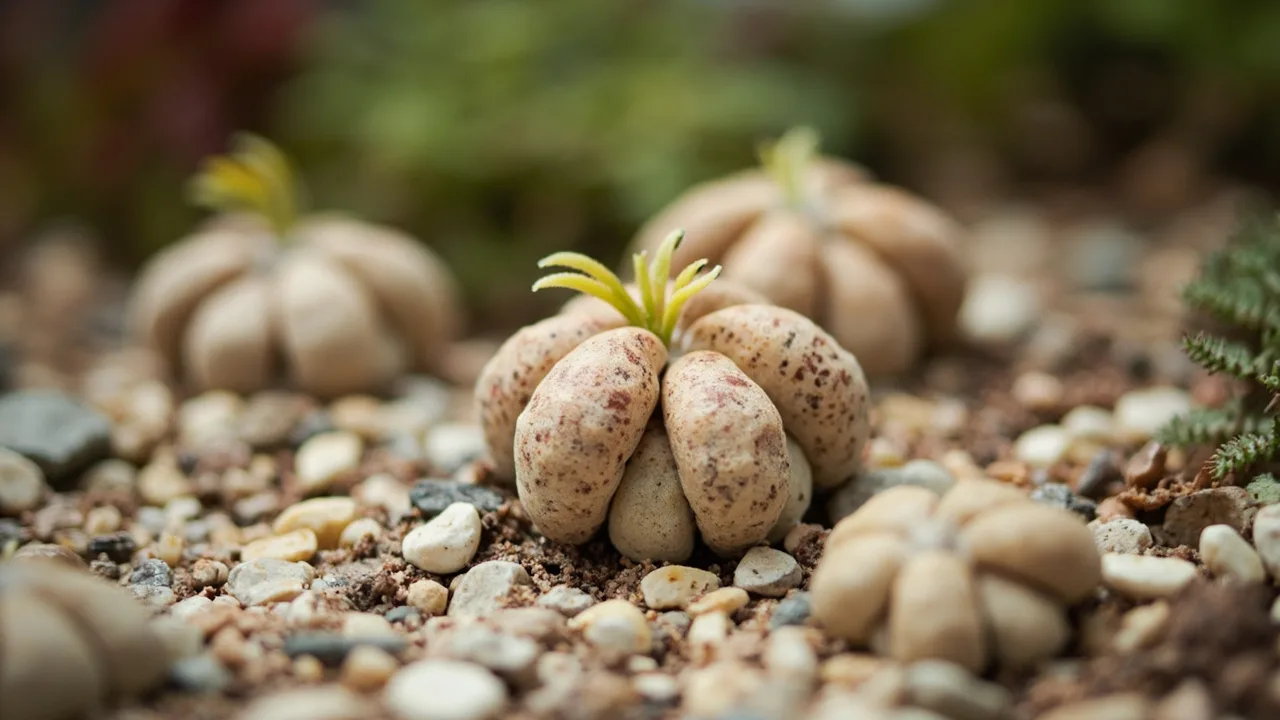
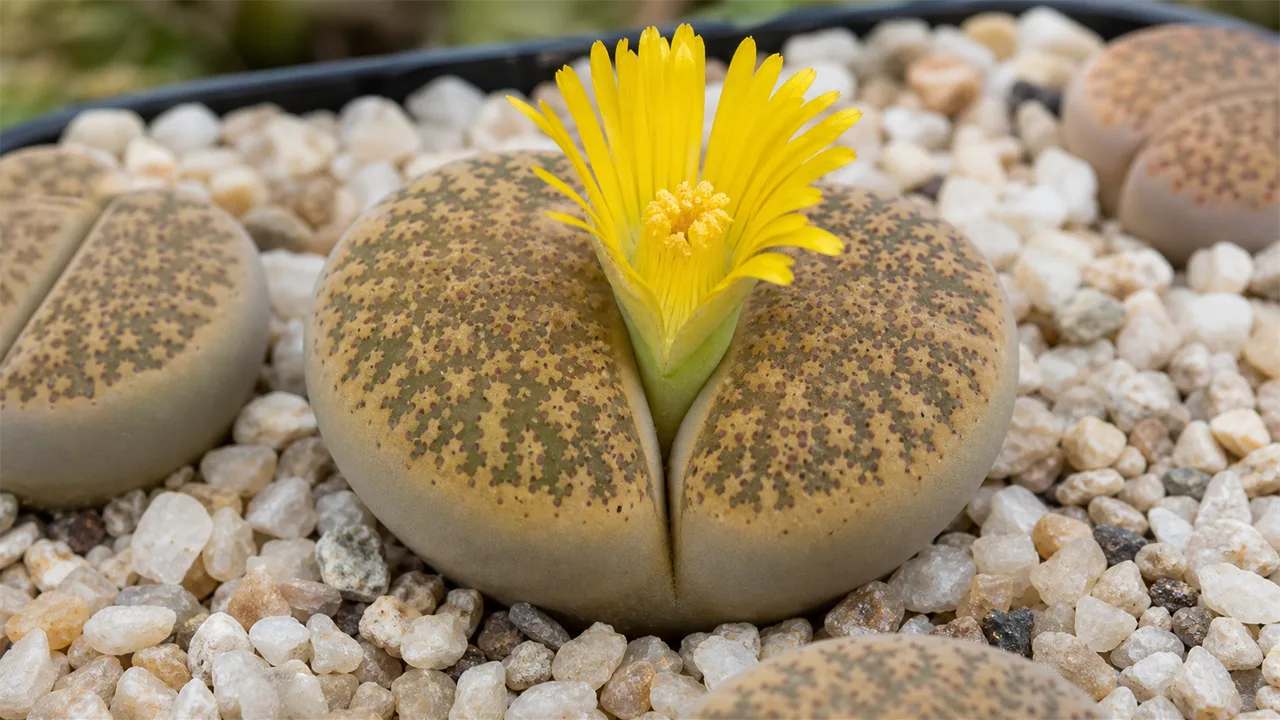
The genus name combines the Greek words for "stone" and "appearance," and dorotheae lives up to it: the leaf bodies are flattened, fissure-topped pebbles in yellowish-buff to pale brown, marked with translucent grey-green windows laced by darker islands and red flecks. Almost the whole plant sits at substrate level, reducing water loss and making it harder for grazing animals to spot.
British conditions are a long way from a Northern Cape quartz field. Treat dorotheae as a specialist houseplant or greenhouse succulent, not as an outdoor rock-garden subject. Its tiny footprint makes it ideal for a south-facing windowsill collection or an alpine house bench, where its autumn-flowering habit can be timed precisely.
The annual cycle matters more than any other piece of care. A new leaf pair develops inside the old one and gradually absorbs its stored water. Watering while the old leaves are being consumed leaves both pairs swollen and vulnerable to rot. Successful cultivation therefore means watching the plant, not following an ordinary houseplant schedule.
Appearance
A single body of L. dorotheae is typically about 20-30 mm tall and a little narrower than it is high, shaped like a slightly flattened, truncate cone. The leaf pair is fused for almost its entire length, divided only by a shallow central fissure from which both the next pair of leaves and the autumn flower emerge. Older plants divide to form two or more heads, so mature specimens are neat, very slowly spreading clumps rather than conventional branching plants.
Colour and pattern are the species' stand-out feature. The body is usually yellowish-brown, buff or pale tan, sometimes with a pinkish flush. Across the flattened upper face runs a translucent window of grey-green or smoky jade, broken by a network of darker channels, islands and a characteristic scatter of small red dots and short red lines. These markings mimic the quartzite pebbles around the plant in habitat, where anything that stands out gets eaten.
The leaves store enough moisture to carry the plant through long dry spells. Each year the inner pair draws water and nutrients from the previous pair; the old leaves wrinkle, thin and finally become a papery husk as the new body expands. This dramatic-looking shrivelling is normal. Removing the old sheath prematurely wounds the new body, so dry remains should be left until they slip away without resistance.
Mature plants, usually at least three years old, flower in early to mid-autumn. L. dorotheae bears a single daisy-like yellow flower from the fissure, generally 25-35 mm across, which can entirely cover the body beneath its petals. Flowers open in strong afternoon light, reflecting the noon-day flowering habit of the genus. A pollinated bloom may set a seed capsule that, in habitat, opens only when rain wets it, flicking the seeds across the gravel.
Growing Conditions
The brightest available position is usually the best one. A south- or west-facing windowsill, a greenhouse bench or a conservatory gives the plant the direct sun needed to keep the body compact and the windows brightly coloured. Around four to five hours of direct sun is a useful minimum, although newly bought plants should be introduced to intense spring sunshine gradually to avoid scorch. Rotate the pot occasionally if light reaches it from only one side.
Keep the plant frost-free and well away from cold, damp air. A dry, airy greenhouse is preferable to a humid bathroom or a deep shelf far from the glass. Ventilation is especially important in spring and autumn, when bright days can warm a closed greenhouse while cool nights leave the compost damp for too long. Avoid sitting the pot immediately above a radiator, where alternating heat and chill disrupt growth.
Drainage must be exceptionally fast. Use a cactus compost improved generously with washed horticultural grit, pumice or another inert mineral aggregate. A largely mineral mix lets water pass through quickly and keeps air around the roots. Ordinary peat-rich multipurpose or houseplant compost stays wet far too long and greatly increases the risk of basal and root rot.
The pot must have an unobstructed drainage hole. Small terracotta pots dry out predictably, although plastic is also fine when watering is carefully adjusted. Pots should be shallow (most lithops have a short, carrot-like tap root) and only one size larger than the clump. A pale gravel top-dressing supports the neck, reduces splash and recreates the natural setting, but should not hide permanently damp compost. Keep dorotheae separate from thirsty houseplants so it does not get watered automatically with them.
Resume watering only when the previous leaf pair has dried to a papery shell and the new body is established, often from late April or May in UK collections. Water thoroughly enough to wet the root zone, then allow the mix to dry completely. Give only a handful of waterings through late spring and summer, according to drying conditions rather than the calendar. Reduce water as flowering ends and keep the plant dry from late autumn through winter and throughout active leaf renewal.
Planting and Care
Plant with the body sitting naturally at the substrate surface rather than burying the growing point. Spread the roots into dry compost, fill carefully around them, and finish with fine gravel around the neck. Do not combine Lithops with vigorous succulents in a decorative bowl: their watering needs conflict, and a container without a drainage hole is unsuitable.
Repot roughly every three or four years, in mid- to late spring after the old leaves have been replaced and shortly before normal watering resumes. Lift the plant gently, remove stale compost and inspect the roots for decay or root mealybug. Trim only dead tissue with a clean blade. Set it into fresh, dry mix and wait about a week before watering so any small root injuries can callus.
Watering is the most important operation. Apply water to the compost rather than letting it pool in the fissure, drain the pot fully, and never leave it standing in a saucer. Wrinkles during the winter renewal phase are not a request for water: the emerging body is consuming the old leaves. Conversely, modest wrinkling during active summer growth can indicate that a fully dry plant is ready for a drink.
Feed sparingly because excessive nitrogen encourages soft, distorted growth. A half-strength cactus fertiliser can be used during active growth, no more often than every two or three weeks and only when a watering is already due. Do not feed a dry, dormant or renewing plant. Fresh mineral compost and the occasional weak feed are sufficient for this slow-growing species.
No pruning is required. Leave old leaf sheaths until completely dry, then remove only material that comes away freely. Cut off a spent flower or dry capsule only if seed is not wanted, taking care not to damage the fissure. Seasonal care consists chiefly of maximum winter light, complete winter dryness, careful spring resumption of water and protection from prolonged summer rain.
Seed is the most reliable propagation method. Specialist seed lists such as Cole numbers (C300 is the classic Pofadder collection) and Field numbers (F357 is another Northern Cape provenance) are widely traded. Sow in spring on a fine, sterilised, free-draining mix, cover very lightly, and provide bright indirect light. Young seedlings need slightly more even moisture than mature plants but should never be waterlogged. Ventilate progressively after germination. Multi-headed specimens can be divided during a spring repot only where each section has viable roots; allow cuts to dry before potting into dry compost.
Common Problems
Softness, yellowing, translucence or sudden collapse usually means basal or root rot. Typical causes are water during leaf renewal, cold wet compost, a blocked drainage hole or an organic mix that dries too slowly. Isolate the pot at once. Cut out rotten tissue with a sterile blade if sound material remains, allow the wound to callus, and attempt to re-root it on dry mineral compost, although advanced rot is seldom reversible.
Mealybug is the other common lithops pest, appearing as small white cottony tufts in the fissure, around the leaf base or among the roots. Isolate affected plants and inspect neighbouring pots. Light body infestations can be dabbed with a cotton bud moistened with 70 per cent isopropyl alcohol; heavier root infestations are best cleared by washing the roots, removing badly affected tissue and re-potting into fresh dry compost. A systemic insecticide labelled for ornamental houseplants can be used for stubborn cases, following current UK label instructions.
An elongated, pale green body is etiolated through insufficient light. Move the plant gradually to a brighter position; an abrupt transfer from shade to full sun risks scorch. Existing stretched tissue will not become compact again, but the next annual leaf pair should develop a more natural shape when light is adequate.
Splitting and excessive swelling generally follow overwatering, particularly when both old and new leaf pairs remain plump together. Stop watering and improve warmth, light and airflow without attempting to cut healthy tissue. By contrast, wrinkling and drying of the old pair during renewal is expected. Assess the inner body and the season before intervening.
Failure to flower can reflect immaturity, weak light or the absence of a proper dry rest. Mature specimens need strong sunshine and a consistent annual cycle. A plant that stays alive but never flowers should first receive brighter light and more disciplined seasonal watering, rather than extra fertiliser.
Scorch appears as pale, tan or corky patches after sudden exposure to intense sunshine, especially behind glass in spring. Acclimatise shaded plants over one or two weeks and ensure ventilation on bright days. Damaged areas are permanent but may disappear when the affected pair is replaced during the next renewal.
Popular Varieties
Variation within L. dorotheae is usually sold under Cole or Field locality numbers rather than conventional garden cultivars, because seed-raised plants already show worthwhile natural variation in window pattern and red flecking. Named selections do exist, mostly from Japanese specialist breeders, but they are uncommon in UK retail.
- C300 (15 km north of Pofadder, Northern Cape) is the type-locality collection, the most widely traded seed-line and the default reference for the species. Bodies are typically buff to pale brown with a broad grey-green window and conspicuous red islands.
- F357 (Northern Cape, exact locality withheld) is another well-known provenance distributed by the Mesemb Study Group and several specialist seed houses. It tends to produce compact, evenly coloured heads and is a useful contrast to C300 in a mixed tray.
- Seed-grown mixed batches without a Cole number are widely sold by UK succulent specialists and are an inexpensive way to start a collection, although colour and pattern will vary from one seedling to the next.
- Lithops dorotheae 'Akahada Reikogyoku' is a Japanese cultivar selection first published by Norihiko Shimada, prized for unusual window patterning. It circulates mainly among specialist collectors and is rarely offered by mainstream UK nurseries.
Named material should be bought from reputable specialist suppliers with accurate provenance. No RHS Award of Garden Merit is claimed for the species and none of the cultivar names currently carry an AGM. The species itself is highly variable and attractive without a cultivar name, and a mixed seed population can give the widest range of pebble-like markings.
Sources and Further Reading
- Royal Horticultural Society: Lithops dorotheae, accessed 2026-07-25.
- British Cactus & Succulent Society: Cultivation Notes on Lithops, accessed 2026-07-25.
- British Cactus & Succulent Society: Growing Mesembs, accessed 2026-07-25.
- South African National Biodiversity Institute: Lithops, accessed 2026-07-25.
- Lithops Scrapbook: Cultivars, accessed 2026-07-25.
- Horticulture.co.uk: Growing Lithops, accessed 2026-07-25.
Pests and Diseases
| Problem | Symptoms | Management |
|---|---|---|
| Root rot | Leaves become soft, translucent, and mushy as the base of the plant decays. | Ensure excellent drainage with gritty compost and water only when the soil is completely dry. |
| Mealybugs | White, cottony wax-like clusters appear in leaf fissures and on stems. | Isolate the plant and treat with a systemic insecticide or dab spots with alcohol-soaked cotton. |
| Aphids | Small green or black insects cluster on new growth, causing distorted leaves. | Wash off with a strong jet of water or apply insecticidal soap if infestation is heavy. |
| Overwatering | Plant body swells excessively then shrivels or splits prematurely without new growth. | Strictly withhold water during winter dormancy and ensure pots have adequate drainage holes. |
| Sunburn | White or brown bleached patches appear on the leaf tips exposed to intense light. | Gradually acclimate plants to full sun and provide shade during peak summer heat if grown outdoors. |
For step-by-step help, read Controlling Aphids Naturally. Or browse the full plant problem solver to diagnose an issue by symptom.
Recommended Products
GardenWizz earns a commission from qualifying purchases made through affiliate links on this page (including links within the article) — as an Amazon Associate, and from Thompson & Morgan via the Awin network. This does not affect the price you pay. See our disclaimer for details.