Yellow Crocus
Crocus flavus
The Gardening Year
Best months in UK gardens · full planting calendar →
🖨 Printable care card (PDF)At a Glance
| Botanical name | Crocus flavus |
|---|---|
| Common name(s) | Yellow Crocus |
| Family | Iridaceae |
| Plant type | bulb (herbaceous perennial geophyte growing from a corm) |
| Height × Spread | 5–6 cm × — |
| Position | Full sun |
| Soil | moist but well-drained; gritty, poor to moderately fertile |
| Flowering | March–May |
| Toxicity | Ornamental bulbs - not to be eaten |
| Native range | Bulgaria, Greece, parts of former Yugoslavia (North Macedonia, Kosovo and Serbia), Romania and northwestern Turkey |
Crocus flavus, the yellow crocus, is a compact spring-flowering corm valued for clear golden flowers when many UK gardens are still dormant. It is particularly effective in rock gardens, gravel, raised beds, containers and short grass, provided the soil drains freely.
Overview
Crocus flavus is a small member of the iris family, Iridaceae. Its natural range extends from the Balkan Peninsula into north-western and west-central Turkey, where it grows as a temperate geophyte. The plant survives its dormant season below ground as a corm: a swollen stem base enclosed by a dry tunic. Each corm resumes growth when seasonal moisture and temperature are suitable, producing leaves and flowers before returning to dormancy.
The species is most often represented in gardens by C. flavus subsp. flavus. Its bright colour, modest height and capacity to increase make it useful in informal drifts. Flowers can also offer pollen to insects active during mild late-winter and early-spring weather, although they remain more tightly closed on cold, dull days.
Yellow crocus suits much of the UK where winter drainage is good. It is not the saffron crocus, Crocus sativus, and should be grown as an ornamental rather than treated as a source of culinary saffron. In heavy, compacted ground, a raised bed, gravel garden or container is generally safer than a wet hollow. Its short annual growth cycle also makes it a useful companion beneath deciduous woody plants that cast little shade in late winter but shelter the dormant ground later in the year.
Appearance
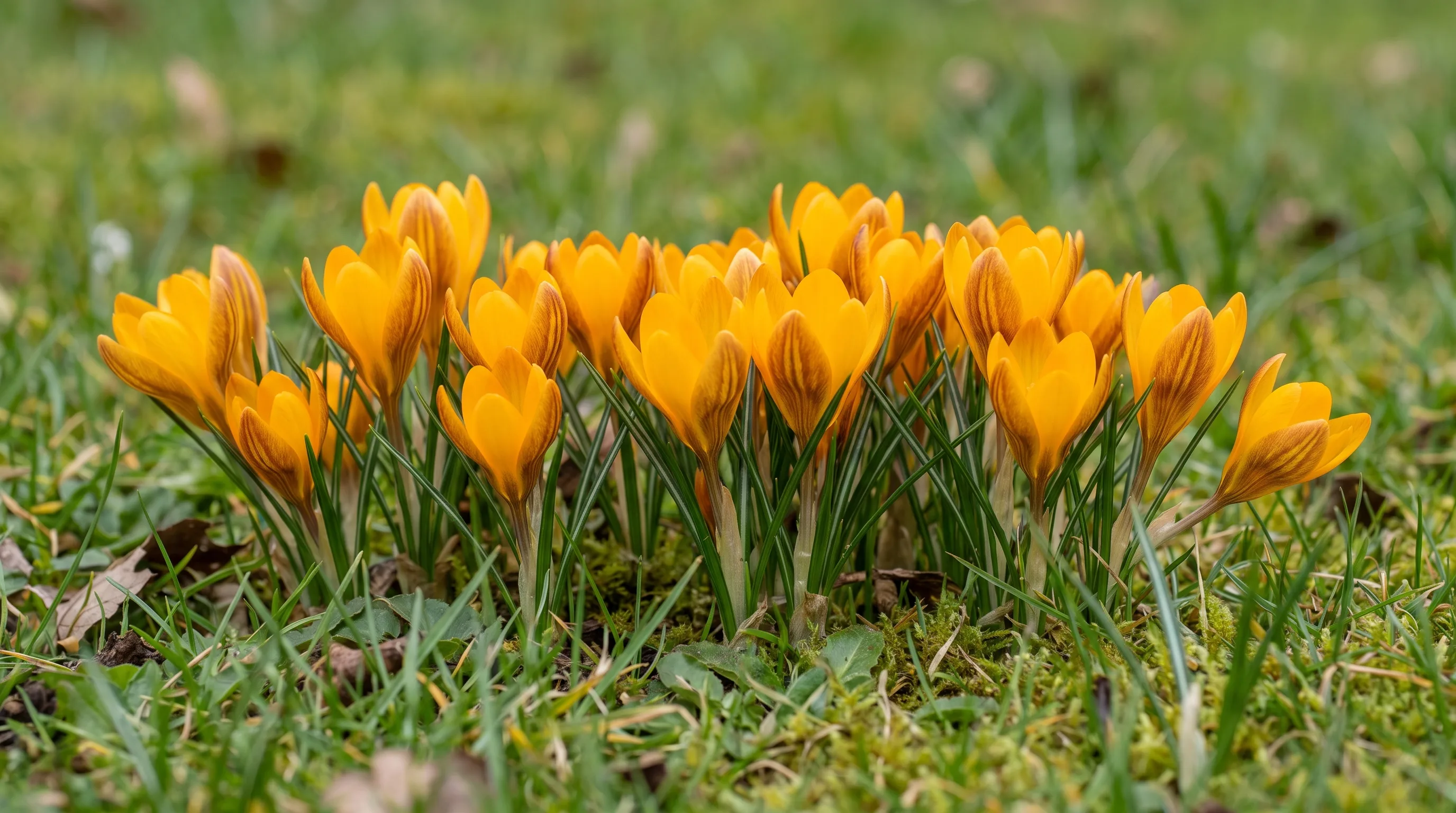
The flowers are upright and goblet-shaped when they first emerge, often appearing bottle-like before opening. In sunshine, the six tepals spread more widely to display a rich, deep golden-yellow interior and prominent orange-yellow reproductive parts. They close or remain cupped during dull or wet weather, which helps protect the centre of the flower. Some forms are lightly scented. Several blooms may arise from an established corm, so even a low plant can make a strong patch of colour.
Leaves appear with the flowers or soon afterwards. They are narrow and grass-like, with the silvery central stripe characteristic of many crocuses. The foliage lengthens after flowering as it rebuilds the corm. This post-flowering stage is essential to the following year's display, even though the leaves can look untidy as they yellow.
Plants are usually about 8–10 cm tall. Their scale suits border fronts, rock crevices, alpine troughs and the upper layer of a container. In grass, irregularly scattered groups look more natural than straight rows. Offsets gradually turn single corms into flowering clumps. The entire above-ground plant disappears during dormancy, so its position is easily disturbed unless marked.
Growing Conditions
Choose an open position in full sun. An east-, south- or west-facing aspect can work, but flowers open best where they receive direct light. A position beneath deciduous shrubs or trees may also be suitable because the overhead canopy is still sparse during the crocus growing season. Dense evergreen shade produces weaker growth and less dependable flowering. A gentle slope is useful because it combines good light with rapid drainage.
Drainage is the decisive soil factor. A gritty loam that is poor to moderately fertile is preferable to rich, water-retentive ground. Yellow crocus tolerates acid, neutral or alkaline soil, so reaction is less important than air around the corm and the prompt movement of excess water. On clay, improve the wider planting area with coarse grit and well-rotted organic matter rather than filling only a small planting hole, which could act as a sump. If water still stands after rain, use a raised bed, sloping bank or pot.
For containers, use a peat-free, loam-based potting mix with added horticultural grit. Choose a pot with generous drainage holes and raise it on feet if water collects beneath it. A broad container allows several corms to be arranged in an informal group while still leaving room for their offsets. Pots can remain outside in sun, but the compost must not stay saturated, particularly when the plants are dormant.
Naturalise yellow crocus in short, sparse grass or lightly wooded ground, avoiding vigorous, heavily fed turf that will compete for light and moisture. The site must be one where mowing can wait until the crocus leaves have yellowed. In borders, mark dormant clumps if summer cultivation might damage them.
Planting and Care
Plant dormant corms from September to November, preferably soon after purchase. Set the pointed growing tip upwards at roughly two to three times the corm's own depth, commonly about 8–10 cm, leaving around 5–8 cm between corms. Plant in small, uneven groups for a natural effect, then water once to settle the soil. If the corms have no obvious tip, place them on their sides; new roots and shoots will orient themselves.
Established plants in open ground seldom need routine watering during a typical UK winter or spring. Water only in an unusually dry growing spell, allowing the surface to begin drying between applications. Container compost dries more quickly, so check it below the surface while leaves are green and water when it is becoming dry. Never leave a pot standing in a saucer of water. Once the foliage has died down and the corms are dormant, reduce watering substantially and avoid irrigating their position merely for neighbouring plants.
Ground-grown clumps normally need no feeding. Excess nitrogen encourages leaves at the expense of flowers and can make surrounding grass too competitive. In a long-term container, apply a dilute high-potassium liquid feed according to its label while the leaves are growing after flowering. Refresh tired compost every second year, taking the opportunity to inspect and space the corms.
No pruning is required. Do not cut, tie or braid green foliage after the flowers fade. Leave it exposed until it turns yellow and dies back naturally, then remove the loose remains. Deadheading is optional rather than necessary. Where corms grow in grass, delay the first mowing until the foliage has finished feeding them, commonly at least six weeks after flowering; judge readiness by yellowing leaves rather than a fixed date.
Propagation is easiest by offsets. Lift a crowded clump during summer dormancy, separate the small cormlets from the parent corms and discard any that are soft, damaged or diseased. Replant sound corms promptly at their original depth, or keep them briefly in a cool, dry, well-ventilated place before autumn planting. Division every few years can restore flowering when congestion has reduced the display. Very small offsets may need more than one growing season before they bloom.
Seasonal care follows the plant's natural cycle: plant in autumn, keep pots lightly moist during active growth, leave foliage undisturbed after flowering, and divide congested clumps in summer where needed. Inspect lifted or newly purchased corms before planting. Fixed wire mesh can protect vulnerable plantings from animals, but openings must be wide enough for shoots to emerge without becoming trapped.
Common Problems
Failure to flower is often cultural rather than a sign of disease. Corms planted too shallowly, grown in deep shade, left overcrowded or deprived of their leaves soon after flowering may produce few blooms. Move or divide them during dormancy, correct the growing conditions and allow a complete growth cycle before assessing recovery. Very small offsets also need time to reach flowering size.
Corm rot is the principal risk in wet or compacted soil. Affected corms become soft or discoloured and emerging growth may collapse. Lift and discard badly affected material, improve drainage across the site and avoid replacing sound corms in the same stagnant pocket. In containers, blocked drainage holes and water-filled saucers are common causes. Buying firm, unblemished corms and planting them promptly reduces the chance of introducing decay.
Grey mould can develop among crowded leaves and fading flowers in cool, still, damp conditions. Remove collapsed or decaying material and improve air movement without stripping away healthy green foliage. Space container plantings sufficiently for air to circulate, and direct water towards the compost rather than repeatedly wetting the flowers.
Squirrels, mice, voles and birds may dig up newly planted corms. Firm the soil after planting and protect vulnerable beds or pots with securely fixed wire mesh, ensuring that shoots can pass through. Slugs and snails sometimes chew leaves and flowers; reduce dense hiding places around pots and inspect plants after damp evenings. Damage is most significant when a small new shoot is eaten repeatedly.
Viruses can cause mottled leaves, distorted growth or irregular streaking and breaking of flower colour. These symptoms can resemble weather damage, pest injury or natural markings, so compare affected plants over time. There is no curative treatment for a virus. Remove persistently abnormal plants with their corms, clean tools after handling them and do not propagate offsets from the affected clump.
Popular Varieties
Named cultivars of Crocus flavus are not widely documented in current UK horticultural references, so cultivar names should not be attached to ordinary yellow crocus corms without reliable nursery provenance. The following genuine botanical or horticultural choices are frequently associated with, or confused with, the species and should be labelled accurately:
- Crocus flavus subsp. flavus is the accepted typical subspecies most familiar in cultivation. It has fragrant, deep-yellow spring flowers and is the most appropriate choice for naturalising where authentic species material is wanted.
- Crocus flavus subsp. dissectus is a name encountered in older specialist collections and references. Current taxonomy treats it as a synonym associated with the separate species Crocus mouradi, so plants sold under the older name should not be represented as a modern cultivar of C. flavus.
- Crocus × luteus 'Golden Yellow' is a vigorous yellow-flowered garden crocus often offered in bulb catalogues. It is a hybrid, not a cultivar of C. flavus, despite the similar colour and the historical association of yellow garden crocuses. It suits gardeners seeking a bolder mass display, but labels should preserve the hybrid name.
For a planting that is botanically true to this page, select C. flavus or C. flavus subsp. flavus from a reputable specialist supplier. Where stock is sold only as “yellow crocus”, confirm the botanical name before assuming that it belongs to this species.
Pests and Diseases
| Problem | Symptoms | Management |
|---|---|---|
| Rodents (mice and voles) | Corms may be dug up, eaten or removed, resulting in missing or damaged plants. | Protect vulnerable plantings with securely fixed metal mesh that allows shoots to emerge. |
| Birds | Bird activity may disturb or damage newly planted corms and emerging growth. | Protect vulnerable plantings with securely fixed metal mesh that allows shoots to emerge. |
| Corm rot | Stored corms soften or discolour as fungal decay develops. | Store corms in cool, dry conditions and handle them carefully to avoid pathogen entry through damage. |
Or browse the full plant problem solver to diagnose an issue by symptom.
Recommended Products
GardenWizz earns a commission from qualifying purchases made through affiliate links on this page (including links within the article) — as an Amazon Associate, and from Thompson & Morgan via the Awin network. This does not affect the price you pay. See our disclaimer for details.