
Lodgepole Pine
Pinus contorta
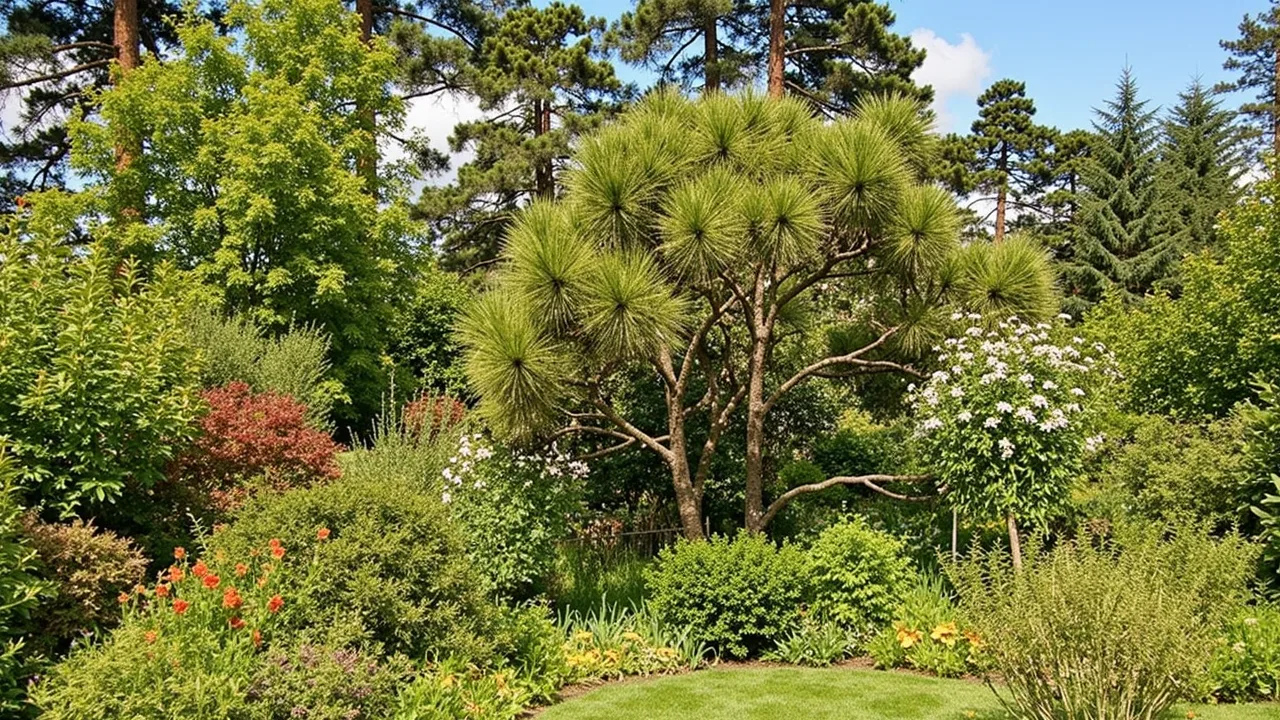
At a Glance
| Botanical name | Pinus contorta |
|---|---|
| Common name(s) | Lodgepole Pine |
| Family | Pinaceae |
| Plant type | tree (Evergreen conifer; shrub or tree form depending on subspecies and conditions.) |
| Height × Spread | 1–25 m × 7.5 m |
| Position | Full sun |
| Soil | Well-drained, acid or neutral soil. |
| Flowering | — |
| Toxicity | — |
| Native range | Western North America |
The lodgepole pine (Pinus contorta) is a hardy, fast-growing evergreen conifer native to western North America, from subarctic Alaska south through the Rocky Mountains and Pacific coast to northern Mexico. Across its enormous natural range it occupies almost every soil type and exposure imaginable — coastal cliffs, peat bogs, mountain scree and dense boreal forest — which makes it one of the most adaptable pines in cultivation. In the UK it has been planted since the mid-19th century, valued as a windbreak, shelterbelt and forestry tree, and it remains a sound choice for exposed or poor-soil sites where other conifers struggle.
Overview
Pinus contorta belongs to the family Pinaceae and the large genus Pinus, which contains roughly 110 species across the Northern Hemisphere. The species was described by David Douglas in 1828 and has since been split by some authorities into three subspecies: P. contorta subsp. contorta (the shore pine of the Pacific coast), subsp. latifolia (the lodgepole pine of the interior mountains), and subsp. murrayana (the Sierra lodgepole pine of California). Gardeners in the UK will typically encounter material derived from the hardy interior subspecies, which performs reliably in cool, wet climates.
The tree's common name refers to its use by Native American peoples and early settlers, who valued its long, straight trunk for lodge poles, teepee frames and structural timbers. The alternate name "shore pine" describes the coastal form, which is shorter, often crooked, and adapted to salt spray and poor sandy soils. In UK gardens it is most often grown either as a specimen in large landscapes, as part of a shelterbelt, or as a low-maintenance evergreen screen.
Appearance
Lodgepole pine has a slender, often columnar silhouette when young, with a single straight leader. With age the crown opens up and becomes irregular, and older specimens frequently develop a slightly twisted or leaning habit — a characteristic that gives the alternative name "twisted pine" some of its justification.
Bark. Young bark is thin and scaly, orange-brown to reddish-brown; on mature trees it thickens and darkens to grey-brown with shallow fissures. The bark is not particularly ornamental but contrasts well with the bright foliage.
Foliage. Needles are borne in pairs, 2–5 cm long, stiff, sharp-tipped and noticeably twisted — hence the species epithet contorta. Colour is bright yellow-green to mid-green, and needles are retained for three to five years, giving the tree a dense appearance throughout the year.
Cones. Female cones are small, ovoid, 2–6 cm long, and frequently asymmetrical. Each scale bears a sharp, reflexed prickle. A distinctive feature of the species is that cones may remain closed on the tree for many years, only opening in response to heat — an adaptation to fire-prone landscapes. Male cones are small, yellowish and clustered at the base of new shoots, releasing pollen in late spring.
Roots. Pinus contorta develops a deep taproot from an early age, which is the key to its drought tolerance and its ability to thrive on shallow, rocky soils. The taproot also makes established trees difficult to transplant.
Growing Conditions
Lodgepole pine is fully hardy across the UK and tolerates frost, prolonged winter wet, exposed coastal winds and salt spray. It performs best in full sun and dislikes heavy shade, where it becomes thin and leggy. Soil requirements are unusually broad for a pine: it will grow in acidic, neutral, sandy, gravelly, peaty or rocky ground, and it tolerates damp conditions better than most pines. The one soil type to avoid is strongly alkaline or chalky ground, where the tree tends to develop chlorosis and decline over time. In its native range it copes with both boggy muskeg and bone-dry scree — a tolerance that translates well to varied UK sites.
The species is naturally wind-firm and is widely used in commercial forestry as a nurse tree to shelter slower-growing species such as Sitka spruce. No Royal Horticultural Society Award of Garden Merit (AGM) rating has been published for Pinus contorta in the current RHS Plant Finder listings; readers wanting a similarly tough pine with confirmed AGM status should look instead to Pinus sylvestris or Pinus mugo.
Planting and Care
Planting. Container-grown stock can be planted at any time of year when soil and weather allow, but autumn and early spring are ideal because the soil is moist and warm. Dig a pit roughly twice the width of the root ball and the same depth; on heavy or poorly drained ground, fork grit into the backfill to improve drainage. Water in thoroughly and stake only where the site is exposed — established lodgepole pines rarely need support.
Watering. Young trees need regular watering through their first two or three growing seasons, particularly during dry spells in late spring and summer. Once the taproot has established, the tree is essentially self-sufficient in all but the most prolonged droughts. Mulching with bark or composted bracken in the first two years helps conserve moisture and keeps down competing grass.
Feeding. Feeding is not necessary and can in fact produce soft, sappy growth that is more vulnerable to wind damage and aphid attack. If a young tree is clearly struggling on very poor ground, a single spring dressing of a balanced slow-release fertiliser is plenty.
Pruning. Little routine pruning is needed. Remove dead, damaged or crossing branches in late summer, when wounds dry out fastest and sap flow is reduced. Never cut back into bare old wood: pines do not regenerate from old stems, and hard pruning is likely to leave a permanent scar. If size control is the aim, consider a smaller cultivar from the outset rather than fighting the mature height of the species.
Propagation. Species trees are raised from seed; named cultivars are grafted onto seedling rootstocks of P. contorta or Pinus sylvestris in late winter. Seed requires no pretreatment but germinates most reliably after a short cold period.
Seasonal care. New growth (the "candles") appears in late spring and can be shortened by half in late May to keep compact specimens tidy — a technique widely used on Japanese black pine and equally effective here. Otherwise, the species asks for very little year-round attention.
Common Problems
Lodgepole pine is generally healthy in the UK, but the following issues are worth watching for.
Honey fungus (Armillaria spp.). The most serious disease affecting mature pines in the UK. Symptoms include dieback in the crown, white mycelial fans under the bark at the base of the trunk, and clusters of honey-coloured toadstools in autumn. There is no chemical control; infected trees should be removed along with as much of the root system as practical, and the site should not be replanted with susceptible species for several years.
Pine sawfly larvae (Neodiprion spp.). These caterpillar-like larvae can defoliate branches in late spring and early summer, particularly on younger trees. Small infestations can be removed by hand; larger outbreaks are treatable with a contact insecticide approved for use on ornamental conifers.
Dothistroma needle blight. A fungal disease that causes needle browning and premature needle drop. It is less aggressive on P. contorta than on Pinus nigra, but it can be unsightly in prolonged wet summers. Good spacing and pruning to improve air movement reduce the risk.
Waterlogging. Although more tolerant than many pines, lodgepole pine will decline on heavy, waterlogged clay. Improving drainage before planting is far more effective than trying to rescue a struggling tree afterwards.
Aphids and scale insects. Occasionally colonise stressed or shaded specimens. They rarely cause serious damage on their own and are usually controlled by natural predators.
Popular Varieties
Several dwarf or coloured-foliage forms of Pinus contorta are grown in UK gardens, though they are still relatively specialist plants and can take a little hunting down in nurseries.
'Spaan's Dwarf' is a slow-growing, bun-shaped selection that reaches around 1–1.5 m tall and wide after many years, with the typical twisted bright green needles. It is well suited to rock gardens and large containers.
'Chief Joseph' is prized for its striking winter colour: the needles turn a luminous golden-yellow in cold weather, reverting to green in summer. It grows slowly to roughly 2 m tall and is one of the most sought-after dwarf conifers for winter interest.
'Taylor's Sunburst' is a vigorous selection with new growth that emerges creamy-yellow in spring before maturing to green. It forms a broad, upright shrub or small tree, eventually reaching 3–4 m.
Where a tall specimen is wanted for a large garden or estate, seedling-grown trees of the type sold for forestry planting are perfectly adequate and far cheaper than named cultivars; they will grow 1–1.5 m per year in good conditions once established. As always when buying conifers, it is worth checking the nursery's provenance and confirming the plant has been raised from seed or grafted in the UK, to reduce the risk of importing pests such as pine wood nematode.
---
Pests and Diseases
| Problem | Symptoms | Management |
|---|---|---|
| Pine shoot moth | Shoots turn brown and die back, often with visible webbing or frass near the tips. | Prune out affected shoots in autumn and apply insecticide if infestations are severe. |
| Honey fungus | General decline, yellowing needles, and white fungal growth at the base of the trunk. | Improve drainage and avoid planting in soil previously infected with honey fungus. |
| Needle cast | Older needles turn brown, drop prematurely, leaving the tree sparse and thin. | Ensure good air circulation and remove fallen debris to reduce fungal spores. |
| Conifer aphids | Clusters of small insects on new growth with sticky honeydew residue on needles. | Wash off with a strong jet of water or treat with horticultural oil in spring. |
| Pine sawflies | Caterpillar-like larvae chew holes in needles, causing significant defoliation. | Hand-pick larvae or apply biological controls like Bacillus thuringiensis. |
For step-by-step help, read Controlling Aphids Naturally. Or browse the full plant problem solver to diagnose an issue by symptom.
As an Amazon Associate, GardenWizz earns from qualifying purchases made through links on this page (including links within the article). This does not affect the price you pay. See our disclaimer for details.