
Michaelmas daisy
Symphyotrichum novi-belgii
The Gardening Year
Best months in UK gardens · full planting calendar →
🖨 Printable care card (PDF)At a Glance
| Botanical name | Symphyotrichum novi-belgii |
|---|---|
| Common name(s) | Michaelmas daisy |
| Family | Asteraceae |
| Plant type | perennial (Deciduous) |
| Height × Spread | — × — |
| Position | Full sun, Partial shade |
| Soil | Moist but well-drained |
| Flowering | September–November |
| Toxicity | — |
| Native range | eastern Canada and the northeastern United States |
The Michaelmas daisy is one of the most dependable late-season perennials for UK gardens, lighting up herbaceous borders from late August through October when most summer flowers have faded. Long grown in Britain under the older name Aster novi-belgii, it was reclassified into the genus Symphyotrichum in the 1990s alongside its New York aster relatives, though gardeners and many nurseries still use the familiar name. Tough, generous with its blooms, and adored by pollinators, it remains a backbone plant of the cottage and wildlife garden.
Overview
Symphyotrichum novi-belgii is a herbaceous perennial in the daisy family (Asteraceae), native to the eastern United States and Canada but naturalised in parts of the British Isles. It has been grown in British gardens since at least the early eighteenth century and, through extensive breeding, has given rise to hundreds of named cultivars in shades of blue, violet, pink, lavender, and white. Its common name refers to the feast of St Michael, which falls on 29 September, when the plant is reliably in full flower.
The species is fully hardy across the UK, rated H5 by the Royal Horticultural Society, meaning it tolerates winter temperatures down to roughly -15 °C in well-drained soil. It is generally trouble-free in a sunny border but does benefit from routine division and from careful siting away from the driest, most exposed spots. For gardeners seeking late-season colour, pollinator value, and reliable garden performance, it remains hard to beat.
Appearance
Michaelmas daisies form slowly expanding clumps from short, creeping rhizomes. Mature plants reach 30–90 cm tall, depending on cultivar, and spread to 30–60 cm. Stems are upright when young, becoming slightly arching as the season progresses and as flower weight builds at the tips. The foliage is narrow, lance-shaped, and mid-green, with leaves typically 5–12 cm long and semi-evergreen at the base in milder winters.
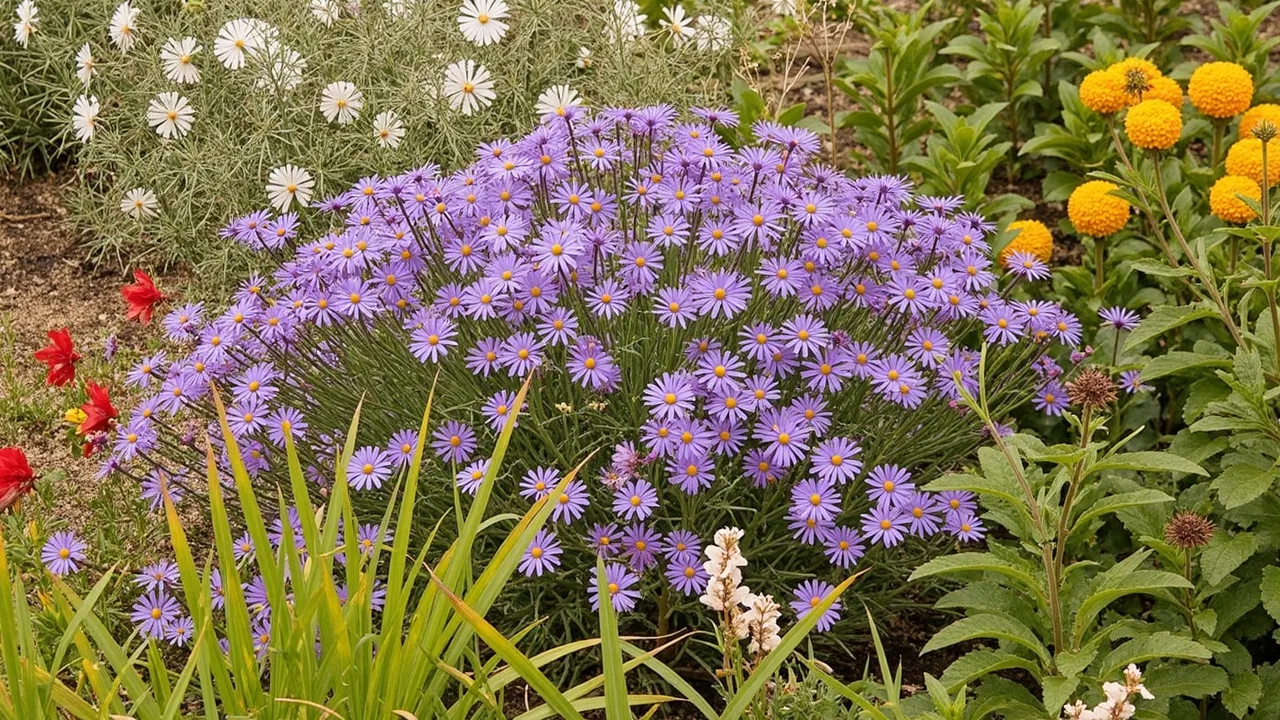
The flowers are classic composite daisies, 2–5 cm across, with a central disc of tiny yellow florets surrounded by slender ray florets. Wild-type plants are typically violet-blue, but cultivated varieties extend the range through deep violet, mauve, lilac-pink, rose, and pure white. Flowers are carried in loose, branched clusters at the stem tips from late summer into mid-autumn, and a healthy clump may carry dozens of blooms at peak.
The overall impression is of a soft, airy mound studded with stars rather than a dense or blocky plant. This makes Michaelmas daisies particularly effective when threaded through ornamental grasses, Verbena bonariensis, or late-flowering sedums, where their flowers float above contrasting foliage.
Growing Conditions
Michaelmas daisies prefer an open, sunny position. They will tolerate light, dappled shade, but flowering is noticeably reduced and stems tend to stretch and flop in heavier shade. A spot that receives at least six hours of direct sun in September produces the strongest display.
Soil should be moist but well-drained, with plenty of organic matter dug in ahead of planting. The species is tolerant of clay and of lighter sandy soils, provided winter drainage is sound; waterlogged ground in winter is one of the few reliable ways to kill an established plant. A neutral to slightly alkaline pH, in the range of about 6.5–7.5, suits it best. On strongly acid soils, growth can be slower and flowering reduced, and a light annual application of garden lime or mushroom compost is helpful.
In the UK it performs reliably from the Scottish lowlands southwards, with some winter die-back in colder inland districts. Coastal and southern gardens generally see the longest flowering season. Plants benefit from a site that is not completely exposed, as strong autumn winds combined with rain can flatten taller cultivars in full bloom.
Planting and Care
Container-grown Michaelmas daisies can be planted at any time the soil is workable, from early spring through to mid-autumn; bare-root plants are best set out in spring. Space plants 40–60 cm apart, depending on the vigour of the cultivar, to allow good air movement between clumps. Water in thoroughly and keep moist during the first growing season.
Once established, plants are moderately drought-tolerant but produce the best display with consistent moisture during dry spells in July and August. Water at the base of the plant rather than over the foliage, as wet leaves encourage powdery mildew. Feeding is light: a single spring application of a balanced organic fertiliser such as blood, fish and bone is usually sufficient. High-nitrogen feeds should be avoided, as they produce lush leafy growth at the expense of flowers.
Mulch lightly in spring with well-rotted garden compost or bark to conserve moisture and suppress weeds. Cut old stems back to ground level in late autumn once flowering has finished, or leave them in place until early spring as a refuge for overwintering insects and as modest winter structure.
Tall cultivars benefit from discreet staking. Pea sticks pushed in around the clump in May grow up through the foliage and provide invisible support, while link stakes work well for larger groups. Pinching back stem tips in early summer (the Chelsea chop, performed in late May or early June) reduces final height by roughly a third and produces more, slightly smaller flowers on bushier plants.
Propagation is straightforward. Lift and divide congested clumps every two to three years in spring, discarding the woody centre and replanting vigorous outer pieces. Soft cuttings taken in late spring root readily in a gritty compost, and named cultivars are best increased this way to keep them true to type.
Common Problems
Powdery mildew is the most familiar issue, appearing as a white, dusty coating on leaves and stems in late summer, particularly in dry, crowded, or poorly ventilated positions. Good spacing, watering at the base of the plant, and the mildew resistance of modern cultivars all reduce the risk; prompt removal of affected foliage slows spread.
Leaf spot diseases, caused by Septoria and Alternaria fungi, produce brown or black spotting on lower leaves. Remove and destroy affected material, clear autumn debris from around the clump, and avoid overhead watering. Aster wilt (caused by Phytophthora) and root rots (Pythium, Rhizoctonia) appear in cold, wet soils; improving drainage and replacing affected plants with fresh stock from a reputable nursery is usually the only remedy.
Aphids cluster on young shoots and flower buds in spring and early summer; encourage natural predators such as ladybirds and hoverflies, or treat heavy infestations with insecticidal soap. Earwigs can shred petals in late summer and are easily trapped in upturned pots loosely stuffed with straw. Slugs and snails graze the young spring growth; the usual range of organic controls is effective if applied early.
With sensible siting, regular division, and prompt removal of diseased material, Michaelmas daisies remain among the most reliable of late-season perennials.
Popular Varieties
'Marie Ballard' is a long-established favourite, producing semi-double, powder-blue flowers on sturdy 90 cm stems from late summer. It holds the RHS Award of Garden Merit and is widely considered one of the best mid-height blues for the back of a border.
'Royal Ruby' carries rich, deep rose-pink, semi-double blooms on compact 60 cm plants, and is valued for its relatively mildew-resistant foliage and reliable performance in smaller gardens.
'Peace' is a tall, vigorous cultivar reaching around 90 cm, with large, soft mauve-pink, fully double flowers that mix easily with grasses and late-season salvias.
'Patricia Ballard' bears clear pink, semi-double flowers on upright 90 cm stems and is a classic choice for traditional cottage borders, where its long flowering season carries the display well into October.
'Lady in Blue' is a dwarf cultivar, around 30 cm tall, with clear mid-blue flowers over a long period; it is particularly useful at the front of a border or in containers where taller Michaelmas daisies would be out of scale.
For gardeners seeking ground cover at the front of a sunny border, dwarf forms such as 'Snow Cushion' (white, 25 cm) and 'Jenny' (compact violet, 30 cm) provide much the same late-season display in a smaller, tidier package. Cultivars sold simply as Symphyotrichum novi-belgii mixed or by colour are often excellent value and perform reliably, though they may lack the uniformity of named clones. Where an Award of Garden Merit is significant, current RHS listings should be consulted, as awards are reviewed periodically.
Pests and Diseases
| Problem | Symptoms | Management |
|---|---|---|
| Powdery mildew | White, dusty fungal growth appears on leaves and stems, often causing distortion. | Ensure good air circulation, avoid overhead watering, and choose resistant varieties. |
| Slugs and snails | Irregular holes in leaves and damage to new growth, especially in damp conditions. | Use physical barriers like copper tape or apply iron phosphate pellets around the base. |
| Aphids | Clusters of small green or black insects on stems and buds, often with sticky honeydew. | Spray off with a strong jet of water or use insecticidal soap for severe infestations. |
| Fusarium wilt | Sudden wilting and yellowing of leaves on one side of the plant, leading to collapse. | Remove and destroy infected plants immediately; avoid replanting asters in the same spot. |
| Leaf and bud eelworms | Distorted, swollen leaves and buds that fail to open properly or drop prematurely. | Remove affected plant parts and dispose of them; rotate crops to break the life cycle. |
| Grey mould (Botrytis) | Fuzzy grey fungal growth on flowers and stems, particularly in humid or wet weather. | Improve air circulation, remove dead foliage, and avoid wetting the foliage when watering. |
For step-by-step help, read Controlling Aphids Naturally, Dealing with Slugs and Snails and Treating Powdery Mildew. Or browse the full plant problem solver to diagnose an issue by symptom.
As an Amazon Associate, GardenWizz earns from qualifying purchases made through links on this page (including links within the article). This does not affect the price you pay. See our disclaimer for details.