
Cow Parsley
Anthriscus sylvestris
The Gardening Year
Best months in UK gardens · full planting calendar →
🖨 Printable care card (PDF)At a Glance
| Botanical name | Anthriscus sylvestris |
|---|---|
| Common name(s) | Cow Parsley |
| Family | Apiaceae |
| Plant type | perennial (herbaceous biennial or short-lived perennial) |
| Height × Spread | 60–170 cm × — |
| Position | Full sun, Partial shade |
| Soil | — |
| Flowering | April–June |
| Toxicity | suspected of being mildly toxic |
| Native range | Europe, western Asia and northwestern Africa |
Cow parsley is one of the most familiar wildflowers of the British countryside. From late April through June its frothy white umbels line motorway verges, hedgerows, woodland edges and railway embankments, briefly turning even ordinary lanes into something out of a Constable painting. It is native to the UK, present in every county, and ecologically valuable as an early-season nectar source. Although it is rarely sold as an ornamental, it has a place in naturalistic plantings, rewilding schemes and pollinator-friendly borders, provided the gardener is alert to its toxic look-alikes.
Quick-Care Table
Overview
Anthriscus sylvestris belongs to the Apiaceae, the carrot or umbellifer family, which also includes parsley, chervil, fennel and hogweed. It is a robust, hollow-stemmed plant that completes most of its growth in spring, flowers briefly but spectacularly, sets seed by midsummer and then dies back to the root. Individual plants are typically biennial, germinating in one autumn, flowering the following spring, and dying after seeding; a small proportion behave as short-lived perennials where conditions allow.
Cow parsley is sometimes confused with the cultivated ornamental known as Queen Anne's lace in North America — a name applied in Britain too, though more often to cow parsley itself than to the related American Daucus carota. Other folk names include wild beaked parsley, keck, and lady's lace. None of these names should be used as a guide to edibility: the plant sits in a family notorious for containing some of the most toxic species in the British flora, including hemlock (Conium maculatum) and hemlock water-dropwort (Oenanthe crocata). Edible claims for cow parsley are traditional rather than authoritative, and gathering it for the kitchen is not recommended unless identification is absolutely certain.
In a garden context cow parsley can be read two ways. To some growers it is a welcome component of a wild or rewilded area, providing cover, pollinator forage and a strong vertical line in late spring. To others it is a vigorous self-seeder that infiltrates cultivated borders and competes with slower-growing ornamentals. Both readings are correct, and how the plant is managed depends entirely on where it is growing and what is expected of it. What follows covers what cow parsley is, how it grows, and how to make room for it where it is welcome and remove it where it is not.
Appearance
The plant forms a basal rosette of finely divided, bright green leaves in its first year. Each leaf is triangular in outline and two- or three-pinnate, giving it a feathery, almost fern-like appearance; the leaflets are toothed and slightly hairy. In the flowering year the rosette sends up one or more tall, hollow, longitudinally grooved stems, lightly hairy below and smoother above, typically reaching 60–150 cm but occasionally taller in rich, sheltered ground.
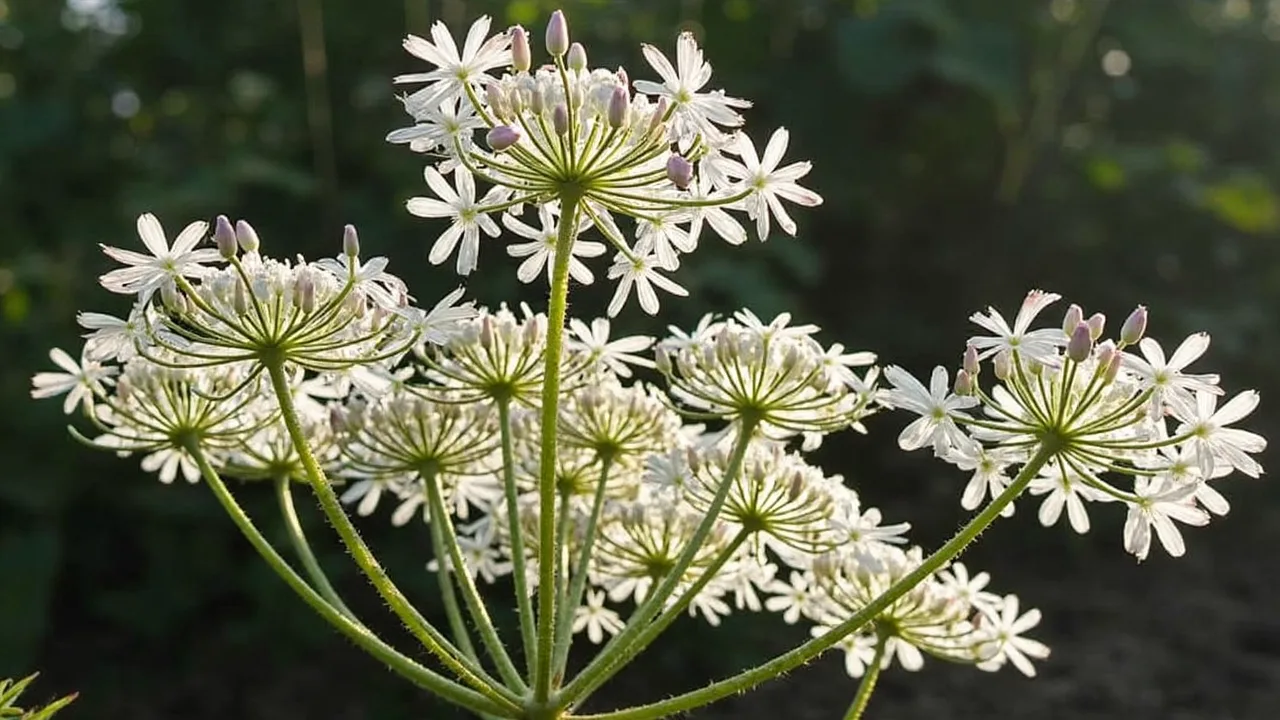
The flower heads are compound umbels, 2–6 cm across, carried on long stalks and made up of between four and ten uneven rays. Each ray terminates in a smaller umbellet of tiny five-petalled flowers, white and only 2–4 mm wide, with the outer florets on each head slightly larger than the inner ones — a feature that gives the umbel its lacy outline. The overall effect is a flat to gently domed plate of white, often flushed faintly pink in cool weather. The flowering season in southern England usually begins in late April and is largely over by mid-June; in Scotland and the north it is correspondingly later.
After pollination the flowers develop into slender, ridged fruits 6–10 mm long, dark brown to almost black when ripe, each tipped with a short beak. These split in two when ripe and shed a prolific seed crop that can persist in the soil for several years.
The most important identification distinction is from hemlock. Hemlock is similar in size and umbel structure but has hairless, blue-green foliage and, crucially, hollow stems distinctly blotched with purple — particularly at the base. Cow parsley stems are green throughout, slightly hairy and grooved rather than blotched.
Growing Conditions
Cow parsley thrives in the conditions that the British countryside provides almost incidentally. It is a gap-phase species, quick to colonise freshly disturbed ground, hedge bottoms and woodland clearings, and is equally at home on a damp road verge as at the shaded edge of a wood.
In garden terms this translates into a preference for partial shade, though it grows well in full sun provided the soil does not dry out. The ideal soil is a moist but well-drained loam of moderate fertility, with a pH anywhere from mildly acidic to mildly alkaline (roughly 5.5 to 7.5). It tolerates clay, especially where organic matter has been worked in, and it copes with seasonal surface wet around the base of hedges. Very dry, very poor sandy soils stunt growth; over-rich, heavily mulched and irrigated borders encourage lush growth at the expense of flowering and seed set.
Ecologically, cow parsley is a significant component of the British hedgerow flora. Its flowers provide abundant nectar and pollen for hoverflies, solitary bees, beetles and other insects at a time of year when little else is in bloom. It is also a host plant for a range of invertebrates associated with native hedgerows, and is regularly recorded as supporting aphid-feeding hoverflies that help to suppress aphid populations later in the season.
Planting and Care
Because cow parsley is a wildflower, most gardeners do not plant it deliberately — it arrives uninvited and is then either welcomed or controlled. Where it is to be encouraged, the easiest approach is to mimic its natural conditions rather than to cultivate it as an ornamental.
Sowing. Seed can be sown in autumn, either directly where the plants are to grow or in seed trays for transplanting later. Surface sow on a fine, weed-free tilth and press the seed in lightly; it does not need covering. Germination occurs in the following spring after a winter of cold and moisture, so autumn sowings are far more reliable than spring ones. Fresh seed germinates freely; old seed can be erratic.
Establishment. Water only during the first summer if the ground dries out for an extended period. Once established, the plant is self-sufficient and rarely benefits from irrigation in the British climate. Feeding is unnecessary and counter-productive — overly rich ground produces leafy growth that flops and flowers poorly.
Pruning and cutting back. The single most useful task is to cut the stems down after seeding. In a naturalistic setting this can be done with a strimmer once the seed has set but before it has fully shed, which limits self-seeding without killing the population. In a more controlled border, deadheading as the flowers fade will prevent seed shed altogether. Do not cut back the basal rosettes of first-year plants; they need their foliage to build up the root before flowering the following spring.
Propagation. Beyond seed, division of older clumps in autumn is possible but rarely worthwhile, as individual plants are short-lived and seed is so much easier. Letting a designated patch set seed and then hoeing out unwanted seedlings is the most practical way to maintain a stable colony.
Seasonal care. Little is needed. In late winter, cut down and remove the dead stems from the previous year before new growth emerges. Watch for seedlings in unwanted places and remove them while young, particularly near cultivated beds where cow parsley can swamp smaller plants.
Common Problems
Cow parsley has few pests and diseases of its own. Aphids may colonise flowering stems in late spring, but they are usually kept in check by the very hoverflies and ladybirds that the plant attracts, and treatment is rarely necessary. Powdery mildew can appear in dry late summers, especially on plants in too much sun, but is cosmetic and self-limiting.
The genuine problems are management and identification rather than pathology.
Misidentification. This is by far the most serious issue. Hemlock (Conium maculatum) grows in similar habitats and flowers at the same time; it is acutely toxic to humans, livestock and pets. The single most reliable field check is the stem: cow parsley has a green, slightly hairy, grooved stem, while hemlock has a smooth, hairless, hollow stem with distinct purple blotching and a foetid, mousy smell when crushed. Hemlock water-dropwort (Oenanthe crocata) prefers wetter ground and has shiny, more finely divided leaves with a celery-like smell. Any umbellifer that cannot be identified with confidence should not be handled without gloves, and certainly never tasted.
Excessive self-seeding. In favourable conditions a single plant can shed several thousand seeds, and a colony can spread quickly into cultivated areas. In wilder settings this is an asset; in mixed borders it is a liability. Deadheading, strimming after seeding, or hoeing out first-year rosettes in autumn are the usual controls.
Habit and stature. The hollow stems can flop in wind and rain, particularly on rich soils, and the plant may smother lower-growing neighbours. Position it at the back of a border or at a woodland edge where its height and lax habit can be accommodated.
Popular Varieties
The species itself is the plant most gardeners grow, knowingly or otherwise. Named cultivars of Anthriscus sylvestris are few, and availability in the UK trade varies year to year.
Anthriscus sylvestris 'Ravenswing'. The best-known ornamental selection, distinguished by its dark purple-bronze to almost black foliage and stems, against which the white umbels show up particularly well. It grows to roughly 90–120 cm and is widely offered by British nurseries as a foliage plant for moist borders and naturalistic plantings.
Anthriscus sylvestris 'Going for Gold'. A more recent selection with golden-yellow to chartreuse foliage in spring, holding its colour best in light shade. Slower and shorter than the species; useful at the front of a damp border.
Anthriscus sylvestris 'Hullavington'. A selected form with particularly fine, lacy foliage and a slightly more compact habit; availability is sporadic and it is mostly found through specialist hardy perennial nurseries.
Beyond these cultivars, regional variants of the wild plant (sometimes distinguished by leaf colour or growth habit) are occasionally offered by seed merchants specialising in British wildflowers, but they are not formally named.
Pests and Diseases
| Problem | Symptoms | Management |
|---|---|---|
| Slugs and snails | Irregular holes chewed in leaves and stems, often with silvery slime trails. | Use beer traps, copper tape barriers, or iron phosphate-based pellets. |
| Powdery mildew | White powdery fungal growth on leaves and stems, causing yellowing and distortion. | Improve air circulation, avoid overhead watering, and apply a fungicide if severe. |
| Aphids | Clusters of small soft-bodied insects on new growth, accompanied by sticky honeydew. | Spray with a strong jet of water or use insecticidal soap/neem oil. |
| Root rot | Wilting and yellowing leaves despite moist soil, often with a foul smell from the base. | Ensure well-draining soil and avoid overwatering; remove affected plants. |
For step-by-step help, read Controlling Aphids Naturally, Dealing with Slugs and Snails and Treating Powdery Mildew. Or browse the full plant problem solver to diagnose an issue by symptom.
As an Amazon Associate, GardenWizz earns from qualifying purchases made through links on this page (including links within the article). This does not affect the price you pay. See our disclaimer for details.