
English Elm
Ulmus minor
The Gardening Year
Best months in UK gardens · full planting calendar →
🖨 Printable care card (PDF)At a Glance
| Botanical name | Ulmus minor |
|---|---|
| Common name(s) | English Elm |
| Family | Ulmaceae |
| Plant type | tree (Deciduous) |
| Height × Spread | 35 m × — |
| Position | Full sun, Partial shade |
| Soil | any well drained soil |
| Flowering | April–May |
| Toxicity | — |
| Native range | south European, extending to Asia Minor and Iran; northern outposts are the Baltic islands of Öland and Gotland |
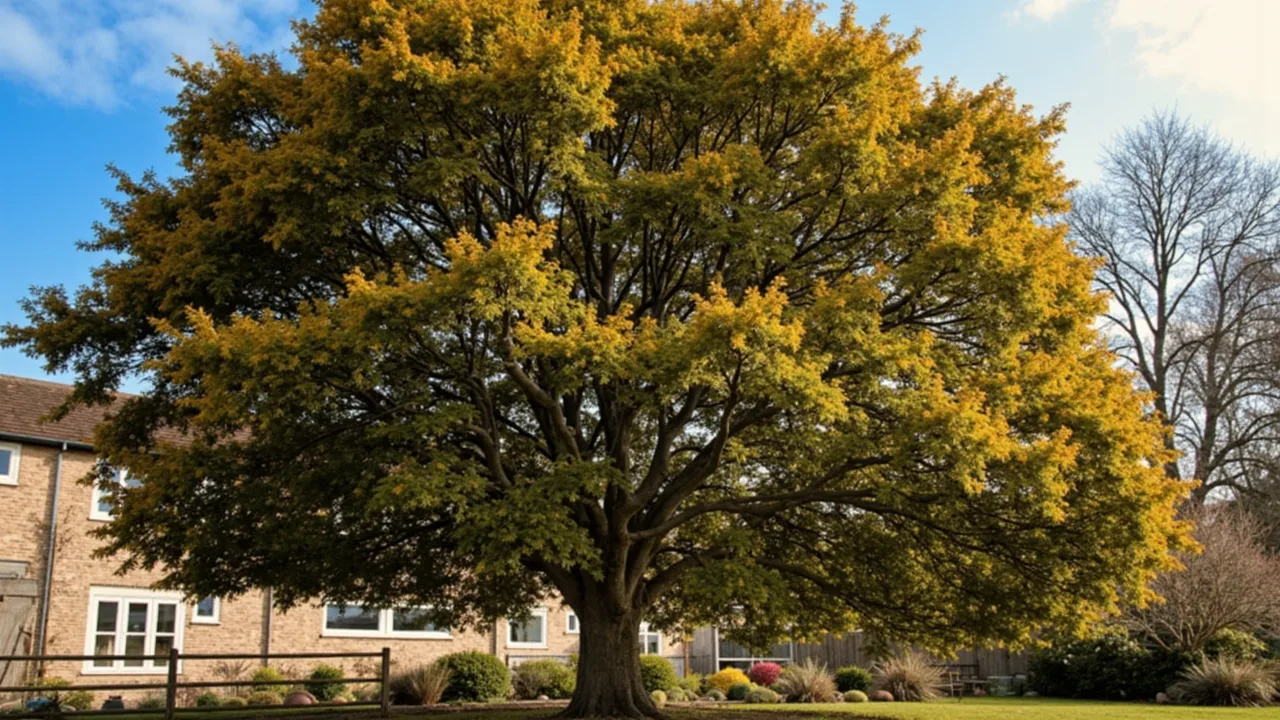
The English Elm is one of the most recognisable broadleaf trees of the British countryside. Once a defining feature of field boundaries, village greens and market squares across lowland England, it was devastated by Dutch elm disease in the twentieth century but remains a vigorous, fast-growing native tree widely planted today in parks, large gardens and woodland restoration schemes. Its broad umbrella-shaped crown, dense summer canopy and distinctive winter silhouette make it an immediately identifiable species, even in leafless form.
Quick-Care Table
Overview
Ulmus minor belongs to the family Ulmaceae and is one of several elms native to the British Isles. It was, until the first pandemic of Dutch elm disease in the 1920s–1940s, the dominant elm of southern and central England, where mature specimens commonly reached 30 m or more and lived for several centuries. A second, more aggressive pandemic caused by the related fungus Ophiostoma novo-ulmi swept through the country from the late 1960s and killed the vast majority of mature English Elms within a generation.
Today the tree persists chiefly as suckering regrowth from old root systems, as planted landscape specimens, and through selected disease-resistant hybrid cultivars developed from continental European stock. It remains culturally significant in the UK, both as a marker of lost lowland landscapes and as a symbol of resilience. Gardeners considering an English Elm should note that, although young trees grow quickly and recover well from cutting back, the species is fundamentally susceptible to Dutch elm disease and should be planted with this in mind, particularly within 5 km of established elm populations.
Appearance
English Elm is a large, broadly domed deciduous tree. In the open it develops the characteristic flat-topped or umbrella-shaped crown, with heavy lateral branches arching outwards from a short, often forked trunk. The bark is dark grey-brown, deeply fissured into rectangular plates on old specimens, and frequently supports twiggy suckers along the trunk and main limbs.
Twigs in the first year are slender and downy, becoming smoother and greyer with age. Buds are small, ovoid and dark purplish-brown. The leaves are alternate, broadly ovate to elliptical, 6–12 cm long and 3–7 cm wide, with a strongly asymmetrical base — a feature that distinguishes elms from many similar broadleaves. The tip is pointed, the margin doubly serrate, and the upper surface is markedly rough to the touch. Veins are prominent and parallel, with tufts of pale hairs in the vein axils beneath. Autumn colour is generally a dull yellow before leaf fall in October or November.
Flowers appear in dense clusters along the previous year's twigs in late winter or very early spring, before the leaves emerge. They are small, petalless and reddish-purple, and are wind-pollinated. The fruits are pale green, flattened, winged samaras roughly 1 cm across, ripening rapidly and shed in late spring; they are a useful early-season food source for finches and small mammals.
Growing Conditions
The English Elm is fully hardy across the UK and tolerates temperatures down to around –20 °C. It grows best in a temperate maritime climate with reliable rainfall and performs well throughout England and Wales. In cooler or wetter parts of Scotland it grows but tends to remain smaller; in exposed northern or upland sites it can be slow to establish and benefits from shelter.
Soil requirements are broad. The tree tolerates clay, loam and chalky substrates provided drainage is reasonable, and it is notably tolerant of the seasonal waterlogging found on heavy clay. Very acidic, peaty soils are less suitable, as are permanently waterlogged sites, where honey fungus (Armillaria spp.) becomes a significant risk. The tree prefers full sun but accepts light dappled shade; growth rate and crown form are at their best in open, sunny positions.
When young, English Elm is exceptionally vigorous, commonly putting on 60–100 cm of height per year on a good site. Growth slows after the first 20–30 years, and the broad crown continues to thicken rather than to extend upward. The species is moderately tolerant of salt-laden coastal winds and is sometimes planted in coastal parkland, although foliage scorch can occur in the most exposed positions.
Planting and Care
Site selection. English Elm is a tree for large gardens, parks, fields and estates. Its mature spread matches or exceeds its height, and a single specimen will dominate anything below it. Avoid planting within 5 m of buildings, drains or underground services; the root system is wide-spreading and competitive. Choose a position in full sun with at least 15 m of clear horizontal space on every side.
When to plant. Bare-root and root-balled whips or standards are best planted between November and March, while dormant. Container-grown stock can be planted at any time of year but establishes most reliably in autumn or spring.
Planting technique. Prepare a hole at least twice the width of the rootball and no deeper. Position the tree so that the root flare sits at or just above soil level, backfill with the original soil, firm gently and water thoroughly. Apply a 5–8 cm organic mulch over a 1 m radius, keeping it clear of the trunk.
Staking. Use a tall, rigid stake and a flexible tree tie. Leave the stake in place for three to five years, or until the trunk has thickened enough to resist wind-rock without support. Remove the tie before it begins to constrict the expanding trunk.
Watering. Water deeply once a week during dry spells for the first two to three summers after planting. Once established the tree is reasonably drought-tolerant and rarely needs supplementary irrigation.
Feeding. On most garden soils no feeding is required. On very poor sandy or shallow chalk soils, apply a balanced slow-release fertiliser in early spring for the first few years to drive establishment.
Pruning. English Elm needs minimal formative pruning. Remove dead, damaged or crossing branches in summer, ideally between June and August, when the sap is rising and the bark-beetle vectors of Dutch elm disease are least active. Never prune elms between October and January, when the risk of fungal transmission is highest. Use clean, sharp tools and sterilise blades with household disinfectant or methylated spirits between trees.
Propagation. The true English Elm is propagated by suckers taken in autumn, by hardwood cuttings, or by grafting on to disease-resistant rootstock. Seed is produced freely but rarely germinates reliably and seedlings are not true to type.
Seasonal care. In late winter, inspect the crown for deadwood after storms. In spring, watch for the first signs of Dutch elm disease (see below) and act quickly. In autumn, clear fallen leaves from beneath the canopy if disease has been an issue nearby, as fallen material can harbour beetles.
Common Problems
Dutch elm disease (Ophiostoma novo-ulmi). By far the most serious threat. The fungus is carried from tree to tree by elm bark beetles (Scolytus species) and also spreads through interconnected root systems. Symptoms appear from late spring: leaves on one or more upper branches turn yellow, then brown, and wilt while still attached. If the bark is peeled back, brown streaking is visible in the current-year sapwood. There is no chemical cure. Affected branches must be cut back at least 3 m below the lowest visible staining, ideally in summer; all cut material should be burned or removed from site, and tools disinfected between cuts. Trees that are more than a third infected should be felled and destroyed promptly to protect neighbouring elms.
Elm yellows (Candidatus Phytoplasma ulmi). A bacterial-like infection causing general yellowing, leaf drop, witches' brooms and slow dieback. Rare in Britain but recorded on the continent. There is no treatment and infected trees should be removed.
Aphid leaf curl. The elm-leaf aphid (Eriosoma ulmi) feeds on new growth, causing leaves to curl and become distorted. Heavy infestations produce honeydew and sooty mould beneath the canopy. Damage is largely cosmetic and can be tolerated; a strong jet of water or a single application of insecticidal soap will bring infestations under control if necessary.
Root rot (Armillaria). On poorly drained or previously wooded sites, honey fungus can attack the roots of mature elms. Symptoms include dieback in the upper crown, peeling bark at the base, and the appearance of honey-coloured toadstools in autumn. Infection is usually fatal; the stump and major roots should be removed and the site left fallow or planted with non-susceptible species.
Bark beetles. Non-Dutch-elm bark beetles may colonise already-weakened trees. They are rarely a primary cause of decline and usually indicate that another problem — drought stress, root damage or disease — is present.
Popular Varieties
There are no widely grown cultivars of the true English Elm in British horticulture, as the entire species is highly susceptible to Dutch elm disease and breeding work has focused instead on disease-resistant hybrids derived from Asian and European elm species. The following are the most commonly planted in UK landscapes where an elm form is desired:
- 'Sapporo Autumn Gold' — a hybrid of U. japonica and U. pumila, with a broadly upright form, golden-yellow autumn colour and good resistance to Dutch elm disease. Reaches around 15 m.
- 'Lobel' — a Dutch-bred hybrid (U. glabra × U. minor × U. wallichiana) with a narrow, upright habit suitable for street planting and avenues. Shows strong field resistance to Dutch elm disease and reaches 18–20 m.
- 'Columella' — another Dutch-bred, narrow-crowned hybrid, very upright and tidy in form. Used where a vertical accent is needed. Resistant to Dutch elm disease to around 15 m tall.
- 'Jacqueline Hillier' — a slow-growing, shrubby elm reaching only around 2–3 m. Useful in smaller gardens, although technically a hybrid rather than a true U. minor cultivar. Shows some field resistance to Dutch elm disease.
For those wishing to retain the authentic English Elm form, suckers from old established hedgerows are sometimes offered by specialist nurseries. These are the true species but carry the same disease susceptibility as wild trees, and planting them should always be discussed with a local tree officer if Dutch elm disease is known to be active in the area.
Pests and Diseases
| Problem | Symptoms | Management |
|---|---|---|
| Dutch elm disease | Foliage suddenly turns yellow, wilts, shrivels and dies, often with shepherd's crook shoot tips. | Remove and burn infected wood immediately to prevent beetle spread; avoid wounding trees. |
| Honey fungus | General decline, dieback of branches, and white fungal growth under the bark at the base. | Improve drainage and soil aeration; remove infected roots and apply registered fungicides if severe. |
| Aphids | Clusters of small soft-bodied insects on new shoots causing leaf curling and sticky honeydew. | Encourage natural predators like ladybirds or use a strong jet of water to dislodge them. |
| Coral spot | Small, bright orange or red fungal fruiting bodies appear on dead or dying branches. | Prune out and destroy affected wood to reduce spore load and improve tree health. |
| Phytophthora root rot | Rapid wilting and yellowing of leaves, often with dark staining on the inner bark at the base. | Ensure well-drained soil conditions and avoid waterlogging around the root zone. |
For step-by-step help, read Controlling Aphids Naturally. Or browse the full plant problem solver to diagnose an issue by symptom.
As an Amazon Associate, GardenWizz earns from qualifying purchases made through links on this page (including links within the article). This does not affect the price you pay. See our disclaimer for details.