Allium
Allium hollandicum
The Gardening Year
Best months in UK gardens · full planting calendar →
🖨 Printable care card (PDF)At a Glance
| Botanical name | Allium hollandicum |
|---|---|
| Common name(s) | Allium |
| Family | Amaryllidaceae |
| Plant type | bulb (Deciduous, clump forming bulbous herbaceous perennial living up to four years after planting.) |
| Height × Spread | 90 cm × — |
| Position | Full sun |
| Soil | Moist but well-drained, fertile soil; avoid damp sites on heavy soil. |
| Flowering | May–June |
| Toxicity | — |
| Native range | Iran and Kyrgyzstan |
Allium hollandicum, commonly known as Dutch garlic or the ornamental onion, is a bulbous herbaceous perennial grown for its tall, architectural flower heads and its value to late-spring pollinators. A member of the Amaryllidaceae family, it sits among the most widely planted ornamental alliums in British gardens, valued for its tolerance of UK winters, its ability to thrive in well-drained borders, and its long-lasting seed heads.
Overview
Allium hollandicum is native to Iran and Central Asia but has become firmly established in British horticulture since its introduction to western gardens in the twentieth century. It is grown almost exclusively as an ornamental; although the genus Allium includes onions, garlic, leeks and chives, A. hollandicum itself is not a culinary crop and is grown for its visual impact rather than its edibility.
The plant is fully hardy throughout the UK, classed as RHS hardiness rating H6 (hardy to between -15 °C and -20 °C), and tolerates a wide range of British soils provided drainage is reliable. It is reliably perennial in most regions, returning year after year from the same bulbs, and is considered deer and rabbit resistant because of the characteristic onion-family scent. The species is widely used in mixed borders, gravel gardens, cottage plantings and prairie-style designs, where its vertical stems and spherical flower heads provide strong structural contrast to lower-growing perennials.
Appearance
Allium hollandicum grows from tunicated bulbs similar in form to those of culinary onions. In spring it produces a basal rosette of narrow, strap-shaped leaves of a grey-green colour. As the flower stem elongates in late spring, the foliage begins to die back, often yellowing by the time the blooms open. Gardeners are sometimes alarmed by this leaf die-back; it is a normal part of the plant's annual cycle rather than a sign of disease.
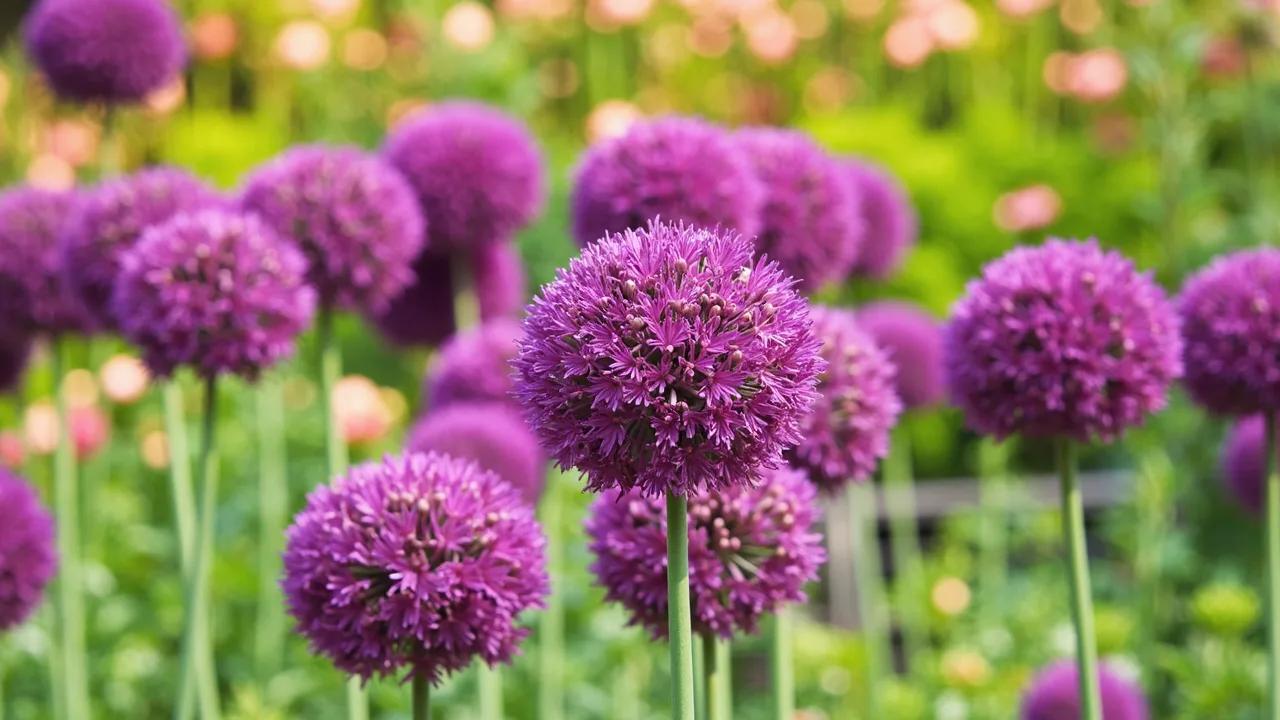
From the centre of the rosette rises a slender, smooth stem typically reaching 60–90 cm tall, occasionally taller on well-grown specimens in rich soil. The stem is topped by a dense, spherical umbel, 6–10 cm across, composed of many small star-shaped flowers in a rich violet-purple. Individual umbels are made up of dozens of florets, each with six tepals, giving the head a finely textured, almost geometric appearance.
The flowers open in late May and June, sitting well above the fading foliage and attracting bees, butterflies and hoverflies in considerable numbers. Once pollinated, the florets fade and the inflorescence dries on the stem, forming a papery seed head that holds its shape well into autumn. These dried heads are prized by gardeners and flower arrangers for their sculptural quality and long persistence.
Growing Conditions
Allium hollandicum performs best in full sun, where the stems grow straight and the umbels colour up most intensely. It tolerates light, dappled shade but flowering is reduced and stems may lean towards brighter light. A sheltered site reduces the risk of late-spring storms flattening taller stems, though the species is generally sturdier than many of the larger allium hybrids.
Soil should be well drained and reasonably fertile. Loamy soils of neutral to slightly alkaline pH suit the plant well; it will also grow in clay soils provided they do not become waterlogged, particularly during summer dormancy when dormant bulbs rot in saturated ground. Adding sharp sand or grit at planting time improves drainage on heavier soils and is the single most useful intervention for gardeners on clay.
The species is moderately drought tolerant once established, reflecting its origin in regions with dry summers. It dislikes winter and early-spring wet combined with cold, which is the most common cause of bulb loss in the UK. A position at the front of a sunny border, on a slight slope, or in a gravel garden replicates the free-draining conditions it prefers.
Planting and Care
Bulbs are planted in autumn, between September and November, while the soil is still workable but no longer warm. Plant each bulb at roughly three to four times its own depth, around 10–15 cm below the surface, pointed end upwards, and space bulbs 10–15 cm apart. Deeper planting on lighter soils helps anchor tall stems; on heavier soils, planting slightly shallower reduces the risk of rot.
A light dressing of bonemeal or a low-nitrogen, high-potash fertiliser at planting time encourages strong root development without promoting soft leafy growth. High-nitrogen feeds should be avoided, as lush foliage is more susceptible to disease and the bulbs themselves store energy more efficiently when growth is steady.
Once flowering has finished, allow the foliage and stems to die back naturally. The leaves continue to photosynthesise while they are still green, replenishing the bulb's reserves for the following year. Cutting the foliage down too early is the most common cause of declining flower performance in subsequent seasons.
Propagation is straightforward by division of established clumps in late summer, once the bulbs are fully dormant. Lift congested clumps, separate the bulbs, and replant the largest immediately at the recommended depth. Smaller offset bulbs can be grown on in a nursery bed for a season or two until they reach flowering size. Seed propagation is possible but slow; seedlings typically take three to four years to reach flowering size and will not come true to type, so named cultivars must always be increased vegetatively.
Dividing clumps every three to four years maintains vigour and prevents the centre of older clumps from dying out. After division, replant into ground refreshed with compost and grit, and water in well to settle the soil around the roots.
Common Problems
The most damaging pest of Allium hollandicum in British gardens is the allium leaf miner (Phytomyza gymnostoma), a small fly whose pale larvae tunnel into leaves and stems, causing distorted growth and discoloured patches. Fine insect mesh laid over emerging foliage in early spring is the most reliable organic barrier; affected leaf tips can also be pinched off and destroyed to kill larvae before they move down into the bulb.
Downy mildew appears as a greyish, fuzzy growth on leaves in cool, damp conditions, particularly in overcrowded plantings with poor air movement. Improving spacing, avoiding overhead watering, and clearing affected foliage at the end of the season reduces carry-over to the following year.
Bulb rot, caused by Fusarium species and other soil-borne fungi, turns bulbs soft and brown, often with a pinkish-white fungal growth. It is almost always associated with poor drainage; affected bulbs should be lifted and discarded, and the ground not used for alliums again for several years.
Narcissus fly may occasionally lay eggs near allium bulbs, with grubs tunnelling into them once they hatch. Good garden hygiene, including the prompt removal of any soft or damaged bulbs, reduces attraction. Slugs and snails sometimes damage emerging shoots in damp springs but rarely cause serious harm.
Allium hollandicum is generally resistant to browsing by deer and rabbits, and the characteristic sulphur compounds in the foliage deter most larger garden mammals.
Popular Varieties
The taxonomy of ornamental alliums sold in the UK trade has been revised several times, and a number of plants historically offered as A. hollandicum have since been reclassified to closely related species. Gardeners buying bulbs under any of the names below should expect very similar performance in the garden.
A. hollandicum itself is most often offered as the species type, with the characteristic violet-purple umbels described above. Bulbs sold simply as "Allium hollandicum" in UK garden centres are usually vigorous seed-raised stock and perform reliably in most well-drained situations.
'Purple Sensation' is the form most widely grown under the A. hollandicum banner, and in much of the British trade continues to be sold as Allium hollandicum 'Purple Sensation'. The Royal Horticultural Society treats it formally as Allium aflatunense 'Purple Sensation', reflecting a long-running taxonomic disagreement. In the garden the two names refer to the same plant: dense 7–8 cm umbels of intense violet-purple on stems around 70–90 cm tall in May and June, with excellent seed-head persistence into autumn.
A. aflatunense is a closely related Central Asian species with very similar appearance and garden performance, and is often grouped with A. hollandicum in border design. It produces slightly larger umbels in a marginally paler purple and is worth growing alongside A. hollandicum for a subtle gradation of tone.
White-flowered alliums, particularly forms of A. stipitatum and A. giganteum, provide a natural companion to the typical purple forms and are widely available as dry bulbs in autumn. While not strictly A. hollandicum cultivars, they are commonly combined with it in mixed plantings to extend the season and lighten the overall colour palette from late May into July.
Pests and Diseases
| Problem | Symptoms | Management |
|---|---|---|
| Allium leaf miner | Leaves develop white, winding trails or brown patches that cause them to wither and die prematurely. | Remove affected foliage immediately after flowering and burn it to break the pest's life cycle. |
| Onion fly | Young shoots turn yellow, wilt, and collapse while larvae feed on the bulb base underground. | Plant in autumn or early spring outside peak flight times and use insect-proof netting as a barrier. |
| Onion white rot | Bulbs become soft and rotten with distinctive white, cottony fungal growth on the base. | Avoid planting alliums in infected soil for at least 10 years and ensure excellent drainage. |
| Onion downy mildew | Foliage shows pale green to yellow streaks covered in a greyish-purple fuzzy mould. | Improve air circulation, avoid overhead watering, and remove severely infected leaves promptly. |
| Bulb rot | Bulbs become soft, mushy, and discoloured due to waterlogging in heavy or poorly drained soil. | Plant in well-drained soil or containers and avoid sites that remain wet during winter. |
For step-by-step help, read Treating Powdery Mildew. Or browse the full plant problem solver to diagnose an issue by symptom.
As an Amazon Associate, GardenWizz earns from qualifying purchases made through links on this page (including links within the article). This does not affect the price you pay. See our disclaimer for details.