
Rue
Ruta graveolens
The Gardening Year
Best months in UK gardens · full planting calendar →
🖨 Printable care card (PDF)At a Glance
| Botanical name | Ruta graveolens |
|---|---|
| Common name(s) | Rue |
| Family | Rutaceae |
| Plant type | shrub (woody, perennial shrub; evergreen) |
| Height × Spread | — × — |
| Position | Full sun, Partial shade |
| Soil | moderately fertile, well-drained soil |
| Flowering | — |
| Toxicity | TOXIC to skin with sunlight. Wear gloves and other protective equipment when handling TOXIC to pets skin with sunlight (dogs). Rue extracts are mutagenic and hepatotoxic. Large doses can cause violent gastric pain, vomiting, liver damage, and death. |
| Native range | Mediterranean |
A bushy, blue-green evergreen subshrub prized for its aromatic, deeply divided foliage and its long history in British herb gardens. Rue (Ruta graveolens) is among the most recognisable of the Mediterranean herbs that have naturalised into UK gardens, valued less for its modest flowers than for the cool, glaucous mound of leaves it produces through every season. It is also a plant that demands respect: its essential oils can cause severe skin reactions in sunlight, and it should be handled with gloves. Grown with that caveat in mind, rue is an exceptionally easy, drought-tolerant and long-lived garden subject, particularly suited to gravel gardens, sunny borders and coastal sites.
Overview
Rue belongs to the Rutaceae, the citrus family, and is closely allied to plants such as Dictamnus and Skimmia. It is a hardy evergreen subshrub, woody at the base with soft, herbaceous growth above, typically reaching 60–90 cm in height and spread when mature. Native to the Balkans and the eastern Mediterranean, it has been cultivated in British gardens since at least the sixteenth century, where it was historically grown as a medicinal herb, a strewing herb, and a supposed protection against plague and witchcraft — earning it the country name herb-of-grace. It is fully hardy across the UK and is grown today primarily as an ornamental foliage plant in herb gardens, gravel plantings and Mediterranean-style borders.
Appearance
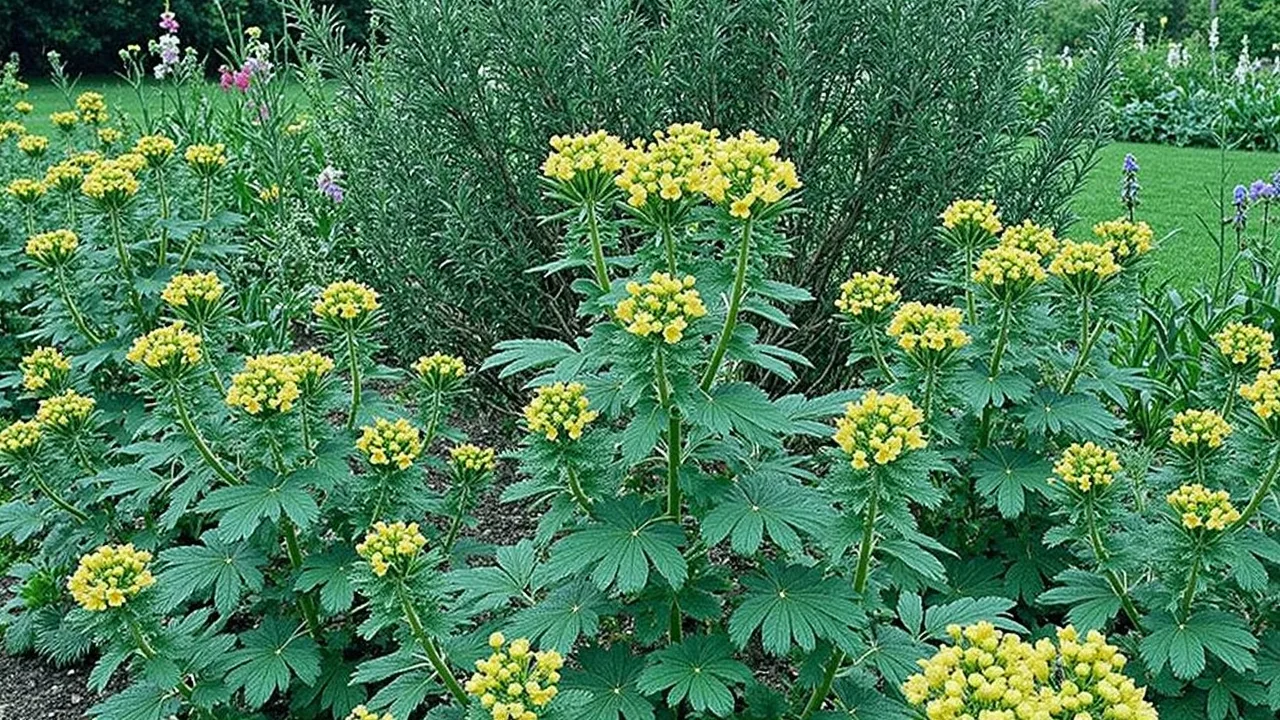
Rue forms a dense, rounded mound of woody-based stems clothed in soft, deeply divided leaves. The leaves are pinnate to bipinnate, meaning each leaf is divided into segments that are themselves further lobed, giving the foliage a feathery, almost fern-like appearance. Colour is the most distinctive feature: a cool, blue-green or glaucous green, often described as the colour of the Mediterranean sea on a cloudy day. The leaves are dotted with tiny oil glands that, when brushed or crushed, release a powerful and rather bitter scent — pungent, resinous, and slightly citrus-like, quite unlike any other common garden herb.
In midsummer, usually from June through August, rue produces terminal clusters of small, four- or five-petalled flowers in a clear, slightly greenish yellow. The blooms are roughly 1.5–2 cm across and held in loose corymbs above the foliage, giving the plant a soft, hazy appearance for several weeks. They are followed by small, rounded seed pods containing numerous brown seeds. Individual plants live for many years; old, woody specimens can develop attractive, gnarled stems, particularly when pruned hard each spring to keep growth compact.
Growing Conditions
Rue performs best in conditions that mimic its Mediterranean origins. It needs full sun for the strongest foliage colour and most abundant flowering, although it will tolerate light dappled shade, particularly in the south of England. Soil must be sharply drained — heavy clay or any ground that lies wet through winter will quickly kill established plants, and it is on this point more than any other that UK cultivation succeeds or fails. Sandy, gravelly and stony soils are ideal, and rue tolerates poor, low-fertility ground far better than rich, manured beds.
The plant prefers a neutral to slightly alkaline pH, roughly 6.5 to 8.0, and shows signs of stress (yellowing foliage, weak regrowth) in strongly acid soils. Once established, rue is exceptionally drought tolerant and needs little supplementary watering, even during prolonged dry spells in southern and eastern England. It is also tolerant of salt-laden winds, which makes it a sound choice for coastal gardens in places such as Cornwall, Norfolk and the Scottish west coast. In containers, use a free-draining mix such as John Innes No. 2 with at least a third by volume of sharp grit, and raise the pot on pot feet to keep the crown clear of winter wet.
UK hardiness is good: rue is rated RHS H5, which corresponds to tolerance of low temperatures down to around −15 °C to −20 °C in well-drained soil. Across most of the UK, including Scotland north to about Aberdeen and the higher ground of Wales and the Pennines, established plants survive winter without protection. In colder inland districts or exposed upland gardens, a dry mulch of grit or gravel over the crown in late autumn helps the plant come through the worst weeks without rot.
Planting and Care
Plant rue in spring or early autumn, the traditional UK planting months of March to May or September to October, when the soil is workable but warm enough for roots to establish before the first hard frost. Space plants roughly 45–60 cm apart to allow for their mature spread and to keep air moving through the foliage. Dig a hole only as deep as the rootball, backfill with the native soil (do not enrich with compost — rue prefers poor ground), and water in once. After that, supplementary watering should be minimal: only during the first growing season in dry weather, and only in prolonged drought thereafter.
Feeding is generally unnecessary. A light spring top-dressing of sharp grit or gravel around the crown reflects the plant's Mediterranean preference and helps keep the base dry through winter. Avoid mulches of bark or rich organic matter, which hold moisture against the stem and encourage rot.
Pruning is straightforward but important. In March or early April, cut the previous year's growth back by roughly a third to a half, removing any frost-damaged, leggy or crossing stems. Older, woody plants respond well to harder pruning into the older wood, provided some live buds remain below the cut. A light trim after flowering in late summer keeps the mound compact and tidy, but avoid hard cutting late in the season, which can leave fresh growth vulnerable to early frosts.
Propagation is easy by any of three methods. Seed can be sown in autumn or spring under a cold frame; germination is reliable but slow. Semi-ripe cuttings, taken in mid- to late summer from the current season's wood, root readily in a gritty cuttings compost with a little bottom heat. Established clumps can also be divided in spring, although rue resents disturbance less than many woody herbs and will recover quickly if lifted and split with a sharp spade.
Seasonal care in the UK is minimal. In March, prune and top-dress. In June, watch for the first flowers and trim lightly after they fade. In September, a final tidy removes any seed heads if self-sowing is not wanted. In November or December, on poorly drained or exposed sites, lay a dry mulch of grit over the crown.
Common Problems
Root rot caused by wet soil is by far the most frequent cause of rue failure in the UK. Symptoms are yellowing foliage, wilting even when soil is moist, and progressive die-back from the tips. There is no effective cure once rot is established, and affected plants should be removed. Prevention is the entire strategy: plant only in well-drained soil, raise container pots on feet, and avoid heavy mulching.
Powdery mildew can appear in humid, still summers, particularly where plants are crowded or shaded. It shows as a white, dusty coating on the leaves. Improve airflow by thinning surrounding growth, water at the base rather than overhead, and remove affected shoots.
Aphids occasionally colonise the soft young tips in late spring, and a strong jet of water or a standard insecticidal soap will usually deal with them. Leaf spot, caused by Septoria species, produces small brown or black spots and is best managed by removing affected material and improving spacing.
Slugs and snails may nibble young foliage in damp springs, particularly in the north and west; standard organic controls are adequate. Foliage scorch can occur on plants in hot, exposed, very dry sites in midsummer, although established plants normally recover.
The most significant issue associated with rue is not a disease but a phototoxic reaction in humans. The foliage contains furanocoumarins, particularly bergapten, which can cause severe phytophotodermatitis: skin contact followed by exposure to sunlight may produce blistering, burning and long-lasting pigmentation changes. Always wear gloves and long sleeves when handling the plant, particularly in sunny weather, and wash exposed skin before going outdoors. Rue is toxic if ingested and should be kept away from children and pets.
Popular Varieties
Named cultivars of Ruta graveolens are relatively few, and gardeners should be cautious of novelty listings that may not be commercially available. The following are reliably established names:
- 'Jackman's Blue' — the most widely grown form, with particularly intense blue-green foliage and a notably compact, dense habit. It holds its colour well through winter and is the cultivar most often recommended for ornamental planting.
- 'Variegata' — a slower-growing form with leaves irregularly splashed and edged with cream. Less vigorous than the type, it is best in a sheltered, sunny position and benefits from a light trim after flowering.
- 'Curly Girl' — a recent selection with finely curled, more divided leaflets giving a distinctive textural effect. Useful in gravel gardens where its finer foliage contrasts well with broader-leaved neighbours.
Beyond these, rue is sometimes sold simply as the species, which itself makes an excellent garden plant. Plants raised from seed may show some variation in foliage tone, but all share the characteristic scent and hardiness of the type.
Pests and Diseases
| Problem | Symptoms | Management |
|---|---|---|
| Phytophthora root rot | Plant wilts, yellowing occurs, and roots appear dark and mushy in wet soil. | Ensure well-drained soil and avoid overwatering to prevent fungal infection. |
| Slugs and snails | Irregular holes chewed in leaves and silky trails left on foliage. | Use physical barriers like copper tape or organic pellets to deter feeding. |
| Vine weevil | Notched leaf margins above ground and root damage below soil level. | Check roots at planting and use biological nematodes in late summer. |
| Powdery mildew | White powdery fungal growth appears on leaves and stems. | Improve air circulation and spray with a sulphur-based fungicide if severe. |
| Phytophotodermatitis | Severe blistering and skin discoloration after sap contact and sun exposure. | Wear gloves and long sleeves when handling to prevent skin contact. |
For step-by-step help, read Dealing with Slugs and Snails and Treating Powdery Mildew. Or browse the full plant problem solver to diagnose an issue by symptom.
As an Amazon Associate, GardenWizz earns from qualifying purchases made through links on this page (including links within the article). This does not affect the price you pay. See our disclaimer for details.