
Borage
Borago officinalis
The Gardening Year
Best months in UK gardens · full planting calendar →
🖨 Printable care card (PDF)At a Glance
| Botanical name | Borago officinalis |
|---|---|
| Common name(s) | Borage |
| Family | Boraginaceae |
| Plant type | annual (Although an annual, it will persist in the garden from year to year through ready self-seeding.) |
| Height × Spread | 60–100 cm × — |
| Position | Full sun, Partial shade |
| Soil | Any reasonably drained soil; dislikes waterlogged conditions. Tolerates chalk, clay, loam, sand. pH acid, alkaline, or neutral. |
| Flowering | June–September |
| Toxicity | Contains liver-toxic pyrrolizidine alkaloids (PAs) in leaves and seed oil. Honey from borage may also contain PAs. |
| Native range | Mediterranean region |
Borage (Borago officinalis) is a hardy annual herb from the Boraginaceae family, native to the Mediterranean region and now thoroughly naturalised across the British Isles. Valued equally as a culinary herb, a pollinator plant and an ornamental cottage-garden annual, borage is one of the easiest and most rewarding plants to grow from seed in UK gardens. Its brilliant sky-blue, star-shaped flowers and bristly, cucumber-scented foliage give it a distinctive character that has earned it a permanent place in herb gardens, allotments and ornamental borders alike.
Overview
Borage is a fast-growing annual that completes its life cycle in a single season but, given the chance, will self-seed freely and return year after year without further intervention. It is grown primarily for its edible flowers and young leaves, both of which carry a mild cucumber flavour, and for its exceptional value to bees and other pollinators. The plant has a long history in British horticulture: it was listed in John Gerard's Herball of 1597 and has been grown in cottage gardens ever since.
In addition to its ornamental and culinary uses, borage has a traditional place in companion planting, particularly near strawberries and tomatoes. Commercial starflower oil, extracted from borage seeds, is a recognised source of gamma-linolenic acid and is widely used in dietary supplements.
Appearance
Borage grows upright to a height of 30–60 cm (1–2 ft) with a branching, somewhat sprawling habit. Both stems and leaves are clothed in stiff white hairs, giving the entire plant a slightly bristly texture and a silvery sheen in strong sunlight. The leaves are ovate to lanceolate, mid-green and roughly textured, typically 5–15 cm long, with the lower leaves being larger and carried on long stalks while upper leaves are smaller and sessile.
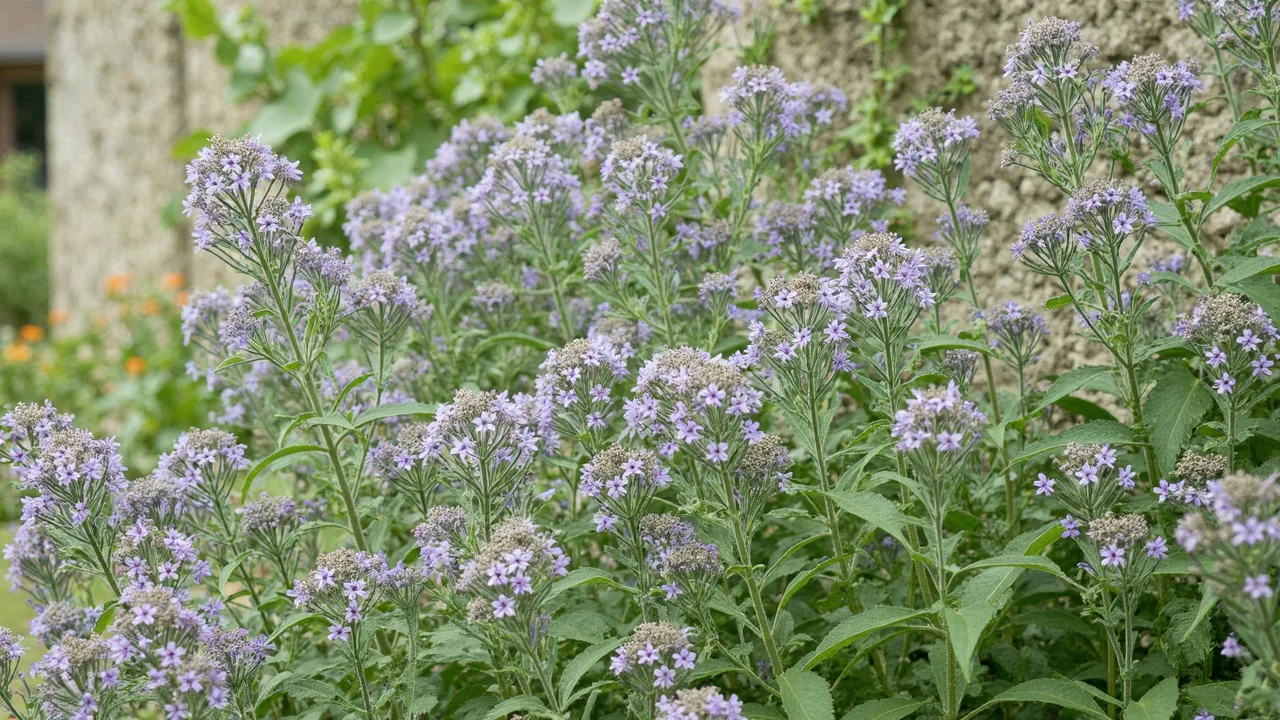
The flowers are the plant's chief glory. Each bloom is a perfect five-petalled star, 2–3 cm across, in a vivid sky-blue colour rarely matched by any other garden plant. At the centre of each flower sits a prominent cone of black anthers, which darken as the flower matures and ripens into a four-chambered seed capsule. Flowering begins in June and continues in successive flushes through to September, particularly if spent blooms are removed.
While the species is overwhelmingly blue, pink- and white-flowered forms do occur naturally and have been selected into named cultivars. The flowers are edible and have a mild, slightly sweet cucumber flavour.
Growing Conditions
Borage thrives in full sun but tolerates light partial shade, particularly in the warmer south and east of England. A sheltered position is preferable on exposed northern or western sites, where strong winds can flatten the somewhat top-heavy flowering stems.
The plant is undemanding about soil. It performs well in ordinary garden soil and is notably tolerant of poor, dry, stony conditions where many other herbs struggle. The one condition it will not tolerate is waterlogging: in heavy or compacted ground, the bristly stems can rot at the base, particularly during a wet winter if autumn-sown plants have been left in situ. Soil pH is not critical; a neutral to slightly alkaline reading (around 6.5–7.5) is ideal but the plant grows acceptably across a wide range.
Being a hardy annual, borage tolerates UK winters without protection, and self-sown seedlings routinely survive frosts well below those typical of even the coldest British winters.
Planting and Care
Sowing is the only realistic propagation method, as borage does not transplant well once the taproot has developed. Sow seeds directly where the plants are to flower, from April to June, at a depth of about 1 cm and spacing of 30 cm between stations. Germination takes 7–14 days at soil temperatures of 15–18°C and is usually reliable without any special treatment. An additional sowing can be made in August or early September; these late-sown plants will overwinter as small rosettes and flower earlier the following year, often by late May.
Once established, borage requires very little routine care. Watering is rarely necessary except during prolonged dry spells, when a thorough soak once a week will keep the foliage from flagging. Feeding is generally unnecessary; in rich soils the plant produces lush leaf at the expense of flowers, so a lean plot is preferable.
Deadheading spent flowers will prolong the display into late summer, but gardeners wishing to maintain a self-seeding colony should leave a proportion of seed heads to ripen and shed. Stems may need staking on fertile sites where the plant grows taller than usual, or in exposed positions. At the end of the season, the whole plant can be lifted and composted after the first hard frost; no formative pruning is needed, as the naturally branching habit requires only the removal of damaged or spent stems to keep the plant tidy.
Propagation is almost entirely by seed; cuttings do not root reliably, and the plant is too short-lived to divide. Saving seed is straightforward: allow a few flower spikes to brown on the plant, then shake or rub the ripe nutlets into a paper envelope. Stored dry and cool, borage seed remains viable for at least three years.
Seasonally, expect a rosette of leaves to form through autumn and winter from late sowings, vigorous growth from April, flowering from June, and senescence from October onwards.
Common Problems
Borage is largely trouble-free, but a few issues are worth noting. Powdery mildew can appear on the foliage in late summer, particularly where plants are crowded or the soil has dried out severely; improve air circulation by thinning to the recommended spacing and water at the base rather than overhead. Aphids, particularly blackfly, occasionally colonise the soft growing tips but rarely reach problematic levels and are usually controlled by natural predators such as hoverfly and lacewing larvae within a week or two. Slugs and snails can damage young seedlings in damp spring weather; standard organic controls (nematodes, beer traps, or hand-picking at dusk) are effective, and growth quickly becomes too tough and hairy for them to bother with. Leaf spot, caused by the fungus Ramularia, produces brown blotches on the leaves during wet summers; remove and dispose of affected foliage (do not compost) and avoid overhead watering. Finally, on heavy soils, stem and crown rot can occur where drainage is poor; remedy by relocating self-sown seedlings to a better-drained spot the following year, or by improving the bed with grit and organic matter before resowing in autumn.
Popular Varieties
A small number of borage varieties are commercially available in the UK, although the straight species is so attractive and easy that many gardeners grow nothing else.
- Borago officinalis 'Alba' — a white-flowered form with the same habit and edible qualities as the blue type; useful for softening mixed plantings where the species blue can read as cold.
- Borago officinalis 'Bianca' — another white selection, sometimes listed separately from 'Alba'; generally taller, around 60–75 cm, and slightly later to flower.
- Borago officinalis 'Variegata' — a less commonly seen form with cream- and green-splashed foliage; the flowers remain the usual blue and the variegation is most pronounced in spring growth.
Pink-flowered plants are occasionally offered as 'Rosea' or under similar names, though availability is inconsistent and the colour tends to be a washed lilac rather than a true pink.
Growers should note that borage crosses readily, so saved seed from mixed plantings will not come true to type. Plants raised from a single named variety, isolated from other borage within bee-flying distance, are needed to keep stock true. Most gardeners, however, treat borage as a population rather than a pedigree and welcome the resulting variation in flower colour and habit as part of the plant's informal charm.
Pests and Diseases
| Problem | Symptoms | Management |
|---|---|---|
| Slugs and snails | Irregular holes chewed in young leaves and stems, often accompanied by slimy trails. | Use physical barriers like copper tape or crushed eggshells, or apply iron phosphate pellets. |
| Powdery mildew | A white, dusty fungal growth appears on leaves and stems, potentially causing distortion. | Improve air circulation, avoid overhead watering, and treat with a sulphur-based fungicide if severe. |
| Leaf-mining flies | Winding, pale tunnels or blotches visible within the leaf tissue as larvae feed inside. | Remove and destroy heavily infested leaves; encourage natural predators like parasitic wasps. |
| Root rot | Plants wilt and yellow despite moist soil, with stems becoming soft or mushy at the base. | Ensure well-drained soil and avoid waterlogging; remove affected plants to prevent spread. |
| Vine weevil | Notched edges on leaves during the day, with root damage causing wilting at night. | Apply nematodes to the soil in autumn and spring to control larvae, or use biological controls. |
For step-by-step help, read Dealing with Slugs and Snails and Treating Powdery Mildew. Or browse the full plant problem solver to diagnose an issue by symptom.
As an Amazon Associate, GardenWizz earns from qualifying purchases made through links on this page (including links within the article). This does not affect the price you pay. See our disclaimer for details.