Leopold Agave
Agave leopoldii
The Gardening Year
Best months in UK gardens · full planting calendar →
🖨 Printable care card (PDF)At a Glance
| Botanical name | Agave leopoldii |
|---|---|
| Common name(s) | Leopold agave |
| Family | Asparagaceae |
| Plant type | succulent |
| Height × Spread | 10–50 cm × 10–50 cm |
| Position | Full sun |
| Soil | well-drained soil |
| Flowering | June–August |
| Toxicity | sap can be irritating to the skin and toxic if ingested; potentially harmful to pets (dogs, cats) if eaten |
| Native range | — |
Overview
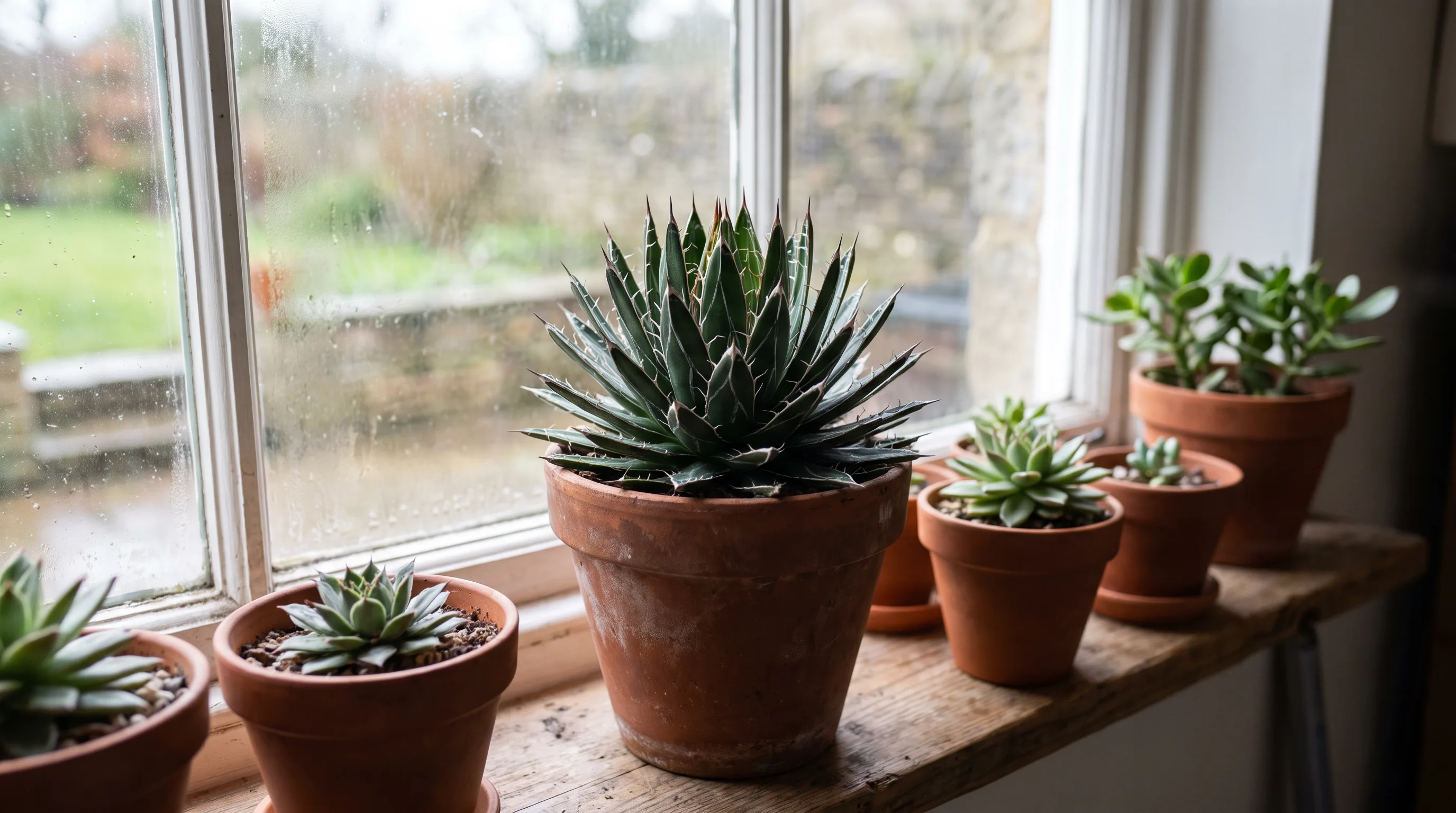
Agave leopoldii is a small, tidy rosette-forming succulent from central-eastern Mexico, valued in British cultivation for its compact size, narrow dark-green leaves and the conspicuous white margins that set it apart from the closely related Agave filifera. Formally described by Thiede and Eggli in 2007, it suits UK growers who want the architectural drama of an agave without the bulk of the larger species. In most of the country it is grown as a frost-free conservatory or glasshouse plant, but in the mildest microclimates of south-west England and the Isles of Scilly it can live outdoors year-round against a sunny wall.
The species belongs to the family Asparagaceae (subfamily Agavoideae) and shares the typical agave life history: each rosette is monocarpic, flowering once at maturity and then dying back, usually after first producing offsets at the base. Unlike A. tequilana and A. fourcroydes — the commercial tequila and henequen species — A. leopoldii is grown purely as an ornamental. Like all agaves it is listed under CITES Appendix II, so internationally traded plants and seeds move under paperwork; UK buyers sourcing from domestic nurseries will rarely see this directly.
In the right spot — bright, dry, cool but frost-free in winter — A. leopoldii is slow-growing, long-lived and largely self-sufficient.
Appearance
The plant forms a tight, near-globular rosette 20–35 cm tall and 30–45 cm across at maturity, noticeably smaller and more compact than most of its relatives. A mature specimen carries 80 to 120 or more leaves arranged in a dense spiral, each narrow and lance-shaped, 12–25 cm long and roughly 0.8–1.5 cm wide.
The leaf colour is a sober dark green to olive-green, often carrying a paler mid-stripe down the centre. The diagnostic feature is a clean, continuous white cartilaginous border running along each leaf margin — a thin, crisp ribbon that contrasts strongly with the dark ground colour. Short white threads peel away from the margin in places, particularly near the leaf tip, giving an older plant a slightly fringed look, though nothing like the long, curling marginal threads of A. filifera. Each leaf terminates in a short, stiff spine 5–10 mm long, dark brown to black, brittle and sharp.
Mature plants flower in summer, sending up a tall panicle to 2–3 m high bearing the tubular greenish-yellow flowers typical of the genus. The flowering rosette then dies. Most garden plants are kept for foliage long before they reach flowering size, and the species is freely suckering, so colonies usually persist through offsets after the flowering rosette is spent.
Growing Conditions
In UK cultivation A. leopoldii is treated as a tender succulent. The two essentials are bright light and free-draining, low-organic compost. Under glass it does best on the brightest bench, where it can take full sun for most of the day; in a glasshouse this also keeps the rosette tight and well-coloured. Outdoors it will tolerate a few hours of light dappled shade, but the rosette loosens and the white margins read less cleanly.
Soil is more important than most growers realise. A loam-based John Innes No. 2 mixed roughly 50/50 with sharp grit or pumice suits it well. The aim is a mix that holds a little moisture at the root but sheds the surplus within minutes of watering. Pure peat-based or coir-based houseplant composts stay wet and cold through a UK winter and are the most common cause of failure. The plant tolerates a wide pH range — approximately 6.5 to 8.0 — and is happier in slightly alkaline conditions than in very acid media.
Watering is sparse. From April to September water only when the compost has dried out, then water thoroughly. From late October to February keep the plant almost dry; a weak half-strength cactus fertiliser once in spring covers the entire feeding requirement — over-fed agaves grow soft and rot-prone.
UK winter treatment is the limiting factor. The species is tender and is damaged by hard frost, with the root ball of any pot-grown specimen freezing at higher air temperatures than a plant in open ground. Conservatory, glasshouse, frost-free porch or a bright windowsill kept just above freezing through winter is the usual answer. Urban and coastal microclimates — central London and parts of Cornwall, Devon and the Scilly Isles — can keep it outside year-round against a south-facing wall, but even there a cold, wet winter is far more dangerous than a cold, dry one. The RHS hardiness rating is held in the structured badge field and is not repeated here.
Planting and Care
Plant out or pot up in late spring, once the soil has warmed and the worst frosts are past — usually May to early June in most of the UK. Use terracotta or another unglazed ceramic pot that is heavy enough to anchor the plant; a top-heavy agave in a plastic pot on a windy patio is an accident waiting to happen. A grit top-dress around the crown keeps the lower leaves off damp compost and discourages rot at the leaf bases.
Watering through the growing season should follow dry-then-thorough rather than little-and-often. Plants stood outside from late May to late September in most districts appreciate the rain, but should be under cover before the first frosts. Pot on every three to four years; slightly pot-bound specimens flower sooner, which most growers prefer to avoid. Repot in spring or early summer, wearing thick gloves — leaf tips and margins are brittle and snap off in skin.
Pruning is essentially unnecessary. The only routine task is the removal of fully dead lower leaves, which usually pull cleanly away from the rosette by hand. Propagation is primarily by division of offsets, lifted in spring or early summer, with the cut surfaces left to callus for 24–48 hours before being potted into dry mix. Seed is also possible but slower and more variable; germination is best at 20–25 °C.
Seasonal care in summary: spring for potting, offsets and the year's only feed; summer for the bulk of watering and outdoor placement; autumn for drying off and bringing under cover; winter for an almost-dry, cool, bright rest.
Common Problems
Cold and wet together kill more agaves in the UK than any pest or disease. Crown and root rots caused by Phytophthora and Fusarium turn the base of the rosette to a foul-smelling mush; once a plant has collapsed in this way it cannot be saved, and any neighbours should be inspected. Prevention is everything: free-draining mix, a dry winter rest and decent ventilation.
The agave snout weevil (Scyphophorus acupunctatus) is the worst insect pest in cultivation. Adults bore into the base of the rosette and the plant then collapses without obvious warning. There is no effective cure once a plant is infested; destroy affected rosettes and inspect their neighbours monthly through the growing season. Keeping plants vigorous and avoiding over-watering reduces the risk.
Scale insects cluster on the underside of leaves at the bases — usually soft brown scale (Coccus hesperidum) or armoured Aspidiotus species. A soft brush and horticultural soap at ten-day intervals deals with light cases; persistent infestations respond to a systemic insecticide containing acetamiprid used strictly per the label. Mealybug (white waxy tufts in the leaf axils) is treated the same way. Isolate new plants for a few weeks before adding them to a collection.
Fungal leaf spot and anthracnose cause brown spotting on leaves under damp, poorly ventilated conditions. Improving airflow, reducing watering and removing badly affected leaves is usually enough. Slugs and snails chew the soft new growth in spring, especially on plants stood outside overnight, and respond to pet-safe controls or night-time hand-picking.
Popular Varieties
Agave leopoldii is a relatively minor species in cultivation, and well-established named cultivars are scarce. Trade lists occasionally offer forms labelled as 'Compacta' or 'Variegata', but neither is an accepted cultivar name in the horticultural literature and they are not listed here. The species itself — uniform, well-marked, compact — is the plant most gardeners will want, and offsets lifted from a parent plant carry exactly the same characteristics.
The closest point of comparison is Agave filifera, with which A. leopoldii was long confused: A. filifera carries long, curling white marginal threads but lacks the continuous white cartilaginous border. For gardeners wanting something larger and equally architectural, Agave attenuata is a popular alternative — bigger, but with no white leaf margins. Agave 'Kissho Kan', a cream-white variegated hybrid in the same size class, is unrelated but worth considering where a small, brightly marked conservatory specimen is wanted.
Where plants of A. leopoldii are offered under a name such as 'Compact Form' or 'Nana', treat the label as an informal trade description rather than a registered cultivar, and expect the rosette to match the species description above.
Pests and Diseases
| Problem | Symptoms | Management |
|---|---|---|
| Scale insects | Small, immobile, waxy or armored bumps appear on stems and leaves. | Isolate the plant and treat with a systemic insecticide or horticultural oil. |
| Root rot | Leaves become soft, mushy, and discoloured while the base of the plant decays. | Ensure well-draining compost and allow the soil to dry out completely between waterings. |
| Mealybugs | White, cottony clusters form in leaf axils and on stems. | Wipe off with a damp cloth dipped in methylated spirits or apply insecticidal soap. |
| Vine weevil | Notched edges on leaves above ground and root damage below soil level. | Use nematodes in the soil during warm months or apply a systemic granular treatment. |
| Sunburn | Blotchy, bleached, or brown patches develop on leaves exposed to intense direct light. | Acclimate plants gradually to brighter conditions and provide filtered light initially. |
Or browse the full plant problem solver to diagnose an issue by symptom.
Recommended Products
GardenWizz earns a commission from qualifying purchases made through affiliate links on this page (including links within the article) — as an Amazon Associate, and from Thompson & Morgan via the Awin network. This does not affect the price you pay. See our disclaimer for details.