Parry's Agave
Agave parryi
The Gardening Year
Best months in UK gardens · full planting calendar →
🖨 Printable care card (PDF)At a Glance
| Botanical name | Agave parryi |
|---|---|
| Common name(s) | Parry's agave |
| Family | Asparagaceae |
| Plant type | succulent (monocarpic—i.e., mature agaves produce a twelve-foot stalk studded with bright, yellow blooms before the plant then dies) |
| Height × Spread | 10–50 cm × 50–100 cm |
| Position | Full sun |
| Soil | Sand |
| Flowering | June–August |
| Toxicity | Potentially harmful Skin irritant. Wear gloves and other protective equipment when handling. Pets (dogs, cats): harmful if eaten. |
| Native range | Arizona, New Mexico, and northern Mexico |
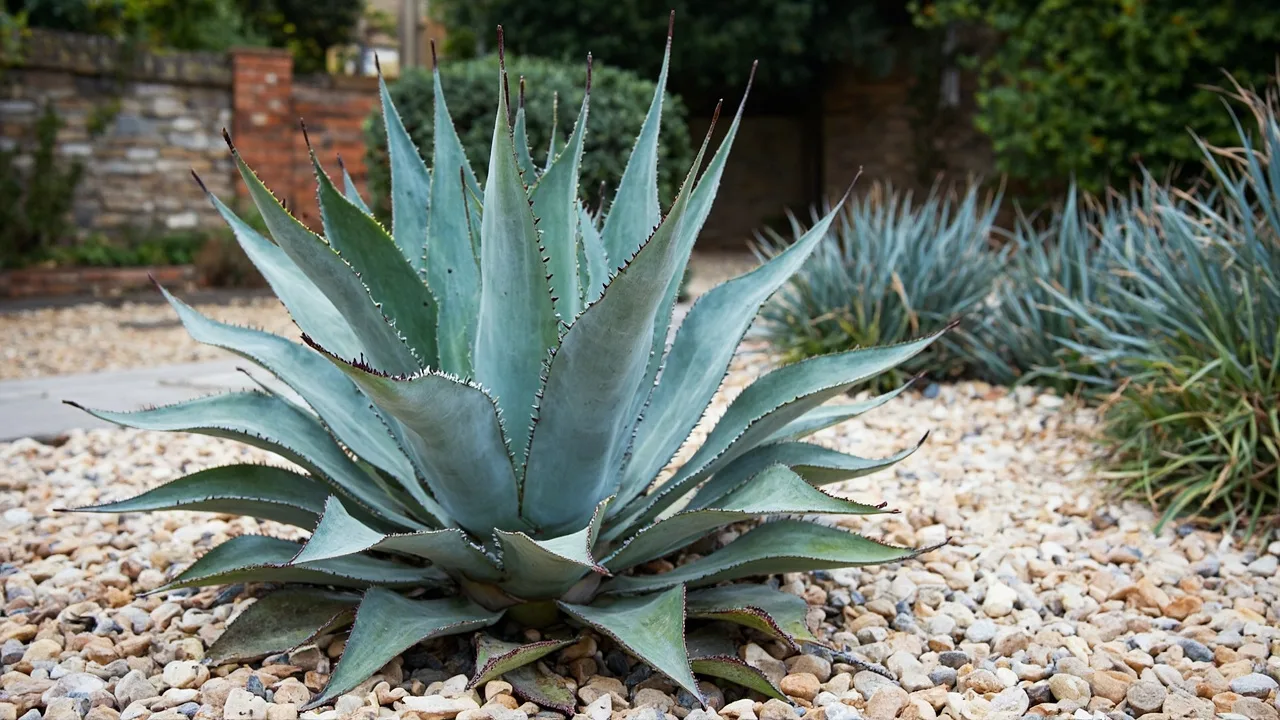
Agave parryi, commonly known as Parry's agave or the artichoke agave, is a rosette-forming evergreen succulent from Arizona, New Mexico and northern Mexico where it grows on rocky slopes between 1,200 and 2,400 m. The Royal Horticultural Society lists it as one of the most reliably cold-tolerant agaves available to UK gardeners, awarding it the AGM (Award of Garden Merit) and noting its suitability for well-drained, sunny borders and large patio containers. Drawn as a tight, almost geometric rosette of broad, blue-grey leaves edged with dark brown teeth and tipped with a stout terminal spine, it is grown primarily for its sculptural form rather than its flowers — a flowering spike may take 10 to 30 years to appear, after which the parent rosette dies and is replaced by offsets around the base.
Overview
Agave parryi is a slow-growing, monocarpic succulent forming a single symmetrical rosette of broad, ovate, blue-grey leaves with a waxy bloom. In UK cultivation it is most often used as a focal specimen in a south- or west-facing gravel garden, in a raised bed built over freedraining substrate, or as a container plant stood out for summer and moved under cover for winter. Its tolerance of UK winter conditions is among the highest of any agave, provided the crown and roots stay dry; cold alone is rarely the killer — wet, cold compost is. Most growers will see a plant 30–60 cm tall and 60–100 cm across after 8–10 years in the ground, with a flowering spike reaching 3–5 m when (eventually) produced.
Appearance
A mature Agave parryi rosette is broader than it is tall, typically 50–100 cm across and 30–60 cm tall once established. The leaves are stiff, broadly ovate to lance-shaped, 15–40 cm long and 8–15 cm wide, with a powdery blue-grey bloom that rubs away if handled. Leaf margins carry a regular row of dark reddish-brown teeth 3–6 mm long, and each leaf ends in a stout, dark terminal spine 2–3 cm long.
In the typical subspecies (A. parryi var. parryi and var. huachucensis) the leaves are wide and overlap tightly, giving the artichoke-like silhouette the plant is named for. The variety truncata has shorter, broader, almost paddle-shaped leaves with a truncated tip, and tends to form a more compact rosette. The variety neomexicana has narrower, more upright leaves and is the hardiest of the group in dry, exposed sites.
Flowering is a once-in-a-lifetime event for the rosette. A mature plant sends up a stout, branched inflorescence 3–5 m tall, bearing masses of yellow to yellow-green tubular flowers 5–7 cm long that are popular with bees and other pollinators in late spring to early summer. The parent rosette dies after flowering, leaving offsets to continue the colony.
Growing Conditions
Agave parryi requires a position in full sun, ideally with at least six hours of direct light in summer, and a sharply draining mineral substrate. In the UK it is best suited to:
- A south- or west-facing border at the base of a wall, where rainfall is shed and summer heat is reflected back.
- A raised bed or mound built up 30–45 cm above surrounding soil level, filled with a 50:50 mix of loam and 4–10 mm grit.
- A large terracotta or stone container (minimum 40 cm diameter) stood on pot feet so the drainage holes cannot block.
Soil pH is not critical — anything from mildly acidic to moderately alkaline suits it — but the substrate must be low in organic matter and free-draining. A loam-based mix such as John Innes No. 2 with one third by volume of horticultural grit is a reliable blend for containers. Heavy clay, woodland loam or any soil that holds water around the crown in winter will kill the plant within a season.
The plant carries a hardiness rating rendered on the GardenWizz plant profile; the structured field holds the authoritative value, and the prose here does not restate it. UK growers should treat it as the most cold-tolerant agave commonly sold, but performance depends as much on drainage as on the air temperature — a sheltered, dry, lean site in Cornwall will outperform an exposed, rich-soil site in the Scottish borders even at the same air temperature.
In very wet upland or northern gardens, container cultivation with winter protection is the safer option. The crown must be kept dry from November through March; rainfall combined with sub-zero temperatures is the standard failure mode.
Planting and Care
Planting. Plant in late spring (May to early June) once soil has begun to warm, so the plant has the full summer to root before its first winter. In containers, replant only every 3–4 years: Agave parryi resents root disturbance and recovers slowly.
Watering. Treat the plant as a dry-climate succulent. Water freely during the growing season (May to September), allowing the substrate to dry between waterings. From late October onward, withhold water almost entirely; an unheated pot stood under a south-facing eaves is ideal. Container plants in active growth benefit from a soak-and-dry cycle rather than little-and-often watering.
Feeding. This is a plant adapted to lean soils. A single low-nitrogen feed in late spring — for example a half-strength tomato fertiliser once, or a top-dressing of wormcast compost in March — is sufficient. Over-fed plants become soft, sappy and more vulnerable to rot in winter.
Pruning. Pruning is not required and is largely undesirable: do not cut the leaf tips, as the terminal spine is the leaf's natural shape and cutting damages the waxy cuticle, leading to dieback. The only routine tidy is the removal of fully dead, brown leaves at the base of the rosette, which can be pulled away by hand once they have dried.
Propagation. The easiest method is division of offsets (pups) from the base of mature plants. In late spring or early summer, loosen the soil around a pup with a hand fork and sever it with a clean knife, retaining as many of its own roots as possible. Allow the cut surface to dry and callus for 24–48 hours in a dry, shaded spot before potting into a free-draining mix and withholding water for a further two weeks. Propagation from seed is possible but slow: surface-sow seed on a 50:50 loam-and-grit mix at 20–24°C, expect germination in 2–4 weeks, and grow seedlings on for 3–5 years before planting out.
Seasonal care. From late October to mid-March, the key task is keeping the crown dry. In the ground, a simple rain-shelter of slate or rigid plastic on a wooden frame over the plant, with the sides open to airflow, is enough in most UK winters. In containers, move the plant into an unheated greenhouse, porch or cold frame and stand it on a shelf so excess water can drain away. Remove winter protection in stages during April to avoid a sudden flush of soft growth.
Common Problems
Crown rot in winter
Symptom: Leaves turn grey-green, then yellow, then collapse inwards; the centre of the rosette becomes soft and foul-smelling, often within days of a cold, wet spell.
Cause: Water sitting in the crown in combination with sub-zero temperatures kills the central growing point. The most common cause is heavy or organic-rich soil, a blocked drainage hole, or rain on a plant under a fleeced frame that prevents evaporation.
Fix: Prevention is the only reliable cure. Plant in free-draining substrate, raise container plants on pot feet, and keep the crown dry from November through March. If rot is caught early (a single affected leaf) cut out the damaged tissue with a clean knife back to firm tissue, dust the wound with sulphur, and keep the plant dry until it calluses.
Sun scorch on container plants
Symptom: Pale, bleached patches on the upper (south-facing) leaves in mid-summer, often on plants moved outside from a greenhouse.
Cause: Plants raised under glass and then placed straight into full sun suffer UV damage before the cuticle has hardened off.
Fix: Harden plants off over 7–10 days, starting in dappled shade and gradually moving them into full sun. Established plants in the ground are rarely affected.
Agave snout weevil
Symptom: A mature plant collapses without warning in late spring or early summer, with no yellowing first; the base is hollowed and grub-ridden.
Cause: The larvae of Scyphophorus acupunctatus bore into the base of the rosette and eat the meristem. Outbreaks in the UK are still rare but increasing as more large agaves are imported.
Fix: There is no effective cure once the plant has collapsed. Remove and burn affected specimens, do not compost them, and inspect neighbouring plants for tell-tale small dark holes at the base. Quarantine new plants for 4–6 weeks before planting out.
Lack of growth and pale colour
Symptom: An established plant produces very little new growth in summer and the leaves are pale green rather than the expected blue-grey.
Cause: Over-feeding, over-watering, or too much shade. Pale, soft growth is usually a sign of too much nitrogen or compost-rich soil.
Fix: Stop feeding, reduce watering and, if the plant is in shade, relocate it to a sunnier position in late spring. Recovery is slow — a season at minimum — but the plant will usually return to its normal colour.
Popular Varieties
Agave parryi var. truncata — A compact, broad-leaved form grown widely in the UK as the most architectural of the parryi varieties. Mature rosettes reach 60–90 cm across and 30–40 cm tall. Tends to be slightly less cold-hardy than the type but is the standard choice for container cultivation. Sold by Big Plant Nursery and most UK succulent specialists.
Agave parryi var. huachucensis — A more open, large-leaved variety with wide, overlapping leaves and a robust trunk-like base in older plants. Reaches 60–100 cm across. Particularly striking in gravel gardens. Available from Pan-Global Plants and several UK succulent nurseries.
Agave parryi var. neomexicana — The narrowest-leaved and hardiest variety, native to higher-elevation sites in New Mexico and west Texas. Forms a tighter, more upright rosette than the type; widely recommended for exposed, dry UK gardens in the south and east. Available from Cotswold Garden Flowers and Plant World Seeds.
Agave parryi 'Cream Spike' — A small, variegated cultivar with cream-edged blue-green leaves, growing to only 10–15 cm tall and 15–20 cm across. RHS lists it as an AGM recipient. Ideal for a small patio pot or a windowsill in cold districts; plant in a sheltered spot and bring under cover for winter. Sold by Coastal Succulents and Cotswold Garden Flowers.
Agave parryi subsp. parryi — The type subspecies, with the classic artichoke form. The most widely available and most often sold in UK garden centres under the simple label Agave parryi. Forms a 60–90 cm rosette and is the most reliable choice for a first planting.
Sources & Further Reading
- Royal Horticultural Society: Agave parryi plant profile. Source: rhs.org.uk/plants/55613/agave-parryi/details, accessed 2026-07-23.
- Royal Horticultural Society: Agave parryi subsp. parryi profile. Source: rhs.org.uk/plants/281831/agave-parryi-subsp-parryi/details, accessed 2026-07-23.
- Royal Horticultural Society: Agave parryi 'Cream Spike' (v) profile. Source: rhs.org.uk/plants/269556/agave-parryi-cream-spike-(v)/details, accessed 2026-07-23.
- Big Plant Nursery: Agave parryi var. truncata — UK availability and overwintering advice. Source: bigplantnursery.co.uk/shop/plants/agaves/agaveparryivartruncata, accessed 2026-07-23.
- Urban Jungle: Agave parryi subsp. parryi — UK nursery listing and hardiness notes. Source: urbanjungle.uk.com/product/agave-parryi-subsp-parryi, accessed 2026-07-23.
- Cotswold Garden Flowers: Agave parryi 'Cream Spike' — UK cultivar profile. Source: cotswoldgardenflowers.co.uk/products/agave-parryi-cream-spike, accessed 2026-07-23.
- Web Garden Centre: Agave Plant Care Guide — Growing Agave in the UK 2025. Source: webgardencentre.com/blogs/uk-plant-care-guides/agave-plant-care-guide-growing-agave-in-the-uk-2025, accessed 2026-07-23.
- Missouri Botanical Garden: Agave parryi Plant Finder. Source: missouribotanicalgarden.org/PlantFinder/PlantFinderDetails.aspx?taxonid=275753, accessed 2026-07-23.
- LLIFLE Encyclopedia of Succulents: Agave parryi var. huachucensis. Source: llifle.com/Encyclopedia/SUCCULENTS/Family/Agavaceae/244/Agave_parryi_var._huachucensis, accessed 2026-07-23.
Pests and Diseases
| Problem | Symptoms | Management |
|---|---|---|
| Root rot | Leaves turn yellow or brown and become soft, mushy, and easily pulled from the base. | Ensure excellent drainage with gritty compost and water sparingly, allowing soil to dry completely between waterings. |
| Mealybugs | White, cottony wax-like masses appear in leaf axils and on stems, often accompanied by sticky honeydew. | Isolate the plant and treat infested areas with a cotton bud dipped in methylated spirits or apply an insecticidal soap. |
| Scale insects | Small, immobile, brown or tan bumps attach to stems and leaves, potentially causing yellowing and stunted growth. | Scrape off visible scales manually and apply horticultural oil or systemic insecticide if infestation is severe. |
| Sunburn | Blotchy white or tan patches appear on leaves exposed to intense, direct sunlight after a period of shade. | Acclimate plants gradually to full sun and provide temporary shade during peak summer heat if necessary. |
| Cold damage | Leaves become translucent, water-soaked, or blackened following frost or prolonged freezing temperatures. | Plant in a sheltered, south-facing position and ensure soil is well-drained to prevent waterlogging during winter. |
Or browse the full plant problem solver to diagnose an issue by symptom.
Recommended Products
GardenWizz earns a commission from qualifying purchases made through affiliate links on this page (including links within the article) — as an Amazon Associate, and from Thompson & Morgan via the Awin network. This does not affect the price you pay. See our disclaimer for details.