Candelabra Aloe
Aloe arborescens
The Gardening Year
Best months in UK gardens · full planting calendar →
🖨 Printable care card (PDF)At a Glance
| Botanical name | Aloe arborescens |
|---|---|
| Common name(s) | Candelabra aloe |
| Family | Asphodelaceae |
| Plant type | succulent |
| Height × Spread | 2–4 m × 1.5–2.5 m |
| Position | Full sun |
| Soil | peat-free cacti potting compost or peat-free loam-based potting compost with added horticultural grit; well-drained, light, sandy |
| Flowering | December |
| Toxicity | Harmful if eaten; causes an upset stomach. Foliage, roots and sap are toxic. |
| Native range | Southern Africa (South Africa, Malawi, Mozambique, Zimbabwe) |
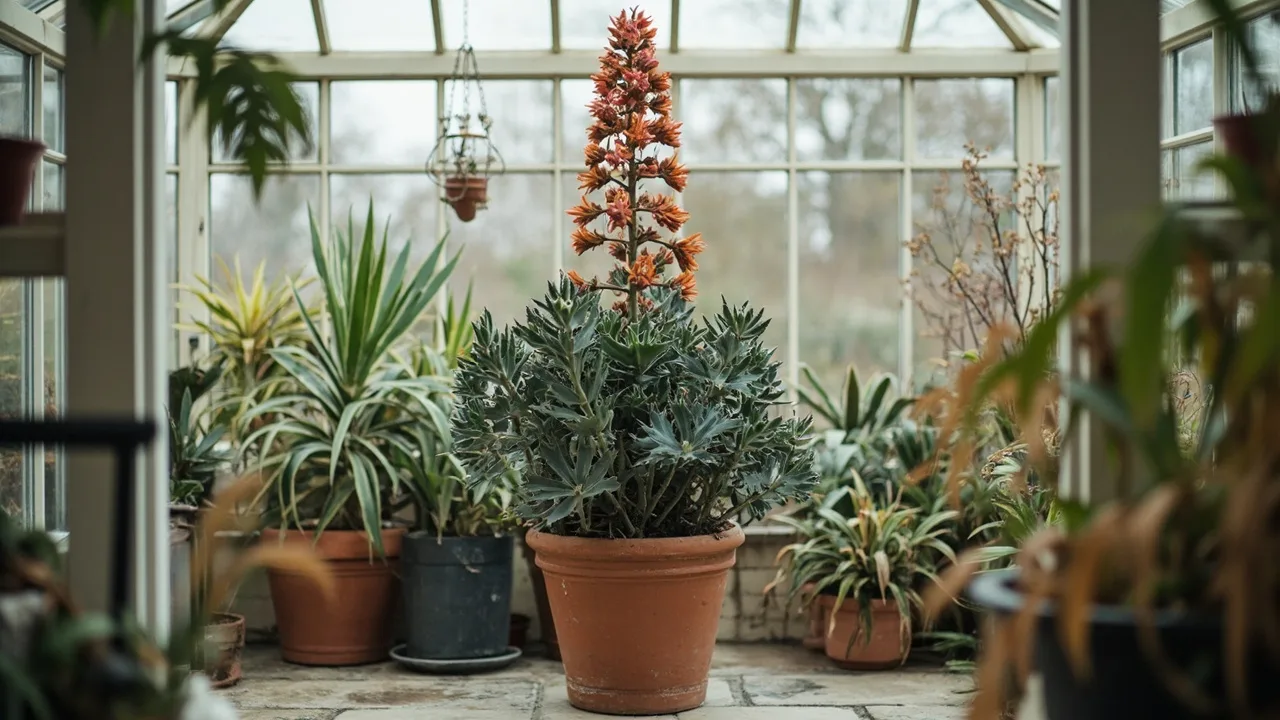
Candelabra aloe is a branching, evergreen succulent shrub native to parts of southern Africa, widely grown in the UK as a container or conservatory plant for its grey-green rosettes and vivid orange-red winter flower spikes. It is grown primarily for its architectural form and off-season flowering, although in the UK it generally requires protection from prolonged cold and wet to thrive.
Overview
Aloe arborescens is a multi-stemmed succulent shrub in the family Asphodelaceae, recorded from South Africa and parts of southern Africa. In mild, frost-free climates it forms large, rounded shrubs several metres across, but in the UK it is best regarded as a tender container or conservatory plant that spends the warmer months outdoors and is brought under cover before cold, wet weather sets in. Its two main ornamental attractions are the dense rosettes of fleshy, lance-shaped leaves and the tall, branched spikes of tubular orange-red flowers that appear when little else is in bloom. Note: the plant is harmful if eaten, so handle with care around children and pets and avoid using it for any internal medicinal purpose.
Appearance
A mature Aloe arborescens develops a branching, shrubby structure made up of many offsets produced at the base of the parent plant. Each branch is topped by a single rosette of stiff, fleshy, lance-shaped leaves up to around 50–60 cm long, coloured grey-green to blue-green and edged with small pale teeth along the margins. The leaf surfaces are generally smooth and slightly curved, and the overall impression is of a tidy, sculptural rosette rather than a ground-hugging rosette plant.
The flowering stems are the most striking feature. From late autumn onwards, mature plants throw up tall, branched spikes that can reach around 60–90 cm above the foliage, each spike carrying a dense head of tubular orange-red flowers. Colour ranges from orange to scarlet, with some forms leaning slightly more yellow. The flowers are tubular and slightly curved, well-suited to sunbirds in their native range, and in the UK they provide a strong hit of warm colour during winter months when conservatory benches are otherwise quiet. The inflorescences may carry multiple side branches, giving the candelabra-like silhouette that lends the plant its common name. Once flowering finishes, the old spike can be cut back to the base.
With age the plant becomes broader and more architectural, but its silhouette is always made up of repeated rosettes on woody stems rather than a single trunk. In a pot it can be kept compact and tidied by removing spent offsets every few years.
Growing Conditions
Aloe arborescens needs the brightest position available and a sharply drained growing medium. In the UK this means the sunniest spot in a frost-free greenhouse or conservatory during the colder months, and a sheltered outdoor position such as a south- or west-facing patio during summer. Inside, an unshaded windowsill, a glass porch or a lean-to will keep the rosettes compact and the leaves well-coloured; in dull conditions the leaves can elongate and become soft.
The growing medium is more important than the container. A mineral-rich, gritty mix suits the plant far better than a peat-based multi-purpose compost on its own. A typical home mix is roughly half loam-based or peat-free multipurpose compost to half grit or horticultural pumice, with a small handful of coarse sand added. Whatever the mix, the pot must have free drainage holes and should not sit in a saucer of water over winter. Terracotta is a sensible choice because the porous walls help the compost dry out between waterings.
Although the plant tolerates drought once the roots are established, it dislikes persistently wet roots, particularly in cool weather, which is the most common cause of losses in the UK. It is therefore better to underwater than overwater, especially from late autumn through to early spring. The plant tolerates dry indoor air well in a heated conservatory, but it appreciates good ventilation in summer to reduce the risk of fungal problems.
Planting and Care
Plant or repot Aloe arborescens during the active growing season, ideally in late spring or early summer when the compost is warming up and the roots will re-establish quickly. Knock the plant out of its existing pot, tease apart any congested roots, and settle it into a slightly larger container using the gritty mix described above. The stem should sit at the same level as before; burying the stem into damp compost encourages rot. Water once lightly to settle the compost, then leave the plant dry for a week or two before resuming a normal watering routine.
Watering should follow the plant's growth cycle. During the main growing season from spring to early autumn, water moderately, allowing the top few centimetres of compost to dry out between applications. As light levels and temperatures drop in autumn, reduce watering substantially so the compost stays on the dry side through winter. The RHS advises very sparing winter watering for this species. In heated rooms a monthly watering during the depth of winter is usually enough; in an unheated greenhouse it may need even less.
Feeding is light. A monthly dose of a general liquid fertiliser from May to August is sufficient, and feeding should stop by early autumn so the plant can slow down for winter. Repotting is needed only every two to three years once the plant has reached a manageable size; older plants can be kept in the same pot and refreshed by removing and replacing the top few centimetres of compost each spring.
Pruning is minimal. The main task is to cut spent flower spikes down to the base once flowering has finished, and to remove any dead or damaged outer leaves by teasing them away from the rosette. Lower leaves naturally die back as the plant grows and can be pulled off cleanly without cutting.
Propagation is straightforward from offsets. As the plant matures, small rosettes appear at the base and on the lower stems. Detach offsets with a short length of stem using a sharp knife, allow the cut surface to dry and callus over for a day or two in a dry, airy place, then pot them into a small container of free-draining compost. Water sparingly until new roots form, then move on to the normal watering routine. Always wear gloves when handling the plant, as the leaf margins are spiny and the sap can irritate skin.
Seasonal care centres on the move between outdoor and indoor life. Acclimatise the plant to brighter outdoor light gradually in late spring by placing it in shade for a few days before moving it into full sun, especially if it has spent winter in a dim greenhouse. Bring plants back under cover before the first hard frosts and before prolonged autumn rain, which is often more damaging than the cold itself.
Common Problems
Overwatering and poor drainage are the leading causes of trouble. The symptoms are soft, yellowing or translucent leaves that collapse easily at the base, often followed by a blackened stem. The fix is to stop watering immediately, unpot the plant, remove any soft or blackened tissue with a clean knife, allow the cut surfaces to dry, and repot into dry, free-draining compost. Going forward, water only when the compost is dry to the touch and keep the plant somewhere with good air movement.
Mealybugs are small, white, cottony sap-feeders that hide in the crown of the rosette and at the joints where leaves meet the stem. They weaken the plant by sucking sap and can be hard to reach with a spray. Wipe small infestations off with a cotton bud dipped in methylated spirits, or use a soft brush to dislodge them. Persistent infestations can be treated with a systemic insecticide suitable for succulents, following the label carefully.
Scale insects appear as small, brown, limpet-like bumps on leaves and stems. They are slow-moving sap-feeders that, like mealybugs, excrete honeydew on which sooty mould can develop. Light infestations can be scraped off with a fingernail or soft brush; heavier ones respond to the same treatment as mealybugs.
Sooty mould is a black fungal coating that grows on the honeydew left by sap-feeding insects. It does not infect the plant directly but dulls the leaves and reduces light reaching the surface. The fix is to deal with the underlying pest, then wipe the leaves clean with a damp cloth.
Aphids may colonise the flower spikes in late autumn and winter, particularly on plants kept in a warm conservatory. They cluster around the buds and can be rinsed off with a sharp spray of water or treated with a suitable insecticidal soap.
Cold damage is most likely where plants are left out during a sharp autumn frost or exposed to freezing rain. Affected leaves develop pale, water-soaked patches that turn brown. Move the plant under cover as soon as possible and remove badly damaged leaves, allowing new growth to replace them.
Popular Varieties
The straight species Aloe arborescens is by far the most commonly grown form in the UK, and most plants sold under this name are seed-raised rather than clonal cultivars. The following names appear in the horticultural trade, although availability is limited and they should be checked with individual nurseries before ordering.
Aloe arborescens var. mzimnyati is a form sometimes associated with the Mzimnyati River area of South Africa, noted for particularly vigorous growth, though it is rarely listed as a separate cultivar in the UK trade.
Aloe arborescens 'Corral Aloe' is occasionally offered by specialist succulent nurseries as a hardier selection, though UK availability is sporadic and it should be treated as a curiosity rather than a reliably distinct cultivar.
Aloe arborescens 'Krakatoa' appears in some specialist catalogues as a compact, free-flowering selection, but it is not widely listed and named stock is inconsistent between sources.
For most UK gardeners, sourcing a healthy, well-grown plant of the species from a reputable nursery is a more reliable choice than chasing a named cultivar, as the species itself is variable and attractive. If searching for a named form, expect to use specialist growers rather than general garden centres.
Pests and Diseases
| Problem | Symptoms | Management |
|---|---|---|
| Mealybugs | White, cottony fluff appears in leaf axils and on stems. | Isolate the plant and treat infested areas with a cotton bud dipped in methylated spirit or apply insecticidal soap. |
| Scale insects | Small, immobile, brown or white bumps attach firmly to leaves and stems. | Scrape off visible scales manually and spray remaining pests with horticultural oil or systemic insecticide. |
| Root rot | Leaves become soft, mushy, and discoloured while the base of the plant collapses. | Ensure well-draining compost and avoid overwatering; repot in fresh mix if roots are blackened. |
| Vine weevil | Notched edges on leaves above ground and root damage below causing wilting. | Use nematodes in the soil during warm months or apply a systemic insecticide to prevent larvae feeding. |
| Sunburn | Leaves develop bleached, brown, or scorched patches after sudden exposure to intense light. | Gradually acclimate plants to brighter conditions and provide shade during peak summer sun. |
Or browse the full plant problem solver to diagnose an issue by symptom.
Recommended Products
GardenWizz earns a commission from qualifying purchases made through affiliate links on this page (including links within the article) — as an Amazon Associate, and from Thompson & Morgan via the Awin network. This does not affect the price you pay. See our disclaimer for details.