Aloe
Aloe
The Gardening Year
Best months in UK gardens · full planting calendar →
🖨 Printable care card (PDF)At a Glance
| Botanical name | Aloe |
|---|---|
| Common name(s) | Aloe |
| Family | Asphodelaceae |
| Plant type | succulent |
| Height × Spread | 3 m × — |
| Position | Full sun |
| Soil | peat-free cactus compost or other good quality peat-free compost with added sharp sand or grit to improve drainage |
| Flowering | June–November |
| Toxicity | — |
| Native range | tropical and southern Africa, Madagascar, Jordan, the Arabian Peninsula, India and various islands in the Indian Ocean |
Aloes bring strong architectural foliage to a bright room, conservatory or summer patio, but their thick leaves store water so effectively that generous watering does more harm than good. In the UK, most are best treated as tender container plants and kept under cover through winter.
Overview
Aloe is a diverse genus in the family Asphodelaceae, centred on Africa, Madagascar and the Arabian Peninsula. These plants are adapted to periods of drought, storing moisture in fleshy leaves rather than relying on continuously damp soil. The familiar Aloe vera is only one member of a much broader group that includes compact, spotted rosettes and substantial branching shrubs.
Aloes are valuable UK houseplants because they combine distinctive form with modest maintenance, provided light and drainage are right. A bright south- or west-facing room, sunny conservatory or frost-free glasshouse usually gives the best results. Plants may stand outside in a sheltered position during warm summer weather, but they should return under cover well before cold, wet autumn conditions arrive.
The genus is sometimes confused with superficially similar succulents, including agaves and haworthias. Aloes generally have softer, more water-filled leaves than agaves and often produce tubular flowers on upright stems. Names have also changed as botanical research has refined relationships among aloe-like plants, so older labels may use synonyms that are no longer preferred.
Flowering is possible but not guaranteed in a UK home. Mature plants need abundant light, sufficient root space and an appropriate seasonal rhythm. Even a healthy Aloe vera may remain foliage-only for years, while some other species flower more readily in a bright conservatory. Their foliage therefore remains the principal ornamental feature for most indoor gardeners.
Appearance
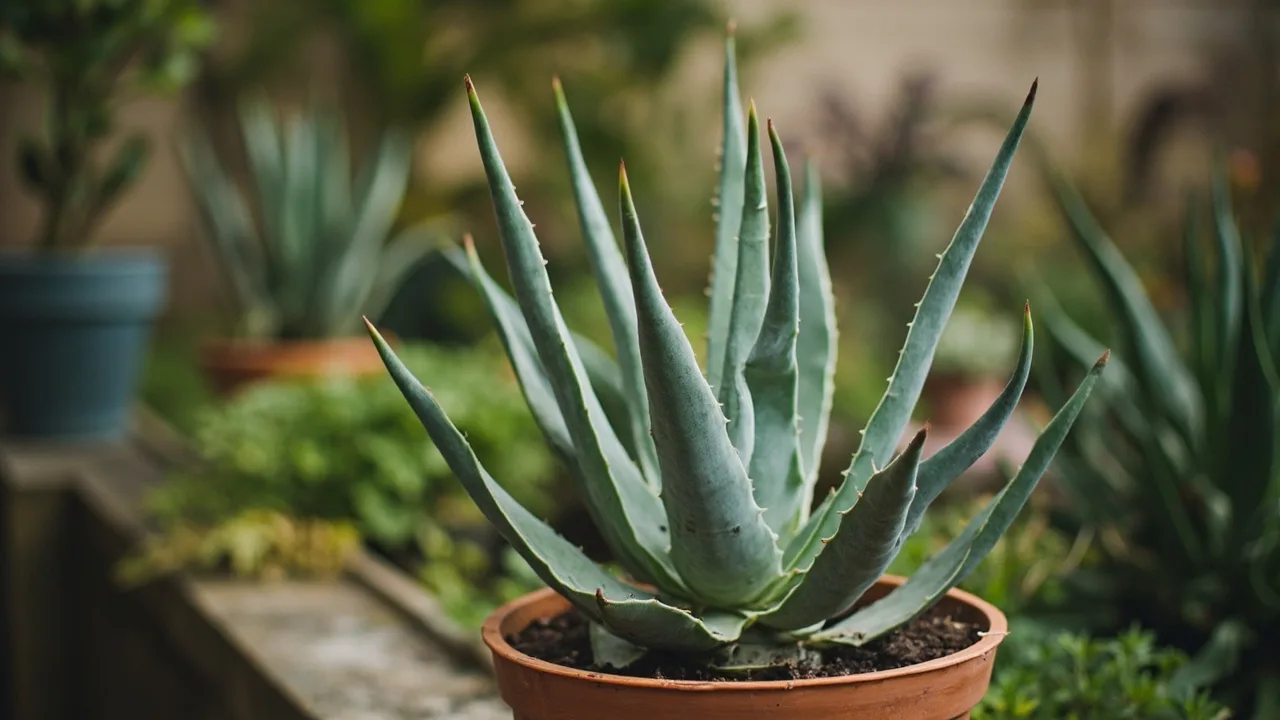
The characteristic aloe shape is a rosette of thick, tapering leaves arranged around a central growing point. Leaves may be upright, spreading or recurved, with colours ranging from fresh green and grey-green to blue-green. Strong light can bring out bronze or reddish stress colouring, while species such as Aloe maculata carry conspicuous pale spots.
Leaf margins commonly have small teeth, and the tips can be pointed, so plants need thoughtful positioning beside narrow paths or where children might brush past them. The teeth vary considerably: some feel relatively soft, while others can scratch skin. A sturdy pair of gloves makes repotting larger specimens more comfortable.
Size and habit differ markedly across the genus. Aloe vera forms a broad, mostly stemless rosette and can approach 60-100 cm in a container over time. Compact species remain suitable for a windowsill, whereas Aloe arborescens can become a branching, woody-stemmed shrub several metres tall in favourable conditions. Container restriction and the lower light of a UK interior usually keep growth smaller.
Many aloes produce offsets, often called pups, around the base. A solitary plant can consequently develop into a crowded colony that pushes against the pot rim. These offsets are useful for propagation, although a fuller clump can also be left intact when the container remains stable and the compost drains freely.
Flowers are carried above the foliage on usually unbranched or branching stalks. Individual blooms are tubular and commonly red, orange or yellow, grouped into dense spikes or clusters. Their dramatic wild pollination relationships are not reproduced in an ordinary UK room, and indoor flowering should be regarded as a welcome bonus rather than a routine expectation.
Growing Conditions
Light is the most important factor after drainage. Give an aloe the brightest practical position, such as a sunny conservatory or a south- or west-facing windowsill. Plants raised in softer light should be introduced to strong direct sun gradually; an abrupt move behind hot glass can cause bleached or brown scorch patches. Light shading and ventilation may be useful during a summer heatwave.
Use peat-free cactus and succulent compost, or another open mix that releases surplus water rapidly. A pot must have unobstructed drainage holes; a decorative outer pot should be emptied after watering. Terracotta is particularly useful because its porous walls help the compost dry, although it also means watering may be needed a little sooner than in plastic.
Water according to the condition of the compost rather than a fixed weekly schedule. From April to September, soak the compost thoroughly and allow excess water to escape, then wait until it has dried before watering again. Never leave the base standing in water. During the darker months, reduce watering sharply because cool, wet roots are highly vulnerable to decay.
A dry, ventilated atmosphere generally suits aloes better than a persistently steamy room. Normal household humidity is adequate, and misting is unnecessary. Keep foliage away from very cold window glass and avoid an unheated porch or greenhouse where the plant could be exposed to frost. A winter position should be both bright and protected.
Outdoor summering can improve light levels. Move the pot outside gradually from late May, after local frost risk has passed, choosing a sheltered patio where heavy rain cannot keep the compost saturated. In northern and exposed UK gardens, wait for settled weather. Bring the plant back inside by early September, or sooner if nights turn cold and wet.
Planting and Care
Choose a container only slightly wider than the root ball. An oversized pot holds a large volume of damp compost around relatively few roots, increasing the risk of rot. Set the plant at its previous depth, keep the rosette crown above the compost surface and firm gently without compacting the mix. A gravel top-dressing can keep lower leaves clear of wet compost, but it must not conceal persistent moisture.
Repot in spring, generally every two or three years or when roots and offsets crowd the container. Support the leaf rosette, ease out the root ball and remove loose, exhausted compost. Trim only roots that are clearly dead or rotten, using a clean blade. If roots are damaged, allow cuts to dry before watering so that wounds can seal.
Feed lightly during active growth. A balanced general liquid fertiliser applied at reduced strength about once a month from April to September is sufficient for most container plants. Do not compensate for slow winter growth with extra feed, and avoid feeding when the compost is dry or the roots are unhealthy. Too much fertiliser produces weak growth and leaves soluble salts in the pot.
Pruning is minimal. Remove a completely dead basal leaf by cutting it close to the stem with clean secateurs, rather than tearing living tissue. Cut spent flower stems near their base after blooming. Do not shorten healthy leaves to reshape the plant: the cut edge remains visible and can become an entry point for decay.
Offsets provide the most dependable method of propagation. In spring or early summer, separate a pup that has some roots of its own, using a clean knife if necessary. Leave any fresh cut surface in a dry, airy place for a day or two, pot the offset into a small container of dry gritty compost, then water sparingly once it has settled. Seed propagation is possible but slower and may not reproduce named selections exactly.
Seasonal care means matching water to light. Growth usually strengthens from April as days lengthen, while autumn signals a reduction in both watering and feeding. Inspect plants before bringing them indoors after summer: mealybugs hidden in leaf axils can spread quickly among houseplants. Quarantine a newly bought aloe until it has been checked as well.
Common Problems
Soft, yellow, translucent or collapsing leaves most often indicate excess moisture and root rot. Remove the plant from its pot, discard wet compost and cut away black or mushy roots with a sterile blade. Let damaged tissue dry, then repot in fresh, dry, free-draining compost. Withhold water until the plant has stabilised; a badly rotted crown may not recover.
Thin or wrinkled leaves can mean the plant has exhausted its stored water, but check the roots before automatically watering. A severely rotted plant may wrinkle because damaged roots cannot absorb moisture. If roots are firm and compost is bone dry, water thoroughly and drain; if roots are failing, treat the decay instead.
Brown patches are often scorch caused by moving a shade-grown plant straight into intense sun behind glass. Shift it out of the strongest midday rays and acclimatise it over a fortnight. Red or bronze colouring can be a less serious response to bright light or drought stress. Review the whole plant rather than treating colour alone as disease.
Glasshouse mealybugs appear as white, cottony clusters in leaf axils and around the base. Isolate the pot, remove small colonies manually and repeat inspections because hidden insects and eggs can survive the first clean-up. Scale insects form fixed brown or pale shells and may leave sticky honeydew. Persistent infestations should be managed with a product approved for ornamental houseplants, following the label exactly.
A leaning, stretched rosette with unusually long, pale leaves is receiving too little light. Move it gradually to a brighter position and turn the container periodically for balanced growth. Existing stretched tissue will not become compact again, but new leaves should grow more strongly. Ensure a top-heavy plant is in a stable pot rather than burying the stem too deeply.
Failure to flower is rarely a sign that an aloe is unhealthy. Immaturity, insufficient light, constant warmth and the absence of a drier winter rest can all contribute. Concentrate on producing firm, well-coloured foliage; forcing bloom with extra fertiliser usually creates poorer growth rather than flower spikes.
Popular Varieties
The plants below are established species or named forms found in cultivation, rather than invented cultivars. Availability changes, so botanical names should be checked carefully when buying.
- Aloe vera - the best-known species, forming broad rosettes of fleshy grey-green leaves. It is widely sold as a UK houseplant and remains a sensible choice for a bright windowsill. Its botanical synonym A. barbadensis may occur on older labels.
- Aloe arborescens - candelabra or torch aloe, a much larger branching species with narrow toothed leaves and red-orange flower spikes. It is best in a spacious conservatory or large container where its eventual scale can be accommodated.
- Aloe maculata - soap aloe, with broad, strongly white-spotted leaves in a neat rosette and orange flowers. The older synonym A. saponaria is still encountered. Its decorative leaf pattern makes it attractive even when it does not flower.
- Aloe variegata - traditionally known as partridge-breasted aloe, a compact plant with patterned leaves arranged in close ranks. Modern botanical treatments may place it under the name Gonialoe variegata, so both names are useful when searching nursery lists.
- Aloe mitis - a rosette-forming species with blue-green foliage and yellow flowers. It remains a tender container subject in most UK situations and is less routinely available than A. vera.
- Aloe arborescens 'Variegata' - a documented variegated form of the candelabra aloe, carrying pale striping through the foliage. It needs excellent light to maintain clear variegation and enough room for its shrubby habit.
A species name is more informative than a pot label reading simply "aloe mix". It determines mature size, flowering habit and the space required under cover. Where identification is uncertain, retain the plant as Aloe sp. rather than assigning a species from foliage photographs alone.
Sources & Further Reading
- Royal Horticultural Society, Aloe plant guide: https://www.rhs.org.uk/plants/aloe (accessed 2026-07-23).
- Royal Horticultural Society, Aloe vera profile: https://www.rhs.org.uk/plants/981/aloe-vera/details (accessed 2026-07-23).
- Royal Horticultural Society, glasshouse mealybug advice: https://www.rhs.org.uk/biodiversity/mealybug (accessed 2026-07-23).
- Royal Botanic Gardens, Kew, evolutionary history of aloes: https://www.kew.org/read-and-watch/evolutionary-history-aloe (accessed 2026-07-23).
- BBC Gardeners' World, How to grow Aloe vera: https://www.gardenersworld.com/house-plants/how-to-grow-aloe-vera/ (accessed 2026-07-23).
- BBC Gardeners' World, How to propagate aloes: https://www.gardenersworld.com/how-to/how-to-propagate-aloes/ (accessed 2026-07-23).
Pests and Diseases
| Problem | Symptoms | Management |
|---|---|---|
| Root rot | Leaves become soft, mushy, and translucent, often starting from the base of the plant. | Ensure excellent drainage with gritty compost and water sparingly only when the soil is completely dry. |
| Mealybugs | White, cottony wax-like clusters appear in leaf axils and on stems, potentially causing yellowing. | Isolate the plant and treat infestations with a systemic insecticide or dab spots with alcohol-soaked cotton. |
| Scale insects | Small, immobile, brown or white bumps attach to leaves and stems, often exuding sticky honeydew. | Scrape off visible scales manually and apply a horticultural oil spray if infestation is heavy. |
| Sunburn | Leaves develop bleached, white, or brown patches where they have been exposed to sudden intense light. | Acclimate plants gradually to brighter conditions and avoid placing them in direct midday sun initially. |
| Cold damage | Leaves turn grey, shrivel, or become waterlogged and translucent after exposure to freezing temperatures. | Keep aloes above 10°C in winter and ensure they are not exposed to frost or cold drafts. |
Or browse the full plant problem solver to diagnose an issue by symptom.
Recommended Products
GardenWizz earns a commission from qualifying purchases made through affiliate links on this page (including links within the article) — as an Amazon Associate, and from Thompson & Morgan via the Awin network. This does not affect the price you pay. See our disclaimer for details.