Two-Lobed Cone Plant
Conophytum bilobum
The Gardening Year
Best months in UK gardens · full planting calendar →
🖨 Printable care card (PDF)At a Glance
| Botanical name | Conophytum bilobum |
|---|---|
| Common name(s) | Two-lobed cone plant |
| Family | Aizoaceae |
| Plant type | succulent (perennial) |
| Height × Spread | 0–10 cm × 0–10 cm |
| Position | Full sun |
| Soil | Loam Sand Well-drained Acid or Alkaline or Neutral |
| Flowering | September–November |
| Toxicity | — |
| Native range | southern South Africa |
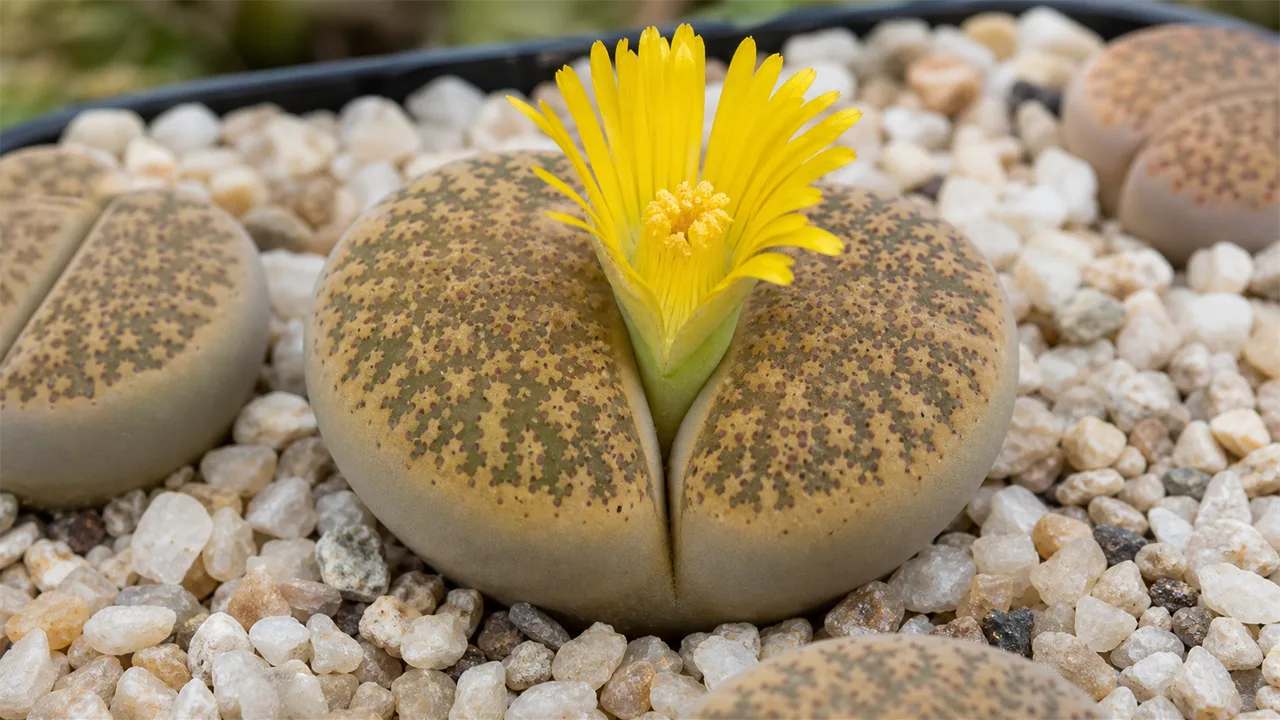
Conophytum bilobum is one of those curious South African succulents that fools every new grower at least once. Each "plant" is actually a pair of thick, fused leaves pressed so tightly together that the body looks like a small, heart-shaped pebble — flat on top, split down the middle by a deep central fissure. In late summer the old pair dries to a papery husk, the new pair pushes through, and a single bright yellow daisy-like flower emerges from the cleft in autumn. Most UK growers who keep it for a season end up collecting several.
Overview
Conophytum bilobum belongs to the Aizoaceae (the Mesemb family), a group of southern African dwarf succulents adapted to extreme aridity and bright light. The genus Conophytum contains roughly 100 species, and C. bilobum is one of the largest-bodied and most widely cultivated of them all. In the UK it is grown almost exclusively as a glasshouse, conservatory or bright windowsill specimen because it is frost-tender — it carries an RHS hardiness rating that places it firmly on the "under glass" side of the spectrum. Its cultivation is governed by a single quirk that catches out almost every beginner: it grows in our autumn and winter and rests in our summer, the reverse of what most UK gardeners expect.
The species was first described by the German botanist Rudolf Marloth in 1907 and transferred to Conophytum by N.E. Brown in 1922. It is native to the Northern Cape of South Africa and southern Namibia, where winter-rainfall desert conditions and quartzite crevices shape its habit. In the UK it has been grown under glass for over a century and is recognised by the RHS, which publishes its own cultivation note.
Appearance
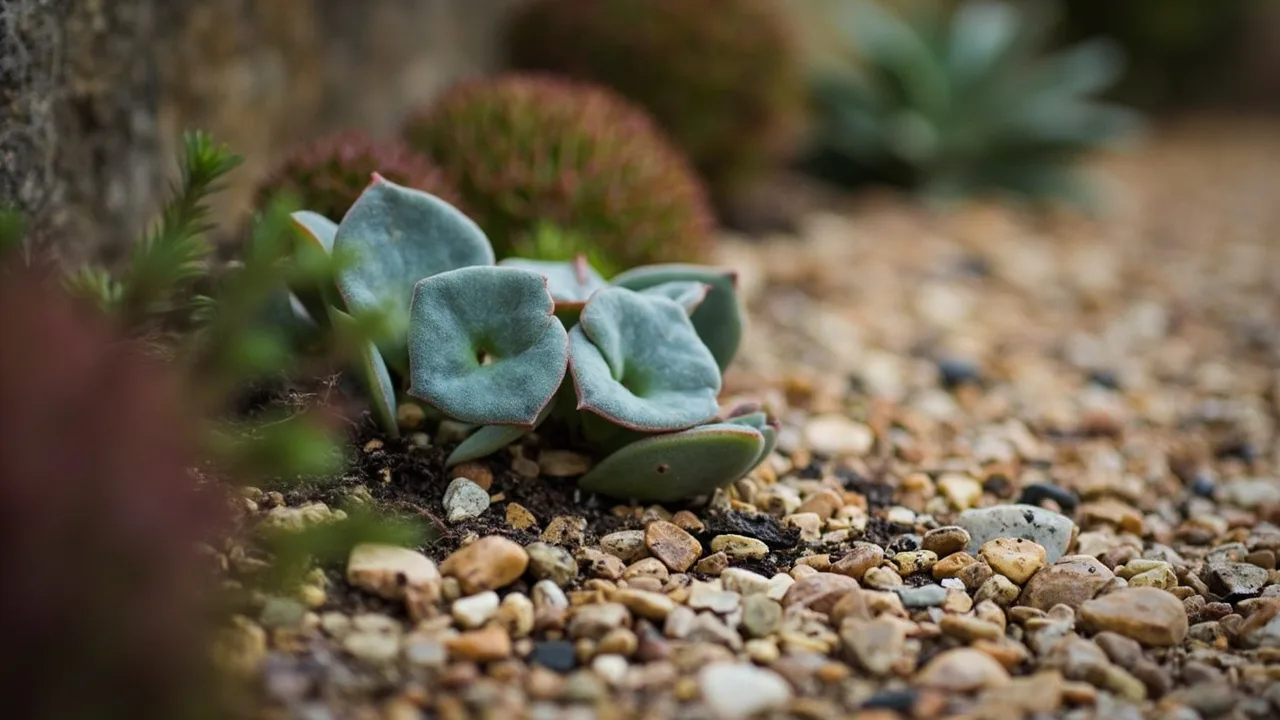
Each body of C. bilobum is a fleshy, inversely heart-shaped (obcordate) pair of fused leaves, roughly 3–7 cm tall, with a flat or slightly domed top. A deep central fissure divides the pair into two rounded lobes — the feature that gives the species both its name (bilobum = two-lobed) and its most popular common name. Bodies range from a bright apple green in shadier positions to a glaucous, blue-grey green in strong light, and many clumps will flush plum, purple or rusty red when exposed to bright sun, cold nights, or as the summer rest begins.
The old leaf pair does not fall off in the normal sense; it dries in place into a thin, pale, papery sheath that wraps around the new pair emerging from the central fissure. In late summer this sheath splits along its seams, exposing the fresh bodies underneath. Flowers emerge from the central cleft, one per body, and are daisy-like, scentless and bright yellow, opening in daylight and closing at dusk. Mature clumps can carry dozens of flowers over several weeks in autumn.
The root system is fine, shallow and slightly tuberous, and is the part of the plant most easily lost to overwatering.
Growing Conditions
In the UK the plant must be grown under glass, in a conservatory, or on a very bright windowsill. The RHS cultivation note for Conophytum bilobum is unusually prescriptive: grow it "under glass in a mixture of two parts each sharp sand and loam and one part leaf mould, in full light. Provide low humidity." That is, bright, dry and well-ventilated — essentially alpine-house conditions with winter protection. Light should be as strong as possible from autumn through spring; in high summer, when the plant is dormant, a touch of afternoon shade is tolerated.
Temperature should not fall much below 5 °C in winter, with 7–10 °C being a comfortable overwintering minimum for most UK growers. A cold greenhouse with no winter heat is risky in most of the country, and an unheated porch will not protect the plant through a hard frost. The plant has an RHS hardiness rating suitable for a tender glasshouse specimen only.
The single most important axis is the watering calendar, which runs opposite to a typical UK houseplant:
- Late August – September: as the papery sheath splits and the new bodies are visible, start watering with a thorough soak.
- September – November: active growth and flowering; water regularly but let the mix dry between drinks.
- Late November – early December onwards: taper and stop as light levels fall.
- End of March – late July: keep dry. This is the summer rest. Old leaves wither into a sheath over the new pair — leave them alone.
The British Cactus & Succulent Society is unambiguous on this point: most Conophytum losses in the UK are watering losses, not cold losses.
Planting and Care
Compost. Use a very free-draining, loam-based cactus mix amended with pumice, perlite or coarse horticultural grit — aim for at least 70% mineral. A small amount of leaf mould or coir is fine; avoid peat-heavy or coir-heavy mixes that hold water.
Pot. Choose terracotta rather than plastic. Terracotta dries faster after each watering and suits the shallow, rot-prone root system. Top-dress the surface with a 5–10 mm layer of horticultural grit to keep the leaf base dry and discourage basal rot.
Repotting. Every 2–3 years, only at the start of the autumn growing season, when the plant is breaking its summer rest. At every other time the dormant bodies are wrapped in fragile old-leaf sheaths and should not be disturbed.
Feeding. Light feeders. Plants repotted regularly into fresh loam-based mix need no supplementary fertiliser. A half-strength, low-nitrogen feed at the start of the autumn growth period is optional for plants that have been in the same pot for several years.
Propagation. Divide established clumps at the start of autumn, when the new bodies are firm and clearly separate. Alternatively, sow seed in late summer or early autumn on a warm (~20 °C), bright bench in a very gritty mix; germination usually takes 1–3 weeks.
Grooming. Do not pull off the dry summer sheath by hand. It is protecting the new leaves inside and will fall away naturally when the plant is ready.
Siting. A bright north- or east-facing windowsill in a cool room works well. A greenhouse or conservatory with a winter minimum heat of 5–10 °C is ideal. A cold greenhouse is too risky in most of the UK.
Common Problems
Splitting or bursting bodies. Almost always caused by watering during the summer rest. The body literally bursts open like an over-filled dumpling. Withhold water immediately, move to a dry, shaded position, and let the plant heal.
Basal or root rot. Caused by damp, cold compost, especially in winter. Use a grittier mix, water only in the growing season, and keep cold-side plants dry. Once rot reaches the body there is little to be done — take healthy offsets as cuttings if any are unaffected.
Mealybug. The classic indoor-succulent pest, hiding in the central fissure and around the roots. Inspect at every repot. Treat visible tufts with a brush dipped in 70% isopropyl alcohol; for serious infestations, a systemic insecticide labelled for use on ornamental succulents can be used, following the manufacturer's instructions.
Failure to flower. Usually the result of watering through the summer rest, so the plant never gets the dry dormant period it needs to set buds; or of keeping it too warm and dim in winter. A cold, dry, bright winter is what triggers flowering the following autumn.
Popular Varieties
Conophytum bilobum is unusual among houseplants in that almost all the "varieties" on offer are botanical subspecies or forms, not named garden cultivars. UK growers should treat them as distinct botanical taxa rather than as branded cultivars.
- C. bilobum subsp. bilobum — the type subspecies, with stout, bright green to glaucous heart-shaped bodies and yellow flowers; the most commonly cultivated form in the UK.
- C. bilobum subsp. gracilistylum — a more slender-bodied subspecies with longer, narrower lobes, paler green bodies, a fine spotting, and pale pink flowers; prized by collectors for its delicate form.
- C. bilobum subsp. gracilistylum f. chauviniae — a selected form within the slender subspecies, similarly refined, also with pink flowers.
No major UK nursery currently sells a branded Conophytum bilobum cultivar, and none has been awarded an Award of Garden Merit by the RHS. Buy only from reputable seed-grown or nursery-propagated stock; never import field-collected plants — wild C. bilobum populations in the Northern Cape are under pressure from illegal collecting.
Sources & Further Reading
- Royal Horticultural Society: Conophytum bilobum plant profile — rhs.org.uk/plants/176640/conophytum-bilobum/details, accessed 2026-07-23.
- British Cactus & Succulent Society: Cultivation Notes on Conophytum — bcss.org.uk/cultivation-notes-on-conophytum/, accessed 2026-07-23.
- World of Succulents: Conophytum bilobum care guide — worldofsucculents.com/conophytum-bilobum/, accessed 2026-07-23.
- SANBI PlantZAfrica: Conophytum bilobum species sheet — pza.sanbi.org/conophytum-bilobum, accessed 2026-07-23.
- BBC Gardeners' World: succulent growing under glass — gardenersworld.com/how-to/grow-plants/growing-succulents-under-glass/, accessed 2026-07-23.
Pests and Diseases
| Problem | Symptoms | Management |
|---|---|---|
| Root rot | Leaves become translucent, mushy, and collapse as the base rots away. | Ensure sharp drainage with gritty compost and water only when completely dry. |
| Aphids | Small green or black insects cluster on new growth and flower buds. | Remove by hand or spray with a mild insecticidal soap if infestation is heavy. |
| Mealybugs | White, cottony wax-like masses appear in leaf fissures and at the base. | Dab affected areas with a cotton bud soaked in methylated spirits. |
| Sunburn | Leaves develop bleached white patches or brown scorch marks on exposed surfaces. | Acclimatise gradually to full sun and avoid intense midday exposure initially. |
| Overwatering | Plants look swollen and turgid but fail to grow, eventually leading to rot. | Keep completely dry during dormancy and ensure pots have adequate drainage holes. |
For step-by-step help, read Controlling Aphids Naturally. Or browse the full plant problem solver to diagnose an issue by symptom.
Recommended Products
GardenWizz earns a commission from qualifying purchases made through affiliate links on this page (including links within the article) — as an Amazon Associate, and from Thompson & Morgan via the Awin network. This does not affect the price you pay. See our disclaimer for details.