Golden Crocus
Crocus chrysanthus
The Gardening Year
Best months in UK gardens · full planting calendar →
🖨 Printable care card (PDF)At a Glance
| Botanical name | Crocus chrysanthus |
|---|---|
| Common name(s) | Golden Crocus |
| Family | Iridaceae |
| Plant type | bulb |
| Height × Spread | 7–10 cm × — |
| Position | Full sun |
| Soil | well-draining soil |
| Flowering | February–March |
| Toxicity | — |
| Native range | southeastern Europe and Turkey |
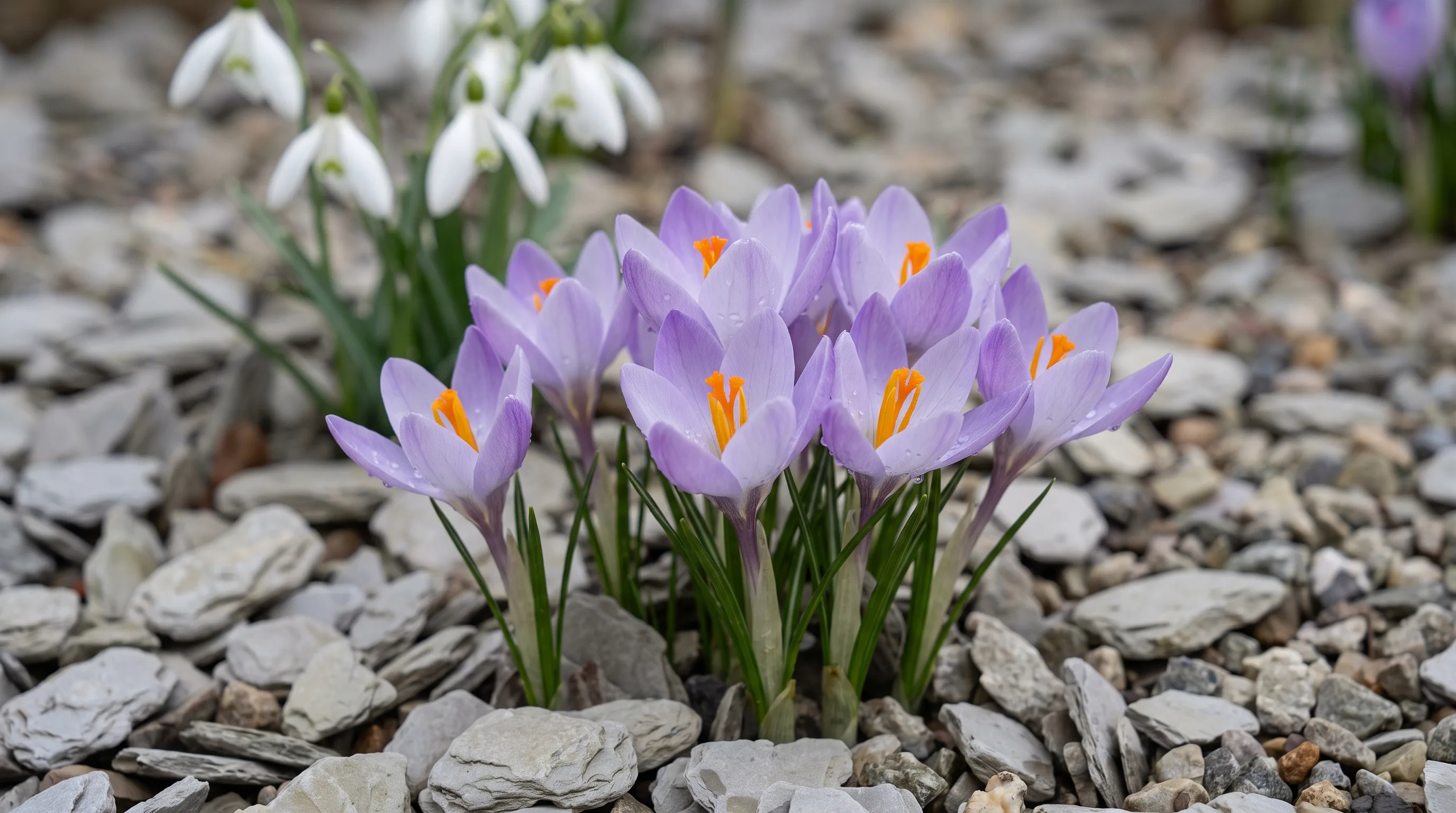
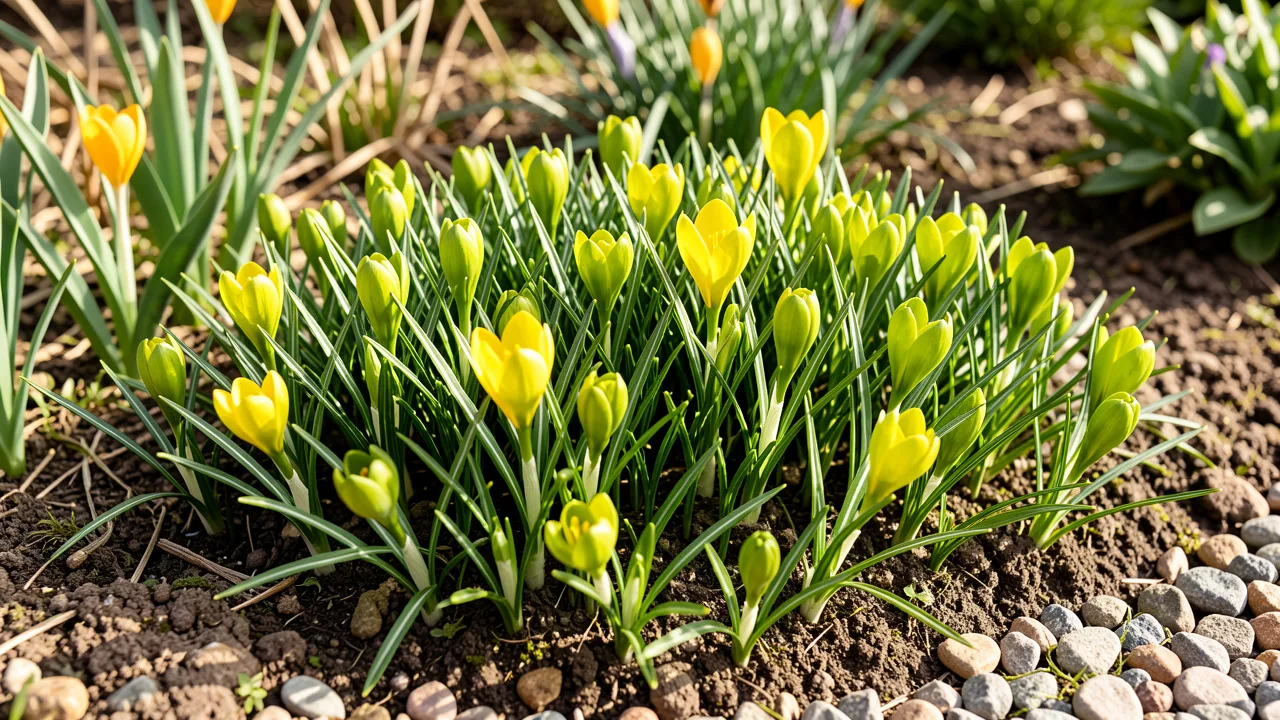
A February herald and one of the earliest bulbs to bloom in British gardens, Crocus chrysanthus opens its small goblet-shaped flowers while winter still has a grip on the landscape. Its common names — Golden Crocus and Snow Crocus — capture both its typical warm-yellow colouring and its willingness to flower through frost and snow. It is a species of considerable garden merit in its own right and, more importantly, the parent of a race of hybrid crocuses widely planted in British lawns, rock gardens and containers.
Overview
Crocus chrysanthus (Herb.) Maw is a low-growing, cormous perennial in the iris family (Iridaceae), native to the Balkans, Greece, Bulgaria and western Turkey. It was introduced to British cultivation in the mid-19th century and has since become one of the most reliable early-flowering bulbs for UK gardens. The species is fully hardy across the British Isles and naturalises readily in short grass, making it a staple of the "spring meadow" planting style.
In the garden, C. chrysanthus is valued above all for its earliness. Flowers typically open from February into March in most of the UK, often a fortnight or more before the larger Dutch hybrid crocuses (Crocus vernus cultivars) come into bloom. Plants are compact, reaching only 5–8 cm tall at flowering, and they multiply steadily from year to year without becoming invasive. Each corm produces one or two flowers, and established clumps can carpet a lawn in a sheet of colour by late winter.
The species also has genuine ecological value. Its flowers are a useful early source of nectar and pollen for queen bumblebees emerging from hibernation and for honeybees on warmer February days, at a time when little else is in flower. A drift of C. chrysanthus in a sunny border or lawn is therefore as much a pollinator resource as an ornamental feature.
Appearance
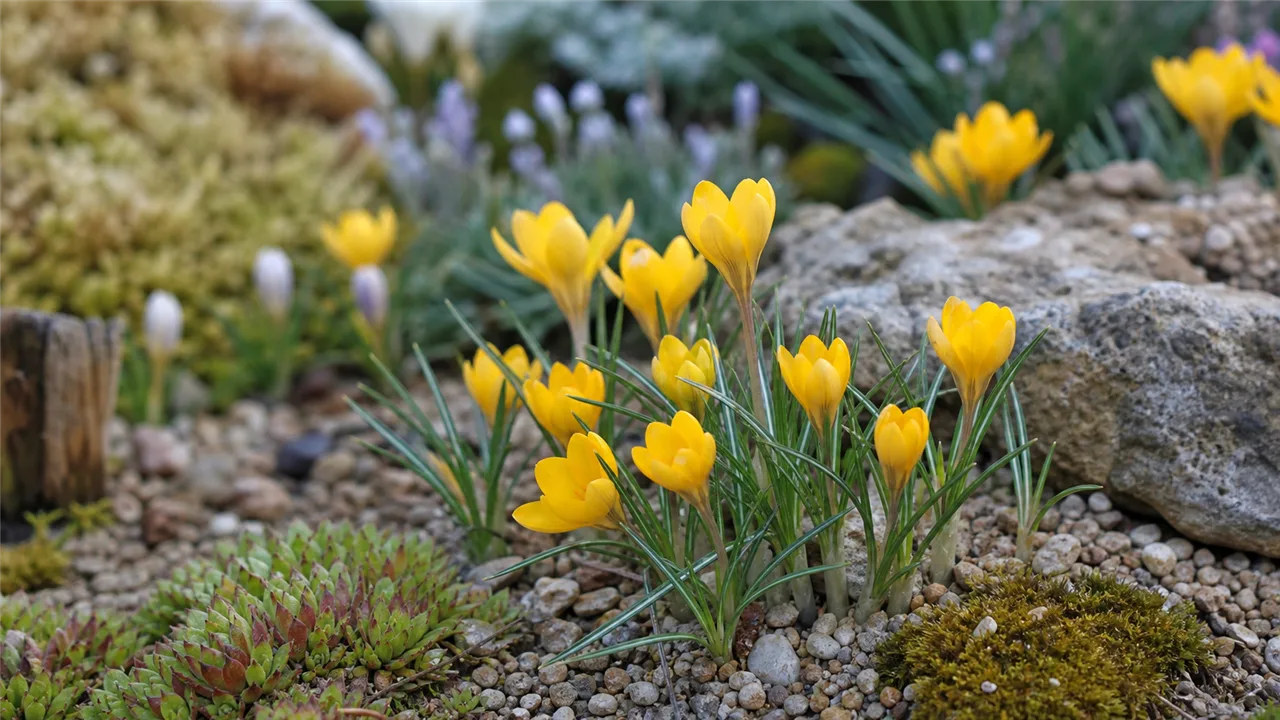
The plant forms a tuft of narrow, linear, dark green leaves with a conspicuous silvery-white central stripe. Foliage appears at or just before flowering and persists for several weeks after the blooms have faded, before dying back in late spring. The leaves are grass-like in appearance and reach roughly the same height as the flowers.
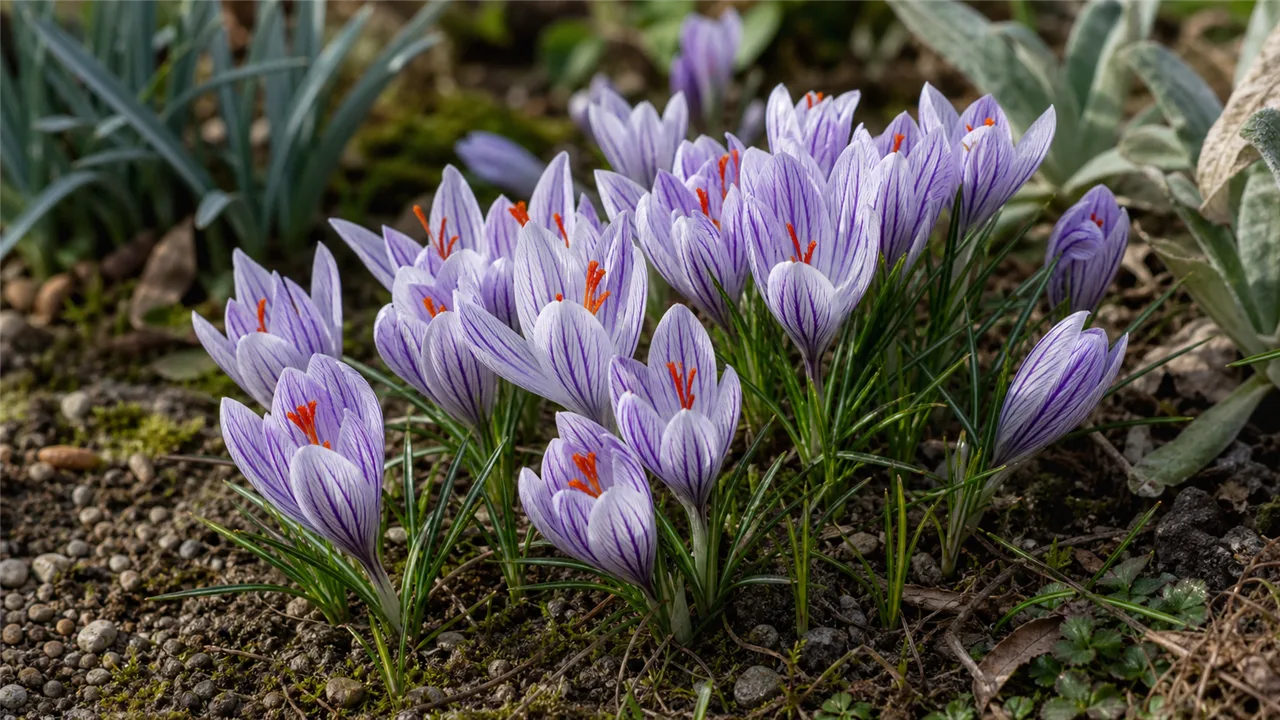
The flowers are small, goblet-shaped and produced singly or in pairs from each corm. In the typical wild form they are bright golden yellow, often paler within than without, and the outer surface of the three outer petals (technically tepals) is frequently stained, feathered or flushed with bronze, purple or mahogany. This two-tone effect is more pronounced in cool weather and gives the flowers their characteristic polished look. The blooms open wide in full sun, closing again in the evening or during dull weather. They carry a light, sweet fragrance that is most noticeable on a calm, sunny day.
Beneath the soil sits a small rounded corm enclosed in a fibrous tunic. Unlike the larger corms of Dutch hybrid crocuses, those of C. chrysanthus are modest in size — typically little bigger than a hazelnut — and they sit close to the surface once established.
Growing Conditions
Crocus chrysanthus performs best in an open, sunny position, although it tolerates light dappled shade, particularly beneath deciduous shrubs and trees that have not yet come into leaf at flowering time. It is one of the best crocuses for naturalising in short grass, provided the lawn is not treated with a selective weedkiller in late winter or early spring.
The plant prefers a well-drained soil and is intolerant of waterlogging, especially during the summer dormancy period when corms are prone to rot in heavy, saturated ground. A gritty or sandy loam is ideal; on clay soils it pays to work in plenty of grit or organic matter before planting, or to grow the corms in raised beds, rock gardens or containers where drainage can be controlled.
Across most of the UK the species is reliably perennial. Its RHS hardiness rating is displayed by the plant badge at the top of this page; in practice, established corms shrug off hard frosts and snow, and damage is rare except in the very coldest, wetter sites in northern Scotland.
Planting and Care
Plant Crocus chrysanthus corms in autumn, any time from September through November, and as soon as possible after purchase because the corms dehydrate quickly in storage. Set them 8–10 cm deep and 5–8 cm apart, pointed end up. For naturalising in grass, scatter the corms informally across the planting area and plant them where they fall for a natural drift effect, lifting a plug of turf with a trowel for each corm.
Watering is rarely necessary after planting, as autumn rainfall usually provides sufficient moisture to settle the corms and trigger root growth. In containers, water moderately through autumn and early spring, then reduce watering as the foliage dies back in late spring; the compost should be kept just moist, never wet.
Feeding needs are modest. An annual dressing of a slow-release bulb fertiliser or a light top-dressing of bone meal and well-rotted garden compost, applied as the flowers fade, will sustain strong flowering in subsequent years. High-nitrogen lawn feeds applied to surrounding turf are best avoided.
Pruning in the formal sense is not required; this is a bulb whose foliage dies back naturally. It is, however, essential to allow the leaves to die back fully before any tidying takes place — at least six to eight weeks after flowering — so that the corms can replenish their reserves. With crocuses naturalised in lawn turf, this means delaying the first spring mow until the crocus foliage has yellowed and collapsed, typically in late April or May.
Propagation is straightforward by division of the small corm offsets that form around the parent corm. Lift congested clumps in June or July once the foliage has died back completely, separate the offsets and replant them at the same depth immediately. Replant promptly; dried-out offsets establish poorly. Seed can be sown in autumn but takes several years to reach flowering size, and named cultivars do not come true from seed, so division is the usual method for home gardeners.
Containers are an excellent way to bring the flowers closer to eye level. Use a free-draining loam-based compost such as John Innes No. 2 with extra grit, plant the corms more densely than in the open ground (about 3 cm apart), and site the pot in a sunny, sheltered spot. Raise the pot on pot feet to ensure sharp drainage through the wetter months.
Common Problems
Crocus chrysanthus is generally trouble-free, but a handful of problems recur on heavy or wet soils.
Corm rot, caused by various fungi including Penicillium and Fusarium species, is the most common complaint. It is almost always a drainage issue. Affected corms turn soft and brown, fail to sprout, or produce weak, distorted foliage. Discard any soft or discoloured corms at planting and avoid re-using the same site or the same compost for several seasons.
Crocus fire (Urocystis colchici) is a less common fungal disease that produces dark brown to black streaks on the leaves and can deform flowers. Infected plants should be lifted and destroyed (not composted) and the affected area avoided for replanting.
Rust may appear as orange or brown pustules on the leaves in mild, damp springs. Improve air circulation around clumps, remove and bin affected foliage, and avoid overhead watering.
Among animals, squirrels and mice sometimes dig up and eat newly planted corms. Planting at the recommended 8–10 cm depth helps, and laying chicken wire just below the soil surface over the planting area is a long-established deterrent in vulnerable gardens. Birds rarely damage the plants themselves but may peck at open flowers in hard weather.
Failure to flower in established clumps is usually traced back to one of three causes: corms planted too shallowly, summer waterlogging, or premature mowing or tidying of the foliage that has denied the corms a full growing season to build up reserves.
Popular Varieties
The species itself is widely grown, and a number of well-established hybrid cultivars derived from C. chrysanthus (often crossed with Crocus biflorus) are particularly prized in British gardens. The following are among the most reliably available and widely planted in the UK.
'Cream Beauty' — soft pale-yellow flowers with a creamy interior and a faint bronze stain on the outer petals. Vigorous and an excellent naturaliser in grass.
'Snow Bunting' — pure white flowers with a delicate pale blue-grey base on the outer petals; one of the best white forms for the UK garden.
'E.A. Bowles' — named after the great British plantsman; rich golden-yellow flowers with a deeper bronze-purple feathering on the outside of the outer petals.
'Ladykiller' — a striking cultivar with pale lilac to white inner petals contrasted against deep purple-violet outer petals; flowers later than some, often into March.
'Blue Pearl' — soft silvery-blue flowers with a paler interior; one of the most popular of the paler chrysanthus hybrids and a strong performer in pots.
'Advance' — a bi-coloured cultivar with violet-blue outer petals and a paler interior; particularly early to flower, often opening in January in mild winters.
'Gipsy Girl' — golden-yellow flowers boldly striped and feathered with dark purple-brown on the outer petals, giving a striped or banded appearance.
'Fuscotinctus' — pale lilac flowers with a distinctive dark purple-blue blotch at the base of the petals; a long-established, hardy cultivar.
All of these hybrids share the species' modest size, early flowering, sweet scent and willingness to naturalise, and any of them makes a fine substitute for, or companion to, the straight species in a lawn, rock garden or container display.
Cultivars and Varieties
| Cultivar | Height | Flower | Notes | AGM |
|---|---|---|---|---|
| 'Cream Beauty' | — | — | RHS AGM (H6) | ✓ |
| 'Zwanenburg Bronze' | — | — | RHS AGM (H6) | ✓ |
Pests and Diseases
| Problem | Symptoms | Management |
|---|---|---|
| Slugs and snails | Irregular holes in leaves and flowers, with slimy trails visible on foliage. | Use slug pellets, beer traps, or hand-pick at night to protect emerging shoots. |
| Vine weevil | Notched leaf margins above ground and root damage causing plant collapse below. | Apply nematodes in autumn or use systemic insecticides in the soil. |
| Crocus virus | Mottled, streaked, or distorted leaves and flowers with reduced vigor. | Remove and destroy infected plants; control aphid vectors to prevent spread. |
| Root rot | Yellowing, wilting foliage and soft, mushy corms in waterlogged soil. | Ensure well-drained soil and avoid overwatering; discard rotted corms. |
| Rabbit damage | Cleanly clipped leaves and stems at ground level, often stripping plants bare. | Install wire mesh guards or use repellents to protect young shoots. |
For step-by-step help, read Dealing with Slugs and Snails. Or browse the full plant problem solver to diagnose an issue by symptom.
Recommended Products
GardenWizz earns a commission from qualifying purchases made through affiliate links on this page (including links within the article) — as an Amazon Associate, and from Thompson & Morgan via the Awin network. This does not affect the price you pay. See our disclaimer for details.