Byzantine Crocus
Crocus banaticus
The Gardening Year
Best months in UK gardens · full planting calendar →
🖨 Printable care card (PDF)At a Glance
| Botanical name | Crocus banaticus |
|---|---|
| Common name(s) | Byzantine Crocus |
| Family | Iridaceae |
| Plant type | bulb (cormous perennial) |
| Height × Spread | 10 cm × 0–10 cm |
| Position | Full sun, Partial shade |
| Soil | moderately fertile, humus-rich, moderately well-drained soil; Chalk Clay Loam Sand; Well–drained; Acid or Alkaline or Neutral |
| Flowering | September–November |
| Toxicity | Ornamental bulbs - not to be eaten. Wear gloves and other protective equipment when handling. |
| Native range | Balkans, particularly in Serbia, Romania and south western Ukraine |
Crocus banaticus is one of the most distinctive autumn-flowering crocuses in UK cultivation, valued for its unusual flower structure, late season, and quiet habit in short grass. Native to the Balkans, the Carpathians and parts of Romania and western Russia, it sits a little apart from the more familiar Dutch crocus hybrids, both in form and in temperament. Where most crocuses present a near-symmetrical goblet, Crocus banaticus opens three outer tepals wide while keeping its three inner tepals markedly smaller and more upright, giving each bloom a curious hooded-and-skirted silhouette. It flowers without foliage, on bare stems, from late September into October, and asks very little in return: a sunny spot, drainage sharp enough to survive a wet British summer, and time to be left alone.
It is a cormous perennial in the family Iridaceae and is sometimes sold under its older synonym Crocus iridiflorus, a name that references the iris-like asymmetry of the flower. Two common names appear in the trade: "Byzacrene crocus" (a reference to its Romanian stronghold) and "showy crocus". Neither is universal, and most UK gardeners will find it labelled simply as Crocus banaticus in bulb catalogues.
Overview
In the UK garden Crocus banaticus is best treated as a specialist autumn bulb for sun-baked borders, rock gardens, alpine troughs and naturalised drifts in thin lawn. It is not a plant for heavy, fertile ground or for shaded borders, and it performs poorly where summer moisture lingers around the dormant corm. Given a well-drained, gritty soil in full sun, it is hardy across most of the British Isles and will establish into slowly expanding colonies over several years.
Its season fills a useful gap. By the time it flowers in late September and October most summer perennials are spent, colchicums are finishing, and the autumn-flowering narcissi have not yet started. The flowers emerge ahead of the new season's leaves, so the effect is one of colour rising straight from bare soil or short grass, with the narrow basal foliage only appearing the following spring. This odd phenology — flower first, leaves later — is the single most useful thing to know about it when siting it in the garden.
For naturalising, the foliage has usually died back by early summer, well before the first cut of a flowering meadow. That timing makes it one of the safer crocuses to grow in lawns intended for spring wildflower colour. It is also a useful pollinator resource in late autumn, supplying nectar and pollen to solitary bees, hoverflies and late-flying bumblebee queens when little else is in bloom.
Appearance
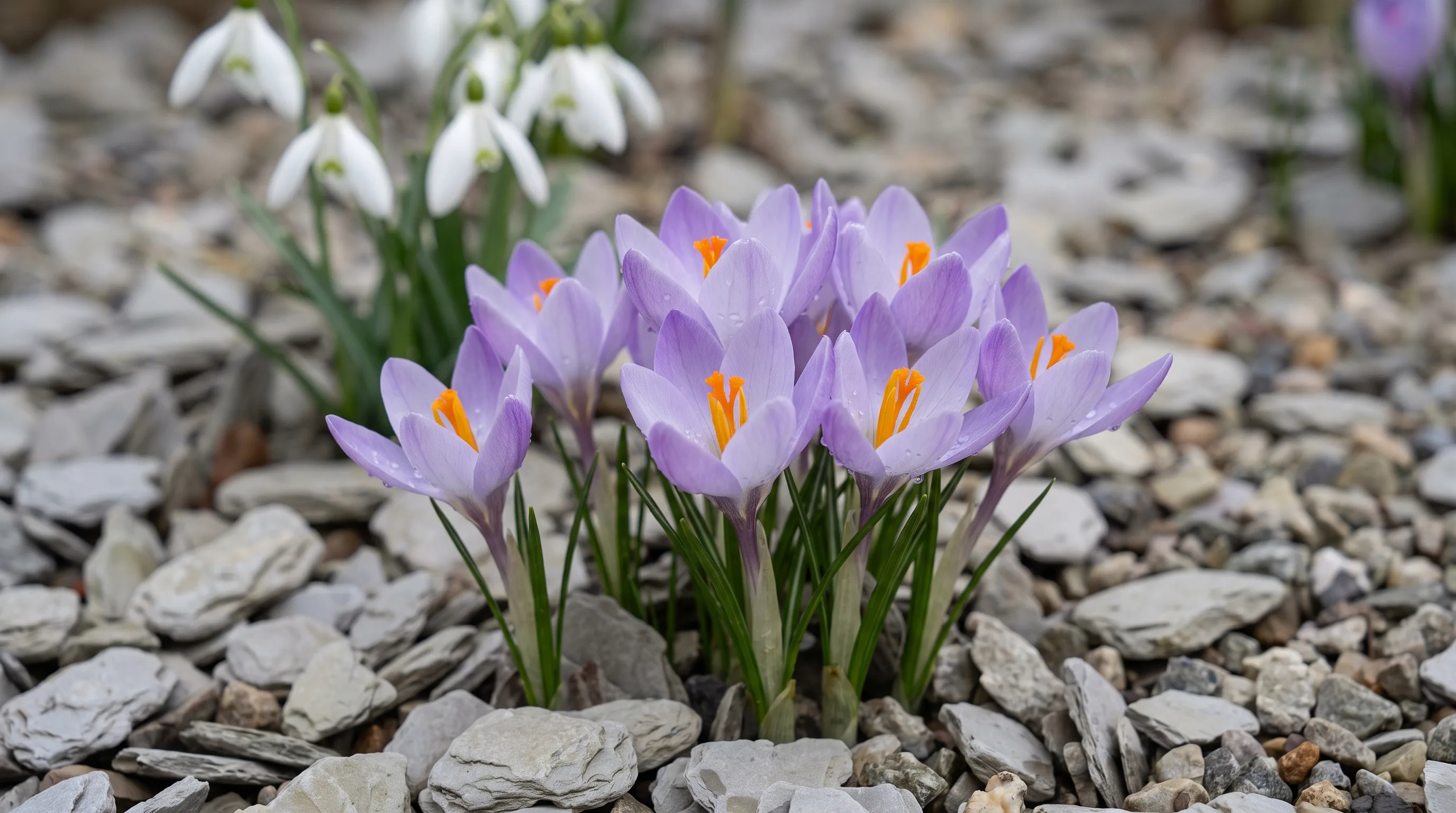
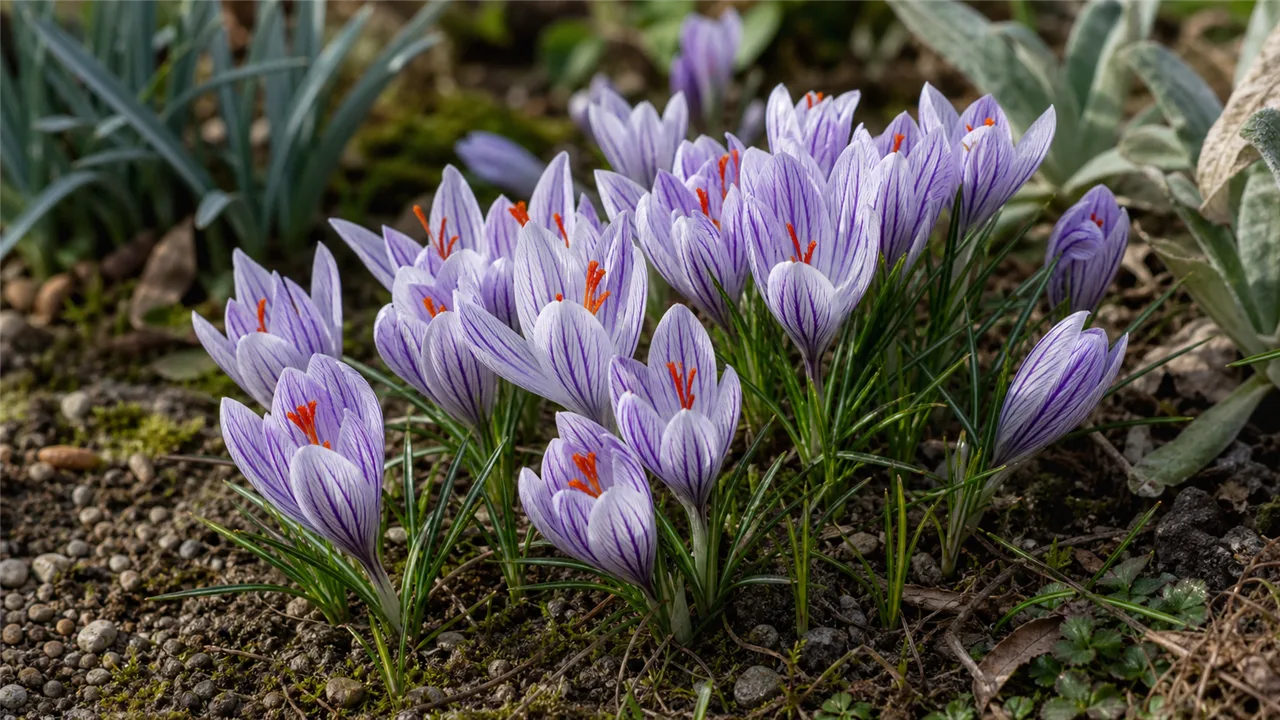
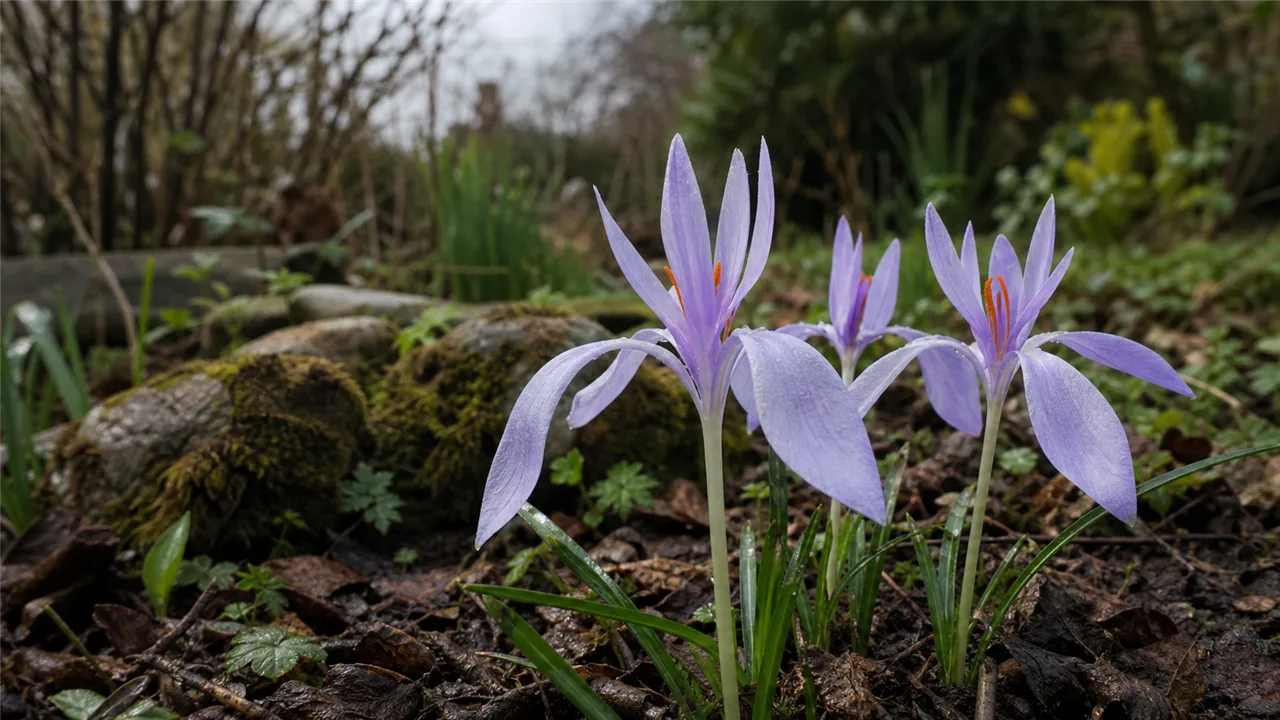
Crocus banaticus is a small cormous perennial that reaches roughly 10–15 cm in flower, with a spread of about 5–8 cm per corm. The flowers are its chief distinction. Each bloom is composed of three large outer tepals and three noticeably smaller inner tepals, the latter held more upright and often paler than the outers. In a typical form the outer tepals are soft lilac to violet-purple, with deeper veining toward the base, while the inner tepals may be paler lilac or, in some selections, a clean white. The result is a flower that looks bigger and more open than a typical crocus, with a small pale "cup" nested inside a wide coloured "skirt".
The stamens are conspicuous: bright orange-yellow anthers on short filaments, sitting at the throat of the flower and visible from a distance. The style branches are similarly orange and slightly feathery. The combination of cool lilac tepals and warm orange centres is what most gardeners notice first.
The corm itself is small, rounded to slightly flattened, and enclosed in a fibrous tunic that splits into rings at the base — a useful identification feature when the corms are sold loose in late summer. Roots are basal and contractile, pulling the corm down to its preferred depth over successive seasons.
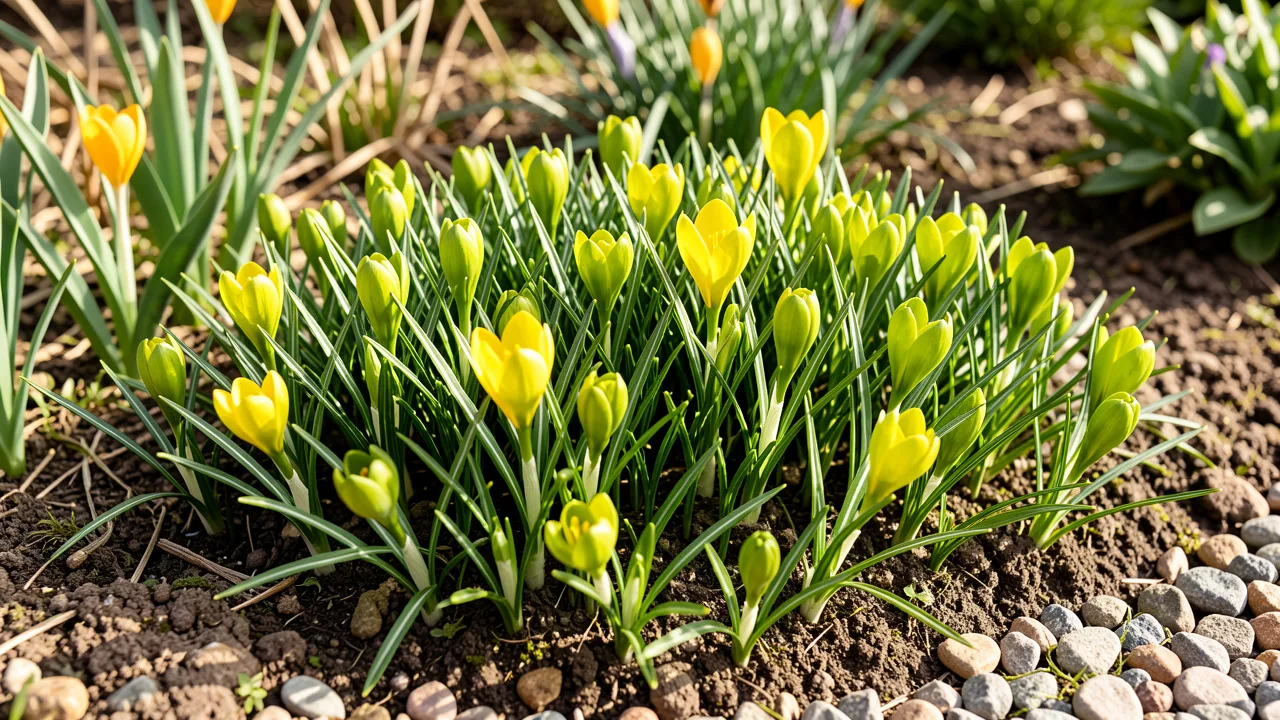
Foliage is grass-like: narrow, dark green, often with a pale central stripe. It appears after flowering, in late autumn or early spring, and dies back by early summer. Plants grown from seed will not flower until their third or fourth season; established corms flower reliably every year once mature.
Growing Conditions
Soil: Sharply drained, gritty soil is essential. Sandy loam, gravelly clay-improved soils, and poor alkaline ground all suit it. Heavy clay that holds water through summer will rot the dormant corms, and richly enriched borders produce leafy growth at the expense of flowers.
Sunlight: Full sun is ideal. Lightly dappled shade under deciduous shrubs is tolerated, but deep shade reduces flowering.
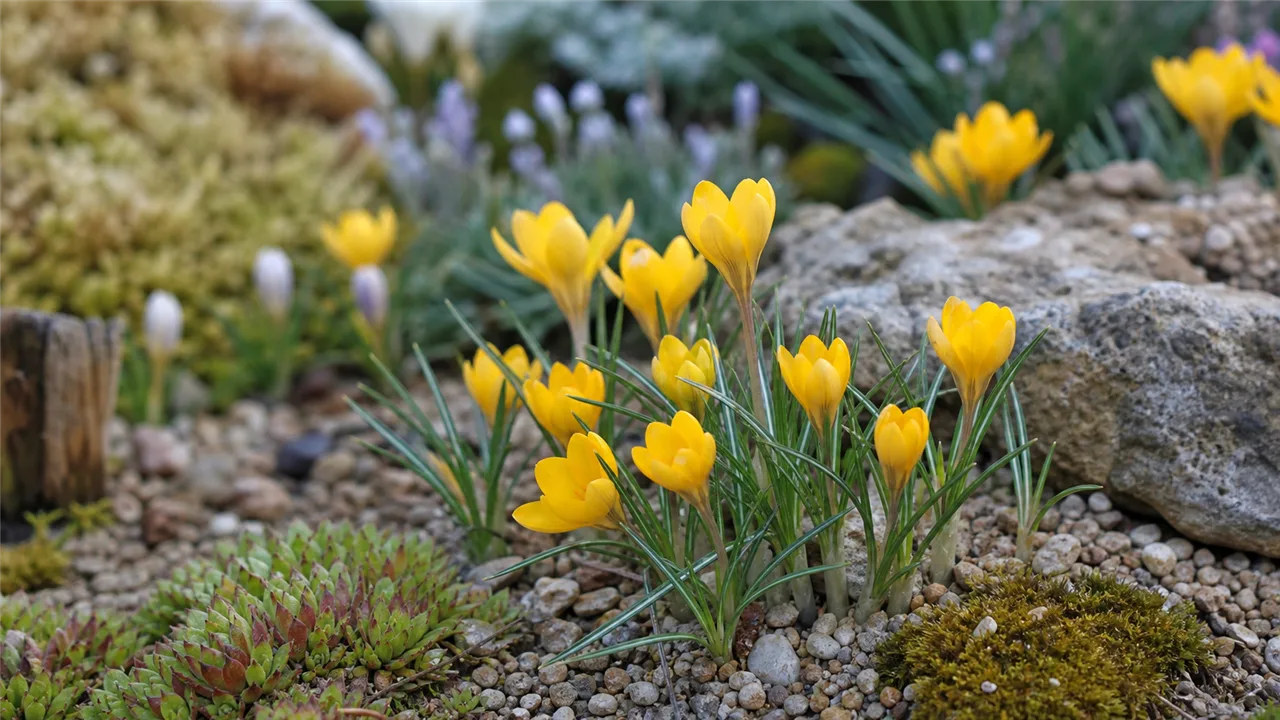
Position: Rock gardens, alpine troughs, the top of a drystone wall, the sunny front edge of a border, and thin short grass are all appropriate. Avoid planting at the foot of a wall where rainwater collects, and avoid the base of hedges where summer shade is densest.
Hardiness: Crocus banaticus holds an RHS hardiness rating appropriate to UK outdoor cultivation. The exact rating is rendered by the plant badge; this article does not state it. What matters in practice is that the corms tolerate typical British winters and dislike prolonged wet during summer dormancy.
Naturalising: It naturalises well in short, unmown grass and in thin meadow turf, particularly where the sward is allowed to grow tall only from late spring through early summer and is cut from mid-July onwards. The corms sit deep enough (typically 8–10 cm once established) to be safe under a high-bladed autumn cut, and the foliage has usually retreated before the first hay cut.
Container cultivation: It grows well in deep terracotta or stone containers in a 50:50 mix of loam-based compost and sharp grit. Containers should be raised on pot feet so that autumn and winter rain drains freely.
Planting and Care
Planting time: Plant in late summer or early autumn, ideally from late August through September, while the corms are dormant and the soil is still warm. October plantings usually establish but flower less reliably in their first spring.
Planting depth and spacing: Set the corms 8–10 cm deep, pointy end up, and 5–8 cm apart. In grass, lift a small turf, tease out a shallow planting hole with a trowel or bulb planter, drop in the corm, and replace the turf. In light soils the corms will pull themselves deeper over the years.
Watering: Once planted, watering is rarely necessary. Natural autumn rainfall is sufficient for root establishment, and the plants want dry conditions from late spring through summer.
Feeding: None required. A lean soil produces better flowering than a rich one. If a boost is wanted in poor ground, a light top-dressing of leaf mould in autumn is enough.
Pruning: Not applicable. The foliage should be allowed to die back naturally in late spring and early summer, which is when the corm rebuilds its reserves for the following autumn's flower. Cutting the foliage early weakens the corm and reduces flowering in subsequent seasons.
Propagation: By division of corm offsets in summer when the plants are fully dormant — typically late July to early August, after the foliage has yellowed off. Lift congested clumps, separate the small offset corms from the parent, and replant immediately at the correct depth. Seed propagation is possible but slow: collect ripe seed in late spring, sow fresh in a gritty seed compost, and grow on for three to four years before the first flower.
Seasonal care: In established drifts in grass, defer the first cut until mid-July. In borders, mark the planting position to avoid disturbance during summer, when the dormant corms are easy to spear with a fork. In containers, move pots to a dry, sheltered spot from June through August if the site is exposed to summer rain.
Common Problems
Corm rot (Fusarium, Penicillium): The most common cause of loss. Triggered by waterlogged or poorly drained soil during summer dormancy. Affected corms turn soft and brown, often with a pink or blue fungal bloom. Lift and destroy affected stock, improve drainage, and replant in a grittier mix. In heavy clay, grow in raised beds or containers instead.
Aphids: Corm aphids can colonise lifted corms in storage and, less commonly, the bases of leaves in spring. They rarely kill established plants but may weaken seedlings or newly divided offsets. Inspect stored corms and dust or rinse if found; in the border, encourage natural predators.
Mice and voles: Corms can be eaten in the ground, particularly in rough grass near hedgerows. In known problem areas, plant into buried wire-mesh baskets or interplant with more deeply buried narcissi as a diversion.
Slugs and snails: Occasional damage to flowers and young autumn shoots, especially in damp seasons. Most established clumps tolerate minor damage without lasting harm.
Narcissus bulb fly: Occasionally lays eggs near crocus corms; the larvae then tunnel into the corm. Not a frequent problem in Crocus banaticus but worth bearing in mind if losses occur and corms are found hollowed out.
Sparrows and other birds: Will peck at crocus flowers in late winter; less of an issue with autumn-flowering species like C. banaticus, whose blooms appear when insect food is still plentiful.
Popular Varieties
Crocus banaticus is grown more often as the species than as named selections, and the wild type is reliably distinct and garden-worthy. Where cultivars are offered, the following are real, established clones in UK trade (all derived from C. banaticus or its close allies) and worth seeking out:
'Albus': A clean white form of the species, lacking the lilac pigment in both outer and inner tepals while retaining the characteristic asymmetry and bright orange stamens. Slower to bulk up than the typical coloured form but striking in autumn light.
'First Snow': A selected white-flowered clone with broader outer tepals than 'Albus' and a slightly earlier flowering window in mid to late September.
'Snowdrift': Another white selection, with pale yellow stamens rather than the orange of the typical species. Useful where a cooler colour combination is wanted.
'Trojanus': A robust lilac-purple form with broader, overlapping outer tepals and slightly larger flowers overall. Often listed as a hybrid between C. banaticus and C. vernus in older references, but treated as a banaticus-type cultivar in current UK trade.
'Early Bird': Selected for an earlier start to the flowering season, typically opening two to three weeks ahead of the species in early to mid September. Useful in northern and exposed gardens where the main season may be cut short by October storms.
'John Marr': A heritage cultivar with deep violet outer tepals and a contrasting white throat, vigorous in well-drained soils. Long-established in UK alpine collections.
Cultivar availability in the UK varies year to year; specialist bulb nurseries, alpine plant societies, and a handful of RHS-affiliated growers are the most reliable sources. The species itself, where offered, gives an excellent garden display and is generally cheaper and more vigorous than named selections.
---
Pests and Diseases
| Problem | Symptoms | Management |
|---|---|---|
| Corm rot | Corms become soft, mushy and discoloured, often leading to plant failure or death. | Ensure well-drained soil and avoid waterlogging, especially during storage or wet winters. |
| Vine weevil | Irregular notches on leaf margins from adults; sudden wilting and root loss from larvae. | Apply biological nematodes to the soil in late summer or use chemical drenches for containers. |
| Slugs and snails | Irregular holes chewed into leaves and flowers, often accompanied by slime trails. | Use slug pellets, beer traps, or encourage natural predators like birds and hedgehogs. |
| Rodents and birds | Corms are dug up and eaten from the soil, leaving empty holes in the planting area. | Plant corms deep enough or use wire mesh barriers to protect them from digging animals. |
| Powdery mildew | A white, powdery fungal growth appears on leaves and stems, potentially stunting growth. | Improve air circulation and apply a fungicidal spray if infection becomes severe. |
For step-by-step help, read Dealing with Slugs and Snails and Treating Powdery Mildew. Or browse the full plant problem solver to diagnose an issue by symptom.
Recommended Products
GardenWizz earns a commission from qualifying purchases made through affiliate links on this page (including links within the article) — as an Amazon Associate, and from Thompson & Morgan via the Awin network. This does not affect the price you pay. See our disclaimer for details.