Fall Crocus
Crocus goulimyi
The Gardening Year
Best months in UK gardens · full planting calendar →
🖨 Printable care card (PDF)At a Glance
| Botanical name | Crocus goulimyi |
|---|---|
| Common name(s) | Fall crocus |
| Family | Iridaceae |
| Plant type | bulb (cormous perennial) |
| Height × Spread | 10 cm × — |
| Position | Full sun |
| Soil | well-drained soil |
| Flowering | September–November |
| Toxicity | — |
| Native range | Greece |
Goulimy's crocus, Crocus goulimyi, is a small autumn-flowering cormous perennial from the limestone hills of southern Greece, grown in UK gardens for its goblet-shaped lilac-blue flowers that open in late October and November. It is a low, slowly multiplying plant that asks only for sharp drainage and a dry summer rest.
Overview
Crocus goulimyi belongs to the iris family, Iridaceae, and sits within the autumn-flowering Mediterranean group of crocuses. In the wild it is restricted largely to the Mani peninsula of the southern Peloponnese and adjacent limestone areas of southern Greece, where it grows in rocky ground and on stony hillsides that dry out completely in summer. The species was named for the Greek botanist Constantine Goulimys, who collected widely in the southern Peloponnese in the twentieth century.
The plant's main garden value is timing. Where most spring-flowering crocuses are over by April and the showy hybrid colchicums finish in September, Goulimy's crocus bridges the gap, opening its flowers in late October and carrying them into November. In mild UK autumns the display can extend into early December, and a sunny day will draw bees and hoverflies to the flowers even at that late stage of the year.
It is closely related to a handful of other autumn-flowering Mediterranean species — notably C. cancellatus, C. serotinus and C. pallasii — from which it is distinguished by its fibrous (rather than netted) corm tunic, its later flowering season and the absence of a bold yellow throat. Cultivated stock has been available in the UK from specialist bulb nurseries for several decades and the species is reliably hardy in most regions when drainage is sharp.
Appearance
Goulimy's crocus is a low clump-forming perennial reaching about 8–12 cm in flower, with leaves extending a little higher once fully emerged. Each corm produces one to four flowers in succession, so a well-established clump gives a longer display than an individual corm would suggest.
The corm is small and flattened, with a tunic of fine parallel fibres rather than the netted sheath seen in some other autumn crocuses — a useful diagnostic feature when comparing dormant stock. Three to five narrow, grassy, dark green leaves emerge with or just after the flowers, usually with a paler central stripe. The leaves continue to grow through winter and into early spring before dying back as the corm enters summer dormancy.
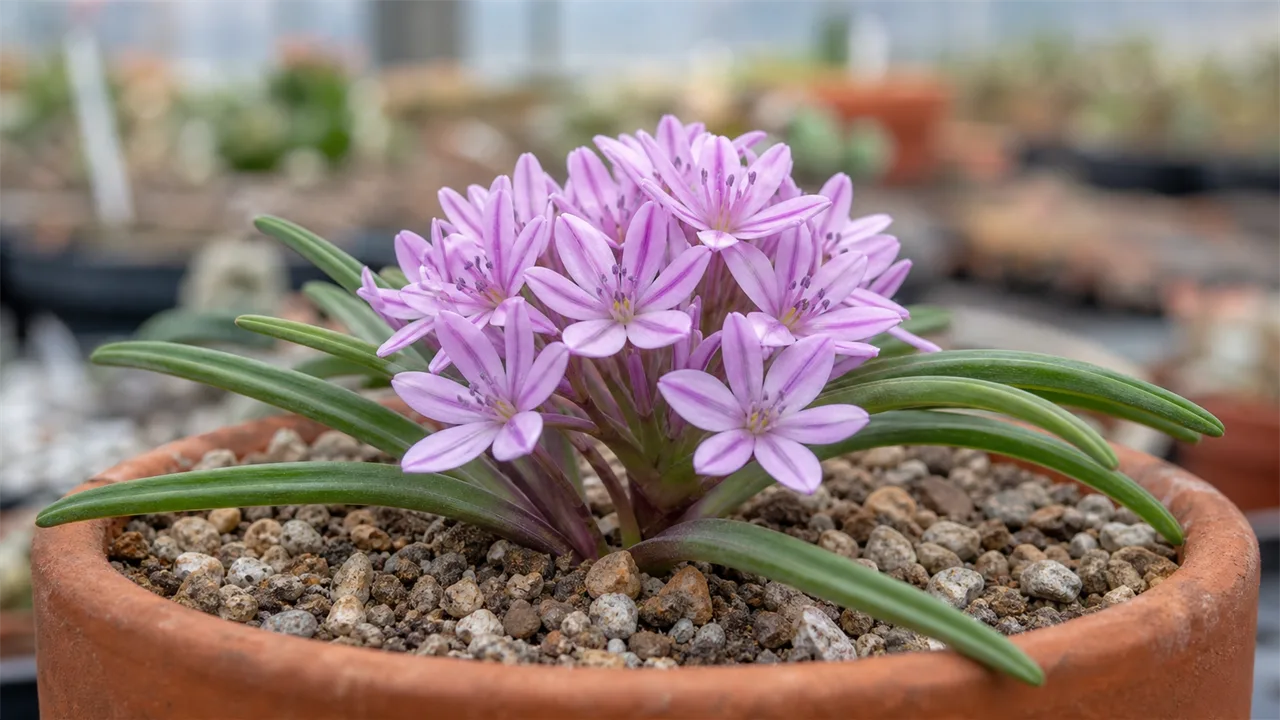
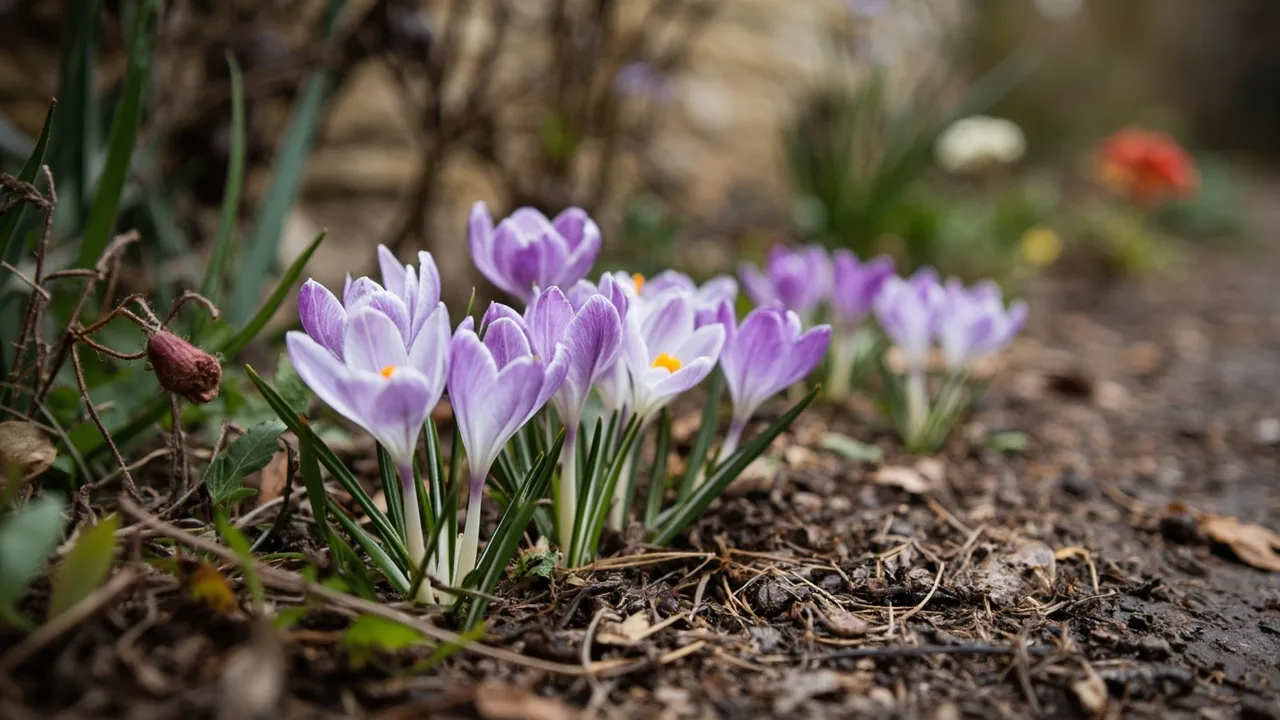
Flowers are the main attraction. Each is a classic crocus goblet of six tepals in two whorls of three, pale to mid lilac-blue, often with delicate veining on the outer surface and a paler throat that may show a faint yellow tinge. Individual blooms are roughly 5–7 cm tall when fully open and last several days in cool autumn weather. After pollination a small capsule forms at ground level on a short pedicel, but in garden cultivation seed is rarely set and most increase comes from corm division.
Growing Conditions
Full sun is essential for reliable flowering. Goulimy's crocus will tolerate very light, dappled shade for part of the day, but heavier shade produces reluctant, leaning flowers and dwindling corms. The most natural setting in a UK garden is a south- or west-facing rock garden, raised bed, sunny bank or gravel border.
The single most important requirement is sharp drainage. The species comes from limestone scree where the soil never stays wet for long, and in cultivation it thrives in a free-draining loam improved with coarse grit, or in a gritty alpine mix of neutral to alkaline reaction. Heavy clay is unsuitable unless modified into a raised bed or berm where surplus water drains away from the corms.
Summer dormancy is pronounced. From late spring, when the foliage yellows and dies back, through to early autumn, when new roots are made, the corms must be kept dry. Natural rainfall in much of the UK is usually sufficient, but in wetter western regions and after unusually damp summers losses from corm rot are common. Planting under the eaves of a building, in a raised bed, or in a gritty mix that sheds water quickly reduces this risk.
In most of lowland and southern England, and in sheltered gardens further north, Crocus goulimyi can be relied on as a hardy autumn bulb provided drainage is sharp. It is borderline in mild, persistently damp western regions, particularly where summers are wet and clay soils hold moisture around the corms. There, grow it in raised beds, alpine troughs or terracotta pans so the dormant corms can stay dry.
Planting and Care
Plant corms 8–10 cm deep, measured from the base of the corm to the soil surface, and 5–8 cm apart. In heavier soils, plant slightly higher and top-dress with 2–3 cm of coarse grit to keep the neck of the corm dry. The best planting time is late summer — typically August to early September — when dormant corms are available from specialist suppliers and the soil is still warm enough to encourage root growth before the flowers emerge.
During the autumn growing and flowering season, natural rainfall is usually adequate. Water only if the autumn is exceptionally dry and the soil begins to bake hard; a single thorough soak is preferable to frequent light watering. Through summer dormancy, do not irrigate.
Goulimy's crocus is a low-fertility plant. A light top-dressing of leafmould or fine gravel in early autumn is sufficient. Avoid rich feeding with general-purpose fertilisers or fresh manure, both of which encourage leafy growth at the expense of flower. The plant is not pruned in the conventional sense; foliage should be allowed to die back naturally through late spring, and yellowed leaves can be tidied away once they have fully withered.
Established clumps can be lifted and divided during summer dormancy, ideally in June or July once the foliage has fully died back. Separate the small offset corms from the parent and replant them at the same depth in freshly prepared ground; divisions usually flower the following autumn. Seed is slower: sow fresh seed in late summer in a gritty compost and keep the pots in a cold frame through winter, with germination in spring and flowering typically in the third or fourth year.
For container growing, Crocus goulimyi is exceptionally well suited. Use a free-draining mix such as John Innes No. 2 with at least 30 per cent grit by volume, and plant corms at the same depth as in the open ground. Plunge the pots in a cold frame or against a south-facing wall for autumn and winter, then move them to a dry, sheltered position and withhold water from late spring through summer. A 2–3 cm gravel mulch on top of the compost deters squirrels and keeps the corm neck dry.
Common Problems
Squirrels and mice are the most damaging pests in UK gardens. Both dig up newly planted corms in late summer and autumn, sometimes eating them on the spot and sometimes caching them elsewhere. A gravel mulch helps, and fine wire mesh laid over the planting and lifted once the foliage is established offers good protection in high-pressure gardens. Birds occasionally peck at the open flowers but rarely cause serious damage.
Corm rot, caused by Fusarium and Penicillium fungi, is the main disease threat and almost always traces back to poor drainage or a wet summer. Affected corms turn soft and brown, fail to emerge in autumn, and may smell musty when lifted. Promptly remove and destroy rotten stock and replant in fresh, grittier soil. Grey mould (Botrytis) can spoil open flowers during still, damp autumn weather; removing spent flowers and improving airflow reduces the risk.
Corms that fail to flower — sometimes called "blind" corms — are most often planted too shallow, kept too wet through summer dormancy, or exhausted by over-rapid increase without division. Yellowing foliage well before flowering usually points to premature summer wet or early autumn rain on still-dormant corms. In both cases the remedy is to lift, divide and replant into a grittier, better-drained site.
Popular Varieties
True cultivars of Crocus goulimyi are few, and the species is most often sold and grown as the type. The names below are the ones that recur reliably in specialist bulb literature.
Crocus goulimyi
The typical form, with goblet-shaped pale to mid lilac-blue flowers and a faintly paler throat, flowering from late October into November. This is the form most commonly offered by UK bulb nurseries.
Crocus goulimyi subsp. leucanthus
A pale-flowered subspecies from the southern Peloponnese with white to very pale lilac blooms. It sits alongside the type in flowering season and habit but provides a brighter, more luminous colour in the autumn garden.
Crocus goulimyi var. leucocyanthus
A rarer variant producing pale blue-white flowers, sometimes listed by specialist alpine and bulb nurseries. Stocks are limited and availability varies year to year.
'Mani White'
A white-flowered selection associated with the Mani peninsula from which the species takes its common name. It flowers at the same time as the type and is grown for its clean, almost luminous white goblets in late autumn.
Given a sunny spot, a gritty free-draining soil and a dry summer rest, Crocus goulimyi establishes slowly into a small colony and produces a reliable show of late flowers year after year, at a time when little else in the rock garden is awake.
Pests and Diseases
| Problem | Symptoms | Management |
|---|---|---|
| Slugs and snails | Irregular holes chewed in leaves and flowers, often accompanied by silky trails. | Use beer traps, copper tape barriers, or hand-pick at night to reduce populations. |
| Vine weevil | Notches on leaf margins from adults; sudden wilting and death caused by larvae eating roots. | Apply nematode biological controls in late summer or use chemical drenches for potted plants. |
| Powdery mildew | White, dusty fungal growth on leaves and stems, potentially causing distortion. | Ensure good air circulation and water at the base to keep foliage dry; treat with fungicide if severe. |
| Corm rot | Soft, mushy corms and yellowing or collapsing foliage due to excess moisture. | Plant in well-drained soil and keep completely dry during summer dormancy. |
| Aphids | Clusters of small soft-bodied insects on new growth, often leaving sticky honeydew. | Encourage natural predators like ladybirds or use insecticidal soap for heavy infestations. |
For step-by-step help, read Controlling Aphids Naturally, Dealing with Slugs and Snails and Treating Powdery Mildew. Or browse the full plant problem solver to diagnose an issue by symptom.
Recommended Products
GardenWizz earns a commission from qualifying purchases made through affiliate links on this page (including links within the article) — as an Amazon Associate, and from Thompson & Morgan via the Awin network. This does not affect the price you pay. See our disclaimer for details.