Autumn Crocus
Colchicum autumnale · meadow saffron · naked boys · naked ladies
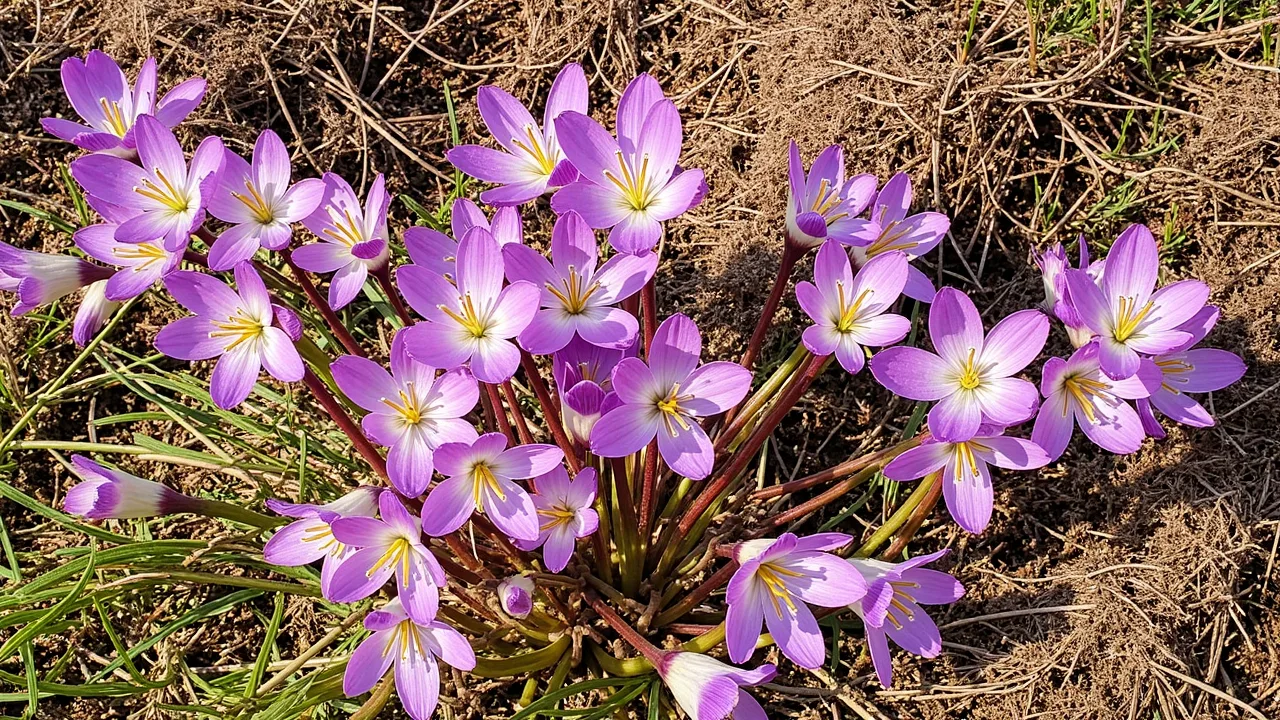
The Gardening Year
Best months in UK gardens · full planting calendar →
🖨 Printable care card (PDF)At a Glance
| Botanical name | Colchicum autumnale |
|---|---|
| Common name(s) | autumn crocus, meadow saffron, naked boys, naked ladies |
| Family | Colchicaceae |
| Plant type | perennial |
| Height × Spread | 25 cm × 10 cm |
| Position | Full sun, Partial shade |
| Soil | Moist but well-drained, deep, humus-rich, fertile soil. Intolerant of waterlogging. |
| Flowering | September–October |
| Toxicity | lethally toxic due to its colchicine content |
| Native range | Great Britain and Ireland, mainland Europe from Portugal to Ukraine, Sweden, European Russia, New Zealand |
Overview
Autumn crocus (Colchicum autumnale) is a hardy, cormous perennial in the family Colchicaceae, native to damp meadows and open woodland across much of central and southern Europe. Despite its common name, it is not a true crocus (genus Crocus, family Iridaceae); the resemblance is superficial and confined to the goblet-shaped flowers that appear on leafless stems in late summer and autumn. The confusion is long-standing in British horticultural writing, and the two should be distinguished by flowering season, number of stamens (six in Crocus, three functional plus three staminodes in Colchicum), and the corm's tunic structure.
In UK gardens, C. autumnale is valued for its reliable late-season display, when most other bulbous plants have finished flowering. It naturalises readily in grass and at the margins of borders, returning year after year from corms that can persist for many decades in undisturbed soil. The plant is, however, treated with caution: all parts contain colchicine and related alkaloids, and it should be handled with gloves and kept away from children and pets. Gardeners familiar with the genus sometimes refer to it as "naked lady" or "meadow saffron" — names that reflect its leafless flowering habit and its historic association with saffron substitutes (true saffron comes from Crocus sativus and the two should never be confused in the kitchen).
Appearance
Colchicum autumnale produces a subterranean corm, typically 5–8 cm across, clothed in a thin brown tunic. From each corm, two to six flowers emerge in succession from late August through October, each borne on a short, pale greenish-white perianth tube that sits largely at or just below ground level. The flowers themselves are 5–8 cm across, with six broadly lance-shaped, pointed tepals in a soft rosy-lilac to pale purple, often with a faint chequered pattern visible on the outside of the bud. The throat is paler, sometimes almost white, and the filaments carry yellow anthers.
Foliage appears in a distinct separate season, from late winter through spring. The leaves are broadly strap-shaped, glossy dark green, semi-erect, and 15–35 cm long, forming a loose rosette that flops untidily as the season progresses. This untidy spring foliage is a familiar feature of established colonies in grass. Seed capsules develop at the base of the foliage in late spring, ripening and splitting to scatter seed close to the parent plant. Mature flowering-size corms reach 6–8 cm in diameter; in good soil, established clumps can spread to 30–40 cm across within a decade.
Growing Conditions
Colchicum autumnale is hardy in most parts of the British Isles. Its hardiness rating is H5, indicating tolerance of winter temperatures between approximately −15 °C and −10 °C. The naturalised populations at various sites in the English Midlands, notably in old meadowland and churchyards, suggest it tolerates a wide range of regional climates when soil drains freely.
The plant prefers a moisture-retentive but well-drained soil that does not dry out completely in summer. It is most often found in loamy or clay-loam soils with a slightly alkaline to neutral pH, although established colonies tolerate mildly acidic conditions provided organic matter is adequate. In light, hungry sands, growth tends to be sparse and flowers smaller. Sunlight requirements are flexible: full sun suits it in the north and west, while light dappled shade from deciduous trees is ideal in the south and east, where the soil can otherwise bake dry in late summer. A position that receives sun in late summer and autumn (when the plant is in active growth and flower) and is shaded in late winter and early spring (when foliage is present) tends to give the best results.
Planting and Care
Corms are bought and planted dry in late summer, usually from July to early September, while they are dormant. Plant them 10–15 cm deep and 15–20 cm apart, with the pointed growing tip uppermost. It is normal for dry corms to flower in the bag or on the potting bench before they reach the soil; this is harmless and they will still establish once planted. Water in after planting if the ground is dry, but in a typical British summer additional watering is rarely needed.
Watering is rarely necessary once the plants are established, except during prolonged summer drought, which can reduce flowering the following autumn. In drier parts of eastern and southern England, a mulch of well-rotted leafmould or garden compost applied in early summer helps conserve soil moisture around the dormant corms. Feeding needs are modest: a single top-dressing of bone meal or a general-purpose organic fertiliser in early spring, as the leaves emerge, is sufficient. Over-feeding produces lush foliage at the expense of flower.
Pruning is minimal. The foliage should be allowed to die down naturally in late spring or early summer; cutting it back early will weaken the corm and reduce flowering the following year. In lawn plantings, the first cut should be delayed until the leaves have yellowed, typically mid- to late June. Propagation is straightforward by division of established clumps every four to six years, lifting and separating the corms in July after the foliage has died back. Seed can be sown fresh in autumn, but seedlings take three to five years to reach flowering size, so division is the usual method for the gardener.
Seasonal care centres on the dual rhythm of the plant. Late summer to mid-autumn is the flowering season, when the show is at its peak. Late winter to late spring is the foliar season, when the corm is building up reserves. A dry, undisturbed summer rest follows, during which the corm should not be waterlogged.
Common Problems
Colchicum autumnale is largely free of serious pests and diseases in UK gardens. Slugs and snails occasionally damage emerging flowers in damp autumns, and the foliage can be marked by rust (Uromyces colchici) in wet springs, though this is rarely severe enough to require treatment. The corms are toxic to most mammals, including deer and rabbits, which generally leave them alone; this is one of the genus's practical advantages in gardens where browsing is a problem.
The most common cause of poor flowering is planting too shallow, planting corms that have been stored too long out of the soil, or cutting back foliage too early. Corms that fail to flower in their first autumn after planting usually settle down in the second year. Botrytis (grey mould) can affect flowers in very wet autumns, but again is rarely a serious problem.
All parts of the plant — corm, leaves, flowers and seed — contain colchicine and related alkaloids, which are highly toxic if ingested. The risk to humans from casual garden contact is very low, but gloves are recommended when handling corms in quantity (for example, when lifting for division), and the plant should be sited away from areas used by toddlers and grazing animals. It should never be confused with true saffron (Crocus sativus); saffron-style culinary use of Colchicum is dangerous and not recommended.
Popular Varieties
Several named forms of C. autumnale and closely related species are widely available from UK bulb suppliers such as RHS partner nurseries, Broadleigh Bulbs, and Peter Nyssen.
- 'Album' — a white-flowered form with pure, untinted tepals and a pale green throat. Slightly later-flowering than the typical species, and often considered the finest white autumn crocus for garden use.
- 'Pleniflorum' (sometimes sold as 'Roseum Plenum') — a fully double, lilac-pink form with many narrow tepals giving a pompon-like flower. Vigorous and long-lived, though the doubled flowers are heavier and may need support after rain.
- 'Major' — a robust, large-flowered selection with deeper pink tepals and bigger corms. Useful for naturalising in grass where impact at a distance matters.
- Colchicum 'Waterlily' — a sterile hybrid (parentage usually given as C. autumnale 'Alboplenum' × C. speciosum 'Album') with large, fully double, lavender-pink flowers resembling a waterlily. Widely sold and one of the most popular autumn crocuses in British gardens.
- Colchicum speciosum 'Album' — although technically a different species, this is often grouped with C. autumnale in catalogues. A large white-flowered form, later-flowering and particularly robust in heavy soils.
The double-flowered forms in particular have a reputation for being slower to establish than the single species, and benefit from being left undisturbed for several years after planting.
Cultivars and Varieties
| Cultivar | Height | Flower | Notes | AGM |
|---|---|---|---|---|
| 'Album' | — | — | RHS AGM (H5) | ✓ |
| 'Nancy Lindsay' | — | — | has gained the Royal Horticultural Society's Award of Garden Merit | ✓ |
Pests and Diseases
| Problem | Symptoms | Management |
|---|---|---|
| toxicity | lethal to felines | — |
Or browse the full plant problem solver to diagnose an issue by symptom.
Autumn Crocus in our guides
Recommended Products
GardenWizz earns a commission from qualifying purchases made through affiliate links on this page (including links within the article) — as an Amazon Associate, and from Thompson & Morgan via the Awin network. This does not affect the price you pay. See our disclaimer for details.