Kotschy's Crocus
Crocus kotschyanus
The Gardening Year
Best months in UK gardens · full planting calendar →
🖨 Printable care card (PDF)At a Glance
| Botanical name | Crocus kotschyanus |
|---|---|
| Common name(s) | Kotschy's Crocus |
| Family | Iridaceae |
| Plant type | bulb |
| Height × Spread | 10–15 cm × 5–8 cm |
| Position | Full sun, Partial shade |
| Soil | moderately fertile, well drained |
| Flowering | September–October |
| Toxicity | — |
| Native range | Turkey to Caucasus and Lebanon |
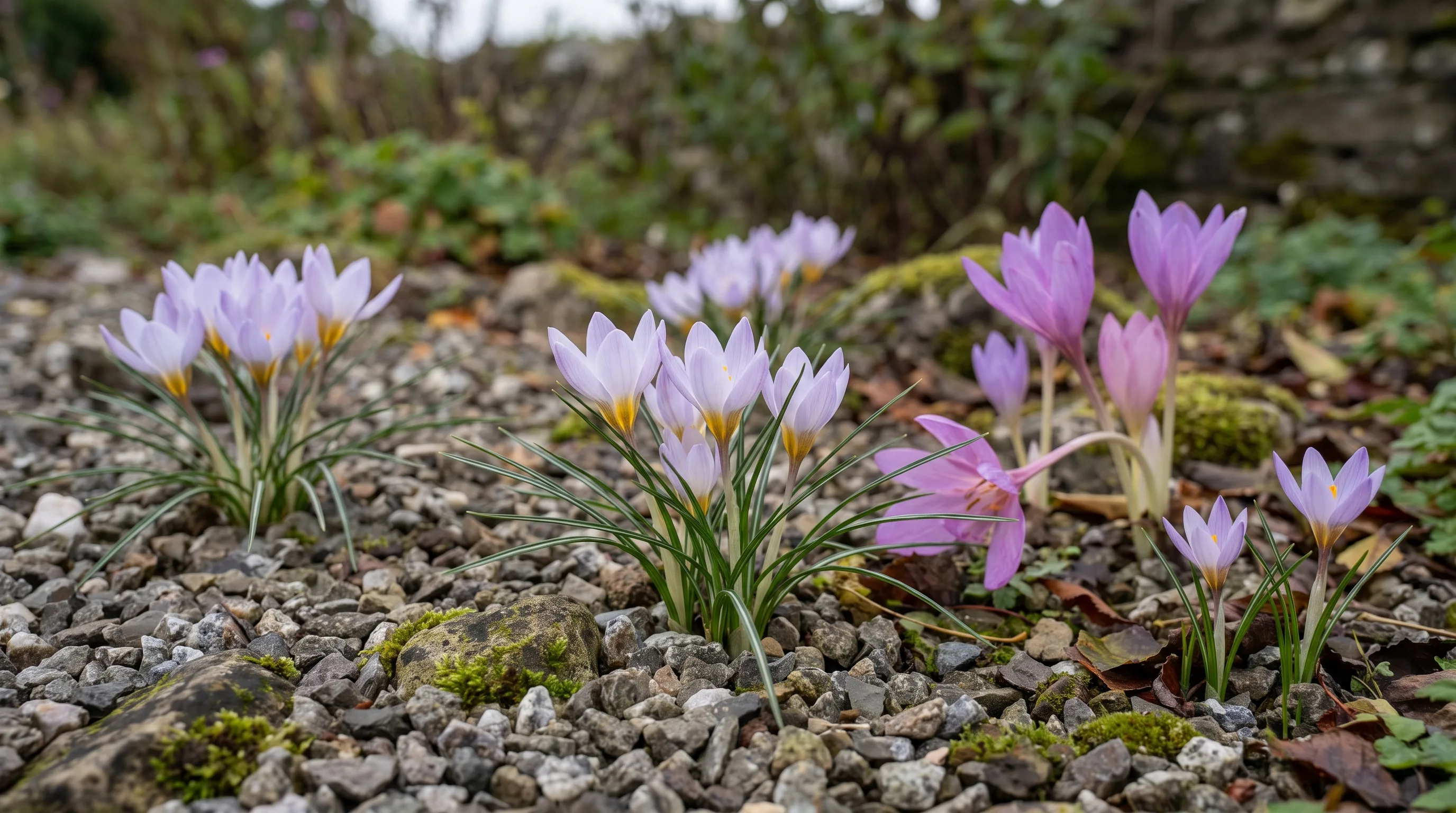
Crocus kotschyanus is a small autumn-flowering crocus valued for its pale lilac flowers and conspicuous orange, finely divided style. Native to mountain country in western Asia, it suits sunny UK rock gardens, gravel gardens, raised beds and containers where the soil remains sharply drained.
Overview
Kotschyanus is a true crocus in the iris family, Iridaceae, rather than a colchicum. It grows from a small tunicate corm and flowers in autumn, usually during September and October in the UK. Its natural distribution includes mountainous parts of southern Turkey, northern Syria and Lebanon, with records extending into the Caucasus region. Rocky slopes and alpine turf in its native range explain its preference for open sun and fast-draining ground.
The accepted botanical name is Crocus kotschyanus. The synonym Crocus zonatus occurs in older books and catalogues and may still appear in bulb lists, but gardeners should use the accepted name when checking current records or buying stock. The specific epithet commemorates the nineteenth-century Austrian botanist Theodor Kotschy, who collected extensively in the Near East.
This is an effective plant for extending a bulb display beyond spring. Its flowers emerge when many herbaceous border plants are declining, bringing a fresh wash of lilac close to ground level. A single corm makes a modest display, so groups are generally more satisfying. Established colonies can spread gradually by offsets and, where conditions allow, by seed.
Suitable positions include rock gardens, alpine beds, gravel gardens, raised borders, troughs and deep pots. It may also be naturalised through short turf, provided the site is sunny and the grass is not cut while crocus leaves are still green. The plant is not saffron crocus, Crocus sativus, and should not be treated as a culinary crop. It is also distinct from Colchicum autumnale, which is frequently called autumn crocus despite belonging to another family.
Appearance
The flowers are goblet-shaped when they first open and broaden into shallow cups in good light. Individual blooms are generally 4–6 cm across, carried on slender tubes so that a flowering plant reaches roughly 8–12 cm in height. Their colour ranges from pale lilac to soft violet-blue. Subtle darker veins may mark the outer segments, while the throat is often noticeably paler.
The centre provides the most useful identification feature. Deep orange style branches divide repeatedly into numerous fine segments, producing a feathery or tufted appearance among the anthers. This intricate style separates the plant from superficially similar colchicums and adds strong colour contrast to the cool-toned petals. Each mature corm can produce one or several flowers, although flowering strength depends upon corm size and growing conditions.
Narrow, grass-like leaves emerge with the flowers or shortly afterwards. They are dark green with the pale central stripe characteristic of many crocuses. The foliage extends through winter and spring, gathering energy that is stored in the replacement corm. It then yellows and disappears in late spring or early summer as the plant enters dormancy.
Below ground, the corm is enclosed by a fibrous, netted tunic. It is renewed through the growing cycle and may form small offsets around its base. Although each plant occupies little space, mature groups become denser over time. Their low stature makes them easiest to appreciate at the front of a bed, beside a path, in a raised alpine feature or in a container positioned near eye level.
Growing Conditions
Full sun is important for compact growth and flowers that open well. Choose a position without shade from evergreen shrubs, walls or dense autumn foliage. A south- or west-facing rock garden is often suitable, but exposure alone is not enough: drainage must remain excellent through wet UK winters and during the corm's summer dormancy.
A gritty sandy loam is ideal. On heavier soil, create a raised planting area and incorporate generous quantities of horticultural grit through the full rooting depth rather than placing a token layer beneath each corm. A grit-only planting pocket surrounded by clay can hold water like a sump, so broad improvement of the bed is safer. Neutral to slightly alkaline conditions reflect the plant's association with limestone and stony mountain habitats, although drainage matters more than a precise pH reading.
Avoid persistently wet clay, compacted hollows and beds reached by roof runoff. Corm rot is most likely where water remains around dormant or newly rooting corms. Very dry, shallow soil can also be unsuitable if autumn rain cannot reach the roots. The aim is moisture while plants are actively rooting and leafing, followed by comparatively dry conditions once foliage has died back.
In short turf, select thin, unimproved grass rather than lush lawn. The leaves must remain untouched until they yellow naturally, which may not suit regularly mown areas. Gravel gardens and the open edges of herbaceous borders can work well where neighbouring plants do not cast heavy shade. Partners such as hardy cyclamen can provide complementary autumn flowers, but vigorous ground cover should be avoided.
Containers offer control where garden soil is heavy. Use a deep pot with unobstructed drainage holes and a free-draining, loam-based compost amended with grit. Stand the container in full sun and raise it on feet if winter water tends to collect beneath it. Pots should not be allowed to become completely desiccated during autumn rooting, yet they should never remain saturated.
Planting and Care
Plant dormant corms in August or early September, before the main flowering period. Set them approximately 8–10 cm deep, measured from soil level to the base, and 5–8 cm apart. Groups of 10–25 create a natural-looking drift, with irregular spacing generally more attractive than rigid rows. Handle sprouting corms carefully because the emerging shoots are easily damaged.
Water after planting if the soil is dry, then allow seasonal rain to maintain moisture. Established plants in open ground rarely need routine watering during winter, but newly planted corms may need water during a prolonged dry autumn. Container plants require closer attention because compost dries quickly; water when the upper layer begins to dry and let surplus moisture drain freely. Reduce watering as the leaves yellow, keeping dormant corms comparatively dry in summer.
Feeding should be restrained. In reasonably fertile soil, an annual feed may be unnecessary. Where flowering declines, apply a low-nitrogen bulb fertiliser as growth starts in early autumn, following the product rate. A dilute potash-rich liquid feed can support container-grown plants while leaves remain green. Avoid high-nitrogen feeds, which encourage soft foliage without necessarily improving flowers.
Crocuses are not pruned. Remove collapsed flowers if tidiness is important, but retain every green leaf until it has yellowed and detached readily in late spring. Cutting or tying foliage prematurely reduces the leaf area available to replenish the corm and may weaken the next display. Keep the planting free of dense weeds while foliage is present, working carefully to avoid shallow offsets.
Propagate established groups by division during dormancy, usually in July or August. Lift the clump gently, separate sound offsets and replant them promptly at the original depth. Small offsets may take more than one growing cycle to flower. Seed propagation is possible: sow ripe seed in a pot of gritty compost and expose it to normal seasonal temperature changes. Germination and development are slow, and seedlings commonly require several years before flowering, but seed is useful for maintaining species diversity.
Seasonal care is simple. Check drainage before autumn growth begins, water only when conditions require it, leave winter foliage undisturbed and allow natural spring dieback. During summer dormancy, avoid frequent irrigation from neighbouring thirsty plants. Corms normally remain in the ground all year; routine lifting and storage are unnecessary where drainage is sound. Divide congested colonies if flowers become fewer or markedly smaller.
Common Problems
Corm rot is the principal cultivation problem. Affected corms become soft or discoloured, and shoots fail to emerge or collapse. Prevention is more reliable than treatment: discard damaged stock, plant in broadly improved, free-draining ground and avoid excessive summer irrigation. If a site remains wet despite improvement, move healthy corms to a raised bed or container rather than repeatedly replacing losses.
Grey mould can affect petals during prolonged cool, damp autumn weather. Brown spotting and fuzzy grey growth develop most readily where flowers remain crowded and wet. Remove decaying material, maintain air movement and avoid splashing flowers when watering pots. Short-lived weather damage is often cosmetic and does not indicate that the corm itself is failing.
Mice, voles and squirrels may dig up newly planted corms. Firming the soil and disguising disturbed ground can reduce attention. In gardens with persistent losses, place a securely fixed wire mesh over or around the planting while ensuring shoots can pass through. Check containers for large drainage openings through which rodents might gain access.
Slugs and snails occasionally damage emerging flowers and leaves, especially in damp, sheltered positions. Clear nearby hiding places and inspect plants during mild evenings. Grazing may spoil individual blooms but usually does not destroy an established colony.
Poor flowering often results from shade, immature offsets, overcrowding, premature foliage removal or soil that stays too wet in dormancy. Review these conditions before adding fertiliser. Leaves showing persistent irregular mottling or distortion may indicate virus infection rather than the normal straight central stripe. Remove suspect plants and do not propagate from them; reliable diagnosis from foliage alone can be difficult, so uncertainty should be acknowledged.
Popular Varieties
This plant is primarily cultivated as a botanical species, and dependable named cultivars are not widely established in UK horticulture. Nursery listings may use the synonym Crocus zonatus, but that is an older botanical name, not a cultivar. Plants sold simply as Crocus kotschyanus can show natural variation in lilac tone, veining and flower size, particularly when raised from seed.
Several infraspecific names have appeared in botanical literature, but their current taxonomic treatment and availability vary. They should not be presented as garden cultivars without a verified nursery identity. For a true-to-name collection, buy flowering-size corms from a specialist bulb or alpine nursery and retain the supplier's label and provenance. Seed-grown plants are best labelled at species level unless their identity has been confirmed.
Gardeners seeking a varied autumn-crocus display can combine the species with separately labelled autumn-flowering crocuses rather than relying on unverified forms. Crocus speciosus offers larger violet-blue flowers, Crocus pulchellus provides delicately veined blooms, and Crocus sativus has its own distinctive purple flowers and red stigmas. These are related species, not varieties of C. kotschyanus, and keeping the names separate preserves horticultural accuracy.
Pests and Diseases
| Problem | Symptoms | Management |
|---|---|---|
| Corm rot | Corms become soft, mushy and discoloured, often failing to produce growth. | Ensure gritty, well-drained soil and keep dry during the summer dormancy period. |
| Rodents and birds | Corms are dug up and eaten from the ground or container. | Plant corms deeply in wire mesh baskets to deter digging animals. |
| Slugs and snails | Irregular holes chewed into emerging leaves and flower buds. | Use slug pellets, beer traps, or hand-pick at night during damp weather. |
| Vine weevil | Notched edges on leaves above ground and root/corm damage below. | Apply biological nematodes to the soil in autumn and spring. |
For step-by-step help, read Dealing with Slugs and Snails. Or browse the full plant problem solver to diagnose an issue by symptom.
Recommended Products
GardenWizz earns a commission from qualifying purchases made through affiliate links on this page (including links within the article) — as an Amazon Associate, and from Thompson & Morgan via the Awin network. This does not affect the price you pay. See our disclaimer for details.