Ashy Crane's-Bill
Geranium cinereum
The Gardening Year
Best months in UK gardens · full planting calendar →
🖨 Printable care card (PDF)At a Glance
| Botanical name | Geranium cinereum |
|---|---|
| Common name(s) | Ashy Crane's-bill |
| Family | Geraniaceae |
| Plant type | perennial (deciduous or semi-evergreen) |
| Height × Spread | 50 cm × 50 cm |
| Position | Full sun |
| Soil | Moist but well–drained or Well–drained |
| Flowering | June–August |
| Toxicity | — |
| Native range | Pyrenees |
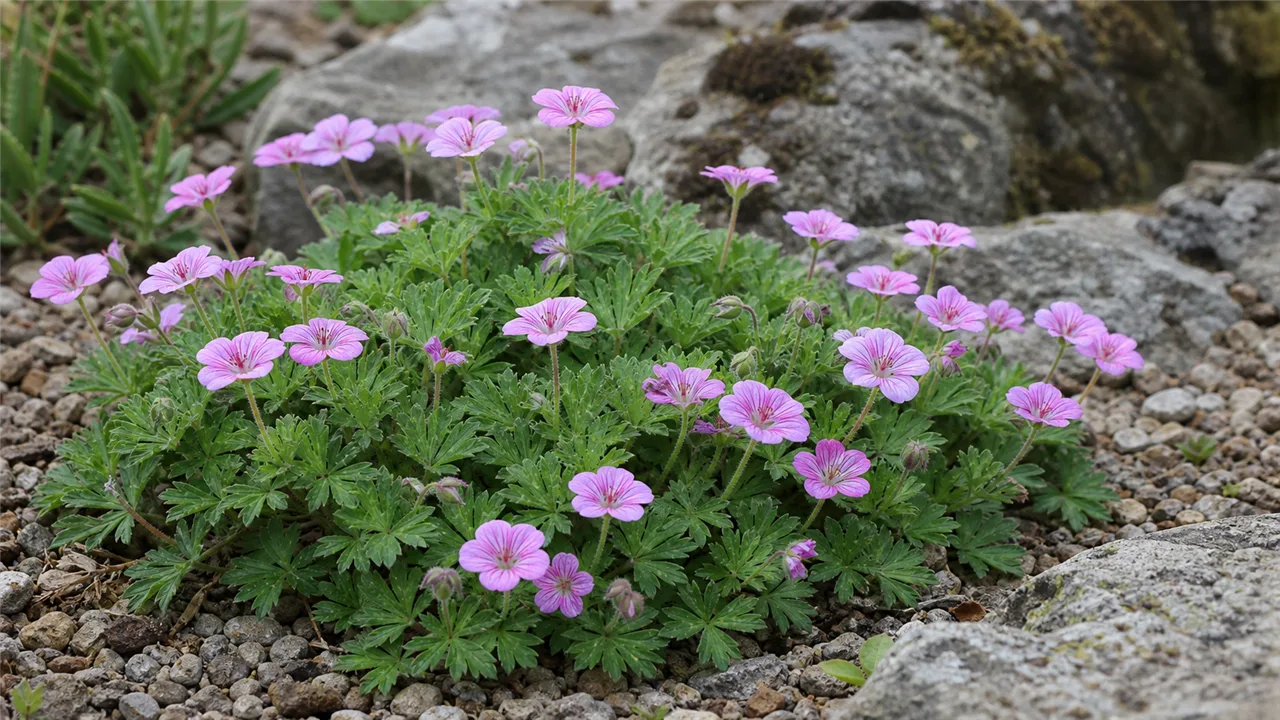
Geranium cinereum, commonly known as dusky cranesbill or grey cranesbill, is a diminutive hardy geranium valued for its disproportionately large flowers, finely cut foliage and restrained, mat-forming habit. Native to European mountain habitats, it is particularly well suited to UK rock gardens, alpine troughs, gravel gardens and sunny border edges where drainage is sharp.
Overview
Geranium cinereum is a compact member of the cranesbill family, Geraniaceae. Its natural range lies in alpine and subalpine parts of central and southern Europe, including the Pyrenees, Apennines and Balkans, where it inhabits mountain meadows, rocky limestone grassland and stony slopes. Those origins explain both its ability to withstand cold and its strong preference for free-draining ground.
Unlike taller border geraniums, dusky cranesbill forms a neat, low mound or spreading mat. It generally reaches only 10–20 cm in height, but may broaden to 30–40 cm with time. This scale makes it useful where a larger hardy geranium would overwhelm neighbouring alpines. It can soften the edge of a path, occupy a crevice between rocks or cover a small patch of bare soil without becoming coarse or excessively vigorous.
In most UK regions the species grows reliably outdoors all year. Winter wet is a greater threat than winter cold: water trapped around the crown can lead to decay, especially in heavy clay or an inadequately drained container. Its restrained dimensions also make it suitable for gardens where space is limited, provided it receives enough light and is not shaded by taller plants.
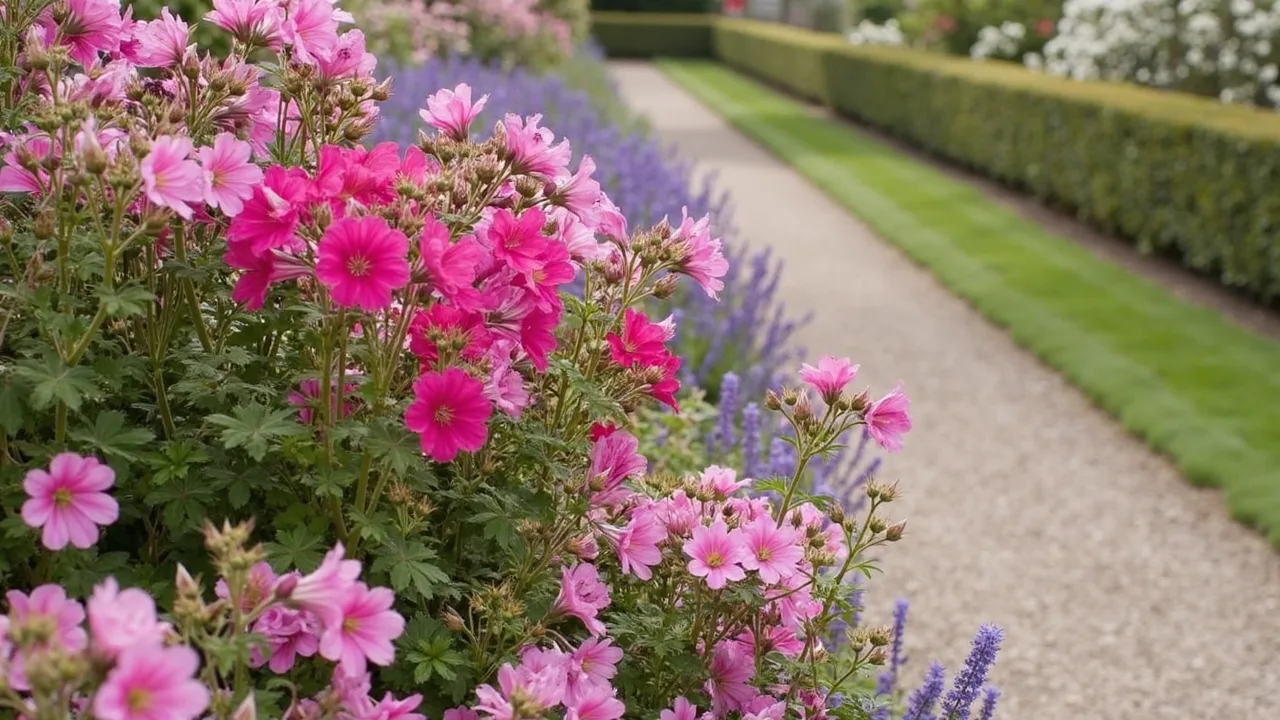
The flowers attract visiting insects, while the foliage supplies a long season of texture. Plants usually perform best as small specimens or in informal groups at the front of a planting scheme. Suitable companions include compact campanulas, dianthus, small sedums and other alpines that share its preference for bright conditions and lean, well-drained soil.
Appearance
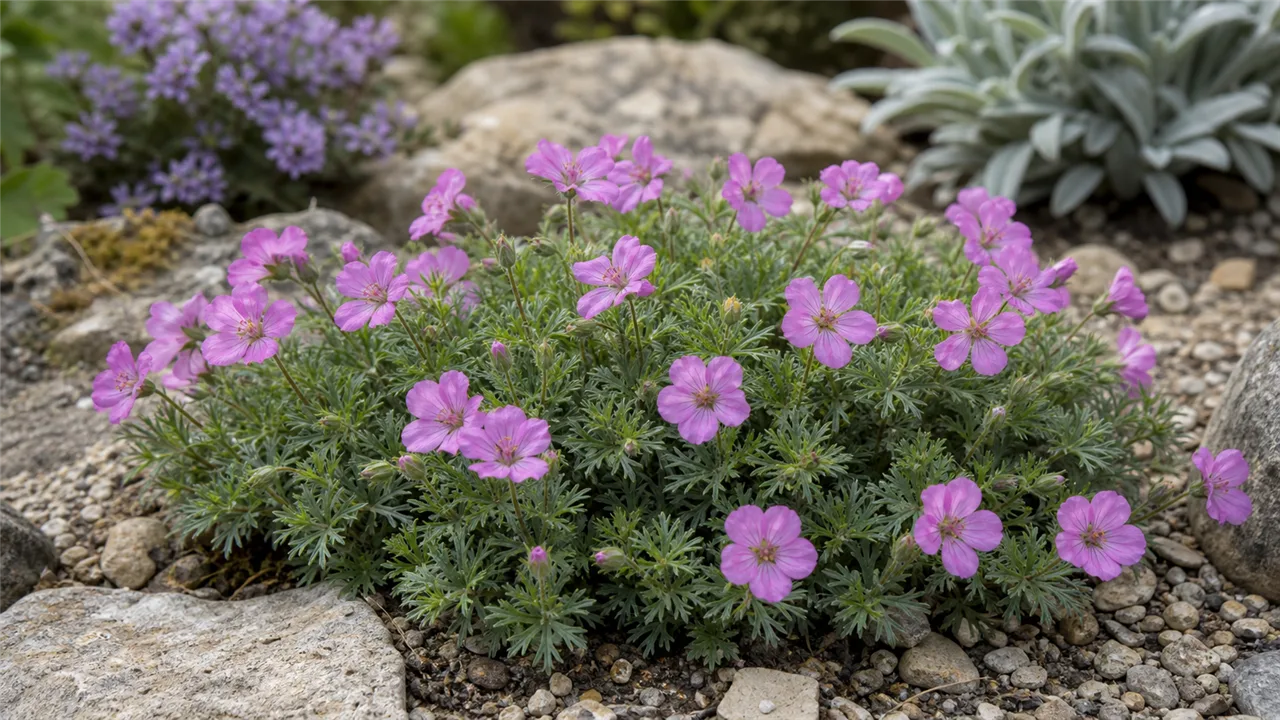
The foliage forms a close cushion at ground level. Each small leaf is deeply divided into narrow lobes, giving the plant a delicate, finely textured appearance. The leaves are usually greyish-green to dark green and may show a subtle metallic cast. This muted colouring is reflected in the specific name cinereum, which refers to an ashen or grey quality. In autumn, some leaves can develop bronze tones.
The plant is evergreen to semi-evergreen rather than uniformly evergreen in every setting. In a mild, sheltered UK garden much of the foliage may remain through winter; in colder, exposed or very wet conditions it can become sparse or untidy before fresh growth appears in spring. The low crown and short stems maintain a compact outline even when the plant is out of flower.
From late May, slender, wiry stems carry open, saucer-shaped flowers above the leaves. Each bloom is about 3–4 cm across, conspicuous in relation to the small plant beneath it. Five rounded petals, often lightly notched at their tips, surround the central stamens. Flower colour within the species and its selected forms ranges from white and pale pink to stronger magenta-pink, commonly marked by darker veins that guide the eye towards the centre.
Flowering normally continues into August, although weather, moisture and deadheading affect its duration. Removing faded blooms and trimming after the principal flush may encourage fresh leaves and occasional later flowers. The resulting display is graceful rather than dense: individual blooms seem to hover above the foliage, preserving the open character valued in alpine plantings.
Growing Conditions
Choose an open site in full sun for the most abundant flowering. Partial shade is acceptable, particularly where plants receive morning sun and light afternoon shade during a hot, dry spell. Deep shade encourages weaker growth, fewer flowers and persistently damp conditions around the crown. Good air movement is beneficial, but an exposed position should not allow the small plant to be buried beneath wind-blown leaves or smothered by vigorous neighbours.
Drainage is the central requirement. A moderately fertile loam improved with grit is suitable, as is the mineral soil found in a rock garden, scree bed or raised alpine trough. The species tolerates alkaline and limestone-derived soils, reflecting habitats within its natural range. Neutral soils are also satisfactory. Very rich ground can produce soft foliage at the expense of flowers, while dense clay that remains saturated is unsuitable unless the planting area is substantially raised and amended.
For heavy soil, create a broad raised pocket rather than placing a little grit in the bottom of a planting hole, which can leave the roots sitting in a sump. Blend coarse horticultural grit with the surrounding soil and set the crown at soil level. A surface mulch of gravel helps keep foliage away from wet earth, reduces splashing and complements the plant's alpine character. Avoid moisture-retentive organic mulch immediately against the crown.
Established plants have moderate drought tolerance, but this should not be confused with a preference for severe dryness. Even moisture during active spring growth and flowering supports a longer display. Water during prolonged dry summer weather, then allow excess water to drain freely. In containers, use a free-draining compost with added grit and ensure drainage holes remain clear. Pots are more vulnerable to alternating saturation and drought than plants rooted in open ground.
Planting and Care
Plant in spring, once the soil is workable, or in early autumn while there is enough warmth for roots to establish. Space plants about 30 cm apart. Dig a hole no deeper than the root ball, position the crown level with the finished surface and firm gently. Water thoroughly after planting, then monitor moisture through the first growing season. Autumn-planted specimens should not be allowed to stand wet over winter.
Water young plants whenever the upper soil begins to dry. Once established, irrigate only during extended dry periods, aiming water at the soil rather than repeatedly wetting the foliage. Container-grown plants require more frequent checks, especially during sunny weather, but saucers should not remain full of water. During winter, shelter pots from excessive rain or raise them on feet so that water escapes readily.
Feed sparingly. A light application of balanced general fertiliser in spring, or a thin top-dressing of mature compost kept clear of the crown, is usually sufficient. Plants in fertile ground may need no annual feeding. Excess nitrogen encourages lush, lax growth and can reduce flowering, undermining the compact habit that makes the species valuable.
Deadhead individual spent flowers where practical to prevent the plant expending energy on seed and to prolong its neat display. This is routine grooming, not woody pruning. After the main flowering flush, usually in August or September, cut back tired flowering stems and worn foliage. Avoid cutting into the crown. Water if conditions are dry; fresh leaves may then develop and a modest second flush can follow. In March, remove only foliage damaged over winter as new growth becomes visible.
Propagation is possible by division in March or April, or in September or October. Lift a mature clump carefully, tease or cut it into sections carrying healthy roots and shoots, and replant immediately at the original depth. Division also rejuvenates a congested plant. Basal cuttings can be taken in spring from young shoots with a small piece of basal tissue and rooted in a gritty medium. Seed may be sown in autumn or spring, although seedlings can vary and will not reliably reproduce a named cultivar.
Seasonal care is straightforward. Check drainage and clear smothering debris in winter; tidy damaged leaves and feed lightly in spring; water and deadhead during summer; then cut back worn growth or divide established clumps in early autumn. No lifting or winter storage is required. In a trough or pot, the chief winter precaution is protection from prolonged saturation rather than bringing the plant into warmth.
Common Problems
Root and crown rots are the most serious problems. Plants that collapse, yellow rapidly or develop soft, dark tissue may have suffered damage from waterlogged soil, sometimes involving organisms such as Phytophthora or Pythium. Remove badly affected plants and contaminated material, improve drainage and avoid immediately replanting into the same wet pocket. Prevention through correct siting is more dependable than attempted treatment.
Powdery mildew may appear as a pale, dusty coating during warm, dry weather, particularly where roots are dry but air circulation around foliage is poor. Water the soil during prolonged drought, thin encroaching plants and remove badly affected leaves. Leaf spots caused by several fungi can produce brown or black marks in prolonged damp conditions. Clear infected debris, avoid overhead watering and preserve spacing so leaves dry promptly.
Aphids occasionally gather on soft shoots or flower buds. Small colonies can be rubbed off or dislodged with water; natural predators often limit them without further action. Slugs and snails may damage tender spring growth, especially where damp hiding places surround a rock garden or trough. Inspect after dark, remove sheltering debris and use wildlife-conscious controls where damage is persistent.
Nearby seedlings of larger, freely self-seeding geraniums can be mistaken for dusky cranesbill before they mature. Species such as meadow cranesbill or hedgerow cranesbill may eventually crowd the smaller plant. Remove coarse, unfamiliar seedlings early. Weed carefully by hand because vigorous roots and dense weeds can disturb the shallow, compact crown when pulled late.
Poor flowering is usually cultural rather than a disease. Common causes include excessive shade, overfeeding, soil that stays wet or competition from taller neighbours. Moving the plant in spring or early autumn to a brighter, sharply drained position often restores its natural compactness and flowering performance.
Popular Varieties
Named selections of Geranium cinereum and closely associated forms offer differences in flower colour and markings while retaining the species' compact alpine habit. Availability varies among UK nurseries, and labels should be checked carefully because some plants sold within the cinereum group involve related taxa or hybrid parentage.
- ‘Ballerina’ bears pale pink to lilac-pink flowers with conspicuous dark purple veining and a darker central eye. It is one of the best-known compact selections for troughs and rock gardens.
- ‘Giuseppii’ produces rich magenta-purple flowers with darker veins. Its stronger colouring stands out clearly above the grey-green, finely divided foliage.
- ‘Purple Pillow’ is valued for deep purplish-magenta flowers and a low, cushion-forming habit suited to sunny edging and alpine containers.
The unselected species remains worthwhile, particularly in naturalistic scree or limestone planting where its variable pink flowers look at home. When buying, choose a plant with a firm crown, healthy compact growth and roots that are neither waterlogged nor tightly congested. Give each selection the same sharply drained conditions as the species, and propagate a named plant vegetatively by division or basal cuttings if preserving its characteristics is important.
Pests and Diseases
| Problem | Symptoms | Management |
|---|---|---|
| Vine weevil | Notches on leaf margins and root damage causing wilting or collapse. | Apply a systemic insecticide drench in autumn to control larvae in the soil. |
| Powdery mildew | White, dusty fungal growth on leaves and stems, often in humid conditions. | Improve air circulation and spray with a fungicide if infection is severe. |
| Downy mildew | Yellowing leaves with fuzzy grey-purple growth underneath during wet weather. | Remove affected foliage and avoid overhead watering to reduce humidity. |
| Capsid bug | Small, distorted new growth and silvered or spotted leaves from sap feeding. | Use insecticidal soap or horticultural oil during the growing season. |
| Geranium sawfly | Skeletalised leaves with large holes chewed by green, slug-like larvae. | Hand-pick larvae or apply a biological control like nematodes. |
For step-by-step help, read Dealing with Slugs and Snails and Treating Powdery Mildew. Or browse the full plant problem solver to diagnose an issue by symptom.
Recommended Products
GardenWizz earns a commission from qualifying purchases made through affiliate links on this page (including links within the article) — as an Amazon Associate, and from Thompson & Morgan via the Awin network. This does not affect the price you pay. See our disclaimer for details.