Speedwells
Veronica
The Gardening Year
Best months in UK gardens · full planting calendar →
🖨 Printable care card (PDF)At a Glance
| Botanical name | Veronica |
|---|---|
| Common name(s) | speedwells |
| Family | Plantaginaceae |
| Plant type | perennial (Genus Veronica can be annuals, perennials or sub-shrubs with paired leaves and small flowers usually in terminal or axillary racemes or spikes. Herbaceous perennial types die back to the ground in autumn and then reappear in spring.) |
| Height × Spread | 10–100 cm × 10–100 cm |
| Position | Full sun |
| Soil | Moist but well–drained or Well–drained; Chalk, Clay, Loam, Sand; Acid or Alkaline or Neutral |
| Flowering | May–August |
| Toxicity | — |
| Native range | Europe, Asia |
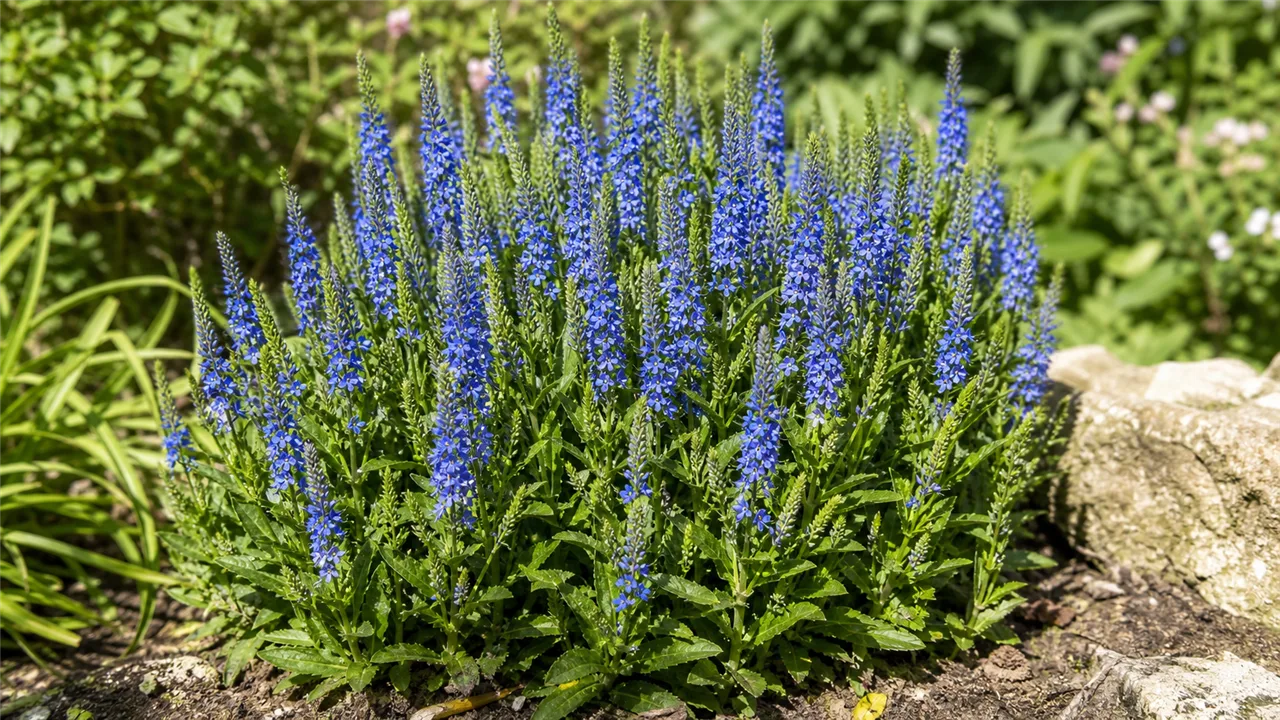
Veronica, commonly known as speedwell, is a varied genus of annuals and perennials valued for blue, violet, pink or white flowers. Its garden plants range from tiny spreading alpines to upright border clumps, so matching the species or cultivar to the site is central to successful growth in the UK.
Overview
Veronica belongs to the plantain family, Plantaginaceae, and comprises a large group commonly called speedwells. The genus includes British native and naturalised wildflowers as well as garden selections bred for stronger colour, a compact habit or long flower spikes. Annual species are often plants of grassland or disturbed ground, while the ornamental perennial forms are more familiar in borders, gravel gardens and rock gardens.
Low, creeping veronicas form mats or cushions for alpine beds, troughs and border edges. Taller herbaceous species make leafy clumps topped by vertical racemes. These groups are not interchangeable: a moisture-retentive border that suits a tall speedwell may be too wet in winter for an alpine species.
Most ornamental veronicas grow well across the UK when given suitable drainage. Their flowers are useful to bees and other pollinating insects, and their vertical or spreading outlines contrast with rounded foliage and daisy-shaped blooms.
Appearance
The leaves are simple and are usually arranged in opposite pairs, although the arrangement varies within this diverse genus. Foliage may be narrow and lance-shaped, oval, toothed or softly hairy. Low species carry small leaves close to trailing stems, creating a green carpet only a few centimetres high. Border perennials commonly form upright, leafy stems rising from a clump at ground level.
Each individual flower is small and typically has four lobes, with the upper lobe broader than the others and two conspicuous stamens. Blue is strongly associated with speedwell, but garden forms also occur in violet, purple, lilac, pink and white. Flowers may be solitary in the leaf axils or assembled into racemes. In cultivated border forms these racemes often appear as narrow, tapering spikes above the foliage.
Flowering generally begins in late spring or early summer and may continue through summer. Removing faded spikes may prompt a smaller second flush. Mature height varies enormously: a prostrate plant may remain below 10 cm, whereas a vigorous border selection can approach 1 m.
Growing Conditions
Full sun normally produces the strongest, most compact growth and the greatest number of flowers. Light shade is tolerated by some species, especially where it protects plants from intense afternoon sun, but deep shade encourages lax stems and reduced flowering. Tall cultivars are best placed where they receive good light without being battered by strong winds; an exposed clump may need discreet support before the spikes lengthen.
Soil requirements depend on growth habit. Taller border veronicas prefer fertile, well-drained ground that retains useful moisture through summer. A loam improved with garden compost is suitable, provided excess winter water can escape. They can also grow on clay if its structure and drainage are improved, or on lighter soil if organic matter is added to slow drying. Most tolerate a range of soil reactions.
Compact alpine and mat-forming species require leaner, sharply drained conditions. Use gritty soil in a raised bed, rock garden or trough, and keep the crown clear of wet debris. Avoid hollows where water stands after heavy rain. Provide air movement without exposing plants to strong wind.
Border veronicas combine well with achilleas, salvias, hardy geraniums and ornamental grasses. Prostrate forms suit other small alpines in gritty ground. Allow enough space for the expected spread; crowding weakens flowering and encourages leaf disease.
Planting and Care
Plant container-grown veronicas in spring, once the soil is workable, or in early autumn while warmth remains for root growth. Spring is preferable on cold, heavy or persistently wet ground. Dig a hole as deep as the root ball and somewhat wider, loosen circling roots gently and set the crown at the same depth as in its pot. Firm without compacting the soil, then water thoroughly. Do not bury the crown beneath mulch.
Water regularly through the first growing season. Once established, border kinds usually need additional water only during prolonged dry periods. Direct water onto the soil rather than foliage. Alpine species need less water and must never sit in saturated compost; troughs require free drainage holes.
Apply a modest mulch of well-rotted compost around border plants in March or April, leaving a clear ring around the crown. On reasonably fertile soil this is often sufficient feeding. Excess nitrogen produces soft, floppy growth at the expense of flowers. Plants in containers can receive a balanced liquid feed at a restrained rate during active growth, but feeding should stop by late summer.
Deadhead by cutting spent racemes back to a healthy pair of leaves. This keeps the clump presentable and can encourage more flowers. Taller stems may be supported with twiggy sticks or a ring support placed early, before growth collapses. After herbaceous foliage dies back in late autumn, cut the stems down to just above ground level; alternatively, leave sound stems briefly for winter structure and remove them before new spring shoots expand. No formal pruning is needed.
Divide congested perennial clumps in March or April, or in early autumn where soil is warm and well drained. Lift the plant, split it into vigorous outer sections with roots and shoots, discard any exhausted centre and replant promptly. Division preserves named cultivars. Softwood cuttings from healthy, non-flowering shoots in late spring or early summer are another true-to-type method, especially for compact forms. Species may be grown from seed, but seedlings from cultivars may not resemble the parent.
In autumn, clear diseased foliage and wet debris from alpine crowns. In spring, renew supports, divide weak clumps and protect emerging shoots from molluscs. During summer, water at soil level and deadhead regularly.
Common Problems
Crown and root rots are the most serious avoidable problems. Affected plants may yellow, wilt despite damp soil or collapse at the base. Improve drainage, remove dead material and avoid replanting a susceptible alpine in the same waterlogged pocket. A gritty raised position is safer than attempting to compensate for poor drainage with reduced watering alone.
Powdery mildew appears as a pale, floury coating, commonly when roots are dry but the air around crowded foliage is humid. Downy mildew and leaf spots may cause discoloured patches and premature leaf loss. Space plants well, water the roots during drought and remove badly affected leaves. Clear infected debris rather than placing it in a home compost heap if disease is severe. Avoid forcing soft growth with high-nitrogen fertiliser.
Aphids can cluster on young shoots and flower stems, distorting growth or leaving sticky honeydew. Small colonies can be rubbed off or washed away while supporting the stem. Slugs and snails chew tender spring shoots and can severely weaken newly divided plants. Remove hiding places, inspect after damp evenings and use barriers or controls appropriate to the garden. Healthy, established plants generally tolerate limited pest damage.
Tall stems may lean because of shade, rich feeding, wind or lack of timely support. Move persistently floppy plants to better light, reduce feeding and install supports in spring. Sparse centres and declining flower production usually indicate an ageing, congested clump; division and replanting of vigorous sections is the practical remedy.
Popular Varieties
- Veronica spicata 'Icicle' bears upright white flower spikes and provides a pale accent in a sunny border.
- Veronica spicata 'Rotfuchs' is a compact border cultivar with deep pink to reddish-pink spikes.
- Veronica gentianoides 'Tissington White' has pale, blue-veined flowers above glossy foliage and suits the front or middle of a well-drained border.
- Veronica prostrata 'Nestor' is a low, spreading selection with blue flowers for rock gardens, gravel and edging.
- Veronica umbrosa 'Georgia Blue' forms a spreading mat with vivid blue spring flowers and is useful at a sunny border edge or on a bank.
- Veronica × media 'First Love' produces bright pink flower spikes on a compact herbaceous plant.
Cultivar names distinguish important differences in height, habit and colour. Check the label for final dimensions and drainage needs, particularly when choosing between ground-cover plants and taller border selections.
Cultivars and Varieties
| Cultivar | Height | Flower | Notes | AGM |
|---|---|---|---|---|
| 'Mint Chocolate' | — | — | RHS AGM (H4) | ✓ |
| 'Mrs Winder' | — | — | RHS AGM (H4) | ✓ |
| 'Pewter Dome' | — | — | RHS AGM (H5) | ✓ |
| 'Red Edge' | — | — | RHS AGM (H4) | ✓ |
| 'Shirley Blue' | — | — | RHS AGM (H6) | ✓ |
| 'Silver Queen' | — | — | RHS AGM (H3) | ✓ |
| 'Wiri Charm' | — | — | RHS AGM (H4) | ✓ |
| 'Wiri Cloud' | — | — | RHS AGM (H4) | ✓ |
| 'Wiri Mist' | — | — | RHS AGM (H4) | ✓ |
Pests and Diseases
| Problem | Symptoms | Management |
|---|---|---|
| Downy mildew | Purple-red blotches on upper leaf surfaces with white spore growth underneath. | Improve air circulation, water at the base in the morning, and remove infected debris. |
| Leaf spot fungi (Stemphylium/Septoria) | Distinct spots on leaves leading to yellowing and premature leaf drop. | Remove fallen leaves promptly and ensure good airflow to keep foliage dry. |
| Powdery mildew | White powdery fungal growth on leaves, stems, or flowers. | Avoid drought stress and maintain good air circulation to reduce humidity around the plant. |
| Grey mould (Botrytis) | Soft, grey-brown rot affecting foliage, particularly in damp conditions. | Remove affected shoots immediately and avoid overhead watering to prevent leaf wetness. |
| Slugs and snails | Irregular holes chewed in leaves and silvery slime trails on foliage or soil. | Use physical barriers like copper tape or apply iron phosphate pellets around the base. |
For step-by-step help, read Dealing with Slugs and Snails and Treating Powdery Mildew. Or browse the full plant problem solver to diagnose an issue by symptom.
Speedwells in our guides
Recommended Products
GardenWizz earns a commission from qualifying purchases made through affiliate links on this page (including links within the article) — as an Amazon Associate, and from Thompson & Morgan via the Awin network. This does not affect the price you pay. See our disclaimer for details.