Tibetan Cowslip
Primula florindae
The Gardening Year
Best months in UK gardens · full planting calendar →
🖨 Printable care card (PDF)At a Glance
| Botanical name | Primula florindae |
|---|---|
| Common name(s) | Tibetan Cowslip |
| Family | Primulaceae |
| Plant type | perennial |
| Height × Spread | 120 cm × 90 cm |
| Position | Full sun, Partial shade |
| Soil | very moist conditions |
| Flowering | June–August |
| Toxicity | — |
| Native range | southeastern Tibet |
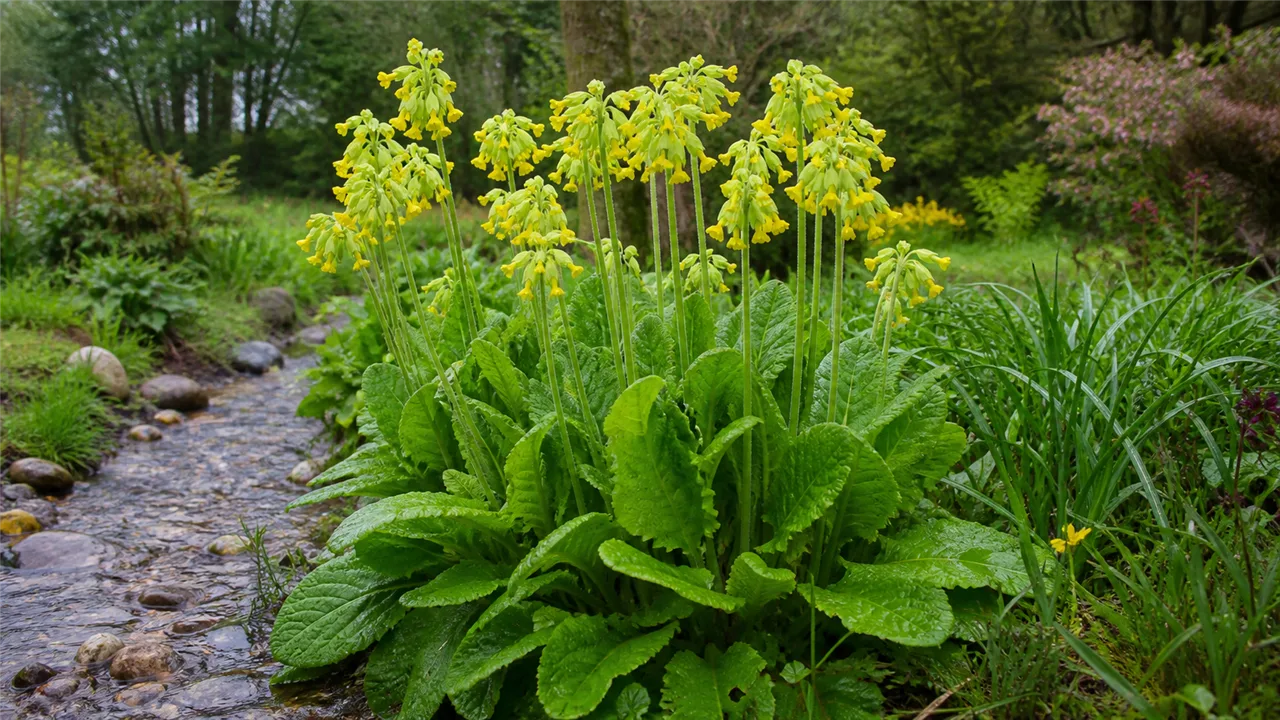
Primula florindae, the giant cowslip or Tibetan cowslip, is a tall, moisture-loving perennial prized for fragrant yellow bells held above bold foliage in midsummer. It is especially effective beside ponds, streams and in bog gardens, where its need for consistently damp soil can be met.
Overview
Native to the eastern Himalayas, including south-eastern Tibet, Primula florindae grows naturally in wet meadows and beside streams. This habitat is the key to cultivating it successfully: the soil around its roots should remain cool and evenly moist throughout the growing season. It is one of the largest garden primulas and brings useful height to ground that is too damp for many familiar border perennials.
Fresh leaves emerge from the crown in spring and build into a substantial basal rosette. By summer, upright stems rise above the foliage and branch near their tops into open, rounded clusters of nodding flowers. The rich yellow bells are noticeably fragrant, particularly in still, warm weather. Flowering in July and August extends the primula season well beyond the main display of many spring-flowering species.
This is a clump-forming perennial rather than a woody plant. Its stems and leaves die back after the growing season, while the crown remains below or at soil level and produces new growth the following spring. In UK gardens it suits bog gardens, damp woodland borders and the moist margins of ponds or streams. A position near water is not essential, but reliable access to moisture is.
The plant makes a strong architectural accent without appearing rigid. Its broad leaves create mass at ground level, while the fine flower stalks and hanging bells introduce movement higher up. It combines particularly well with moisture-loving ferns, hostas, astilbes and other primulas, provided neighbouring plants do not crowd its crown.
Appearance
The foliage forms a broad rosette of oblong to oval green leaves. Individual leaves have toothed margins, a softly textured surface and prominent veins. They can become large in rich, damp ground, giving an established plant a lush appearance from spring until the foliage begins to collapse later in the year. The leaves arise directly from the crown and spread outwards, so enough room should be allowed for the clump to develop.
Flower stems commonly reach 90–120 cm in favourable conditions. They are held well above the leaves and finish in rounded clusters made up of numerous flowers on slender individual stalks. Each flower hangs downwards and has a bell-shaped, slightly flared form. The typical species bears yellow flowers, often with subtly deeper colouring towards the mouth or on the outside of the tube.
The open arrangement of the flower cluster distinguishes giant cowslip from shorter, denser primulas. Seen from a path or across a pond, its pendant bells form a light canopy over the foliage. The fragrance is another valuable characteristic and can be appreciated most easily where plants are positioned near a path, seat or frequently used garden edge.
Seed-raised plants may differ slightly in stature, flowering time and flower colour. Named selections and hybrids broaden the palette into apricot, copper, orange and red shades, but plant labels should be retained because seedlings do not necessarily reproduce a selected colour exactly.
Growing Conditions
Consistent moisture is the main requirement. The ideal soil is deep, fertile and rich in humus, retaining water without becoming stagnant and airless around the crown. Clay soil can be suitable when its structure is improved with garden compost, leaf mould or other well-rotted organic matter. Lighter soil needs generous organic amendment and regular mulching to slow moisture loss.
Partial shade is dependable in most UK gardens because it limits evaporation and keeps the root zone cool. Morning or late-afternoon sun with shade during the hottest part of the day is often effective. Full sun can also suit the plant beside water or in naturally wet ground, but a sunny site that dries during summer will lead to wilting, scorched leaf edges, reduced growth and a shorter flower display.
A sheltered position protects the tall stems from persistent strong wind. Staking is not normally necessary when plants are well established in open but protected ground, although an exposed site may cause flower stems to lean or snap. Avoid dry banks, gravel gardens and raised beds unless irrigation can keep the soil evenly moist. Containers are possible but demanding, as their compost dries rapidly and can also become congested or waterlogged.
The edge of a wildlife pond is suitable when the crown sits in damp soil rather than being planted deeply under water. Likewise, streamside soil should be stable and moisture-retentive, not a place where fast-flowing water regularly erodes or buries the crown. Good companions share the need for damp soil without forming an impenetrable mat around the plant.
Choose a site with space for both the basal rosette and its tall summer display. The plant's structured hardiness information should be checked when matching it to local conditions, while a spring mulch helps moderate changes in soil temperature and moisture. In colder or wetter districts, preventing stagnant winter conditions around the crown is more important than adding a thick insulating layer.
Planting and Care
Plant in spring or early autumn, when the soil is workable and naturally moist. Dig a hole wide enough to spread the roots without bending them, and incorporate well-rotted organic matter through the surrounding soil rather than creating a small pocket of very different compost. Set the crown at soil level: planting too deeply encourages crown problems, while exposed roots dry readily. Firm gently, water thoroughly and keep the root zone moist during establishment.
Water whenever rainfall is insufficient, especially from late spring through flowering. A slow, thorough soaking is more useful than frequent light sprinkling because it moistens the full root zone. Direct water towards the soil and avoid repeatedly wetting foliage and faded flowers. Plants beside ponds may still need watering if the surrounding soil dries; proximity to water does not guarantee that roots can reach it.
Apply a 5–8 cm mulch of leaf mould, garden compost or well-rotted organic matter in spring. Leave a clear gap immediately around the crown to maintain airflow. On reasonably fertile ground this annual mulch may provide enough nutrition. Where growth is weak, a balanced general-purpose feed in spring can be used at the label rate. Avoid excessive high-nitrogen feeding, which promotes soft foliage at the expense of balanced flowering.
Routine woody pruning is not appropriate. Remove spent flower stems at their bases if seed is not required, or leave selected stems to ripen where seedlings are wanted. Allow healthy leaves to remain while green, as they continue feeding the crown. Cut back collapsed foliage and old stems after they die down, clearing decaying material that might shelter slugs or encourage grey mould.
Divide congested clumps in spring as growth begins. Lift the plant carefully, separate vigorous outer sections with healthy roots and discard any dead centre. Replant divisions promptly at their original depth in prepared damp soil, then water well. Division rejuvenates older clumps and is the most dependable way to reproduce a plant with a particular flower colour.
Propagation from seed produces more plants but allows natural variation. Sow freshly collected seed in a tray or pot of moisture-retentive seed compost, cover only as appropriate for the seed, and prevent the compost from drying. Germination can be irregular, so retain the container while conditions remain sound. Grow seedlings on with steady moisture and plant them out once they are robust enough to withstand slug damage. Seed from named forms may yield a range of colours rather than exact copies of the parent.
In autumn and winter, keep drainage channels and pond margins free enough to prevent the crown sitting in compacted, stagnant mud. In spring, inspect emerging shoots for grazing and renew mulch before summer demand increases. During prolonged summer drought, prioritise deep watering; after flowering, continue watering while foliage remains active rather than allowing the clump to dry abruptly.
Common Problems
Slugs and snails can damage young leaves and emerging shoots, particularly because the damp habitat they favour also suits the plant. Inspect crowns as new growth appears, reduce unnecessary hiding places nearby and use garden-appropriate controls where damage is persistent. Protecting early shoots gives the clump the best chance to build a full rosette.
Vine weevil is chiefly a concern in containers. Adults notch leaf margins, while larvae feed below the compost surface and can cause a plant to wilt despite adequate watering. A loose or collapsing root system should be examined promptly. Replace infested compost and use an appropriate biological or approved control according to its instructions.
Primula leaf spots may appear as brown or pale-centred patches, especially where foliage stays wet and air movement is poor. Remove badly affected leaves, clear fallen material and water at soil level. Space plants so leaves can dry after rain without sacrificing the consistently moist root conditions the species requires.
Grey mould can colonise fading flowers, damaged leaves and other soft material during humid, still weather. Regular clearing of decaying growth and sensible spacing reduce the amount of susceptible tissue. Do not respond by drying the root zone; improve hygiene and airflow instead.
Root or crown rot causes yellowing, wilting or collapse when the crown is buried or surrounded by compacted, oxygen-poor soil. This problem differs from the abundant but moving moisture of a healthy stream margin. Lift an affected plant if practical, remove rotten material and replant sound divisions at the correct depth in improved soil.
Drought stress is more common than disease. Limp leaves, scorched margins and weak flowering indicate that moisture has become inadequate or erratic. Water the soil deeply and renew the mulch, then review whether the site can be kept moist in future summers. Tall stems damaged by wind point to exposure rather than a health disorder and can be avoided by choosing a more sheltered position.
Popular Varieties
The yellow-flowered species remains the most widely recognised choice and is valuable for its fragrance, scale and dependable colour. Several genuine named selections and colour forms are also recorded, although availability in UK nurseries can vary and plants may sometimes be offered simply as colour strains.
- ‘Butterscotch’ has flowers in warm butterscotch tones, offering a softer alternative to the clear yellow species.
- ‘Ray’s Ruby’ is a named red-toned selection that brings a deeper colour to moist perennial planting.
- ‘Dave’s Red’ is another recognised red-flowered selection of the species.
- ‘Muadh’ is a named selection listed in cultivation, but buyers should confirm current flower and growth details with the supplying nursery rather than relying on an unverified description.
- Keillour Hybrids are grown as a hybrid strain and may produce variation rather than the uniformity expected from a vegetatively propagated cultivar.
Colour-described forms such as apricot-flowered, bronze-flowered, copper-flowered, orange-flowered and terracotta-flowered plants are also recognised in cultivation. These descriptions may represent selections or seed strains rather than fixed cultivars. For a precise planting scheme, choose a labelled, vegetatively propagated plant; for a more natural range of warm colours, a reputable seed-raised strain can be appropriate.
Pests and Diseases
| Problem | Symptoms | Management |
|---|---|---|
| Slugs and snails | Irregular holes chewed in leaves and flowers, often accompanied by slimy trails. | Use copper tape barriers, iron phosphate pellets, or hand-pick at night. |
| Powdery mildew | White, dusty fungal growth on leaves and stems, potentially causing distortion. | Ensure good air circulation and spray with a sulphur-based fungicide if severe. |
| Root rot | Yellowing, wilting foliage despite moist soil, often due to waterlogged conditions. | Plant in well-draining soil and avoid overwatering; remove affected plants immediately. |
| Aphids | Clusters of small soft-bodied insects on new growth, causing stunted or curled leaves. | Spray off with a strong jet of water or apply insecticidal soap/neem oil. |
| Vine weevil | Notched leaf margins and wilting plants due to larvae feeding on roots. | Apply nematodes to the soil in autumn or use systemic insecticides as a preventive measure. |
For step-by-step help, read Controlling Aphids Naturally, Dealing with Slugs and Snails and Treating Powdery Mildew. Or browse the full plant problem solver to diagnose an issue by symptom.
Recommended Products
GardenWizz earns a commission from qualifying purchases made through affiliate links on this page (including links within the article) — as an Amazon Associate, and from Thompson & Morgan via the Awin network. This does not affect the price you pay. See our disclaimer for details.